Feng Shui
Feng Shui Wealth Corner: Three Different Answers, and Which Ones Are Chinese
Where is the feng shui wealth corner? There are three answers in circulation and they are not the same tradition. Chinese households use the bright wealth spot, the diagonal corner from the door of the living room. Classical compass feng shui uses the southeast, the seat of the trigram Xun, and a personal direction computed from your birth year. Popular Western books use the far back-left square of the floor plan as you walk in the front door, a rule from a school that has only been taught in the United States since the 1970s. Below, all three, what actually goes in the spot, and the one thing nearly every English page gets backward.
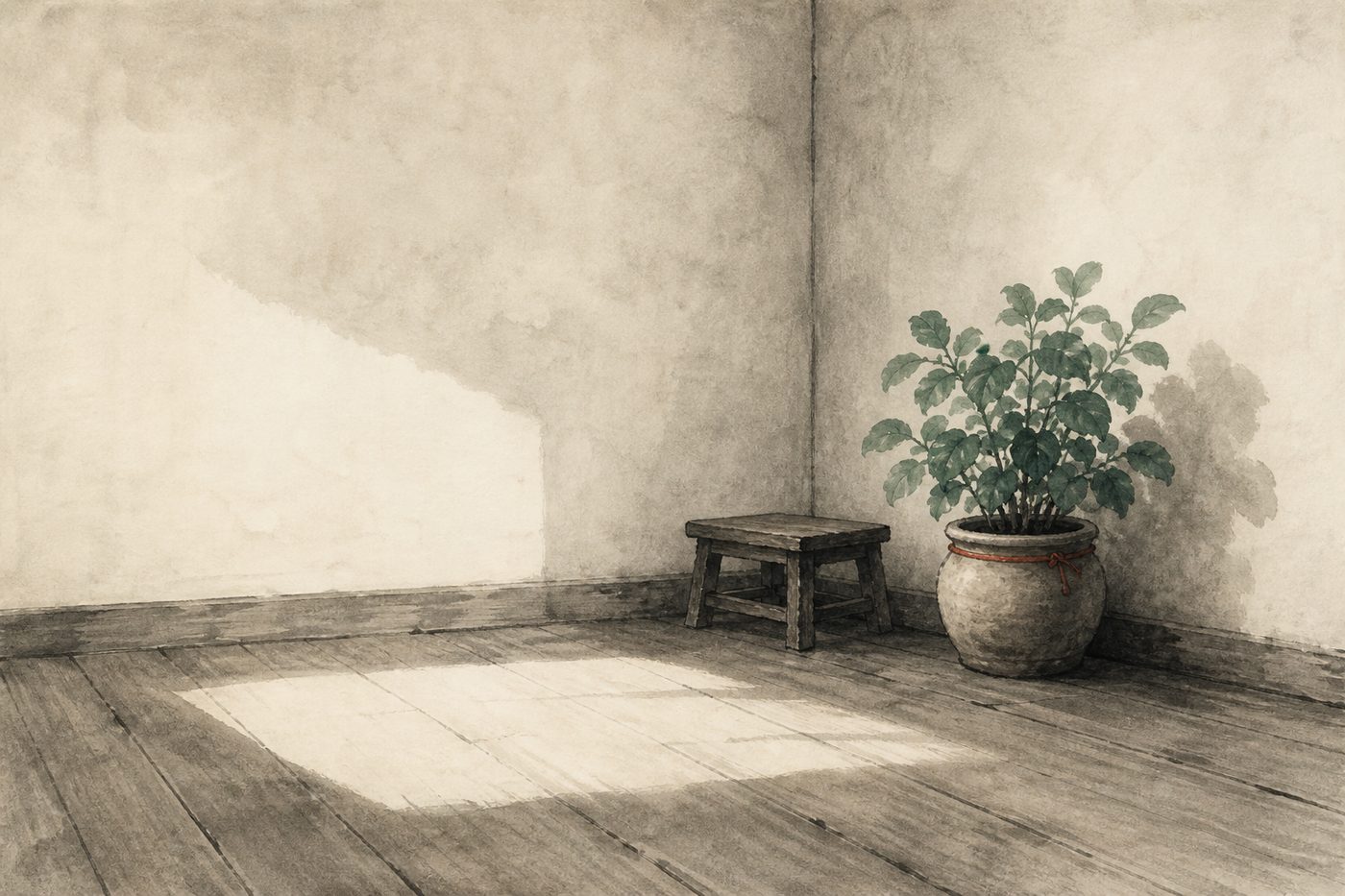
Three wealth corners, and why your book only gave you one
Ask where the wealth corner is and you will be told, with equal confidence, three different things. The confusion is not anybody's fault. Feng shui is not one system but a stack of them, laid down over roughly two thousand years, and the wealth question happens to be a place where three of the layers give different coordinates.
| The answer | How you find it | Where it comes from |
|---|---|---|
| The bright wealth spot | The corner diagonally opposite the door of the living room | Standard Chinese household practice, taught everywhere in Chinese, rarely in English |
| The southeast, and your own best direction | A compass on the floor plan, plus your birth year | Compass feng shui, on the trigram seats; the money label is a later layer |
| The far back-left square | Stand in the front door facing in, divide the plan into nine, take the back-left | Black Sect feng shui, brought to the United States in the 1970s |
None of the three is a fraud. They answer the question at different resolutions, and a practitioner in Hong Kong would use the first two together without blinking. The third is the one worth labeling, because it is the version most English-language readers have been given, usually without being told that it is younger than the pocket calculator.
The bright wealth spot
This is the answer a Chinese family actually uses, and it is the one missing from nearly every English guide.
The bright wealth spot is located by geometry rather than by compass. Stand at the door of your living room, look in, and take the corner on the diagonal. If the door sits toward the left of the wall, the spot is the far right corner; if it sits to the right, the far left; if it is centered, either diagonal will do. It wants to be a corner that catches and holds, not a piece of hallway with traffic running through it. That is the whole method, which is why it survives in ordinary use: it needs no instrument and no birth date.
What goes there is governed by a list every Chinese decorating column reproduces, five things to do and six to avoid.
Keep it bright, by daylight or by a lamp, because a dark corner is read as money going stagnant. Put something living in it, a green plant grown in soil, nothing spiny. Sit in it, which is the instruction people find most surprising: put the sofa or the dining table in the spot so that the household spends its evenings there. Give it a solid wall at its back rather than a window, so the corner has something to lean on. And if you want an emblem in it, the classical choice is a wealth god or the three star gods of fortune, rank and long life, whose characters we take apart on the symbol for prosperity.
The six taboos are the more useful half. Do not crush the spot under a heavy cabinet or a beam. Do not leave it empty behind, meaning a glass window rather than a wall. Do not aim a sharp corner or a furniture edge into it. Do not let it become where the junk lands, and never let it be the bathroom. Do not let it be dim.
And do not put water in it.
The water rule everyone reverses
This is the most common mistake in English-language feng shui, and it is not a small one. Search for a wealth corner and you will be told to install a fountain, a water feature, or an aquarium with a lucky number of fish. Chinese practice says the opposite, plainly, and puts it near the top of the list of things not to do: the wealth position should be still rather than moving, and a tank set in it is described as pushing the money into the water, where it dissolves.
Both sides are working from the same maxim, which is where the trouble starts. Mountains govern people, water governs wealth, runs the practitioner's saying, and it is genuinely part of the tradition's working vocabulary; it turns up in every school, and honesty requires saying that nobody can point to the classical text it comes from. But the maxim is about landscape. It belongs to the oldest branch of feng shui, the one that reads the shape of the ground, and it concerns the river below the site, the way water approaches and leaves, and how a building is oriented to it. It is a statement about where you build a house and which way it faces.
Take a sentence about siting a village and apply it to a side table in the sitting room and you get the aquarium. The tradition does not object to water in the home, and a well-placed tank is a perfectly ordinary feature of a Chinese business. It objects to water in that particular corner, for the same reason it wants a wall there rather than a window: the wealth spot is supposed to be the still, gathered, backed part of the room, and moving water is the opposite of still.
The compass answer, and your own direction
The second layer is older and needs an instrument. Lay the eight trigrams over the floor plan in their fixed seats and the southeast belongs to Xun, which the Book of Changes commentary that arranges the trigrams calls wood and wind. Laying that grid down correctly is its own job, and our bagua map guide walks through both ways it is done and the four mistakes that keep happening.
Modern practice, in Chinese as much as in English, hangs the wealth label on that southeastern seat, and it is a reasonable move within the system: Xun is growth, gradual and persistent, which is a fair description of how money is supposed to accumulate. What the honest version adds is that the label is younger than the seat. The classical text gives Xun wood and wind and says nothing about your income. Our colors guide works from the same compass, and the greens and blues it assigns to the southeast are the element speaking, not the money.
The sharper answer is personal rather than architectural. Eight Mansions, the school our calculator runs on, takes your birth year and gives you four favorable directions in a fixed order, and the first of them, Sheng Qi, is the vitality direction. It is the one traditionally read as prosperity and forward momentum, and it differs from person to person, which is precisely why no page can tell you your wealth direction without asking when you were born.
Find your directions
Your kua number comes from your birth year and sex, with a calendar wrinkle in early February. The fastest way to get it right is our calculator; then find your row below.
| Kua | Trigram | Group | Best (Sheng Qi) | Health (Tian Yi) | Harmony (Yan Nian) | Steady (Fu Wei) | Avoid (Jue Ming) |
|---|---|---|---|---|---|---|---|
| 1 | Kan ☵ | East | Southeast | East | South | North | Southwest |
| 2 | Kun ☷ | West | Northeast | West | Northwest | Southwest | North |
| 3 | Zhen ☳ | East | South | North | Southeast | East | West |
| 4 | Xun ☴ | East | North | South | East | Southeast | Northeast |
| 6 | Qian ☰ | West | West | Northeast | Southwest | Northwest | South |
| 7 | Dui ☱ | West | Northwest | Southwest | Northeast | West | East |
| 8 | Gen ☶ | West | Southwest | Northwest | West | Northeast | Southeast |
| 9 | Li ☲ | East | East | Southeast | North | South | Northwest |
Kua 5 does not appear: the traditional formula reassigns it, 2 for men and 8 for women, which the calculator handles.
Used together the three layers stop competing. The bright wealth spot tells you which corner of the room to care about. The compass tells you which quarter of the house the sector logic favors. Your own Sheng Qi direction tells you which way to face while you work in it, which is the piece a general chart can never supply. If you only get one of the three, take the first: a clean, bright, backed corner with a plant and a chair in it beats a perfect compass reading in a room nobody sits in.
Does the wealth corner move each year?
The three answers above all hold still. There is a fourth layer that does not, and it is the one behind the question people actually type, which is where the wealth corner is this year.
Flying star feng shui deals nine numbered stars across the compass and reshuffles them every year at the start of spring, so a sector that was quiet last year can be carrying the wealth star this one. The star in question is the 8 White, the wealth-and-property star of the current period. For the year that runs from February 4, 2026, it sits in the east, which makes the eastern side of a home the year's most favored ground. Our 2026 flying star chart walks the whole grid sector by sector, including the two sectors this particular year wants left alone.
Two cautions about stacking that on top of everything else. The annual star is a visitor and it leaves; the bright wealth spot in your living room does not. Practitioners use both, and where they disagree the fixed position is the one treated as the household's real wealth corner, with the annual star as a hint about which part of the house to lean on for twelve months. And the annual layer is not the ancient one. The three-by-three grid underneath it is genuinely old, but the yearly rotation as practiced today was systematized in the late imperial period, which is recent by the standards of the rest of this page.
About that far back-left corner
The Western rule deserves a fair hearing rather than a sneer.
It comes from Black Sect feng shui, taught in the United States by Lin Yun, who brought the school west in the early 1970s and whose temple was founded in Berkeley in 1986. Its method drops the compass entirely: you align the eight-sector grid to the front door instead of to magnetic north, so the far back-left square is always the wealth area regardless of which way the house actually faces. The standard surveys of feng shui's branches list it flatly as a westernized method not based on classical teachings, which is accurate and, from the school's own point of view, not really a criticism, since it never claimed to be a compass school.
Now notice what the Western rule and the Chinese one have in common. Both send you to the far diagonal corner from where you come in. The kindest and probably the truest reading is that the back-left rule is a compass-free simplification of a convention that was already there, flattened for readers who were never going to stand in their living room with a luopan. It lands in roughly the right part of the room for roughly the right reason.
Where it goes wrong is in the trimmings, and the water is the tell. A tradition that had actually carried the Chinese wealth-corner rules across the Pacific would have carried the taboo against putting a tank in them.
The money frog, the coins, and how old the charms are
Objects are the part of this subject with the worst ratio of confidence to evidence, so it is worth sorting them by age rather than by price.
The oldest layer is the divine one. Figures of the wealth god, and of the three star gods of fortune, rank and longevity, are genuinely traditional, are what the classical lists mean by an auspicious object, and belong to household religion rather than to interior decoration.
The pixiu is the interesting case. The beast is ancient and completely real as a creature of Chinese myth: it turns up in the Book of Documents as a simile for brave soldiers, and its winged stone form has been standing outside tombs near Nanjing for fifteen hundred years. Its career as a money charm, the bracelet that swallows wealth and cannot pass it, is modern folk practice with no classical text behind it. Ancient animal, recent job. That page also carries the wearing rules, which are a different question from the placing rules below.
The three-legged money frog
The gold toad with a coin in its mouth is the jin chan, and it has a story, which is more than most of this shelf can say.
It belongs to Liu Haichan, a Daoist master of the tenth century who was mythologized after his death into one of the standard figures of Chinese art. He is nearly always shown the same way: a grinning man on the road with a three-legged toad, which he is said to have caught with a string of square-holed cash coins. The toad was believed to spit gold coins, and the wealth it brought him he gave away, which is how a wandering alchemist ended up filed with the gods of wealth. Look at a real toad's back and you can see where the idea started, since the pattern on the skin reads, if you are in the right mood, like a scatter of coins. The pairing settled into Chinese art somewhere between the twelfth and fourteenth centuries and ran hard through the Ming and Qing, which is why the motif turns up on jade carvings, bed hooks and porcelain long before anyone thought of it as a feng shui product.
Where it goes is where the modern advice gets specific, and the honest label has to go on first: this part is practitioner convention, not classical text. The consistent instructions are these. Put it low, on the floor or a side table rather than up on a shelf, because it is a creature and not a deity. Set it near the entrance, diagonally in from the door, so it sits inside the room's arriving path. And face it inward. This is the one rule every seller repeats and the one buyers reverse: a frog aimed out through the front door is read as carrying the money out with it.
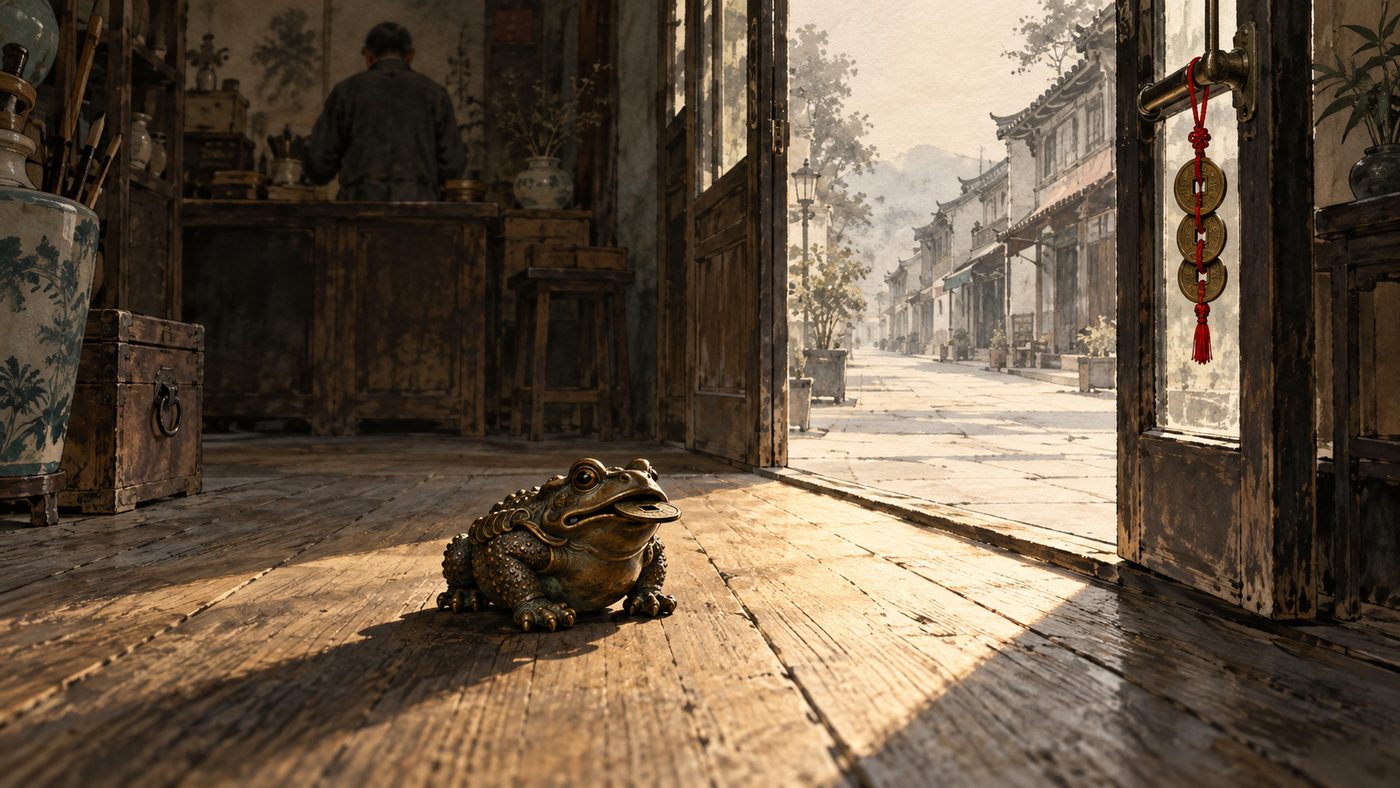
Where it should not go echoes the corner's own taboo list: not the bedroom, not the bathroom, not the kitchen, and not directly facing a mirror or a toilet door. Nor should there be a herd of them. The numbers that circulate, three frogs or six or nine, are retail arithmetic rather than tradition.
What "activating" a charm actually means
Searches for money charms fill up with activation: rituals for switching a frog on, waking a bracelet, charging a coin string in the sun. The classical material has no such procedure. What it has is consecration, kaiguang, which means opening the radiance: the rite that closes the making of a Buddhist or Daoist image, performed by a monk or a Daoist master, after which the image is treated as animate rather than as an object. In Taiwan a shop will cover a newly consecrated statue's eyes with red paper so that the first thing it sees is the person who commissioned it. That is what a real ritual for an object looks like, and it is done by clergy to a god, not by a shopper to an ornament.
Everything sold as activation, rinsing in salt water, exposing the piece to the first light of a certain morning, tying it with red thread, turning it toward the door and away again, is recent commercial practice, and it is recent because it does a job for the seller: a charm that must be activated correctly can never simply have failed. Buy the frog if you like the frog. It is a good-looking object with a real history. Nothing in the tradition asks you to perform a ceremony over it.
The five emperor coins
The strings of old bronze coins tied with red cord are wudi qian, the five emperor coins, and the set is more specific than most sellers explain. The usual five are Qing: Shunzhi, Kangxi, Yongzheng, Qianlong and Jiaqing, five reigns running back to back for roughly a hundred and seventy years across the dynasty's strongest stretch, which is the whole logic of the set. The coins are supposed to carry the luck of a period when things went well. There is also a rarer greater set drawn from five earlier dynasties, the Qin half-tael, the Han wuzhu, and one coin apiece from the Tang, the Song and the Ming, but when a shop says five emperor coins it means the Qing five.
The underlying practice, on the other hand, is genuinely ancient, and it makes a better story than the one on the label. Chinese mints and workshops have been making coin-shaped objects meant for luck rather than for spending since the Western Han, more than two thousand years ago; the technical name is charm coins, and they carried inscriptions, animals and trigrams that no shopkeeper would have accepted as payment. Stringing five particular Qing reigns together for a doorway is a late folk development on top of a very old habit.
Two practical notes. Qing coins were struck in enormous numbers and circulated for centuries, so genuine ones are common and cheap, and any price that assumes rarity is assuming something false. And a coin string is a doorway and threshold object in most conventions, hung on a handle, laid under a mat, tucked into a wallet, rather than a wealth-corner object, so it does not compete with the still, backed corner this page is mostly about.
Use any of these if you like them. Just do not let an ornament stand in for the four things that actually govern the corner, which are light, a wall behind, a living plant, and the absence of clutter.
When the money is real
If you want to know whether anyone takes this seriously with their own capital, look at Hong Kong.
The Bank of China Tower is the only major building in the city that skipped the customary feng shui consultation before construction, and it has been argued about ever since. Practitioners objected to its sharp edges and to the X-shapes in the original design, some of which the architect softened after the criticism; from certain angles the finished tower resembles a meat cleaver, and its Cantonese nickname is simply "the knife." The building is admired and the argument has never quite died.
The story usually told next is the one worth checking. Everyone repeats that HSBC, down the road, mounted two cannon-like devices on its roof aimed at the Bank of China to fire the bad energy back. They are maintenance cranes, they were part of the original architectural plan, and the Bank of China Tower was not finished until 1990, after they were installed. The dates do not allow the story. It is the single most repeated feng shui anecdote in English, and it is false.
What is true about HSBC is quieter and more interesting. Its bronze lions have been sited and re-sited only after extensive consultation with feng shui practitioners, including when they were moved for the 1981 demolition and moved back in 1985, and people still bring children to rub their paws. And the building's celebrated advantage is that nothing blocks its view of the harbor across the open ground of Statue Square, which is the mountains-and-water principle applied at the scale it was actually designed for: not a tank in a corner, but a bank looking straight down an unobstructed approach to the sea.
What the corner can and cannot do
Most people reading this rent, share walls, or cannot move the sofa without a negotiation. The tradition expects that. It began as advice about ground you already had.
Take the smallest true version. Find the diagonal corner from your living room door. Clear it, light it, put a plant in soil there, and give it a wall at its back. If a chair fits, sit in it sometimes. Skip the fountain. If you want the personal layer, get your direction from the kua number calculator and face that way at the desk. If you want the room to look like it means it, the colors guide will tell you which shade belongs on that side of the house, and the plants guide will keep you from buying a species under the wrong name.
Then stop. Nobody can promise you that a corner will pay you, and the pages that do are selling ornaments. What the practice can honestly claim is older and less exciting than the marketing: a house that is bright, uncluttered, well-oriented and cared for is a better place to think about money in. The tradition has always known that the arrangement is doing part of the work and the person living in it is doing the rest.
Questions people ask
Where is the wealth corner in feng shui?
It depends which school you are asking. In everyday Chinese practice the answer is the bright wealth spot, the corner diagonally opposite the door of the living room, which is the position you can find without a compass. In classical compass feng shui the wealth sector is the southeast, the seat of the trigram Xun, and the more personal answer is your Sheng Qi direction, computed from your birth year. In most Western books it is the far back-left square of the floor plan as you face into the house from the front door, a rule that comes from a modern American school rather than from the classical tradition.
Should I put a fountain or an aquarium in my wealth corner?
Chinese practice says no, and this is the single most common reversal in English-language feng shui. The rule of thumb for the bright wealth spot is that it should be still rather than moving, and standard lists of its taboos put water first, on the grounds that setting a tank where the wealth sits turns your money to water. The maxim that water governs wealth is real, but it is about landscape and approach, the river outside and the flow toward your door, not about a tank in the corner of the sitting room. Put the aquarium somewhere else.
Where should a water fountain be placed in a home?
Away from the wealth corner, which is the one place English advice keeps sending it, and toward the front of the house. The tradition's water thinking is about approach: water is read as arriving, so a feature near the entrance, visible from it, and flowing inward rather than draining away is the placement practitioners are comfortable with. North is the water direction in the compass system, and east and southeast are the two seats water feeds, so those are the sectors most often suggested. Two conditions carry more weight than the direction: keep it out from under a staircase, and keep it working. A stagnant, scummy or switched-off water feature is the one case every school agrees is worse than no water at all.
Where should a fish tank be placed according to feng shui?
The same logic as a fountain, and for the same reason: a tank is moving water plus something alive, so it belongs in the sociable, active part of the home rather than in the still one. A living room, an entrance hall or an office suits it. What practitioners warn against is a tank in a bedroom, where moving water and a running pump work against the room's job, and a tank in the wealth position, where the tradition says the money dissolves into it. A well-placed tank in a shop or a restaurant is completely ordinary in Chinese practice and always has been, which is worth remembering before anyone tells you the tradition dislikes aquariums.
Which fish is lucky for wealth?
Modern practitioner convention, not classical text, and it is worth saying so before listing it. The usual answers are the arowana, prized for size and bearing and expensive enough to be a statement in itself, and goldfish, whose name overlaps with gold. The common tank convention is an odd number, most often nine, with eight of one color and one black, the black one described as absorbing whatever goes wrong. No classical manual specifies any of this. If a fish dies, the folk reading is that it took a misfortune for the household, which is a kind and unfalsifiable idea, and the practical reading is that you should check the tank.
What should you put in the feng shui wealth corner?
The traditional list is short and mostly about condition rather than objects. Keep it bright, since a dim corner is read as stagnant money. Put a living plant there, grown in soil, nothing spiny. Put something you actually use in it, a sofa or the dining table, so the household spends time in the spot. Give it a solid wall behind it rather than a window. And if you want an emblem, the classical choice is a figure of the wealth god or the three star gods of fortune, rank and long life, rather than a novelty charm.
Is the southeast really the wealth corner?
The southeast is the seat of Xun, and modern practice, Chinese as well as Western, does attach the wealth label to it. What is worth knowing is that the compass seat is old and the money label on top of it is a later layer. Classical texts assign Xun to wood and wind, not to your bank balance. Treating the southeast as a wealth sector is standard, widely taught, and reasonable within the system's own logic. It is not something you will find written in the Book of Changes.
What should you not put in your wealth corner?
The Chinese list of taboos is six items long and more useful than the list of things to add. Do not put water there, no fountain and no fish tank, which is the item English guides reverse most often. Do not crush the spot under a heavy cabinet or a structural beam. Do not leave a window behind it where a solid wall should be. Do not aim a sharp furniture edge or a projecting corner into it. Do not let it become the place where junk lands, and never let it be the bathroom. And do not let it be dim, since a dark corner is read as money going stagnant.
Where should a money frog be placed?
Low, near the entrance, and facing into the room. Put it on the floor or a side table rather than high on a shelf, since it is a creature rather than a deity, and set it diagonally in from the door so it sits along the path into the room. The rule buyers reverse most often is the direction: a money frog aimed out through the front door is read as taking the money out with it, so it faces in. Keep it out of the bedroom, the bathroom and the kitchen, and away from a mirror or a toilet door. None of this appears in a classical text. It is modern practitioner convention, which is the thing to remember if someone offers to charge you for the placement.
How do you activate a feng shui money frog?
You do not, and nothing in the tradition says you have to. The classical procedure people are half-remembering is kaiguang, the temple rite in which clergy formally open up a religious image, which applies to a consecrated Buddhist or Daoist figure rather than to a shop-bought ornament. The activation rituals sold online, salt-water rinses, first light on a particular morning, red thread, turning the piece toward the door and back, are recent commercial practice. They persist because they are convenient for sellers: a charm that must be activated correctly can never simply have failed to work.
Where is the wealth corner of the house in 2026?
Two answers, and they are not in competition. Your fixed wealth corner does not move: it is still the bright wealth spot diagonally opposite your living room door, and still the southeast on the compass. The layer that changes each year is flying star, where the 8 White wealth star takes a new sector every spring. For the year running from February 4, 2026, it sits in the east, so the eastern side of the home is the year's favored ground. Practitioners use both, and treat the fixed spot as the household's real wealth corner with the annual star as a twelve-month hint. Our 2026 flying star chart maps the whole grid.
Does the feng shui wealth corner actually work?
Nobody can tell you that it does, and any page that promises money is selling something. What the practice reliably does is make you look hard at one corner of your home, clear it, light it, and put something living in it, which is a real improvement to a room whatever you believe about qi. The tradition itself is more modest than its marketing: the classical material is about siting, orientation and the flow of approach, and the rest is a set of habits for keeping a house in good order.
Sources
- • Wu Xing (the five phases, the generating and overcoming cycles, and their directions), Wikipedia
- • Shuo Gua (Book of Changes commentary; seats the eight trigrams by direction and calls Xun wood and wind), Chinese Text Project
- • Sina Home: the five recommendations and six taboos for the bright wealth spot, including the water taboo
- • China Construction Bank, ten household wealth feng shui tips: a Chinese bank's own consumer explainer of household wealth-position conventions
- • Liu Haichan (the tenth-century Daoist master paired with the three-legged money toad and the string of cash coins), Wikipedia
- • Sotheby's, Gold Coins and Immortality: The Legend of Liu Hai and Toad: the motif in Chinese art from the Yuan through the Ming and Qing
- • Chinese numismatic charm (yansheng coins: coin-shaped charms made for ritual rather than for spending since the Western Han, and the five-emperor Qing string), Wikipedia
- • Sina Collectibles, on the greater and lesser five-emperor sets: the Chinese collectors' distinction between the Qing five-emperor set and the older five-dynasty set
- • Michael Naparstek (University of Tennessee), writing in The Conversation on kaiguang, the consecration that makes an Asian sacred image animate, and the red paper over a new statue's eyes
- • Yun Lin Temple: on Grandmaster Lin Yun, who brought Black Sect feng shui to the United States, and the temple founded in Berkeley in 1986
- • Feng shui (the Form School and Compass School branches, and BTB listed as a westernized method not based on classical teachings), Wikipedia
- • Bank of China Tower, Hong Kong (the bank that skipped the feng shui consultation, and the vertical knife), Wikipedia
- • HSBC Building, Hong Kong (the lions, the harbor view, and the rooftop cranes that were never cannons), Wikipedia
Get your kua number and full direction chart
Enter your birthday and we work out your kua, your group, and all eight directions, with the February boundary handled for you. Open the calculator