Feng Shui
Feng Shui Office and Desk: The Wall Behind You, and the Tiger on Your Right
How do you feng shui an office desk? Put a solid wall behind your chair, keep the door in view without sitting in its path, leave open floor in front of you, and keep the taller and busier objects on your left. That order is the Chinese one, and it is worth knowing why most feng shui desk advice in English looks nothing like it: English office feng shui is mostly about attracting money, and Chinese office feng shui is mostly about surviving other people.
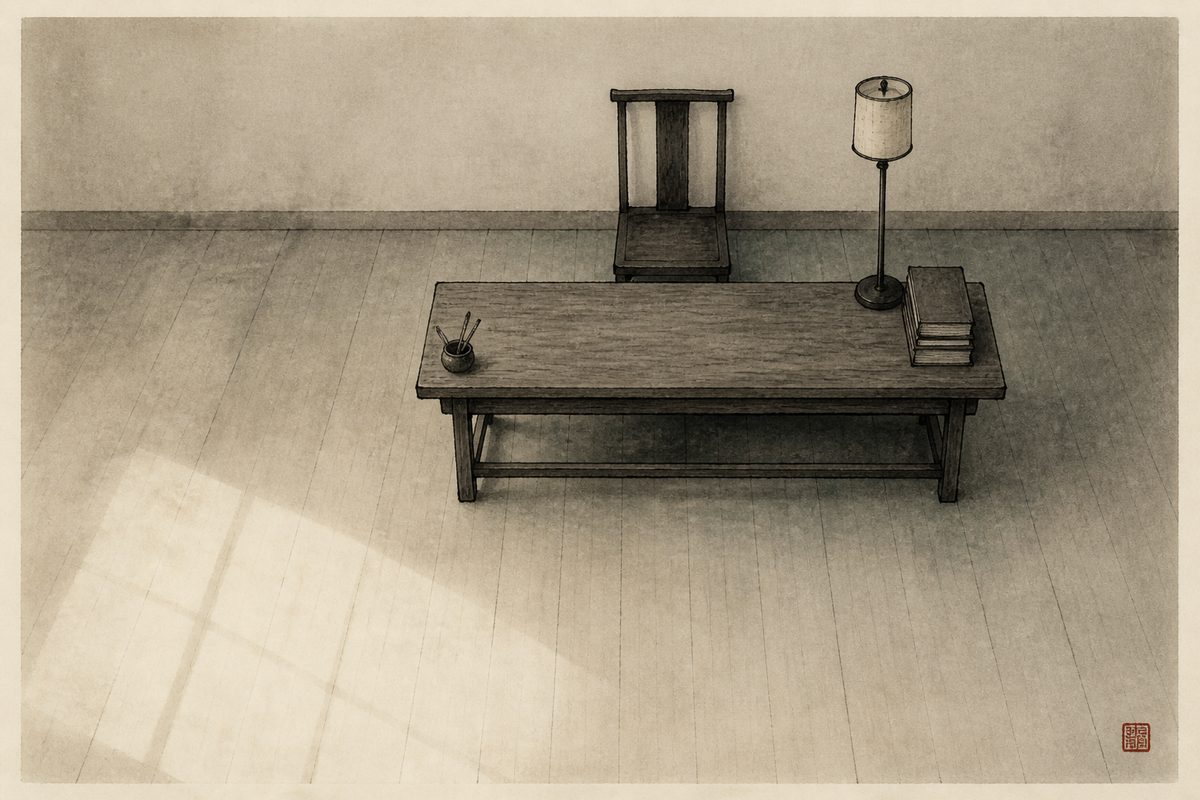
English office feng shui is about money. Chinese office feng shui is about people.
This is the first thing to say, because it reframes everything that follows, and because it is the difference you can feel the moment you read Chinese-language sources next to English ones.
Search for office feng shui in English and you get wealth corners, citrine clusters, a small fountain, a jade plant in the southeast. The organizing anxiety is money, and the proposed solutions are mostly purchases.
Search in Chinese and the vocabulary is startlingly different. The recurring words are not about money at all. They are about a patron who will protect you, a colleague who will undermine you, and whether the shape of your seat leaves you exposed to the second while cut off from the first. Chinese office feng shui is, overwhelmingly, a set of instructions for surviving an organization.
That is not mysticism versus common sense. It is two cultures worrying about two different things, and I find the Chinese version the more useful of the two, because the thing it worries about is real.
The wall behind you has a name, and the name is also a person
Start with the rule every Chinese source leads with: there must be a wall behind your chair.
The term for it is kàoshān (靠山), and here is the part that does not survive translation. Open the Taiwan Ministry of Education's dictionary and the word has two senses. The first is the literal one, near the mountain. The second is backing in personnel matters, and the example sentence the dictionary gives is not about architecture at all. It is, roughly, he's got backing upstairs, don't go picking a fight with him.
So when a Chinese practitioner tells you your seat has no kaoshan, they are making a pun that is not really a pun. The same word covers the solid thing behind your chair and the senior person who covers for you in a meeting you are not in. The physical arrangement and the office politics are named identically, and the advice is built on the assumption that the two travel together.
Once you see that, the specific taboos stop sounding arbitrary. A seat backing onto a window has nothing behind it. So does a seat backing onto a corridor, a walkway, a stairwell, an elevator, or the main door. Taiwanese sources describe the last of these as leaving an opening for xiǎorén (小人), the petty person, the office term for the colleague who works against you quietly. It is a wonderfully specific piece of vocabulary and English office guides have no equivalent for it, which is presumably why they never mention the problem it names.
The everyday diagnosis is also more grounded than you might expect. Sitting with your back to the traffic keeps you in a low, constant state of alertness. Chinese guides say this outright: you sit in a subconscious tension, your thoughts scatter, and your work suffers. You do not need to believe anything metaphysical to have noticed this about open-plan seating.
The remedies, in the order practitioners rank them. Turn the desk, if that is within your power. If it is not, put something solid behind the chair at roughly shoulder height: a screen, a bookcase, a filing cabinet. It should not be glass-fronted or open-shelved, because the barrier has to read as solid to count. If your office forbids moving furniture, a high-backed chair is accepted as a real if modest substitute, and some practitioners suggest hanging an earth-tone cloth or jacket over the chair back to make the silhouette of a hill.
Your desk is a grave site, scaled down
Here is where the office rules come from, and it is a stranger pedigree than the desk-accessory market lets on.
The Book of Burial, attributed to the fourth-century scholar Guo Pu, is the text that names feng shui as a discipline. It is, as the title suggests, a manual for choosing where to put a grave. Its outer chapters contain a passage that any Chinese practitioner can recite, and it goes like this: in burial, the left is the azure dragon, the right the white tiger, the front the vermilion bird, the rear the black tortoise. Then it says what each of them should be doing. The black tortoise lets its head hang down. The vermilion bird dances in flight. The azure dragon winds and coils. And the white tiger crouches tamely, head lowered.
Then the warning. Where the form is contrary to this, the rule is ruin and death. And the text gets specific about the failure modes: a tiger that squats up rather than lying low is said to be holding the corpse in its mouth; a dragon that hunkers down instead of winding is said to be envying the master; a black tortoise that will not bow its head is said to be refusing the corpse.
Now put a desk in the middle of it.
| The emblem | Where it sits | What the text wants it doing | Your desk |
|---|---|---|---|
| Black tortoise | Behind | Head bowed, settled, close | The wall behind your chair |
| Vermilion bird | In front | Dancing, open, with room to move | Open floor in front of the desk, not a wall six inches from your nose |
| Azure dragon | Your left | Winding, coiling, alive | Lamp, monitor, phone: the tall and active things |
| White tiger | Your right | Crouched, tame, head lowered | Low, tidy, quiet. The pen cup, and not much else |
That is the whole of desk feng shui, and it is a burial manual read at one-hundredth scale. Modern Taiwanese guides state it in almost those words: the left dragon side favors movement, the right tiger side favors stillness. Some go further and want the left side visibly higher or longer than the right, a configuration they call a strong dragon and a weak tiger.
I want to be careful about how much weight to put on this. The four-emblems passage is about landscape, about hills around a grave, and nothing in the Book of Burial says a word about furniture. The application to a desk is a modern extension of an old principle, not an old rule about desks. But it is a genuine extension, made by practitioners inside the tradition using the tradition's own logic, and that puts it in an entirely different category from a crystal you were told to buy last Tuesday.
There is also a nicely unmysterious reason the arrangement works for most people. The majority are right-handed, and keeping the right side of the desk clear leaves the writing hand room to move while the tall equipment sits out of the way on the left. Whether the tradition noticed this or arrived somewhere sensible by another road, I could not tell you.
What the front of the desk is for
The space in front of you has a name too, and it belongs to another room. Chinese practice calls the open ground in front of a site the bright hall, and because that idea does most of its work in the living room, we have given it a full explanation on the feng shui living room page rather than repeating it here.
The office version is short. You want open floor in front of the desk. A desk jammed nose-first against a wall is the classic mistake, and Taiwanese career guides put it in terms that are hard to argue with: an open outlook produces an open perspective, a cramped one produces cramped thinking. If the room only allows a wall-facing desk, pull it back from the wall by whatever you can spare, and hang something with depth in front of you rather than a bare surface.
Two other placements to avoid, both widely repeated. A desk directly facing the main door puts you in the traffic, and practitioners say you will struggle to settle into work with the whole corridor in your sightline. And a desk close to or facing a lavatory door is treated as a genuine problem rather than a fastidious one, on the reading that foul air gathers there.
Which direction should you face?
This is where the compass finally comes in, and it comes in last on purpose.
In the Eight Mansions school, direction is personal rather than universal. Your birth year gives you a kua number, that number gives you four favorable directions and four unfavorable ones, and two people at adjacent desks can correctly want to face opposite ways. There is no good direction for an office, only a good direction for you.
Find your directions
Your kua number comes from your birth year and sex, with a calendar wrinkle in early February. The fastest way to get it right is our calculator; then find your row below.
| Kua | Trigram | Group | Best (Sheng Qi) | Health (Tian Yi) | Harmony (Yan Nian) | Steady (Fu Wei) | Avoid (Jue Ming) |
|---|---|---|---|---|---|---|---|
| 1 | Kan ☵ | East | Southeast | East | South | North | Southwest |
| 2 | Kun ☷ | West | Northeast | West | Northwest | Southwest | North |
| 3 | Zhen ☳ | East | South | North | Southeast | East | West |
| 4 | Xun ☴ | East | North | South | East | Southeast | Northeast |
| 6 | Qian ☰ | West | West | Northeast | Southwest | Northwest | South |
| 7 | Dui ☱ | West | Northwest | Southwest | Northeast | West | East |
| 8 | Gen ☶ | West | Southwest | Northwest | West | Northeast | Southeast |
| 9 | Li ☲ | East | East | Southeast | North | South | Northwest |
Kua 5 does not appear: the traditional formula reassigns it, 2 for men and 8 for women, which the calculator handles.
Work out your own number with our kua number calculator, then aim to face one of your four good directions while seated. The same method applied to sleeping is laid out in detail on feng shui bed direction, and the underlying grid of seats is explained on the bagua map.
But hold the priority order in mind, because this is the single most common way Western feng shui gets the tradition backward. Chinese practice ranks the form first and the compass second. A desk facing your very best direction, with its back to an open walkway and nothing behind the chair, is a worse seat than one facing your worst direction against a solid wall. Fix the shape, then take the reading.
The open-plan problem
Almost every rule above assumes a room you control, and most people reading this have neither.
If you work at a hot desk, in a low-partition bullpen, or in a bank of desks facing each other, the honest position is that the tradition has no clean answer, and pretending otherwise would be a sales pitch. What it does have is a ranking, and a ranking is still useful when you only get one choice.
Given a free pick of seats, take the one with a wall or a solid partition behind it, even if that means facing an unfavorable direction. Failing a wall, take the one where the open side is beside you rather than directly behind your spine. Avoid, in roughly this order, the seat directly in front of the main door, the seat under a structural beam or a heavy air-conditioning unit, the seat backing onto the corridor everyone uses, and the seat facing a lavatory door. If you are stuck facing a colleague across a shared bench, practitioners regard a monitor or a low divider between you as a real improvement, which is the same instinct that made the folding screen a piece of Chinese furniture in the first place.
And if you have no choice at all, a high-backed chair and a tidy right-hand side are, genuinely, most of the available benefit.
Which of these is old, and which was invented recently
I would rather you left this page able to tell the two apart, so here is the sorting.
Old, and traceable to the classical texts. Solid ground behind, open ground in front, an active left and a quiet right. This is the four-emblems passage, and it is roughly seventeen centuries old. Direction as a personal rather than universal quantity is Eight Mansions method, and also old, though younger than the form principles.
Practitioner convention, meaning a real tradition applied to modern furniture. The wall behind the office chair, the screen-or-bookcase remedy, the lamp on the left and the pen cup on the right, the objection to backing onto a window. No classical text mentions any of it, because classical texts predate the office. It is the tradition reasoning by analogy, and doing it consistently.
Modern, and largely commercial. This is where most English feng shui desk advice lives: crystal clusters for beams overhead, wealth ornaments, desktop fountains, prosperity plants sold specifically as office cures, and most of the color advice. Some of this is harmless and some of it is pleasant, but none of it is old, and a good deal of it comes from the westernized Black Sect school rather than from Chinese practice. If you want a plant on your desk, have one, and read our plants page for what the tradition actually says about which. If you want the wealth corner, it lives on the wealth page, and it belongs to the room rather than to your desk.
The reason this sorting matters is not purity. It is that the old layer is about your body in a room and costs nothing, and the new layer is mostly about your wallet. If you only do the free part, you will have done the part the tradition actually cares about.
Questions people ask
Where should your desk be placed in an office for good feng shui?
Against a solid wall, with the wall behind your chair rather than in front of it, positioned so that you can see the door without sitting directly in line with it. Chinese practice puts this ahead of every compass consideration, because the seat is read as a miniature building site: something solid behind you, open ground in front of you. Avoid backing onto a window, a corridor, a walkway, a stairwell or an elevator, all of which count as having nothing behind you. If your desk faces a wall so closely that you have no open floor in front of you, that is treated as a real defect too, on the reading that a cramped outlook produces cramped thinking.
Is it bad feng shui to sit with your back to the door?
Yes, and in Chinese sources it is the single most-repeated office warning. The stated objection is twofold. Practically, you are exposed to the traffic of everyone coming and going and you sit in a low-grade state of alertness all day, which Chinese guides describe plainly as a subconscious tension that muddies your thinking. Metaphysically, a seat with nothing behind it is a seat with no backing, and the word for that backing is the same word Chinese uses for a patron who protects your career. The standard remedies, in order of preference, are to turn the desk, to put a screen or a solid bookcase behind the chair, or failing both to swap to a high-backed chair.
Which direction should your desk face in feng shui?
There is no universal good direction, because in the Eight Mansions school direction is personal. Your birth year gives you a kua number, and that number gives you four favorable directions and four unfavorable ones, so two colleagues sitting side by side can correctly want to face opposite ways. Work out your number, then try to face one of your four good directions while seated. Treat it as the last constraint rather than the first: a desk facing your best direction with its back to an open walkway is a worse seat than one facing your worst direction against a solid wall.
What should you put on your office desk for good feng shui?
Less than the shopping lists suggest. The one genuinely old rule is about arrangement rather than objects: keep the taller, busier, more active things on your left as you sit, and keep your right side low, tidy and quiet. Modern Taiwanese guides render this as the left side favoring movement and the right side favoring stillness, so the lamp, the monitor and the phone go left, and the pen cup goes right. Beyond that, a plant is fine and a clear surface matters more than anything you can buy. Crystals, wealth ornaments and desktop water features are modern retail rather than classical teaching, and no old text asks for them.
How do you fix a desk with no wall behind it?
In descending order of how much Chinese practice thinks it helps. Move the desk, if you have any say in it. If you cannot, put something solid and roughly shoulder-height behind the chair: a screen, a bookcase, or a filing cabinet, provided it is not glass-fronted or open-shelved, since the point is that the barrier be visually solid. If office rules forbid furniture changes, use a high-backed chair, which practitioners accept as a genuine if minor substitute, and some suggest draping an earth-tone cloth over the chair back to make the shape of a hill. In an open-plan office where none of that is possible, angle the chair so that the open side is at least not directly behind your spine.
Sources
- • Book of Burial (Zangshu), Outer Chapters: the four-emblems passage the modern desk rule descends from, with the Azure Dragon on the left, the White Tiger on the right, the Vermilion Bird in front and the Black Tortoise behind, and the warning that a site with the forms reversed is a dead one (Chinese Wikisource)
- • Kaoshan (靠山), Taiwan Ministry of Education Revised Mandarin Chinese Dictionary, entry 77045: sense 1, near the mountain; sense 2, backing in personnel matters, with the example sentence 'he has backing above him, don't provoke him'
- • 104 Job Bank (Taiwan's largest job board), nine points on office-desk feng shui, crediting the practitioner Ziqi: a wall behind the seat counts as a mountain at your back, the dragon side should be strong and the tiger side weak, and an open bright hall in front of the desk opens the view
- • MACUS Business Center (Taiwan), office feng shui guide: the left dragon side favors movement and the right tiger side favors stillness, with lamps and computers left and static objects right; also the screen-or-bookcase remedy for a seat backing onto a window, and desks near lavatories
- • Feng shui (the form school and compass school branches, and Black Sect Tantric Buddhism listed as a westernized method not based on classical teachings), Wikipedia
- • Guo Pu, the fourth-century scholar to whom the Book of Burial is attributed, Wikipedia
Get your kua number and full direction chart
Enter your birthday and we work out your kua, your group, and all eight directions, with the February boundary handled for you. Open the calculator