Chinese Symbol
Chinese Symbol for Water (水): Meaning, the Element, and Origin
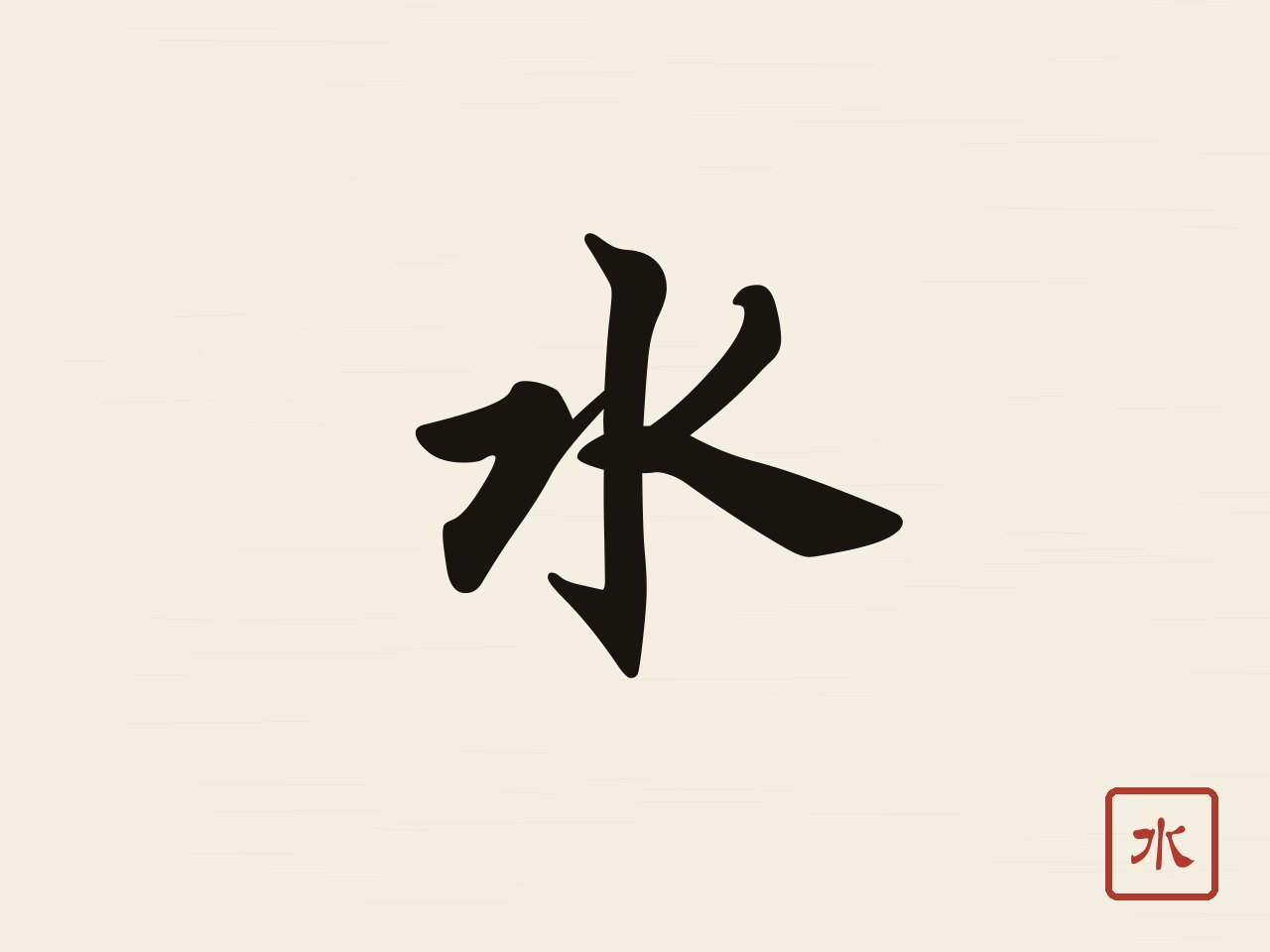
The Chinese symbol for water is 水 (shuǐ, said like "shway"), a four-stroke pictograph of a stream: a central current running down with ripples flying off each side. It is one of the oldest characters in the language and one of the Five Elements, the phase of the north. It is also the single most important image in Daoist philosophy, and, more recently, the internet's favorite word for anything cheap and watered-down.
- Strokes
- 4
- Radical
- 水 (water; it is its own radical, Kangxi 85)
- Formation
- Pictograph (象形)
Trace 水 yourself, or watch it drawn
See 水 in seal, brush & cursive Try it
How it's written
水 is four strokes and, like fire, it draws the thing it names. Down the middle runs a single vertical stroke that hooks at the bottom, the main channel of the stream. To its left, a short bent stroke and a downward sweep; to its right, one long, broad sweep flowing out and down. The result is water running down a course with spray thrown to either side. It is identical in simplified and traditional Chinese. The shapes to keep it clear of are 木, "tree," which has a straight horizontal across the top instead of water's free strokes, and 米, "rice," which adds a cross. When 水 stands on the left of another character it shrinks to three little drops, 氵, the "three-dots-of-water" radical you meet in 河 (river), 海 (sea), and 泪 (tear). That radical is one of the busiest in the language, because so much of the world, to Chinese eyes, is a kind of water.
What it means
水 (shuǐ) is water in every sense the English word has and a few it does not: the liquid, a river, a body of water, any fluid at all. It is also the water element of Chinese cosmology, and, in a very old figurative habit, a standard of what is level and fair, since still water settles to a perfectly flat surface.
Water earns its outsized place in Chinese thought as one of the wǔxíng, the Five Phases or Elements that sort the whole world. Each has a direction, a season, a color, and relationships with the rest:
| Element | Direction | Season | Color | It generates | It controls |
|---|---|---|---|---|---|
| Wood 木 | East | Spring | Green | Fire | Earth |
| Fire 火 | South | Summer | Red | Earth | Metal |
| Earth 土 | Center | Late summer | Yellow | Metal | Water |
| Metal 金 | West | Autumn | White | Water | Wood |
| Water 水 | North | Winter | Black | Wood | Fire |
Water's line is the north, winter, and black, born from metal and giving birth to wood, and, most usefully, the element that puts out fire. If a bazi chart calls someone a water person, or a feng-shui reading places water in the wealth corner, this is the character at work. The word feng shui itself, 风水, is literally "wind-water."
- 水果 fruit (literally 'water-fruit')
- 喝水 to drink water
- 水平 level; standard, proficiency (literally 'water-flat')
- 洪水 flood, floodwater
- 口水 saliva (literally 'mouth-water')
- 泪水 tears
- 风水 feng shui (literally 'wind-water')
- 水军 paid online commenters (an 'internet water army')
- 灌水 to spam or pad a thread (literally 'to pour water')
- 水货 knockoff or gray-market goods (literally 'water-goods')
Idioms
- 上善若水“the highest good is like water”the ideal of benefiting all things while contending with none; the soft strength Daoism prizes. (Laozi, Dao De Jing, chapter 8)
- 水滴石穿“dripping water bores through stone”steady, patient persistence overcomes any obstacle in time.
- 饮水思源“when you drink the water, remember the source”never forget where your good fortune came from; gratitude to your origins.
- 如鱼得水“like a fish that has found water”perfectly in one's element; a person who has found exactly the right situation.
- 水火不容“water and fire cannot share a roof”utterly incompatible; two things or people that cannot coexist.
Right vs wrong forms
| Form | Type | Note |
|---|---|---|
| 水 | simplified ✓ | The standard form everywhere, identical in simplified and traditional Chinese: four strokes, never simplified. On the left of another character it compresses to the three-drop radical 氵 (as in 河, river), but that is the same water, not a different character. |
| 木 or 米 (the look-alikes) | wrong | Not variants of 水, but the two characters it is most often confused with. 木 (tree) has a straight horizontal bar across the top; 米 (rice) adds a cross. 水 has neither: its side strokes flow free. Work from a clear reference so a stencil doesn't drift into the wrong character. |
| 水 (flipped or rotated) | mirrored | Not a variant. A mirrored or rotated 水 from a low-resolution stencil reads instantly as an error. Check against a dictionary at full size before inking. |
For a tattoo
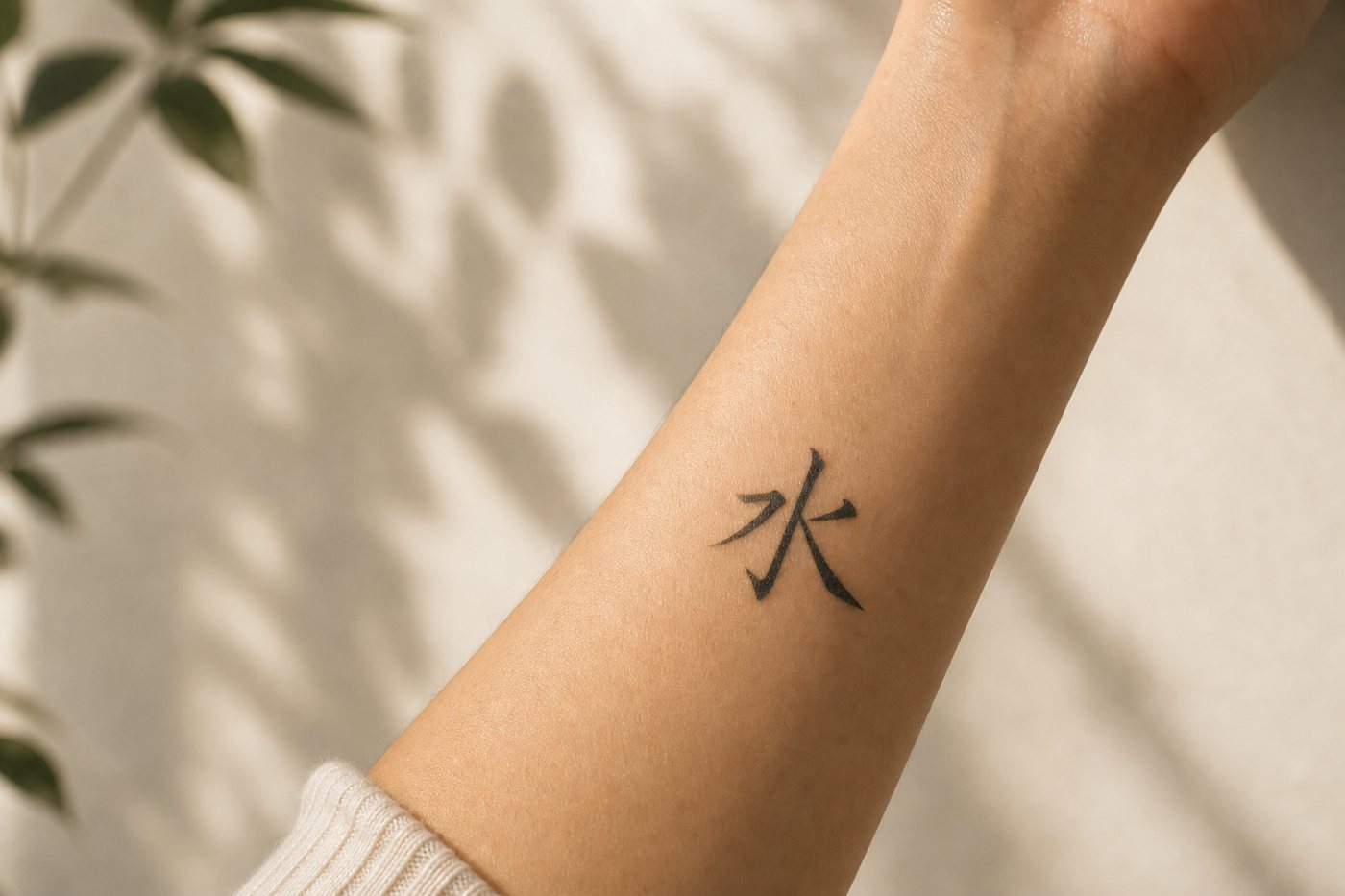
水 makes a serene, meaningful tattoo, and it comes with a ready-made phrase for anyone who wants more than one character: 上善若水, "the highest good is like water," is one of the most popular calligraphy and tattoo pieces in the Chinese-speaking world, precisely because of the Laozi philosophy behind it. On its own, 水 is only four strokes, identical in simplified and traditional Chinese, and clean on skin. The shapes to make sure your artist keeps distinct are 木 (tree) and 米 (rice), which are close cousins; a clear, full-size reference prevents the mix-up. And as with any character you cannot yet read, have a Chinese reader confirm the design, especially if you go for the full four-character phrase, before the needle comes out.
Before you commit to any character, the eight ways a Chinese tattoo goes wrong covers the failure modes that are not specific to this one, including the stroke-density arithmetic that decides whether a traditional form survives at small sizes.
Water in life today
The internet's word for weak
For a character that carries the highest philosophy in the language, 水 has taken a remarkable fall online, where it now means cheap, thin, low-quality. To call an essay, a product, or an argument hěn shuǐ, "very watery," is to say it is padded and weak, all filler and no substance. The verb guànshuǐ, "to pour water," means to spam a forum or pad a word count. A shuǐhuò, "water-goods," is a knockoff or a gray-market import. And a wǎngluò shuǐjūn, an "internet water army," is a whole small industry of people paid to flood social media with fake comments and reviews, drowning real opinion under manufactured noise. The element Laozi praised for benefiting all things is now the internet's shorthand for stuff that benefits no one.
Wind and water
The most famous thing water does in Chinese is hide inside another word entirely. Fēngshuǐ, the art of arranging space to catch good fortune, is written 风水 and means, literally, "wind-water," the two flowing, invisible forces a good site is meant to hold in balance. The whole discipline is named for the movement of air and water across a landscape, and water in particular, a pond, a fountain, a curve of river, is treated as a catcher and keeper of wealth, which is why so many Chinese restaurants and offices keep a small trickling fountain by the door. Our feng-shui pages run on this same idea.
Water means money
Feng shui treats water as wealth, and southern China took the idea straight into its everyday speech. In Cantonese, séui (水) is common slang for money itself: to be flush is to "have water," to pay up is to "weigh out water," a refund is "water coming back," and to be swindled is to have your water scooped away. A Hong Kong trader who tells you a deal has "no water" means there is no money in it. The most yielding of the elements, in the mouths of Cantonese merchants, quietly became hard cash.
A name, and a source
Nearly every 水 on a Chinese map is a river, and the character is common in place names and given names alike, chosen for a wish of flow, calm, or wisdom, since water is the element of the wise.
Curious what your own name could become in Chinese, matched to its sound and a
good meaning? Our Chinese name generator builds one for you.
Where the character comes from
The Shuowen Jiezi, the first Chinese dictionary, defines 水 in a way that captures both its look and its logic. Around the year 100 it glosses the character as zhǔn, "a level" or "a standard," the flatness of still water taken as the measure of true; then it places water cosmologically as "the phase of the north"; and finally it describes the shape itself as "a picture of many streams flowing together, with a trace of yang within." That last phrase is quietly lovely. Even water, the most yin of the elements, is said to keep a spark of yang at its center, the moving current inside the still pool. The oracle-bone forms three thousand years old show the same flowing lines, which makes 水, like 火, one of the handful of characters a modern reader shares almost unchanged with the Bronze Age.
History & roots
The highest good is like water
If Chinese culture has a single favorite thing to say about water, it is Laozi's, and it is the crown of this character. Chapter eight of the Dao De Jing opens with four words every educated Chinese person knows: shàng shàn ruò shuǐ, "the highest good is like water." In James Legge's translation, "the excellence of water appears in its benefiting all things, and in its occupying, without striving to the contrary, the low place which all men dislike." Water nourishes everything and competes with nothing; it seeks the low ground others scorn; it yields to any obstacle and, given time, wears the hardest stone away. For the Daoist this is not weakness but the deepest strength there is, the soft outlasting the hard. Laozi presses the point later in the same book, in chapter seventy-eight: nothing in the world is softer than water, and yet nothing does better at wearing down what is hard and strong. Water became the permanent Chinese image of that paradox, and to be told you are like water is one of the finest compliments the tradition can pay.
The phase of the north
As one of the Five Elements, water is the north, the direction of cold and dark; its season is winter, its color black, its organ the kidney, and its virtue is wisdom, the deep, still, patient kind. Its relationships hold the system together: metal gathers water as dew beads on a cold blade, water feeds wood as rivers grow forests, and water conquers fire. That last pairing is why, in a bazi chart or a feng-shui reading, water is the balancing answer to too much fire: a person running hot is told they need more water. It is the same logic behind the everyday phrase shuǐ huǒ bù róng, "water and fire cannot share a roof."
Dripping water, and remembering the source
Two of China's most-used proverbs turn water into plain life advice. Shuǐ dī shí chuān, "dripping water bores through stone," is the country's favorite line about persistence: not force but patience, the smallest steady effort beating the hardest resistance given enough time. And yǐn shuǐ sī yuán, "when you drink the water, remember the source," is its favorite line about gratitude, the reminder to honor where your good fortune came from, be that your parents, your teachers, or your home. Between Laozi's praise and these two proverbs, water in Chinese is less an element than a whole way of living: benefit others, seek no credit, keep at it, and never forget who filled the well.
The dark warrior of the north
Water, like fire, has a beast in the sky. In the Four Symbols, the ancient guardians of the heavens' four quarters, the north belongs to the Xuánwǔ, the "Dark Warrior," pictured as a black tortoise entwined with a snake, the emblem of water, winter, and the cold northern dark; it is the water-half of the same cosmic map whose southern, fiery quarter is the Vermilion Bird. And water's link to a particular kind of person is older even than Laozi. Confucius, in the Analects, drew a line every Chinese student still learns: zhìzhě lè shuǐ, rénzhě lè shān, in James Legge's translation, "The wise find pleasure in water; the virtuous find pleasure in hills. The wise are active; the virtuous are tranquil." The mind that loves water is the quick, flowing, curious one, forever moving and finding its way around obstacles. To this day, to call someone a water person is to call them clever and adaptable, and the compliment is twenty-five centuries old. That pairing is not a poetic accident: in Han cosmology the virtue of wisdom is itself assigned to water.
Questions people ask
What is the Chinese symbol for water?
It is 水 (shuǐ), a four-stroke pictograph of a stream, with a central current and ripples to each side. It means water, a river, or any liquid, and it is one of the Five Elements (五行) of Chinese cosmology, the element of the north, winter, and the color black. It is written identically in simplified and traditional Chinese, and it is the water in 风水 (fēngshuǐ), feng shui, literally 'wind-water.'
What is water in Chinese?
Water in Mandarin Chinese is 水, pronounced shuǐ (a third, dipping tone), roughly 'shway.' The same single character is the water element in Chinese astrology and feng shui, and it appears in everyday words like 喝水 (hēshuǐ, to drink water), 水果 (shuǐguǒ, fruit), and 洪水 (hóngshuǐ, flood).
Is the Chinese character for water read 'sui' or 'mizu'?
Neither in Chinese: those are the Japanese readings. Japanese borrowed the very same character 水, and reads it sui (in compounds, from the old Chinese sound) or mizu (on its own, the native Japanese word). In Mandarin Chinese the character is read shuǐ. Same written symbol, three different spoken words across the two languages.
What is the water element in the Chinese zodiac?
In the sixty-year cycle, each zodiac animal pairs with one of the Five Elements, and years ruled by water (roughly those ending in 2 or 3 in the Chinese calendar, such as 2022 and 2023) give a water Tiger, a water Rabbit, and so on. A water-element sign is traditionally read as intuitive, adaptable, and wise, water being the element of wisdom. Any year's element comes from its heavenly stem, which our Chinese calendar converter will give you for any date.
Is the Chinese symbol for water a good tattoo?
Yes, and it is a popular one, both alone and as the phrase 上善若水 ('the highest good is like water'), a favorite tattoo drawn from Laozi. On its own 水 is four clean strokes, identical in simplified and traditional Chinese. The main thing is to keep it distinct from the look-alikes 木 (tree) and 米 (rice); a clear reference and a Chinese-reading friend's check before inking will settle it.
Sources
- Wiktionary: 水 (pictograph origin, radical, Five Elements)
- Shuowen Jiezi entry for 水: 準也。北方之行 (hancibao.com)
- Dao De Jing, chapter 8: 'the highest good is like water' (Chinese Text Project, Legge translation)
- Wuxing (Five Phases): water's direction, season, and cycles (Wikipedia)
- Internet Water Army (网络水军): the 'water' metaphor for online filler (Wikipedia)
- The Analects, Yong Ye: 'the wise find pleasure in water' (Chinese Text Project, Legge)
- Four Symbols: the Black Tortoise of the North represents water (Wikipedia)
Make Water your own
See 水 in calligraphy
From ancient seal script to flowing cursive. Pick a look before a tattoo or a card.
 Name
Name Get a Chinese name
A name matched to the sound of yours, with a meaning that fits.
Start yours Chinese Almanac
 Try the Chinese Gender Predictor
A different corner of Chinese culture: the old Qing-palace birth chart, worked out from your lunar birth date, with the math shown and its coin-flip odds honestly weighed.
Open the toolBy Julian 祝君瑜, sourced from the classics and from modern life, updated 2026-07-22