Chinese Symbol
Chinese Symbol for Patience (忍): The Blade Over the Heart, and the Ninja
The Chinese symbol for patience is 忍 (rěn), and it is not the mild, waiting-room patience of the English word. Look at how it is built and you can feel the difference: a blade, 刃, sitting directly on top of a heart, 心. 忍 is patience with a knife's edge laid against your chest, the gritted-teeth endurance of holding still while something hurts. It is one of the most tattooed Chinese characters in the world, and it is also the character inside the word "ninja."
- Strokes
- 7
- Radical
- 心 (heart; Kangxi 61)
- Formation
- Phono-semantic compound (刃 blade, phonetic + 心 heart, semantic)
Trace 忍 yourself, or watch it drawn
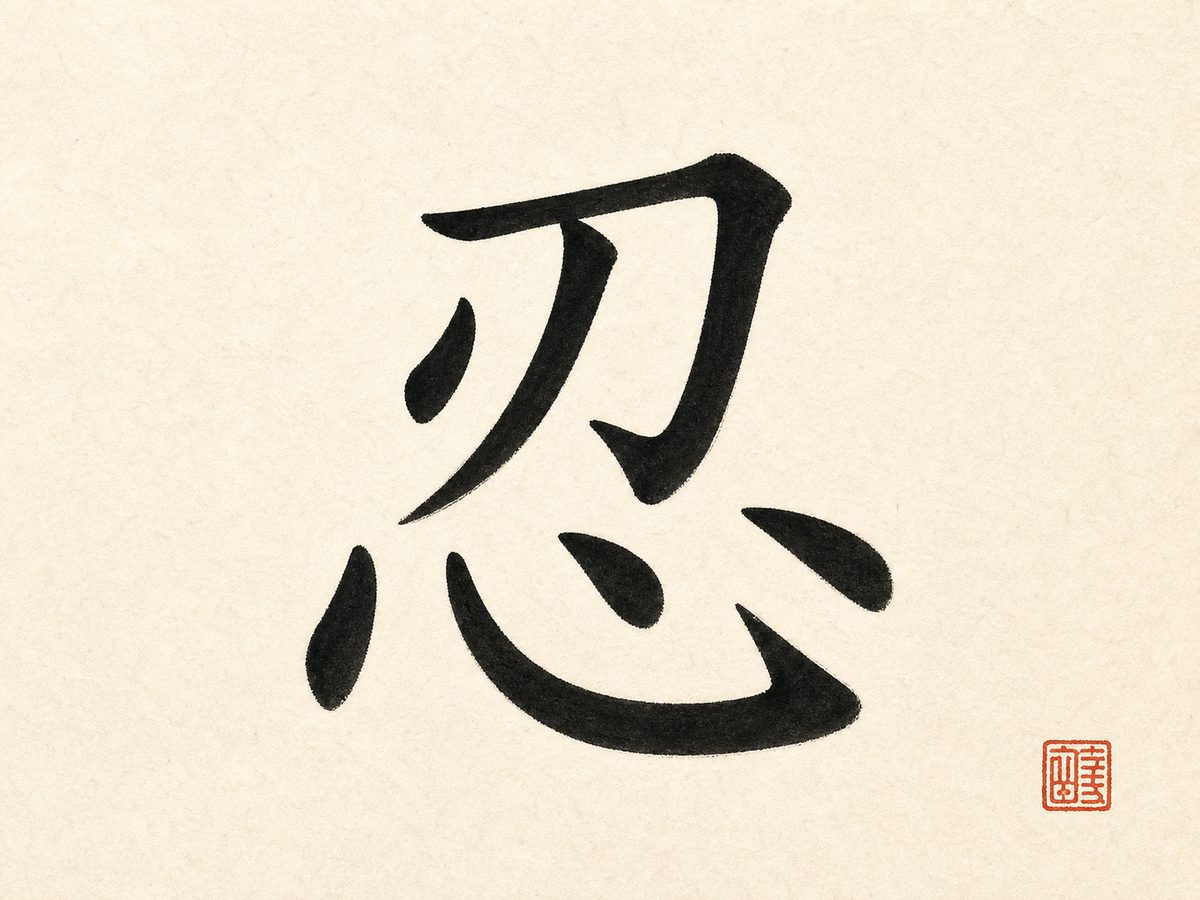
See 忍 in seal, brush & cursive Try it
How it's written
忍 is seven strokes in two stacked parts, and it is one of the most vivid pictures in the writing system. The bottom is 心 (xīn), the heart, the same component that sits under so many words for feeling. On top is 刃 (rèn), which is not quite "knife": it is the character for knife, 刀, with one short stroke added to mark the cutting edge, so 刃 means specifically the blade. Stack the two and the image is unmistakable, a blade poised over a heart.
Scholars will point out that the 刃 is really there for its sound, since it and 忍 rhymed in old Chinese, and that is true. But no Chinese child learns this character without being shown the knife resting on the heart, because the picture captures exactly what the word means. 忍 is written identically in simplified and traditional Chinese, so there is only one form to learn.
What it means
忍 (rěn) means to endure, to bear, to put up with, and to hold back. It is patience of a particular, muscular kind, less "waiting calmly" than "enduring without flinching," the strength to swallow pain, anger, or humiliation and not react. When you bite back a retort, hold in tears, or grit your way through hardship, that is 忍.
It has a darker twin meaning that catches learners off guard, and it grows from the same root. If 忍 is the capacity to bear what is hard, then at the far end it is also the capacity to be hard, to steel your heart against pity. So cánrěn means cruel and ruthless, and rěnxīn means to harden your heart enough to do something painful; its negation, "unable to bear it in the heart," is exactly how Chinese says that you could not bring yourself to do a thing. The same blade that lets you endure cruelty is the one that lets you commit it.
- 忍耐 to endure, to be patient; endurance
- 忍受 to bear, to endure (suffering)
- 容忍 to tolerate, to put up with
- 忍住 to hold back, to restrain (a laugh, tears)
- 忍不住 cannot help (doing something)
- 残忍 cruel, ruthless (the harsh sense of 忍)
- 忍心 to have the heart to do something painful or cruel
- 隐忍 to bear in silence, to endure quietly
- 坚忍 steadfast endurance; fortitude
- 忍者 a ninja (literally 'a person of endurance/stealth')
Idioms
- 忍辱负重“endure humiliation, bear a heavy load”to put up with disgrace in order to carry out an important mission.
- 小不忍则乱大谋“not enduring small things ruins the great plan”impatience over trifles wrecks large designs; keep your temper for the sake of the goal. (《论语·卫灵公》)
- 忍无可忍“to endure to where there is no more enduring”to reach the very limit of one's patience; to be pushed too far.
- 忍气吞声“swallow the anger, gulp down the voice”to suffer in silence; to submit meekly to insult.
- 是可忍,孰不可忍“if this can be endured, then what cannot?”this is an intolerable outrage, past all bearing. (《论语·八佾》)
Right vs wrong forms
| Form | Type | Note |
|---|---|---|
| 忍 | simplified ✓ | The standard form everywhere, identical in simplified and traditional Chinese: seven strokes, the blade 刃 stacked over the heart 心. It was never simplified, so there is only one form to learn. |
| 忍 with 刀 instead of 刃 on top | wrong | The trap to avoid. The top must be 刃 (rèn, 'blade'), which is the knife 刀 with a small stroke added for its cutting edge. Drop that little edge-stroke and you have written 刀 (knife) over the heart, which is not the character. Keep the blade's edge-mark. |
| 忍 (mirrored or rotated) | mirrored | Not a variant. A flipped or rotated 忍 from a low-resolution stencil reads as an error to anyone literate. Check against a dictionary at full size before inking. |
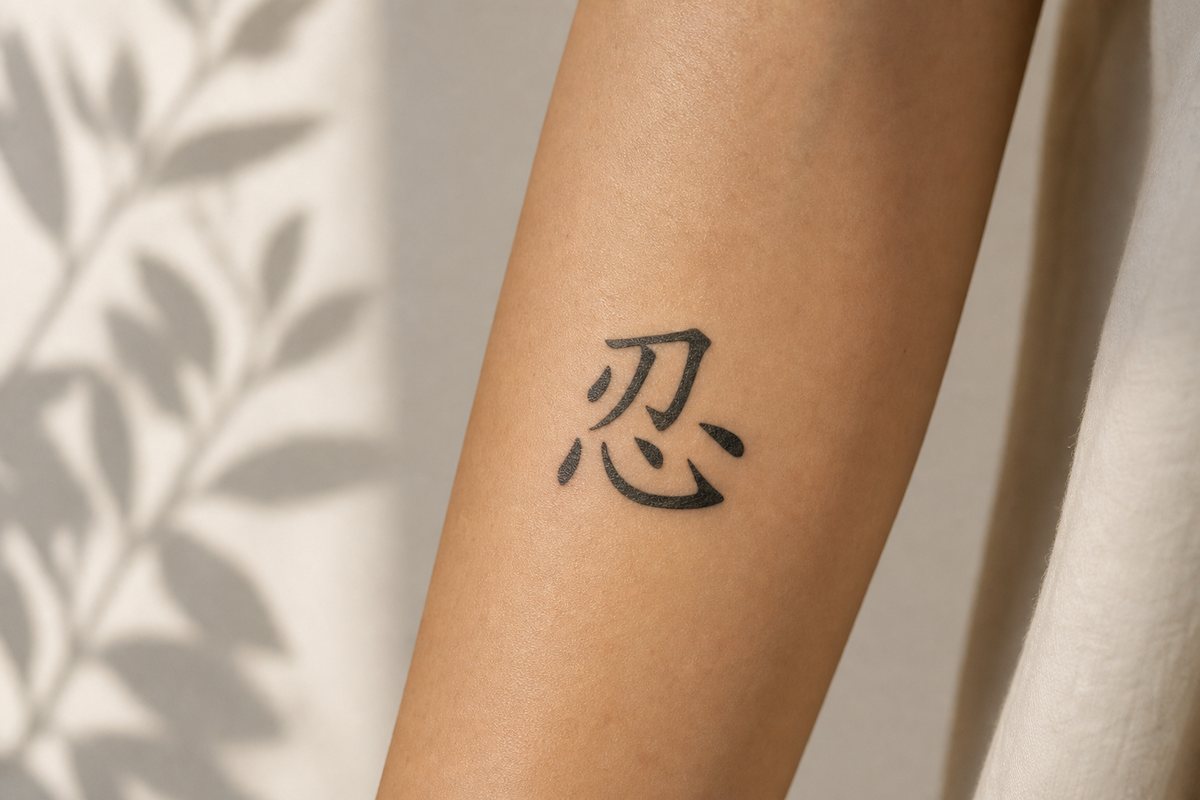
For a tattoo
忍 is one of the most popular Chinese characters in Western tattooing, and for once the popularity is well earned. Unlike many one-word "meaning" tattoos, 忍 carries a real, layered idea that a Chinese reader will recognize and respect: endurance, self-mastery, the strength to bear what is hard. The blade-over-heart construction gives it a built-in story most people love the moment they hear it, and it is genuinely used this way in China, not a foreigners-only pick.
A few notes. It is seven strokes and identical in simplified and traditional Chinese, so there is no version to weigh. Know that it leans toward "endure, grit through" rather than gentle "patience," and that it can shade toward "hold back" or, at its harsh extreme, "callous," though on its own as a single character it reads clearly as endurance. And it is, of course, the ninja character, which some people count as a bonus and others as a reason to think twice. As always, print it at full size and have someone who reads Chinese confirm the design before the needle.
Before you commit to any character, the eight ways a Chinese tattoo goes wrong covers the failure modes that are not specific to this one, including the stroke-density arithmetic that decides whether a traditional form survives at small sizes.
Patience in life today
The character on the ninja
For most people outside China, the first 忍 they ever see is on a ninja. The Japanese word ninja is written 忍者, "a person of 忍," and it uses this exact character in its Japanese reading, nin. It is a perfect fit, because 忍 carries not only endurance but also the senses of moving silently, hiding, and stealing away: a ninja is one who bears hardship and works unseen, and the art itself, ninjutsu, is literally "the techniques of 忍." When a Western teenager inks 忍 for "ninja" and a Chinese reader takes it as "endurance," both are right. The character has always meant both the patience and the stealth.
Endure a moment, and the storm passes
As a rule for living, 忍 runs all through Chinese everyday wisdom, almost always as advice to swallow your temper. The best-known version is a folk couplet: rěn yì shí fēng píng làng jìng, tuì yì bù hǎi kuò tiān kōng, "endure for a moment and the wind drops and the waves fall still; step back a pace and the sea turns wide and the sky turns vast." It is the line Chinese parents reach for against road rage, office feuds, and family arguments, the reflex to absorb a small provocation rather than let it detonate. In a crowded, relationship-dense society, the ability to 忍 is read less as weakness than as maturity.
Curious what your own name becomes in Chinese, matched to its sound and a good
meaning? Our Chinese name generator builds one for you.
Where the character comes from
The oldest dictionary gives 忍 a one-word gloss that is quietly profound. The Shuowen Jiezi, from around the year 100, defines it not as "to suffer" but as néng, "to be able, to be capable," and notes that it is built from the heart with 刃 supplying the sound. Endurance, in this earliest reading, is not passive at all; it is a capacity, a strength, something one is able to do. The Qing scholar Duan Yucai drew out the double edge of it: the same word holds both the power to act and the power to refrain, which is the whole paradox of 忍, that the hardest thing to do is very often nothing at all.
History & roots
The man who crawled between the legs
The most famous act of 忍 in Chinese history is a humiliation. Before Han Xin became the greatest general of his age and the architect of the Han dynasty's founding victories, he was a poor nobody in his hometown, and a local butcher decided to shame him. As the Records of the Grand Historian tells it, the bully blocked his path in the market and sneered: if you are so brave with that sword, run me through; if you are not, crawl between my legs. Han Xin looked at him for a long moment, then bent down and crawled through on his hands and knees, while the whole market laughed and called him a coward. He was not a coward. He judged that his life was worth more than his pride in that instant, endured the shame, and went on to win an empire. The lesson Chinese draws is not that Han Xin was meek, but that he was strong enough to 忍.
The king who slept on firewood
The same virtue powers one of China's favorite redemption stories. King Goujian of Yue, crushed and humiliated by a rival state, is said to have spent his years of endurance sleeping on a pile of firewood and tasting a bitter gall bladder hung by his door, so that discomfort and bitterness would keep his shame raw and his resolve hard. The phrase for it, "sleeping on brushwood and tasting gall," became the Chinese shorthand for patient, disciplined endurance pointed at a distant goal. To 忍 in this tradition is never mere passivity; it is a coiled spring, strength held under pressure until the moment to release it arrives.
A hundred forbearances
Endurance also holds families together, and China keeps a folk hero for that too. A Tang-dynasty patriarch named Zhang Gongyi was famous for keeping nine generations of his family living together in peace. When the emperor asked his secret, the old man asked for a brush and wrote a single character one hundred times over: 忍. His house became known as the Hall of a Hundred Forbearances, and the saying "a hundred forbearances turn to gold" entered the language. The Buddhists made a discipline of it as well: rěnrǔ, "enduring insult," is counted among the six perfections a bodhisattva must master on the road to enlightenment, patience raised into a spiritual art.
Questions people ask
What is the Chinese symbol for patience?
It is 忍 (rěn), a seven-stroke character made of 刃 (a blade) stacked over 心 (a heart): patience as the gritted-teeth endurance of holding still while something hurts. It means to endure, to bear, and to hold back, and it is written identically in simplified and traditional Chinese. It is also the character inside the word 'ninja' (忍者).
Why is the character 忍 a blade over a heart?
忍 stacks 刃 (rèn, a blade) on top of 心 (xīn, the heart), and the image reads directly as enduring pain without flinching, a knife on the heart. Scholars note that 刃 is technically there for its sound (it rhymed with 忍 in old Chinese), but the picture of the blade on the heart captures the meaning so perfectly that it is how the character is taught.
How do you write patience in Chinese?
You write 忍 (rěn), seven strokes, built from the top down. Start with 刃 (rèn), the blade: the two strokes of 刀, a knife, plus one short added stroke that marks the cutting edge. Then set 心 (xīn), the heart, underneath in four more. The stroke order matters less than the detail people get wrong, which is that little edge-mark. Leave it off and you have written a plain knife sitting on a heart, which is not a character at all. There is only one form to learn, since 忍 is written identically in simplified and traditional Chinese.
What is the kanji for patience?
The same character. Japanese writes 忍 and reads it nin, with the same core sense of bearing something without breaking, so a single 忍 lands correctly for a Chinese or a Japanese reader. This is one of the cases where the two scripts genuinely agree. The difference is in the ordinary word: everyday Japanese for putting up with something is gaman, which is written with different characters entirely, while the more formal nintai, built on 忍, is shared with Chinese as rěnnài. So if what you want is the common Japanese word for patience, it is not 忍 on its own. For where the two writing systems part company, see Chinese characters and Japanese kanji.
What is the Chinese proverb about patience?
Three of them carry the idea, and they come from different places. The one everybody says out loud is a folk couplet: rěn yì shí fēng píng làng jìng, tuì yì bù hǎi kuò tiān kōng, 'endure for a moment and the wind drops and the waves fall still; step back a pace and the sea turns wide and the sky turns vast.' The classical source underneath it is Confucius, who put the same idea as a warning in the Analects: xiǎo bù rěn zé luàn dà móu, 'if you cannot endure small things, you will ruin the great plan.' And the household version is bǎi rěn chéng jīn, 'a hundred forbearances turn to gold,' which comes from the Tang patriarch Zhang Gongyi, who kept nine generations of his family under one roof and, when the emperor asked his secret, wrote out this one character a hundred times. Between them they say what the character says: patience here is something you gain by, not something you give up.
What is the Chinese symbol for calm?
Not this one, and the difference is worth knowing before anybody inks either. 忍 (rěn) is endurance, holding still while something hurts, and there is strain built into it. Calm in the sense of stillness is a different character, jìng, which covers a quiet room and a quiet mind with no gritted teeth involved. So if the feeling you want is settled and unruffled, jìng is the one; if it is the strength to hold your temper, 忍 is. The third character people land on here is hé, peace and harmony, which is about things fitting together rather than about an inner state. See the Chinese symbol for peace.
Is 忍 a good tattoo?
Yes, it is one of the better-earned Chinese tattoos. 忍 carries a genuine, layered meaning, endurance and self-mastery, that Chinese readers recognize and respect, and the blade-over-heart construction gives it a real story. Note that it leans toward 'endure / grit through' rather than gentle patience, and that it is also the ninja character. Print it at full size and have a Chinese reader confirm the design.
Is 忍 the character in ninja?
Yes. The Japanese word ninja is written 忍者, literally 'a person of 忍,' using this same character in its Japanese reading (nin). 忍 combines the meanings of enduring hardship and moving unseen or stealing away, which is why it suits both 'endurance' and the ninja's stealth; the art of ninjutsu is written as 'the techniques of 忍.'
What does xiao bu ren ze luan da mou mean?
Xiǎo bù rěn zé luàn dà móu (小不忍则乱大谋) means 'if you cannot endure small things, you will ruin the great plan.' It is from the Analects of Confucius, and it is the classic argument for 忍: hold your temper and swallow minor provocations, because losing control over trifles wrecks the larger design.
Sources
- Wiktionary: 忍 (刃 blade + 心 heart; 7 strokes; endure/bear and the harsh 'callous' sense)
- Shuowen Jiezi entry for 忍: 能也,从心刃聲 (shuowen.org)
- Analects, Wei Ling Gong (论语·卫灵公): 小不忍则乱大谋 (ctext.org)
- Records of the Grand Historian, Marquis of Huaiyin (史记·淮阴侯列传): Han Xin crawls between the legs (ctext.org)
- Ninja (忍者): 忍 (shinobi) = 'to hide / steal away,' by extension 'to forbear' (Wikipedia)
Make Patience your own
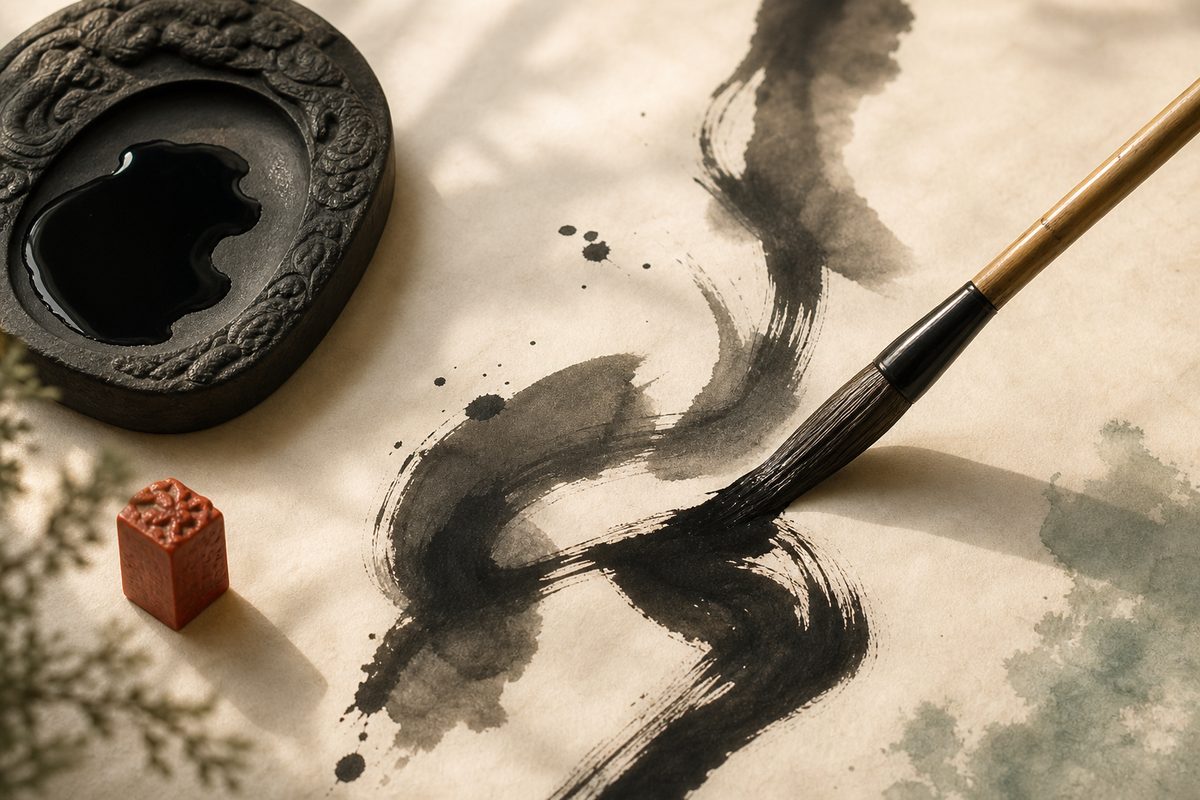
See 忍 in calligraphy
From ancient seal script to flowing cursive. Pick a look before a tattoo or a card.
 Name
Name Get a Chinese name
A name matched to the sound of yours, with a meaning that fits.
Start yours Chinese Almanac
 Try the Chinese Gender Predictor
A different corner of Chinese culture: the old Qing-palace birth chart, worked out from your lunar birth date, with the math shown and its coin-flip odds honestly weighed.
Open the toolBy Julian 祝君瑜, sourced from the classics and from modern life, updated 2026-09-05