Chinese Symbol
Chinese Symbol for War: Meaning and Origin
The Chinese symbol for war is 战 (zhàn), written 戰 in traditional characters. It is the word for a battle, for warfare, and for the act of fighting one. Both forms are built on 戈, the dagger-axe, the standard Chinese weapon for most of the Bronze Age. What almost nobody mentions is that the older form hides a second weapon inside it, and that the character English speakers usually want for a tattoo is probably not this one.
- Strokes
- 9
- Radical
- 戈 (dagger-axe; Kangxi 62)
- Formation
- Phono-semantic compound
Trace 战 yourself, or watch it drawn
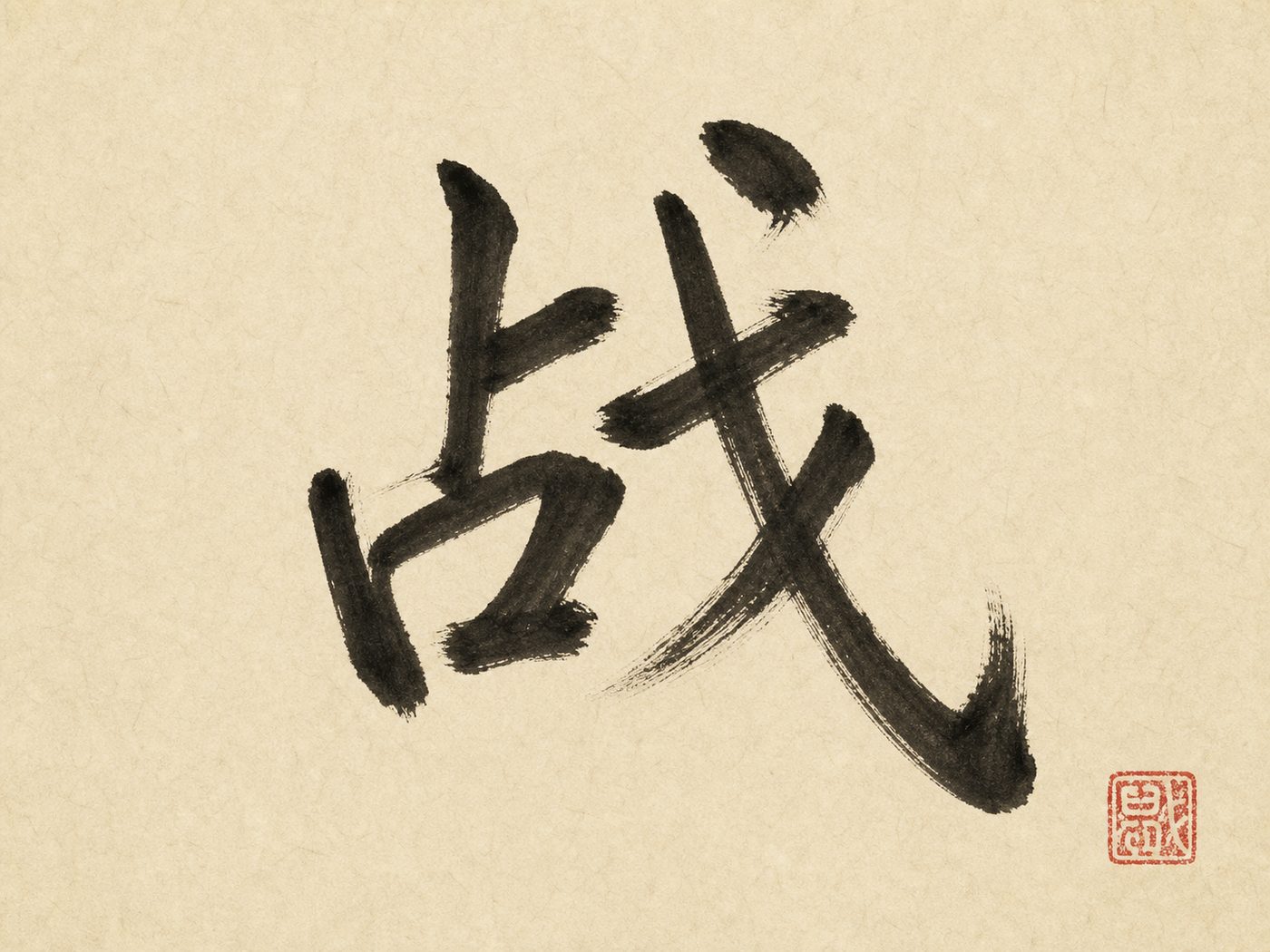
See 战 in seal, brush & cursive Try it
Calligraphy
War in six calligraphy hands
Pick a hand and save it as an image, sized for printing, a phone wallpaper or a tattoo consultation. The full generator adds seal script, paper, mounting and a seal of your own.
Typefaces drawn after calligraphic hands (SIL Open Font License), not brushwork: a way to choose a look before you commission one.
How it's written
The simplified 战 is nine strokes and splits cleanly down the middle. On the left is 占 (zhàn), which is there purely for the sound. On the right is 戈, the dagger-axe: a long horizontal blade mounted crosswise on a shaft, drawn as a slanting stroke with a hook and a dot above it. You write left to right, finishing the sound half before the weapon. The traditional 戰 is sixteen strokes and keeps 戈 in the same place on the right, but the left half is the much heavier 單 (dān). When the character was simplified, the meaning half never moved. Only the sound half was swapped, 單 out and the simpler 占 in, which is exactly what the simplification program did across hundreds of characters: it left the part that carries the sense alone and cut the part that only carries the pronunciation.
What it means
战 (zhàn) covers war, battle, and the verb "to fight." It is the word in the news when a country goes to war and the word in a sports report when a team faces another. Like most Chinese characters it rarely stands alone in modern speech: the ordinary noun for war is zhànzhēng, and combat as an activity is zhàndòu. It is worth separating it from three neighbors people mix it up with, because they are genuinely different ideas rather than synonyms.
| Word | What it names | Where it belongs |
|---|---|---|
| 战 (zhàn) | A battle; to fight; warfare as an event | The fighting itself |
| 兵 (bīng) | Soldiers, troops, arms; war as an institution | Sun Tzu's title is about this word, not 战 |
| 武 (wǔ) | Martial, military, the martial arts | A quality of a person, not an event |
| 争 (zhēng) | To contend, to struggle over something | The wanting that starts a war |
There is also a second, quieter meaning that surprises learners. 战 can mean to tremble or shiver, as in zhànlì, to quake with fear. English does something similar when a person is "shaking," and Chinese lets the same character carry both the battle and the fear of it, which is either a coincidence of sound or the bleakest pun in the language.
- 战争 war (the ordinary noun; fighting plus contending)
- 战斗 combat; to fight (an engagement rather than a whole war)
- 挑战 a challenge; to challenge (literally 'to provoke a fight')
- 战友 comrade-in-arms; someone you went through something hard with
- 战略 strategy (the large plan)
- 战术 tactics (the local method)
- 内战 civil war
- 战场 battlefield
- 价格战 price war
- 战栗 to tremble, to quake (the character's other sense)
Idioms
- 百战百胜“a hundred battles, a hundred victories”Unbeatable; victorious in everything. Used today as plain praise, though its source produces the phrase in order to reject it: winning every battle, Sun Tzu argues, is not the highest skill. (《孫子兵法·謀攻》)
- 速战速决“fight fast, settle fast”To finish something quickly and decisively. Used far more often about meetings and errands than about combat.
- 背水一战“to fight with a river at your back”To fight with no way to retreat, staking everything on one attempt. From the tactic of drawing up an army against a river so that no soldier can run.
Right vs wrong forms
| Form | Type | Note |
|---|---|---|
| 战 | simplified ✓ | The mainland standard, nine strokes. The phonetic 單 was replaced by the simpler 占; the dagger-axe 戈 was untouched. |
| 戰 | traditional | Standard in Taiwan, Hong Kong and Macau, sixteen strokes. Denser and preferred by calligraphers, but it will fill in at small tattoo sizes. |
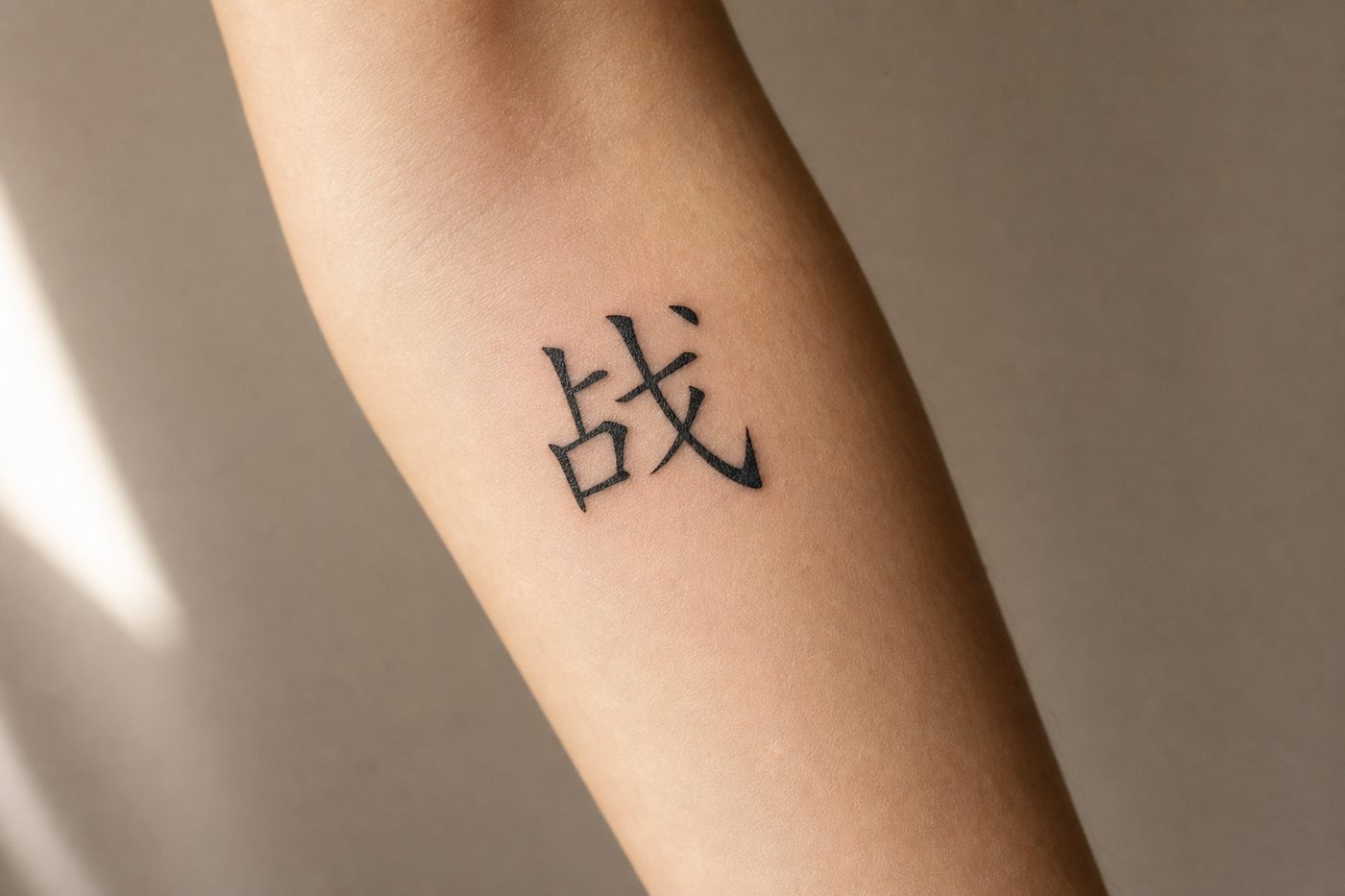
For a tattoo
Before anything else: check that 战 is the character you actually want. It names an event, a battle or a war, not a quality of a person. English "warrior" energy, the idea of being a fighter, is 武 or 力, and a great many people who ask for the war character turn out to have meant one of those. A native reader seeing 战 alone reads "battle," the way an English reader would take in the single word WAR on someone's arm: legible, blunt, and slightly unclear about what is being claimed. If it is the right character, decide between the two forms deliberately. Simplified 战 is nine strokes and reads clean at small sizes. Traditional 戰 is sixteen and has real visual density, which is why calligraphers prefer it, but at small scale on skin those strokes will close up into a blot within a decade. Do not mix the forms with other characters from the other system in the same piece. Two more things worth knowing. The character also carries the sense of trembling, which does not read as a contradiction to a native eye but is worth knowing before someone tells you about it afterward. And a two-character word is often the better tattoo: 百战 alone is meaningless, but the full idiom about a hundred battles, or zhànyǒu, comrade-in-arms, says something a single character cannot.
Before you commit to any character, the eight ways a Chinese tattoo goes wrong covers the failure modes that are not specific to this one, including the stroke-density arithmetic that decides whether a traditional form survives at small sizes.
War in life today
The word that swallowed everything competitive
Modern Chinese reaches for 战 constantly, and almost never about actual warfare. A challenge is a tiǎozhàn, literally a "provoked fight," and it is one of the most used words in the language, in job ads, motivational posters, and school essays. Price wars between retailers are jiàgézhàn. Corporate rivalry is shāngzhàn, business war, which is also an entire genre of television drama. An esports squad is a zhànduì, a war-team.
Comrades in arms, at the office
The warmest word in this family is zhànyǒu, a comrade-in-arms. It began as strictly military, the person beside you in the same unit, and it has drifted into ordinary speech for anyone you went through something hard alongside: a colleague from a brutal project, a friend from exam year. It is a notch more serious than "teammate" and carries the implication that you both survived something.
The character on a screen near you
Because 战 reads as intense rather than grim, it turns up constantly in titles. Any Chinese action film, war epic, or fantasy series has a decent chance of putting it in the name, and gaming has absorbed it wholesale, from kāizhàn (to start the fight) to shízhàn, meaning real combat as opposed to practice, a word that has spread into ordinary use for anything hands-on rather than theoretical.
Where the character comes from
Both forms are what scholars call phono-semantic compounds: one component points at the meaning, the other only tells you roughly how to say the word. Here 戈, the dagger-axe, is the meaning, and it is doing honest work. The dagger-axe was the characteristic weapon of Bronze Age Chinese warfare, and it sits inside a whole family of martial characters. The interesting half is the one that is supposedly "just" the sound. 單 (dān), the phonetic in the traditional 戰, was not originally an abstract sound-marker at all. The oldest forms depict a weapon: a Y-shaped wooden stick with two stones lashed to the top, a hunting and fighting implement, thrown or swung. Some scholars read it instead as a weighted net for catching animals. Either way it is a thing you use to bring something down. Over centuries the shape was tidied into abstraction, the central mark flattening into a box and finally into 田, until nothing about it looked like equipment anymore. Which produces a small, grim elegance in the traditional character. 戰 is a dagger-axe standing beside another weapon. Not a weapon and a reason, not a weapon and a consequence. Two weapons, and nothing else in the frame. That is worth holding next to its neighbor. The character for martial, 武, is built from the same dagger-axe plus 止, a foot, and a famous classical reading turns that into "to stop the weapon," martial virtue as the ending of conflict. Whatever one thinks of that reading, and the warrior page takes it apart properly, the point here is that 戰 offers no such consolation. There is no foot in it, nothing that halts. The 單 has quietly stopped meaning "weapon" over three thousand years, and today it means single, simple, or a printed list, so that the most common modern use of the character hiding inside "war" is the word for a restaurant bill.
History & roots
The age that named itself after fighting
For roughly two and a half centuries, from about 475 to 221 BCE, China had no center. Seven major states, Qin, Qi, Chu, Yan, Wei, Han and Zhao, spent the era absorbing their smaller neighbors and each other, and the scale of the fighting expanded beyond anything the previous age had seen. The period is called the Warring States, and the name is not a modern label: it comes from the Zhan Guo Ce, the Strategies of the Warring States, a compilation of the era's political maneuvering put together in the early Han. The age ended in 221 BCE when the king of Qin finished conquering the rest and declared himself the First Emperor. It is one of the more useful ironies in Chinese history that this same stretch of constant war produced most of Chinese philosophy. Confucianism, Daoism, the Legalists and the Mohists were all arguing at full volume while the states were destroying each other, and quite a lot of what they were arguing about was how to stop it.
China's most famous book about war is against fighting
The Art of War, in Chinese the Sunzi Bingfa, is attributed to Sun Tzu and was probably composed between about 500 and 430 BCE. It has been read for two and a half thousand years as the definitive treatise on how to win, and it is now compulsory reading in business schools that have never been within a thousand miles of a battlefield. What those readers often miss is that its central argument is that fighting is a failure. In Lionel Giles's 1910 translation, the third chapter opens by ranking the options plainly: "the best thing of all is to take the enemy's country whole and intact; to shatter and destroy it is not so good." A few lines later comes the sentence the whole book is built on: "supreme excellence consists in breaking the enemy's resistance without fighting." Note what that does to the idiom. Chinese has a well-worn phrase, bǎi zhàn bǎi shèng, "a hundred battles, a hundred victories," used today as straightforward praise for someone unbeatable. It comes from this very passage, where Sun Tzu produces it only to dismiss it: winning every battle you fight, he says, is not supreme excellence. The compliment people pay each other is a fragment of a sentence arguing the opposite.
Questions people ask
What is the Chinese symbol for war?
It is 战 (zhàn), written 戰 in traditional characters. Both are built on 戈, the dagger-axe that was the standard weapon of Bronze Age China, and both mean a battle, warfare, or the act of fighting. The everyday noun for war is the two-character word zhànzhēng.
What is the difference between the Chinese symbols for war and warrior?
They are different ideas, not synonyms. 战 (zhàn) names an event: a battle, the fighting itself. 武 (wǔ) names a quality: martial, military, the martial arts, the character behind the word for the martial arts and for a warrior. If you want the sense of being a fighter rather than the sense of a war happening, 武 is the character you mean.
Is the Chinese symbol for war a good tattoo?
It works if you actually mean a battle rather than a fighting spirit, which is the distinction most people get wrong. Read as a single character on skin, 战 lands roughly the way the English word WAR would: clear, blunt, and a little ambiguous about what you are claiming. If the intended meaning is closer to strength or warrior, 力 or 武 will read the way you want. Whichever you pick, choose the simplified or traditional form deliberately and never mix systems within one design.
Why does the Chinese character for war also mean to tremble?
The same character carries both senses, and zhànlì means to quake or shiver with fear. Chinese does this fairly often, letting one character serve two meanings that arrived by different routes. English does something comparable when it calls a frightened person shaken.
How is the Chinese symbol for war written in simplified and traditional Chinese?
Simplified is 战, nine strokes. Traditional is 戰, sixteen. The simplification kept the meaning component 戈 exactly where it was and replaced only the sound component, swapping the complicated 單 for the simpler 占. That is the standard pattern across the simplification program: the part carrying the sense stays, the part carrying only the pronunciation gets cut down.
Is the Japanese kanji for war the same as the Chinese symbol?
Close, but it is a third form. Japan writes 戦, read sen or ikusa, its own simplified form (shinjitai) of the traditional 戰. It keeps the dagger-axe 戈 and shortens 單 to 単, while mainland China swapped the same half for 占. A Chinese reader will usually recognize 戦 but read it as Japanese (why the two scripts split). It is a well-known character in Japan too: 戦 was chosen as Japan's Kanji of the Year in 2001 and again in 2022. For a Chinese piece, use 战 or 戰.
Sources
- Wiktionary: 戰 (glyph origin, 戈 semantic + 單 phonetic, Kangxi radical 62)
- Wiktionary: 战 (simplified form, 占 phonetic + 戈 semantic, 單 → 占)
- Wiktionary: 單 (original depiction, a Y-shaped weapon with two stones)
- The Art of War, tr. Lionel Giles (1910), Attack by Stratagem (verses quoted inline)
- The Art of War (attribution and dating)
- Warring States period (dates, the seven states, the Zhan Guo Ce)
- Wiktionary: 戦 (Japanese shinjitai of 戰, 単 + 戈; readings sen, ikusa)
- Kanji of the Year (戦 chosen in 2001 and 2022)
Make War your own
See 战 in calligraphy
From ancient seal script to flowing cursive. Pick a look before a tattoo or a card.
 Name
Name Get a Chinese name
A name matched to the sound of yours, with a meaning that fits.
Start yours Chinese Almanac
 Try the Chinese Gender Predictor
A different corner of Chinese culture: the old Qing-palace birth chart, worked out from your lunar birth date, with the math shown and its coin-flip odds honestly weighed.
Open the toolBy Julian 祝君瑜, sourced from the classics and from modern life, updated 2026-10-19