Chinese Symbol
Chinese Symbol for Happiness: Meaning, Origin, and Music
The Chinese symbol for happiness is 乐 (lè, which sounds like "luh"), the everyday character for being happy and glad. It hides a small surprise in its history: 乐 began as a picture of a musical instrument, silk strings stretched over a wooden frame, and the word for joy grew straight out of the word for music. The Chinese character for happiness is, at the root, the sound of a plucked string.
- Strokes
- 5
- Radical
- 丿 (the top slash; the traditional 樂 is under 木, wood)
- Formation
- Pictograph (象形)
Trace 乐 yourself, or watch it drawn
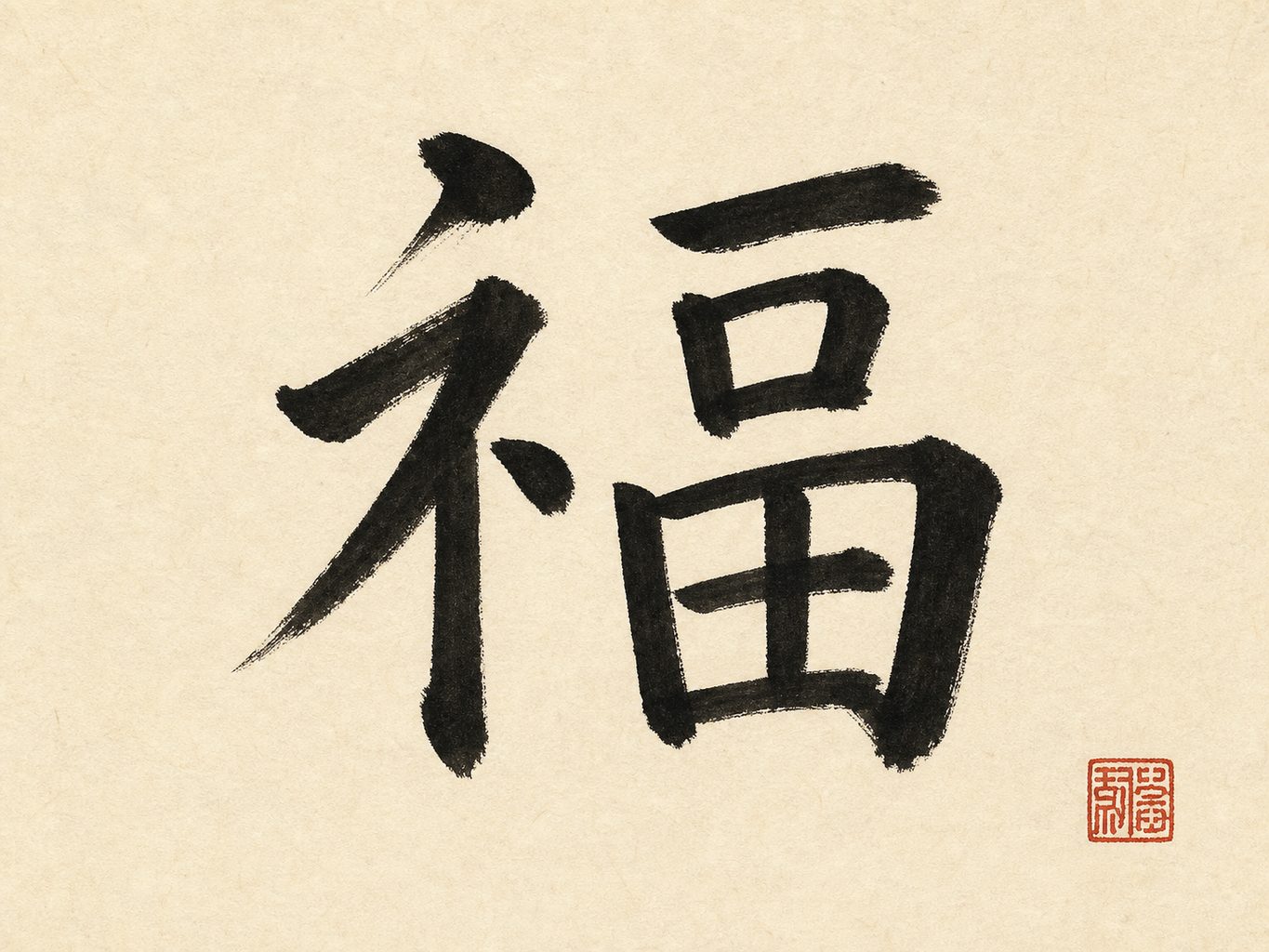
See 乐 in seal, brush & cursive Try it
How it's written
There are really two characters to talk about here, because 乐 is one of the most drastically simplified in the language. The traditional form, still standard in Taiwan and Hong Kong, is 樂, a dense fifteen-stroke tower: two coils of silk thread balanced on either side of a small central element, all sitting on top of 木, the character for wood. Read it as an object and it is a stringed instrument, silk strings mounted on a wooden stand. The mainland's simplified 乐 keeps only a ghost of that shape: five quick strokes, a little crown over a base shaped like 小, "small." One is a lute; the other is the memory of a lute. To write the simplified 乐, a short top slash and a hooked horizontal make the crown, then a hooked vertical with one dot on each side finishes the base.
What it means
乐 (lè) is the plain, everyday word for happy, glad, and joyful, and for taking pleasure in something. It is the 乐 in kuàilè, "happy," the word on every birthday card and New Year greeting: shēngrì kuàilè, happy birthday; xīnnián kuàilè, happy new year. If you want the Chinese for the feeling of being happy, this is the workhorse character.
The knot to untangle, and the reason this page exists, is that the single English word "happiness" is spread across several Chinese characters that are not interchangeable:
| Character | Pinyin | What it really means | Best for |
|---|---|---|---|
| 乐 | lè | Happy, glad, joyful (also music, read yuè) | The everyday feeling of being happy |
| 福 | fú | Luck, fortune, blessing (often loosely called "happiness") | Good luck and fortune |
| 喜 | xǐ | Joy, delight tied to an occasion | Happy events; doubled as 囍 for weddings |
| 幸福 | xìngfú | Happiness, well-being (the two-character word) | Happiness as a whole state of life |
So the honest answer to "the Chinese symbol for happiness" is 乐 if you mean the feeling of being happy. Reach for a different character for a different shade: 福 for luck and fortune, the one so often loosely called "happiness"; 喜 for the joy of an occasion, doubled into the wedding emblem 囍; or the two-character word 幸福 for happiness as a whole condition of life. And one thing to know before you ink it: read the same character as yuè and it means music, an overlap the rest of this page is about.
- 快乐 happy (the everyday word)
- 欢乐 joyous; festive, merry
- 乐趣 delight; the fun or pleasure of something
- 乐观 optimistic (literally 'joy-view')
- 娱乐 entertainment; amusement
- 乐意 to be glad to; willing
- 音乐 music (the character read yuè)
- 可乐 cola; (colloquial) hilarious, a scream
- 乐园 paradise; a pleasure garden
- 逗乐 to amuse; to make someone laugh
Idioms
- 助人为乐“to take helping others as one's joy”to find real happiness in helping people; a stock civic virtue.
- 乐不思蜀“so happy one does not think of Shu”too content in new comfort to miss home or duty. From Liu Shan, the deposed last king of Shu, who told his captor he did not miss his lost kingdom at all. (the story of Liu Shan, last ruler of Shu Han (3rd century))
- 乐极生悲“joy at its peak gives birth to sorrow”extreme happiness tips over into grief; do not celebrate too hard.
- 知足常乐“one who knows contentment is always happy”lasting happiness comes from knowing when you have enough. (echoing Laozi, who wrote that one who knows contentment is rich)
- 安居乐业“to live in peace and take joy in one's work”to live and work in contentment; the picture of a settled, happy society.
Right vs wrong forms
| Form | Type | Note |
|---|---|---|
| 乐 | simplified ✓ | The simplified form, standard on the Chinese mainland and in Singapore: five strokes, a shrunk-down descendant of the traditional 樂. This is the everyday modern character for happy. |
| 樂 | traditional | The traditional form, standard in Taiwan and Hong Kong: fifteen strokes, and still clearly a picture of a stringed instrument on a wooden stand. Not wrong, just the older, fuller shape; choose it if you want the traditional look. |
| 楽 | wrong | The Japanese form of the same character. Close but not identical to either Chinese standard, so avoid it if you specifically want Chinese; a reader will recognize it as the Japanese shape. |
For a tattoo
乐 is a warm, positive choice for a tattoo, but it is one of the characters where you genuinely have to pick your version on purpose. The simplified 乐 (five strokes) and the traditional 樂 (fifteen) look almost nothing alike, so choose deliberately rather than trusting whatever a random font hands you: 乐 is standard on the mainland, 樂 in Taiwan and Hong Kong, and Japan uses a third form again, 楽. None is "wrong," but they are not the same shape, and a Chinese reader will clock which world yours comes from. The other thing to know is that the same character, read yuè, means music, so a 乐 tattoo quietly says both "joy" and "music" at once, which most people decide is a happy bonus rather than a problem. As always, print the design at full size and have someone who reads Chinese confirm it before the needle comes out.
Before you commit to any character, the eight ways a Chinese tattoo goes wrong covers the failure modes that are not specific to this one, including the stroke-density arithmetic that decides whether a traditional form survives at small sizes.
Happiness in life today
The word you already half-know
If you have ever been sung to in Chinese, you already know 乐. It closes the two most-sung phrases in the language: shēngrì kuàilè, "happy birthday," and xīnnián kuàilè, "happy new year." Kuàilè, built from "quick" and "happy," is the standard everyday word for happy, taught in the first week of any Chinese class. Lately 乐 has also picked up a thoroughly modern second job online. Typed on its own in a chat, it has become the Chinese internet's dry way of saying "lol," or more exactly "well, isn't that something," a faintly weary amusement at the world; someone who enjoys watching other people's drama unfold is a lèzǐrén, a "fun-seeker." The oldest character for joy is now also shorthand for a smirk.
The best brand name in China
The single most admired piece of translation in modern China is a soft drink. When Coca-Cola settled on its Chinese name it chose 可口可乐, kěkǒu kělè, which sounds like "Coca-Cola" and reads, roughly, as "tasty, and able to make you happy," a bottle that lets the mouth rejoice. It landed so completely that 可乐, "can-be-happy," is now simply the Chinese word for cola, any brand of it. The internet has since pushed the joke along, nicknaming any sugary soft drink kuàilèshuǐ, "happy water," the cheap bottled chemical joy that gets you through an afternoon. The 乐 in all of it is our character, doing what it has always done: fastening joy onto a thing. The whole business of naming things for happiness, from yúlè, "entertainment," to a thousand shop signs, runs on this one bright syllable.
A name that wishes you joy
As a given-name element, 乐 is a straightforward, sunny wish, a hope that a child grows up glad.
Curious what your own name could become in Chinese, matched to its sound and a good
meaning? Our Chinese name generator builds one for you.
Where the character comes from
The oldest forms settle any argument about what 乐 is. On the oracle bones and bronzes, 樂 is unmistakably a drawing of a musical instrument: silk strings stretched taut over a wooden frame, the ancient cousin of a zither, with a plectrum added in the middle in later forms. The Shuowen Jiezi, the first Chinese dictionary, compiled around the year 100, defines it as wǔ shēng bā yīn zǒng míng, "the general name for the five tones and the eight timbres," and notes that the wood at its base is the instrument's stand. In its first life, the character meant music, plain and simple.
The leap from music to happiness is the good part, and it is not a Chinese quirk: linguists have traced the same slide from "music" to "joy" in other languages of the region. Music was the thing that made people glad, so the character for the instrument came to carry the gladness too, and one written shape split into two spoken words: yuè for the music, lè for the joy it brings. Happiness, in Chinese, is quite literally what music does to you.
There is a whole lost world folded into that first meaning. The Shuowen's "eight timbres" are the eight materials early China sorted its instruments by, from metal bells and stone chimes to silk strings, bamboo pipes, and clay ocarinas, and music mattered enough that tradition counts a Classic of Music among the ancient canon, one of the Six Classics set beside the Book of Songs and the Book of Documents. That music classic was lost early, so the character 乐 is now among the few things that outlived it: a small picture of an instrument, still carrying a whole vanished art on its back.
History & roots
When happiness was music
Because 乐 was music before it was joy, it sits near the center of how classical China thought a person should be shaped. Confucius held that a civilized human being was built by two things working together: lǐ, ritual or propriety, and yuè, music, this same character. Ritual gave you the right outward form; music tuned your inner feeling until doing the right thing actually felt good. The pairing lǐyuè, "rites and music," was the whole Confucian program of moral education compressed into two words. Happiness, music, and goodness were not separate departments to the classical mind. They were one project, and this character stood in the middle of it.
The happiest man in the alley
The most admired happiness in the Chinese tradition belongs to a man who had almost nothing. Yan Hui was Confucius's favorite student, and the Master's praise of him in the Analects has been memorized for twenty-five centuries. In James Legge's translation: "Admirable indeed was the virtue of Hui! With a single bamboo dish of rice, a single gourd dish of drink, and living in his mean narrow lane, while others could not have endured the distress, he did not allow his joy to be affected by it." The word for that joy is 乐. Yan Hui became the permanent Chinese image of a happiness that owes nothing to money or comfort, the state the tradition simply calls "the joy of Yan Hui," and it is the quiet rebuke standing behind every luckier, richer character on this site.
Too happy to go home
Chinese being Chinese, there is also a cautionary tale about happiness, and it is both funny and a little cruel. When the kingdom of Shu fell in the third century, its last ruler, Liu Shan, was carried off to the enemy capital and kept in comfortable captivity. His conqueror, testing him, laid on a banquet with the music and dances of lost Shu, expecting tears. Liu Shan enjoyed the show enormously. Asked whether he missed his kingdom, he answered, cheerfully, cǐ jiān lè, bù sī Shǔ: "It is lovely here; I do not think about Shu at all." The line hardened into the idiom lè bù sī Shǔ, "so happy he forgets Shu," the Chinese name for a contentment that has mislaid its own dignity. Whether Liu Shan was a fool or a survivor playing dumb, historians still argue. Either way, the language kept the line.
The joy you have to share
There is one more classical idea worth knowing, because it is the most generous thing anyone said about happiness in Chinese, and it turns on the very music-and-joy overlap this character carries. The philosopher Mencius, pressing a pleasure-loving king in the fourth century BCE, asked a deceptively simple question. Is it more enjoyable, he said, to enjoy music alone, or to enjoy it with others? With others, the king admitted. And with a few, or with many? With many. The whole argument is a pun that only works in Chinese, where one character does both music and joy, so that "enjoying music" and "having joy" are written the same way. A ruler who will, in Legge's words, "make pleasure a thing common to the people and himself" has already won them: yǔ mín tóng lè, sharing your joy with the people. Happiness kept to yourself, the oldest Chinese philosophy of joy insists, is barely happiness at all.
Questions people ask
What is the Chinese symbol for happiness?
It is 乐 (lè), the everyday character for happy, glad, and joyful, as in kuàilè, 'happy.' Its simplified form has five strokes; the traditional form is 樂. Note that English 'happiness' maps to several Chinese characters: 乐 is the feeling of being happy, while 福 (fú) is luck and fortune (often loosely called 'happiness'), and the two-character word for happiness as a state of life is 幸福 (xìngfú).
What is the Chinese symbol for joy?
The main character is 乐 (lè), which covers happiness and joy together, and read as yuè it also means music. For joy tied to a specific happy occasion, like a wedding or good news, Chinese uses 喜 (xǐ), which has its own page here and is doubled to make 囍, the red 'double happiness' emblem. For a general, everyday sense of joy, 乐 is the natural choice.
What is the difference between the Chinese symbols for happiness and luck?
They are different characters. 乐 (lè) is happiness as a feeling, the 'happy' in kuàilè. 福 (fú) is luck, fortune, and blessing, the character pasted on doors at New Year, which English often loosely translates as 'happiness' but which really means good fortune. If you want the feeling, choose 乐; if you want luck, choose 福.
How do you write happy in Chinese?
The usual word is 快乐 (kuàilè), two characters meaning 'happy,' as in shēngrì kuàilè, 'happy birthday.' The key character is 乐 (lè), which carries the sense of joy on its own. So 'happy' is 快乐, and the single symbol at its heart is 乐.
Is the Chinese symbol for happiness a good tattoo?
Yes, though you have to choose your version deliberately. The simplified 乐 (five strokes) and the traditional 樂 (fifteen strokes) look very different, and Japan uses a third form, 楽; pick the one that matches the world you want. Note too that the same character read yuè means music, so a 乐 tattoo carries both 'joy' and 'music,' which most people like. Have a Chinese reader confirm the design first.
What is the Asian symbol for happiness?
There is no Asian one, only a Chinese one, and here the harder problem is that there are several. 乐 (lè) is joy as a state of being; 福 (fú) is the good fortune pasted on doors at new year; 喜 (xǐ) is the delight of an occasion, doubled to 囍 for weddings. Searching in English collapses all three into the single word happiness. Decide which of the three you actually mean before it goes on anything permanent.
Sources
- Wiktionary: 樂 / 乐 (glyph origin as a musical instrument, readings lè/yuè, meanings)
- Shuowen Jiezi entry for 樂: 五聲八音緫名 (hancibao.com)
- The Analects, Yong Ye: the joy of Yan Hui (Chinese Text Project, Legge translation)
- Liu Shan and the idiom 乐不思蜀, 'too happy to miss Shu' (Wikipedia)
- Coca-Cola's Chinese name 可口可乐 (Wikipedia)
- Mencius, King Hui of Liang II: sharing joy with the people, 与民同乐 (Chinese Text Project, Legge translation)
Make Happiness your own
See 乐 in calligraphy
From ancient seal script to flowing cursive. Pick a look before a tattoo or a card.
 Name
Name Get a Chinese name
A name matched to the sound of yours, with a meaning that fits.
Start yours Chinese Almanac
 Try the Chinese Gender Predictor
A different corner of Chinese culture: the old Qing-palace birth chart, worked out from your lunar birth date, with the math shown and its coin-flip odds honestly weighed.
Open the toolRelated: good luck, double happiness, joy, love, family, peace
By Julian 祝君瑜, sourced from the classics and from modern life, updated 2026-07-26