Chinese Symbol
Chinese Symbol for Longevity (寿): Meaning, Fu Lu Shou, and the God of Long Life
The Chinese symbol for longevity is 寿 (shòu), and it is one of the most auspicious characters in the language, a single word that means "long life" and works as a blessing all by itself. You meet it everywhere a Chinese family wishes an elder well: on birthday banners, on peach-shaped buns, embroidered onto silk. It is also the character that changes most dramatically between the two writing systems, from a brisk seven strokes in simplified Chinese to an ornate fourteen in traditional 壽.
- Strokes
- 7
- Radical
- 寸 (thumb/inch); the traditional 壽 is classed under 士 (Kangxi 33)
- Formation
- Phono-semantic compound (semantic 老 'old' + a phonetic element)
Trace 寿 yourself, or watch it drawn
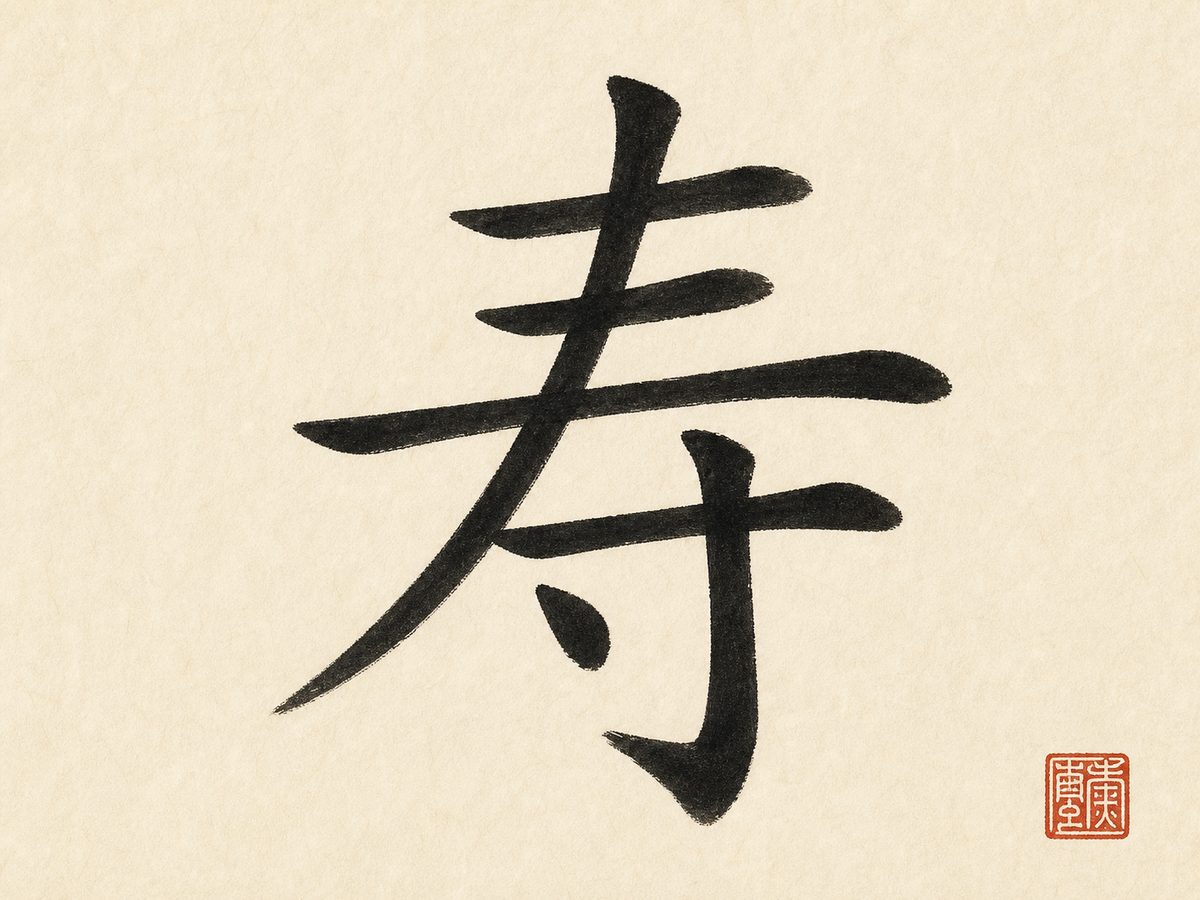
See 寿 in seal, brush & cursive Try it
How it's written
This is the character where the gap between simplified and traditional Chinese is at its very widest, so it is worth seeing both. The traditional 壽 is a tower of a thing, fourteen strokes stacked tall, historically filed under 士 and built, the old dictionaries say, on 老 (lǎo), "old," with a phonetic element beneath it: age, spelled out at length. The simplified 寿 shears all of that down to a lean seven strokes, three quick horizontals crossed by a sweeping diagonal, with 寸 (a hand) at the foot.
If you are choosing 寿 for calligraphy or a tattoo, this is the one decision to make first: which world do you want. The antique, dense 壽 that you see carved into old furniture and embroidered on silk, or the clean modern 寿 of a mainland street sign. They are the same word and the same sound, and they look almost nothing alike.
What it means
寿 (shòu) means long life, longevity, and by extension lifespan and age itself. But it is not a neutral, clinical word the way "lifespan" is in English. 寿 is warm and honorific, reserved for the old and the revered: an elder's birthday is their shòu, to wish someone long life is to zhùshòu, and a person of great age has gāoshòu, a "high longevity" you ask after politely. You would never use it of a child. It belongs to white hair and grandchildren.
It also leads a quietly practical second life. Because naming death outright is unlucky, Chinese wraps the things of death in the language of long life instead: burial clothes are shòuyī, "longevity clothes," and a coffin bought in advance for an aging parent, an act of filial care rather than gloom, is a shòucai, a "longevity board." The most auspicious word in the language doubles as its gentlest way of not saying the end.
- 长寿 long life, longevity
- 寿命 lifespan, life expectancy
- 寿星 the god of longevity; the guest of honor at a birthday
- 祝寿 to wish an elder long life; to celebrate their birthday
- 寿辰 an elder's birthday
- 寿桃 longevity peach; a peach-shaped birthday bun
- 高寿 advanced age; a polite way to ask an elder's age
- 寿衣 burial clothes (literally 'longevity clothes,' a euphemism)
- 寿终正寝 to die peacefully of old age at home
- 延年益寿 to prolong life and increase longevity
Idioms
- 万寿无疆“ten thousand longevities without bound”may you live forever; the classic blessing for an emperor or a revered elder. (《诗经·小雅·天保》)
- 寿比南山“longevity to rival the Southern Mountain”may you live a very long life; usually paired with 福如东海, 'fortune as vast as the Eastern Sea.' (《诗经·小雅·天保》)
- 延年益寿“extend the years, increase longevity”to promote long life; said of tonics, exercise, and healthy living.
- 人寿年丰“people long-lived, harvests bountiful”an era of peace and plenty.
- 长命百岁“long life, a hundred years”may you live to a hundred; said warmly to children and elders alike.
Right vs wrong forms
| Form | Type | Note |
|---|---|---|
| 寿 | simplified ✓ | The standard simplified form, seven strokes: three horizontals crossed by a diagonal, with 寸 at the foot. This is the everyday mainland form and the default for a modern design. |
| 壽 | traditional | The traditional form, fourteen strokes, built historically on 老 ('old'). It is standard in Taiwan and Hong Kong and is the form used in nearly all decorative, antique, and formal contexts, the 壽 you see carved on furniture and embroidered on silk. Fully correct, simply the traditional shape. |
| 寿 (mirrored or rotated) | mirrored | Not a variant. A flipped or rotated character from a low-resolution stencil reads as an error to anyone literate. Check against a dictionary at full size before inking, especially with the strokes as dense as the traditional form's. |
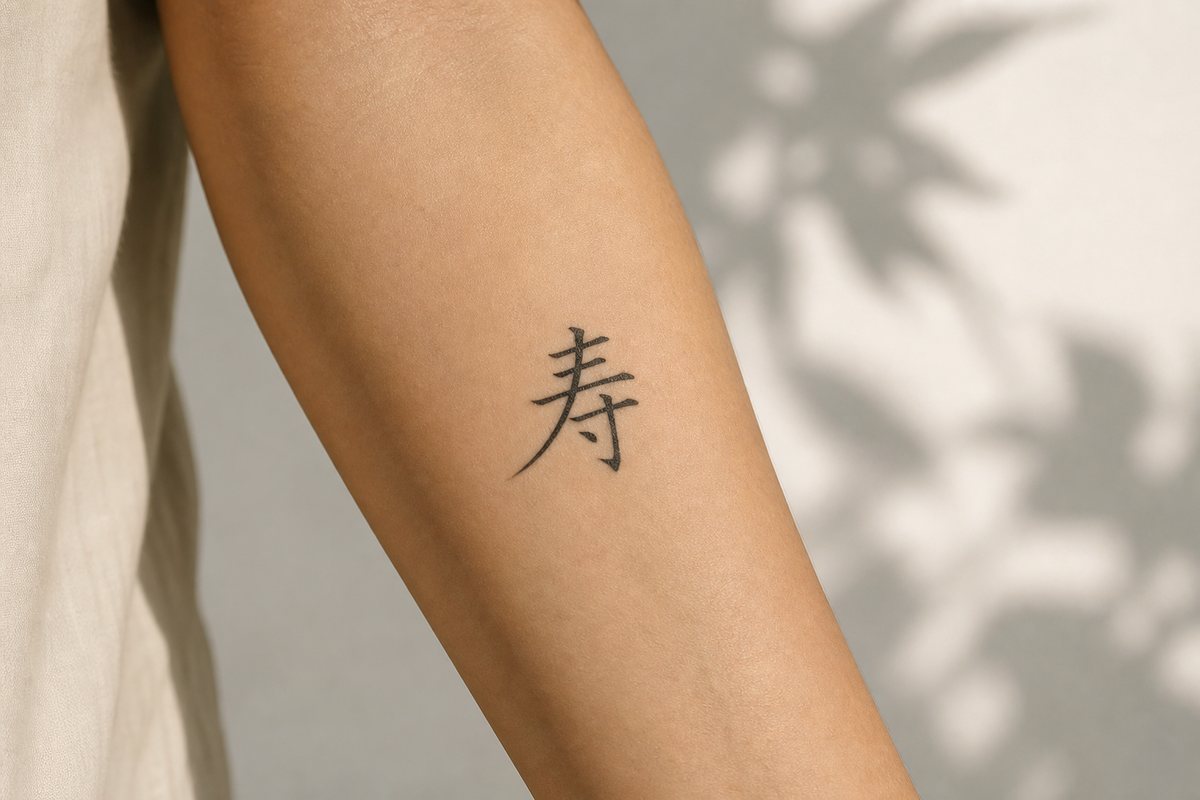
For a tattoo
寿 is a meaningful tattoo, if a slightly unusual one, because in Chinese culture it is far more a gift and a decoration than a piece of body art, most at home on a grandparent's birthday scroll. That is not a mark against it, but it is worth knowing the register you are borrowing: 寿 reads as a warm, respectful wish for long life, with a faint sense of honoring the old.
The big decision is simplified against traditional, and here the two really do diverge. The traditional 壽, fourteen dense strokes, is the ornate antique form you see carved and embroidered, and it makes a striking tall column of a tattoo. The simplified 寿 is cleaner and more modern at seven strokes. Neither is wrong, but they look nothing alike, so choose on purpose rather than trusting whatever a font hands you. As always, print it at full size and have someone who reads Chinese confirm the design before the needle comes out.
Before you commit to any character, the eight ways a Chinese tattoo goes wrong covers the failure modes that are not specific to this one, including the stroke-density arithmetic that decides whether a traditional form survives at small sizes.
Longevity in life today
The god with the enormous forehead
Chinese longevity has a face, and it is a memorable one. The god of long life, Shòuxīng, the "Longevity Star," is unmistakable: a beaming old man whose bald head bulges upward into a great domed forehead, with a long white beard, a staff in one hand and a peach in the other. Astronomers know him as the star Canopus; the myths know him as the Old Man of the South Pole, said to have been carried in his mother's womb for ten years and born already old. He is the third of the three luck gods, the trio of little statues, Fú Lù Shòu (福禄寿), that stand on shop counters and living-room shelves across the Chinese world: fortune, prosperity, and long life, read right to left like a line of old text, so 寿 is the white-bearded elder on the viewer's left. The three star gods have a page of their own: which star each one is, and the Han census that handed every seventy-year-old a staff.
Peaches, noodles, and a very long lunch
An elder's birthday comes with an edible vocabulary of longevity. You serve chángshòu miàn, "longevity noodles," a single noodle made as long as the cook can manage, never cut and ideally slurped down in one piece, because the uncut length is the whole point. And you give shòutáo, "longevity peaches," soft steamed buns shaped and blushed to look like the fruit, a nod to the fabled peaches of immortality that ripened just once every few thousand years in the garden of the Queen Mother of the West. Eat the peach, borrow the immortality.
The birthday you have to earn
Not every birthday is a 寿. The word is saved for the milestone birthdays of the old, the sixtieth, seventieth, eightieth, marked with a formal zhùshòu, a "longevity toast," at which the guest of honor is literally called the shòuxīng, the living "longevity star" of the day. The grandest version was imperial: an emperor's birthday was the festival of "ten thousand longevities," and the cry raised to him, wàn shòu wú jiāng, "may your longevity be without bound," is a phrase every Chinese speaker still half knows.
Curious what your own name becomes in Chinese, matched to its sound and a good
meaning? Our Chinese name generator builds one for you.
Where the character comes from
The oldest dictionary keeps it short. The Shuowen Jiezi, from around the year 100, glosses 寿 in a single word, jiǔ, "long-lasting, enduring," and files it under 老, "old": longevity as, quite simply, the state of having lasted. Almost from the start, though, 寿 was less a word than a wish. Long before it settled into its modern shape it was being written for its meaning as much as its sound, cast onto bronze vessels and, in time, turned into pure ornament.
That ornamental life is the genuinely remarkable thing about it. 寿 is probably the most decorated single character in all of Chinese culture. Craftsmen worked out two stylized versions, the 团寿, a round 寿 coiled into a wheel, and its stretched-out cousin drawn tall like a column, and stamped them onto everything from rice bowls to bedposts. There is even a classic design called the 百寿图, the "hundred longevities," a single scroll showing the character written a hundred different ways, no two the same. No other word gets quite this treatment. Long life was the blessing people most wanted written on the things they lived among.
History & roots
May your years match the mountain
The two most famous longevity blessings in Chinese both come from a single ancient poem. In the Book of Songs, the Shijing, gathered well before Confucius, sits an ode called Tianbao, a courtier's stack of good wishes for his lord, and two of its lines never left the language. One asks that his years be "like the longevity of the Southern Mountain, which neither wears away nor collapses," which gave Chinese its evergreen birthday line shòu bǐ nán shān, "may you live as long as the Southern Mountain." The other simply wishes him wàn shòu wú jiāng, "longevity without bound." Three thousand years on they are still the words brushed on the birthday scroll, and usually paired: long life like the mountain, fortune as deep as the sea.
The company that longevity keeps
Because long life is an abstraction, Chinese art gave it a cast of living stand-ins, and they crowd in wherever 寿 appears. The pine and the cypress, green through the dead of winter, stand for an old age that does not fade. The crane and the tortoise, both believed to live for centuries, became the very animals of longevity: a crane among pines is a wordless "long life" on a hanging scroll. Even the peach belongs to the set. To paint any of these is to write 寿 without a brush, which is why an old person's birthday room can be thick with cranes and pines and never once spell the word out.
A good long life, and a good end
Chinese has always judged a life partly by how it closes. The ideal death, the one actually called a blessing, is shòu zhōng zhèng qǐn, "to end one's longevity in the main bedroom": to die old, at home, in your own bed, having seen your grandchildren, the natural end of a full span rather than a sudden or violent one. The patron of the impossibly long life is Péng Zǔ, a kind of Chinese Methuselah said to have lived eight hundred years, whose name still turns up in the wish to live as long as he did. Longevity, in the end, was never only about counting years. It was about reaching the far end of them whole, and on your own terms.
Questions people ask
What is the Chinese symbol for longevity?
It is 寿 (shòu) in simplified Chinese, or 壽 in traditional. It means long life and longevity, and it is one of the most auspicious characters in the language, used as a blessing on birthdays and gifts. It is also the third of the three luck gods, Fu Lu Shou (福禄寿): fortune, prosperity, and long life.
Is the Chinese longevity character simplified or traditional?
Both forms exist and they diverge sharply. The simplified 寿 has seven strokes and is standard on the mainland; the traditional 壽 has fourteen and is used in Taiwan and Hong Kong and in almost all decorative and antique contexts. They are the same word (shòu) but look very different, so for calligraphy or a tattoo you should choose deliberately.
What does Fu Lu Shou mean?
Fu Lu Shou (福禄寿) is the trio of three star gods worshipped together for a complete good life: 福 (fú) is fortune and happiness, 禄 (lù) is prosperity and official rank, and 寿 (shòu) is longevity. Their three little statues stand in homes and shops across the Chinese world. Shou, the longevity god, is the smiling old man with a hugely domed forehead, a peach, and a staff.
Is the Chinese symbol for longevity a good tattoo?
Yes, though it is traditionally more a decoration and a gift than body art, so it carries a warm, respectful, honor-the-elders register. The key choice is simplified 寿 (seven strokes, clean and modern) versus traditional 壽 (fourteen strokes, ornate and antique); they look nothing alike. Whichever you pick, print it at full size and have a Chinese reader confirm the design first.
What does wan shou wu jiang mean?
Wàn shòu wú jiāng (万寿无疆) means 'may your longevity be without bound,' literally 'ten thousand longevities without limit.' It is the grandest of the birthday blessings, once shouted to the emperor on his birthday, and it comes from an ancient ode called Tianbao in the Book of Songs (Shijing).
Sources
- Wiktionary: 壽 / 寿 (phono-semantic on 老 'old'; 14 vs 7 strokes; meanings incl. euphemistic)
- Shuowen Jiezi entry for 壽: 久也,从老省 (guoxuedashi.net)
- Book of Songs, Xiaoya, Tianbao (诗经·小雅·天保): 如南山之壽 + 萬壽無疆 (ctext.org)
- Sanxing (Fu Lu Shou): Shou the Longevity Star = the Old Man of the South Pole (Wikipedia)
- Peaches of Immortality: 蟠桃 in Xiwangmu's garden, the 寿桃 birthday buns (Wikipedia)
Make Longevity your own
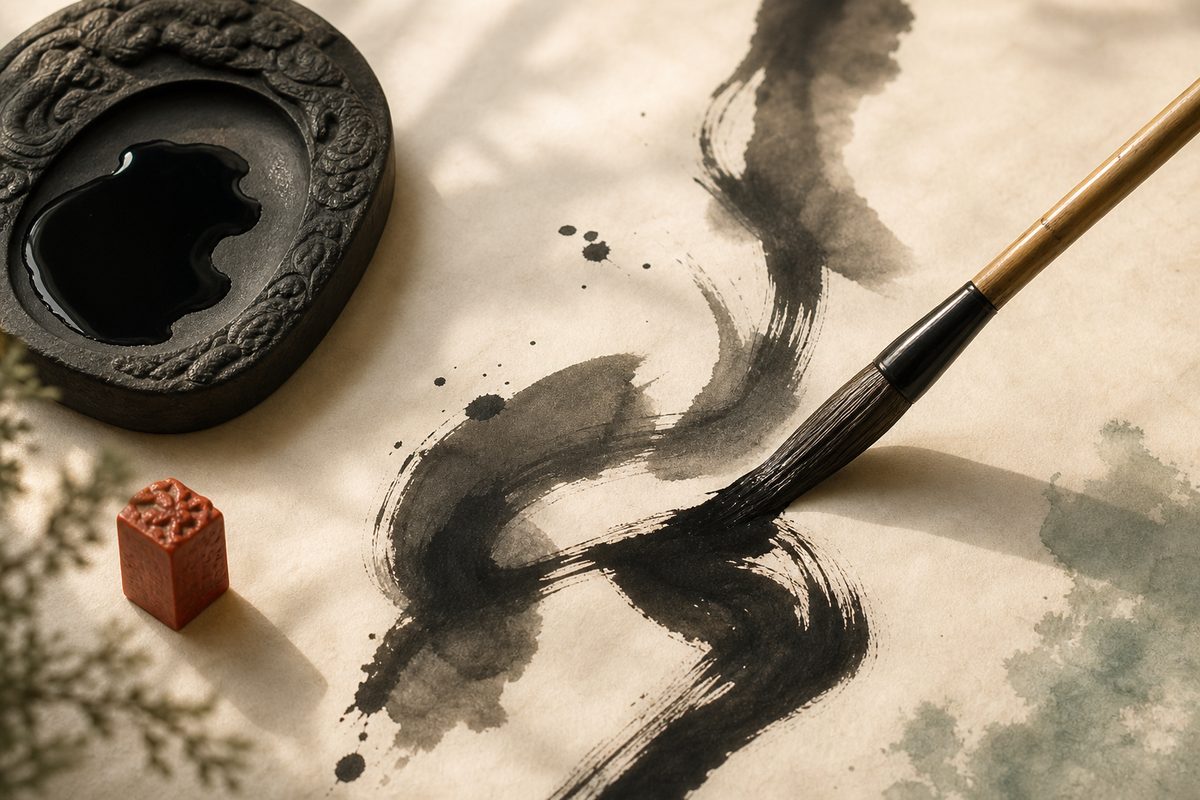
See 寿 in calligraphy
From ancient seal script to flowing cursive. Pick a look before a tattoo or a card.
 Name
Name Get a Chinese name
A name matched to the sound of yours, with a meaning that fits.
Start yours Chinese Almanac
 Try the Chinese Gender Predictor
A different corner of Chinese culture: the old Qing-palace birth chart, worked out from your lunar birth date, with the math shown and its coin-flip odds honestly weighed.
Open the toolRelated: prosperity, good luck, family, peace, death
By Julian 祝君瑜, sourced from the classics and from modern life, updated 2026-09-16