Chinese Symbol
Chinese Symbol for Life (生): Meaning, Origin, and the Sprout
The Chinese symbol for life is 生 (shēng), and it began as a tiny drawing of a plant pushing up out of the earth. That single image, a sprout breaking ground, still runs underneath everything the character does: to be born, to grow, to live, to produce. It is one of the busiest characters in the whole language, turning up in the ordinary words for birthday, student, doctor, stranger, and the raw as opposed to the cooked.
- Strokes
- 5
- Radical
- 生 (life; it is its own radical, Kangxi 100)
- Formation
- Ideograph: a sprout (屮) rising above the ground (一)
Trace 生 yourself, or watch it drawn
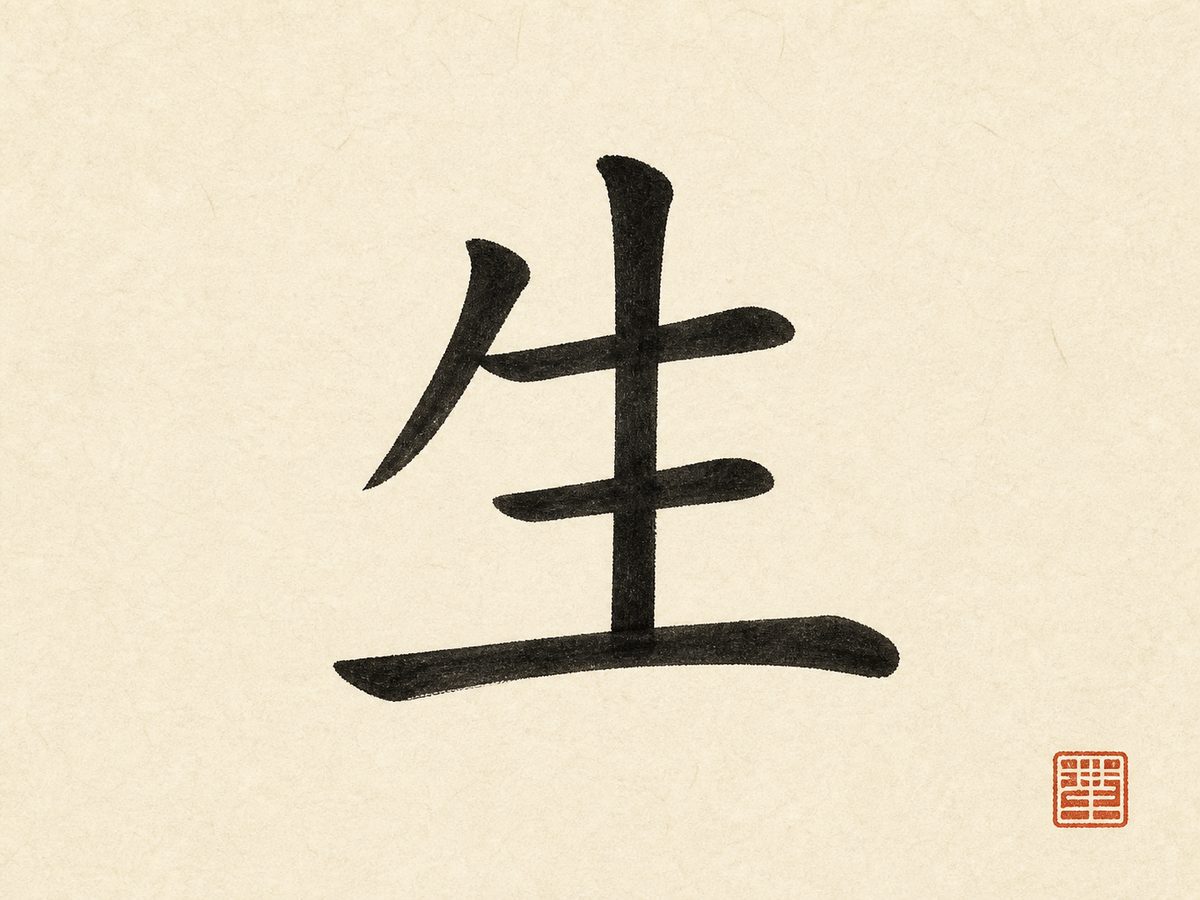
See 生 in seal, brush & cursive Try it
How it's written
生 is only five strokes, and it is one of those characters you can still read as the picture it started as. At the bottom is a single horizontal line, the ground. Rising through it is 屮, the old sign for a young shoot, its stem pushing up with a leaf splitting off to one side. Put them together and you have the whole idea in a single stroke of insight: a plant breaking the surface of the earth, which is to say, life beginning. It is written identically in simplified and traditional Chinese, so there is only one form to learn, and its five easy strokes make it one of the very first characters a student ever writes.
What it means
生 (shēng) is the great all-purpose word for life and living, and it is greedy in a way English splits across several words. It means to live and to be alive; it means to be born and to give birth; it means to grow; and it means to produce or bring into being. The thread joining them is the sprout: everything 生 does is something coming into existence and pushing upward.
From that core it fans out in directions English would never guess. Because a living thing is fresh and unprocessed, 生 also means raw and uncooked, the opposite of "done," which is why the pair shēng versus shú (cooked, ripe, familiar) is one of the first a cook or a student meets. And because what is new is also unfamiliar, 生 reaches on to mean strange or unknown: a stranger is a "raw" person, a word you have never met is a "raw" word. Life, freshness, rawness, strangeness, all carried by the one character.
- 生命 life (a living thing's existence)
- 生活 life, living, daily life
- 人生 (human) life; one's life
- 出生 to be born
- 生日 birthday (literally 'birth day')
- 学生 student (literally 'study-growing one')
- 先生 mister; sir; husband; teacher (literally 'born earlier')
- 医生 doctor (literally 'healing one')
- 生肖 the Chinese zodiac (one's birth-year animal)
- 陌生 unfamiliar, strange
Idioms
- 生生不息“life begetting life without cease”the endless cycle of life, growth, and renewal. (《易经·系辞》: 生生之谓易)
- 出生入死“out of life and into death”to brave mortal danger; to go through thick and thin. (《老子》(道德经) ch. 50)
- 置之死地而后生“place them on death ground, and only then do they live”cornered with no retreat, people fight hardest to survive. (《孙子兵法》(The Art of War))
- 起死回生“raise the dead back to life”to bring back from the brink; a miraculous recovery or turnaround.
- 生龙活虎“a living dragon and a lively tiger”bursting with energy and vigor.
Right vs wrong forms
| Form | Type | Note |
|---|---|---|
| 生 | simplified ✓ | The standard form everywhere, identical in simplified and traditional Chinese: five strokes, a sprout rising through the ground. It is its own radical and was never simplified, so there is only one form to learn. |
| 生 vs 牛 (ox) | wrong | Not a variant, but the look-alike to avoid. 生 (life, five strokes) sits one horizontal stroke away from 牛 (niú, 'ox,' four strokes). Keep the strokes evenly spaced and all present so 生 stays unmistakably itself. |
| 生 (mirrored or rotated) | mirrored | Not a variant. A flipped or rotated 生 from a low-resolution stencil reads as an error to anyone literate. Check against a dictionary at full size before inking. |
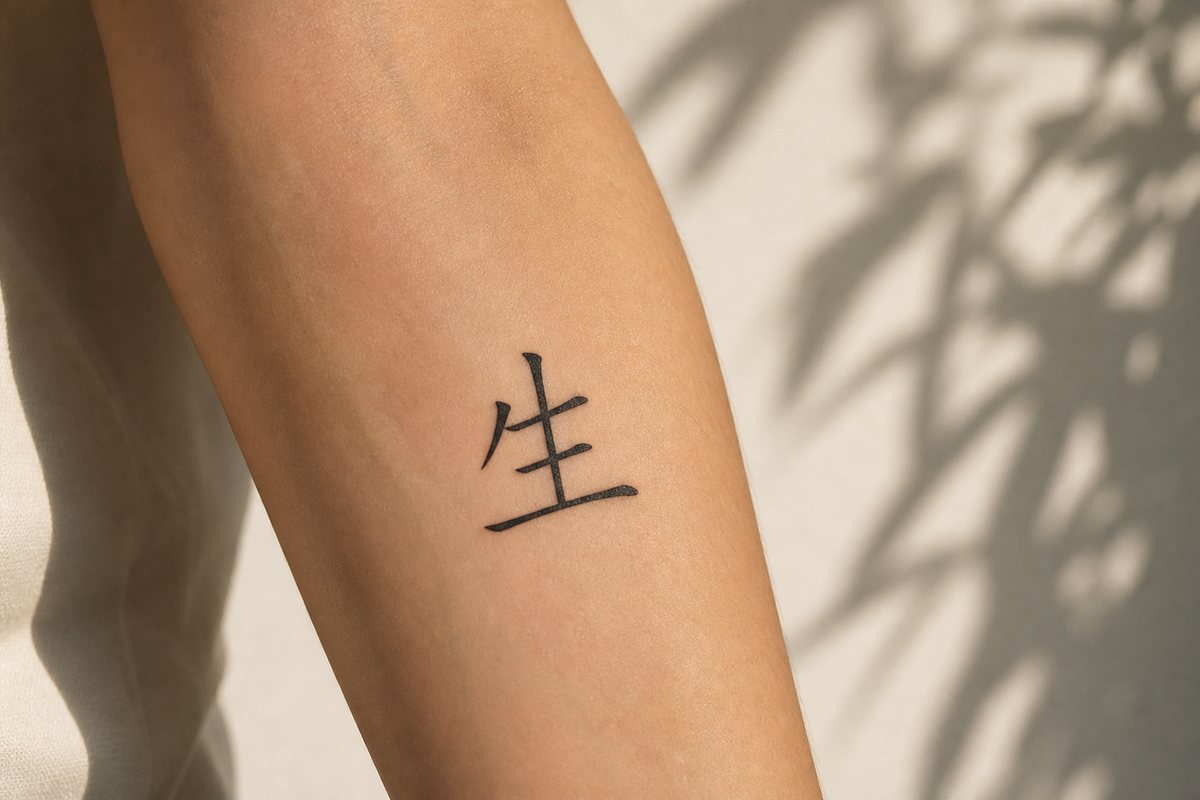
For a tattoo
生 is a clean, resonant tattoo, five strokes that mean, at the simplest, "life" and "to live." It has a few things going for it as body art: it is short and balanced, it is identical in simplified and traditional Chinese so there is no version to weigh, and its meaning is broad and positive without tipping into the saccharine, "life" in the full sense of birth, growth, and being alive.
Some people pair it with sǐ (death) for a life-and-death set, or set it inside a longer phrase like yìshēng, "a whole life." Two small things to know. To a Chinese eye 生 also carries "raw" and "unfamiliar," so on its own it reads mainly as "life," but a reader may feel those other tones underneath. And its five strokes want clean spacing to stay crisp, since a cramped 生 can drift toward look-alikes such as 牛 (ox). As always, print it at full size and have someone who reads Chinese confirm the design before the needle.
Before you commit to any character, the eight ways a Chinese tattoo goes wrong covers the failure modes that are not specific to this one, including the stroke-density arithmetic that decides whether a traditional form survives at small sizes.
Life in life today
The word hiding inside a hundred others
Once you know 生, you start seeing it everywhere, because Chinese builds a huge share of its daily vocabulary out of it. A birthday is a "birth day," shēngrì. A student, a xuésheng, is a "study-growing one"; a doctor, a yīshēng, is a "healing one." Even the plain word for "mister," xiānsheng, also used for "sir," "teacher," and "husband," is literally "born earlier," an elder-first courtesy baked right into the language. Life, in Chinese, is not a rare or lofty word. It is a syllable you say a hundred times a day without noticing.
Raw, and the art of not being it
Because 生 means raw, it runs quietly through Chinese food and its judgments. Something shēng is uncooked, unripe, or green in the sense of inexperienced; its opposite, shú, is cooked, ripe, and also "familiar." So the same axis that divides raw fish from cooked also divides strangers from friends, and to warm from shēng to shú with a person, from "raw" to "cooked," is exactly how Chinese describes a friendship settling in. You can hear the sprout underneath it: what is new is raw, and what is raw has not yet been lived with.
The birth in your zodiac
The character sits at the center of the thing most outsiders meet first about Chinese culture, the zodiac. The Chinese name for it is shēngxiào (生肖), the "birth likeness," the animal fixed to the year you were born, and the 生 in it is precisely this one, the sign of your birth. It reaches deeper into the cosmology too, where the Five Elements produce one another in a cycle called xiāngshēng, "mutual generation," and the verb in it is this 生: wood feeds fire, fire makes earth, on around the ring. Whenever a Chinese astrologer says one element "produces" another, that is 生 doing the work.
Curious what your own name becomes in Chinese, matched to its sound and a good
meaning? Our Chinese name generator builds one for you.
Where the character comes from
The oldest dictionary saw the picture clearly. The Shuowen Jiezi, from around the year 100, defines 生 as jìn, "to come forth," and explains the graph in plain terms: it "pictures grass and trees growing up out of the earth," the lower part the soil, the upper part the emergence. The oracle-bone forms from a thousand years before that show exactly the same thing, a little sprout over a line, which makes 生 one of those characters whose meaning you can still see at a glance three thousand years on.
That farmer's-eye root gave Chinese one of its deepest ideas about the universe. In the Book of Changes, the Yijing, sits the line shēng shēng zhī wèi yì, "life begetting life is what Change means," which makes endless generation the very definition of the cosmos: reality is not a collection of things but a ceaseless bringing-forth, life producing more life without stop. Its everyday descendant is the phrase shēng shēng bù xī, "life multiplying without cease," still used for anything that renews itself forever, from a family line to a forest.
History & roots
Life and death, the pair that runs everything
生 has a shadow it is almost never written far from: death (死). Together, shēng-sǐ, "life-death," is one of the fundamental pairs of Chinese thought, and the pairing is unusually clear-eyed. A friendship deep enough to die for is a "life-death friendship." To brave terrible danger is chū shēng rù sǐ, "out of life and into death," a phrase from the Daodejing. And the strategist Sun Tzu turned the pair into tactics: throw soldiers onto "death ground," where retreat is impossible, and they will fight their way back to life. Life, in the Chinese view, is defined by the death pressing against the other side of it.
The wheel of births
Buddhism, arriving from India, gave 生 a second and vaster frame. In the Buddhist scheme a being does not live once but is reborn again and again, life after life, turning on the wheel of samsara until it can finally step off. This is why Chinese speaks so naturally of a jīnshēng, "this life," a láishēng, "the next life," and a qiánshēng, "a former life": a love said to be fated three lifetimes back, a debt carried over from a previous birth, a kindness to be repaid in the one to come. And it framed suffering itself as a sequence that opens with 生: birth, aging, sickness, and death, the four sorrows every life is born into.
Nourishing the sprout
If life is a growing thing, then it can be tended, and out of that grew one of China's most enduring pursuits: yǎngshēng, "nourishing life," the whole tradition of diet, breathing, herbs, tai chi, and rest aimed at living long and living well. It is why a Chinese grandmother has firm opinions about which foods are "heating" and when you ought to be asleep. It shades straight into the old Daoist dream of chángshēng, "long life," and its impossible cousin, living forever without aging, the immortality that emperors once sent fleets to find. Sipping a herbal soup or chasing an elixir, you are tending the same sprout.
Questions people ask
What is the Chinese symbol for life?
It is 生 (shēng), a five-stroke character that began as a pictograph of a young plant sprouting up out of the ground. It means to be born, to grow, to live, and life itself, and it also stretches to mean raw or uncooked and unfamiliar. It is written identically in simplified and traditional Chinese.
What does the Chinese character for life mean?
生 (shēng) covers a wide range: to live, to be born, to grow, and to produce. Because a living thing is fresh, it also means raw or uncooked; because the new is unfamiliar, it also means strange. It appears in everyday words like 生日 (birthday), 学生 (student), 先生 ('mister,' literally 'born earlier'), and 生肖 (the zodiac).
Is the Chinese symbol for life a good tattoo?
Yes. 生 is short and balanced at five strokes, identical in simplified and traditional Chinese so there is no version to choose, and broadly positive, meaning life in the full sense of birth and growth. Note that it also carries 'raw' and 'unfamiliar' to a Chinese eye, and keep the strokes well spaced so it does not drift toward the look-alike 牛 (ox). Always verify at full size.
What does sheng sheng bu xi mean?
Shēng shēng bù xī (生生不息) means 'life begetting life without cease,' the endless cycle of growth and renewal. It descends from a line in the Book of Changes (Yijing), 生生之谓易, 'life begetting life is what Change means,' which makes ceaseless generation the very definition of the cosmos.
Where does the character 生 come from?
The Shuowen Jiezi (around the year 100) explains 生 as a picture of 'grass and trees growing up out of the earth,' the lower part the soil and the upper part the sprout emerging. The oracle-bone forms show the same shoot-over-ground shape, which is the source of all its meanings: to be born, to grow, and to live.
Sources
Make Life your own
See 生 in calligraphy
From ancient seal script to flowing cursive. Pick a look before a tattoo or a card.
 Name
Name Get a Chinese name
A name matched to the sound of yours, with a meaning that fits.
Start yours Chinese Almanac
 Try the Chinese Gender Predictor
A different corner of Chinese culture: the old Qing-palace birth chart, worked out from your lunar birth date, with the math shown and its coin-flip odds honestly weighed.
Open the toolBy Julian 祝君瑜, sourced from the classics and from modern life, updated 2026-07-23