Tied wishes

The Chinese knot: what each knot’s name means, and where it hangs

A Chinese knot is a decorative knot tied from a single cord, usually red silk, in a symmetrical pattern, and hung at the door, on a gift or at a wedding for luck. Its meaning is in its name, because every knot is named after a wish: the endless knot for things that last, the same-heart knot for a marriage, the ruyi knot for "as you wish," the ping’an knot for "safe and well."

The name "Chinese knot" is younger than most of the people who buy one. It was given to the craft by a book published in Taipei in 1981. The knots themselves are old enough that Song dynasty households hung them over the door at New Year, and brides and grooms in twelfth-century Kaifeng walked to the wedding hall holding the two ends of one.

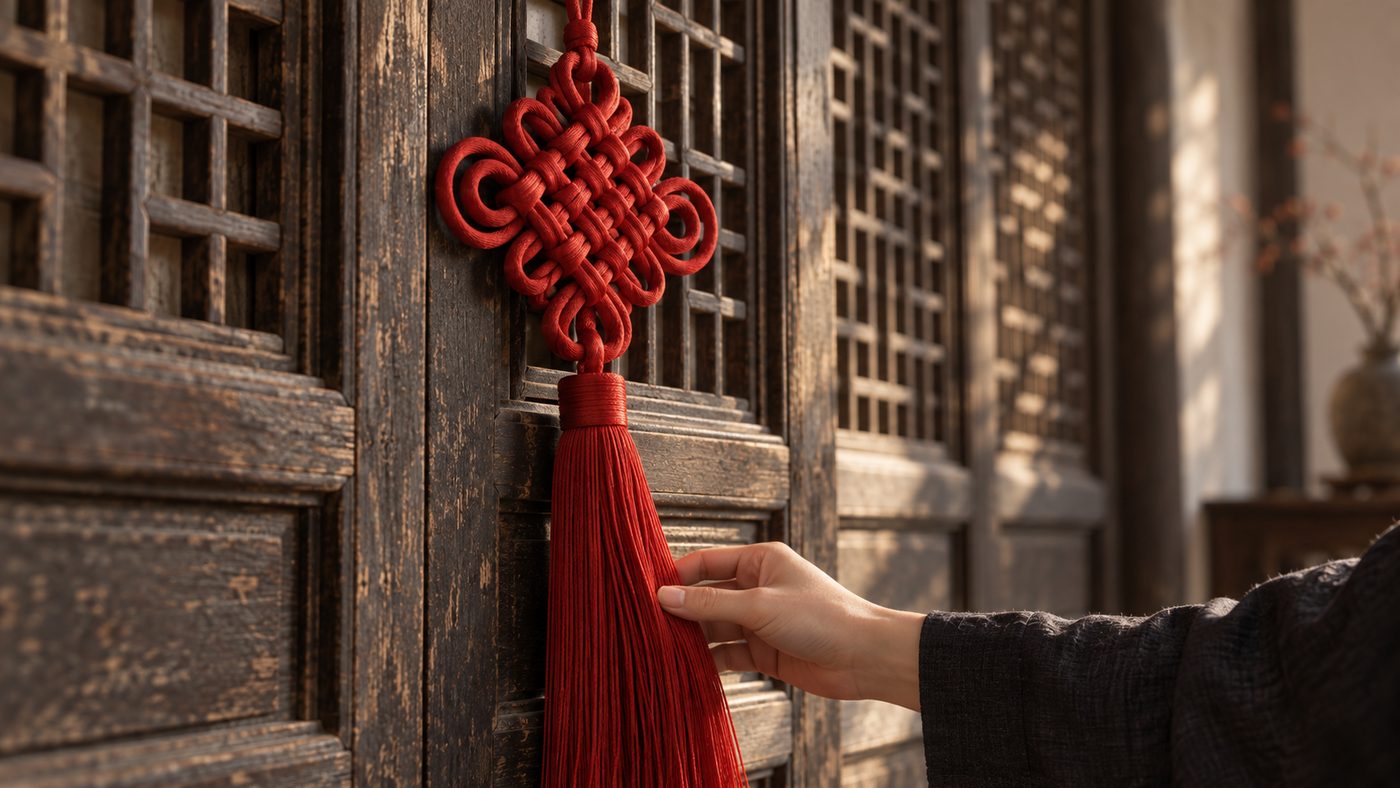
A large red endless knot with a long silk tassel hanging on an old wooden lattice door, a hand straightening the tassel in soft side light.
The endless knot, the one most New Year knots are built on. Illustration.

The knots and what their names wish

Common Chinese knots: the name of each knot, the wish its name carries, and where and when it is hung.
Knot Its name The wish Where it hangs
Endless knot pan chang, "coiled length" Things that last and run on without a break The big red knot at the door for New Year; the base of most large wall knots
Same-heart knot tong xin, "one heart" Two people of one mind Weddings and love tokens; tied into the wedding sash and the wedding cups in the Song
Auspicious knot ji xiang, "auspicious" Good luck in general Small hangings and gifts, all year
Ruyi knot ru yi, "as you wish" Everything going the way you want it Gifts and jewelry; it matches the New Year greeting "may all things go as you wish"
Ping’an knot ping an, "safe and well" Safety, especially on the road Rear-view mirrors, bags, anything that travels
Double-coin knot shuang qian, "two coins" Money, and good things in pairs Gifts and purses
Fang sheng fang sheng, two overlapping lozenges Two joined into one An old ornament shape, already on a knotter’s pattern list in the 1700s
Button knot pan kou, "coiled fastening" Less a wish than a fastening The knotted buttons on a qipao or a Chinese jacket

One honest note on the table. Most of these knot names are the modern craft’s own, settled when the knots were collected, drawn and taught from books from the 1980s on. The wish-words themselves are centuries older, and so are the endless knot, the same-heart knot and the fang sheng, which turn up by name in the old texts below.

The name is the wish

English names a knot for what it does: a reef knot, a slipknot, a hitch. Chinese names a decorative knot for what it hopes. Ruyi means "as you wish," and it is half of the most ordinary New Year greeting there is, wanshi ruyi, "may all things go as you wish." Ping’an is "safe and well," the thing you say to someone setting off on a journey, which is why the ping’an knot so often swings from a car’s mirror. Jixiang is plain "auspicious," the word an almanac uses of a good day, and our page of Chinese good luck symbols sorts it from the other Chinese words for luck. Buy a knot by its name and you have bought a sentence.

English also ties the knot when it marries, and here Chinese got there first and meant it more literally. The ordinary word for marrying, jiehun, begins with the verb for tying a knot. An older phrase for a married couple, "tied-hair husband and wife," goes back to the tying up of the hair at coming of age, and opens a parting poem attributed to the Han envoy Su Wu, preserved in the sixth-century anthology New Songs from a Jade Terrace. The wedding blessing yong jie tong xin, "forever tied in one heart," is still written on banners and engraved in rings, as our page on the Chinese symbol for forever tells.

If you want the wish without the knot, our calligraphy generator will write ruyi in a proper brush hand for a card to go with it.

The endless knot

The big square red knot that hangs on doors at New Year, diamond-shaped, with loops round its edges and a tassel beneath, is almost always built on the pan chang, the endless knot. It came into Chinese decoration with Buddhism. The Palace Museum in Beijing lists it as the last of the eight treasures set before the Buddha on the altar, after the wheel, the conch, the parasol, the canopy, the lotus, the vase and the golden fish, and glosses it as "turning round and running through, with everything made clear." Because the eight treasures meant good fortune, the museum adds, they became one of the main motifs of Chinese craft, on porcelain, lacquer and embroidery as well as in cord.

The name is written two ways, and the difference is a small joke the tradition has kept. In the museum’s entry it is the "coiled intestine," a line with no beginning and no end folded back on itself. In ordinary use it is the "coiled length," with chang read as "long," so a knot that never ends is also a wish that things go on for a long time: a marriage, a family, a business, a life. Hang it for any of them.

The same-heart knot, and the wedding

The knot for love is the same-heart knot, tong xin jie, two cords worked into one, and it has the best paper trail of any knot in China. In the sixth century Xiao Yan, Emperor Wu of Liang, wrote a love poem, collected in New Songs from a Jade Terrace, in which the speaker dreams that the paired silk sash at the waist has turned into a same-heart knot. Six hundred years later it was a fixed part of the wedding.

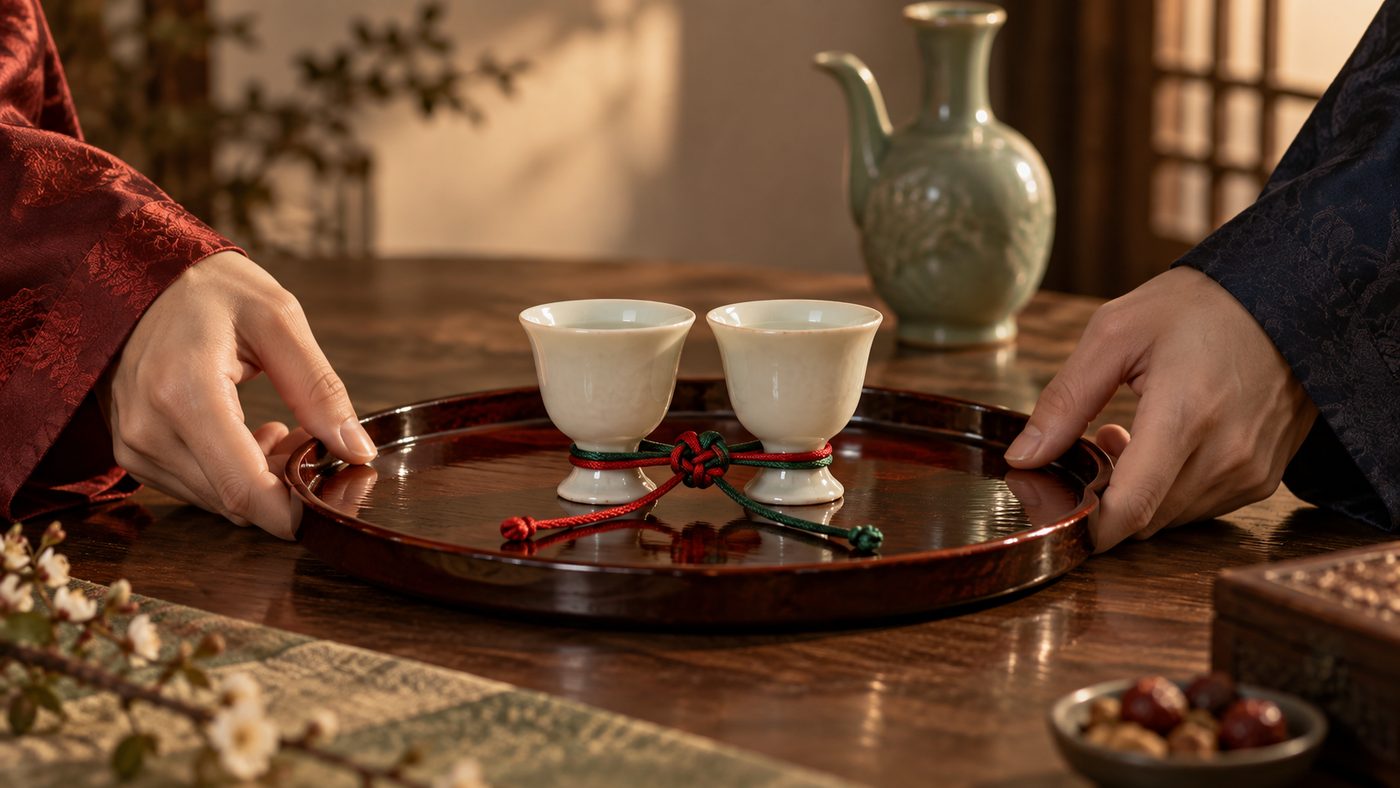
In Kaifeng, according to Meng Yuanlao’s memoir of the Northern Song capital, the two families each brought a length of colored silk and tied them together into a single same-heart knot, which was called the "pulling sash." The groom hung his end on the ceremonial tablet in his hands, the bride took hers over her hand, and he walked out backward, leading her. In Hangzhou a century later, Wu Zimu adds two touches: the groom’s knot was a paired same-heart knot of red and green silk, and back in the bridal chamber the two wedding cups were tied together at the base with a red-and-green same-heart knot before the couple drank. Then one cup was laid face up and one face down under the bed, which Wu says was done for great luck.

Two small porcelain wine cups on a lacquer tray, their feet tied together with a red and green silk knot, two hands at the edges of the tray about to lift them.
Two cups, one knot: the Song wedding drink. Illustration.

The red-and-green is worth noticing, because a modern wedding has lost the green and kept the red. At a modern wedding the same-heart knot hangs beside the doubled joy character on the doors and the gifts, and our page on double happiness covers the character. The knot says the same thing with a cord instead of ink: two, made into one, and not coming undone.

At New Year, and at the Dragon Boat Festival

The New Year knot began as protection. In the twelfth month in Southern Song Hangzhou, Wu Zimu records, the city’s doctors sent their regular households a sachet of spiced tusu wine and knots tied from thread of five colors, some in the shape of four golden fish in a same-heart knot, others called the "hundred things lucky" knot. The families hung them on the lintel over the door to ward off evil influences, in the same month the shops were selling the new door gods. The red knot hanging on a front door at New Year is doing that job still, and it goes up and comes down with the rest of the Chinese New Year decorations.

The fifth-month festival kept a cousin of the custom. The Jingchu Suishiji, a sixth-century calendar of customs, has five-colored silk tied around the arm at the Dragon Boat Festival, called "wards off weapons" and meant to keep plague away, and children still wear it on the wrist. That thread is a tie rather than a decorative knot, and it belongs to a different family from the single red string of fate, which is about marriage. All three are the same idea at bottom: something tied on, in color, to keep something out.

What the colors mean

Red is the real code. It is the color of joy, weddings and New Year, and almost every knot sold for either is red, usually with some gold. Past that, be skeptical. The charts that assign pink to love, blue to career and green to health are shop copy, and no old source supports them.

The old attitude to color is on record, and it is refreshingly practical. In chapter 35 of Dream of the Red Chamber, written in the mid-eighteenth century, the maid Oriole comes to tie knotted nets for the young master Baoyu, for his fans, his scent pendants and his sash. Asked about a bright red sash, she says it needs black netting to look right, or stone-blue to hold the color down; pale pine-pollen yellow goes with peach pink; her own favorites are onion green and willow yellow. When her mistress Baochai suggests netting Baoyu’s jade instead, she rules out mixed colors, red because it clashes, yellow because it disappears and black because it is too dark, and settles on gold thread twisted with black. Nobody mentions luck. Color was taste.

The one color with a firm meaning is white, which is the color of mourning. A white knot is not unlucky to own, but it is the wrong thing to give at a wedding or New Year. A black knot carries no such weight: in the novel it is simply the cord that makes red look redder.

Where the name "Chinese knot" comes from

Knots are older in China than writing, or so the Great Commentary to the Book of Changes says: in high antiquity people were governed by knotted cords, and later sages replaced the cords with written records. That is a statement about record-keeping rather than decoration, but it is the reason Chinese writers have always treated a knot as something that carries meaning.

In the novel, Oriole’s knots are not called Chinese knots, or knots at all. They are luozi, knotted nets, and she reels off the patterns she knows like a menu: the incense stick, the sky-facing stool, the elephant’s-eye squares, the fang sheng, the linked rings, the plum blossom and the willow leaf. The one Baoyu picks is the pattern she tied the week before for his cousin, the "plum blossom with a gathered heart." That list is a fair picture of an eighteenth-century household craft, done by women and maids, named for everyday things.

The modern name comes from Taiwan. Chen Hsia-sheng, who worked at the National Palace Museum in Taipei, was introduced to knotting when her father-in-law, the calligrapher and deputy museum director Chuang Yen, asked an old museum craftsman, Wang Zhenkai, to teach her; he knew two knots, the button knot and the auspicious knot. She spent the next decades collecting knots from objects in the museum and in antique shops, and in 1981 published a book with the Echo publishing house that called the craft "Chinese knot," the name it has carried ever since, as the Taipei Commercial Times reported in 2023. She also corrected herself in print: a knot she had first dated to the Qing turned up in a photograph of a Tang tomb find, and she wrote another book to fix it.
Questions people ask

What does a Chinese knot symbolize? +

Whatever its name says. Each knot in the tradition is named after a wish: the endless knot (pan chang) for things that last, the same-heart knot (tong xin) for a couple of one mind, the ruyi knot for "as you wish", the ping’an knot for "safe and well", the double-coin knot for money. Tied in red, the color of joy, and hung at a door, on a gift or at a wedding, the knot is a wish you can hold. Older still, knots were protective: a Southern Song account of Hangzhou has families hanging knots of five-colored thread over the door at New Year to keep evil influences out.

What does a red Chinese knot mean? +

Red is the color of joy, celebration and luck in Chinese custom, the color of weddings and New Year, so a red knot is simply a happy one. The meaning of a particular knot comes from its pattern and its name rather than its color: a red endless knot wishes for things that last, a red same-heart knot for a marriage. Almost every knot sold for New Year or a wedding is red, often with a little gold.

What do the different colors of a Chinese knot mean? +

Less than the charts online suggest. Red is the real code, for joy and luck, with gold beside it. The color lists that give pink for love, blue for career or green for health are modern marketing with no old source behind them. In the eighteenth-century novel Dream of the Red Chamber, a maid who ties knots talks about color entirely as a matter of taste: a bright red sash needs black or stone-blue netting to hold its color, pale yellow goes with peach pink. White is the one color to avoid for a gift, because it is the color of mourning.

What is the Chinese knot for love and marriage? +

The same-heart knot, tong xin jie. A sixth-century poem by Emperor Wu of Liang has its speaker dream that a paired silk sash has turned into one. At Song dynasty weddings the two families each brought a length of colored silk, tied them into a single same-heart knot, and the bride and groom held the two ends as they walked to the hall; in Hangzhou the two wedding cups were tied together at the base with a red-and-green same-heart knot before the couple drank. The wedding wish yong jie tong xin, "forever tied in one heart", still names it.

Which Chinese knot is for good luck? +

Several, by name. The auspicious knot, ji xiang jie, is named for luck in general; the ruyi knot for things going as you wish; the ping’an knot for safety. For New Year the usual choice is the big red endless knot, pan chang, whose name wishes for things that last. In the Southern Song record of Hangzhou the New Year knots were called the "hundred things lucky" knot and the "four golden fish same-heart" knot.

Is the Chinese knot the same as the endless knot? +

The endless knot is one Chinese knot, and the most important. It is pan chang, one of the eight auspicious treasures of Buddhism set before the Buddha, which the Palace Museum in Beijing glosses as turning round and running through, with everything made clear. Many large decorative Chinese knots are built on it, but "Chinese knot" is the name of the whole craft, which includes dozens of other knots.

Where should you hang a Chinese knot? +

At the front door or in the entrance for New Year, where the old Hangzhou households hung theirs on the lintel; on a wall of the main room; at a wedding, on the doors and the gifts; from a rear-view mirror for a safe journey; on a gift for anyone. There is no fixed rule about height or direction. The New Year knots traditionally come down with the rest of the decorations after the Lantern Festival, though many families leave a good one up all year.

Does a Chinese knot protect you? +

That was one of its first jobs. In the Southern Song, doctors sent their regular households knots of five-colored thread in the last month of the year, and the families hung them above the door to ward off evil influences. At the Dragon Boat Festival, a sixth-century calendar of customs has five-colored silk tied on the arm, called "wards off weapons", to keep plague away. Whether a knot protects anyone is a matter of belief; what is certain is that people have been tying them for exactly that reason since at least the twelfth century.

Sources and further reading

Keep going

Stay in the loop.

Chinese mythology, the zodiac, and the meaning behind names and symbols, rooted in the classics and read back to you. No spam. Unsubscribe anytime.