Chinese Symbol
Chinese Symbol for Protection: Meaning, Origin, and What to Wear
The Chinese symbol for protection is 护 (hù, said like "who"), a hand standing at a door. It is the character in the Chinese word for amulet, and it protects two different ways depending on which form you write: the modern one guards with a hand, the classical one with words. The oldest picture of protection in Chinese, though, is not this character at all. It is a grown-up carrying a child on their back.
- Strokes
- 7
- Radical
- 扌 (hand; Kangxi 64), the narrow component on the left
- Formation
- Phono-semantic compound (a hand for the meaning, a door for the sound)
Trace 护 yourself, or watch it drawn
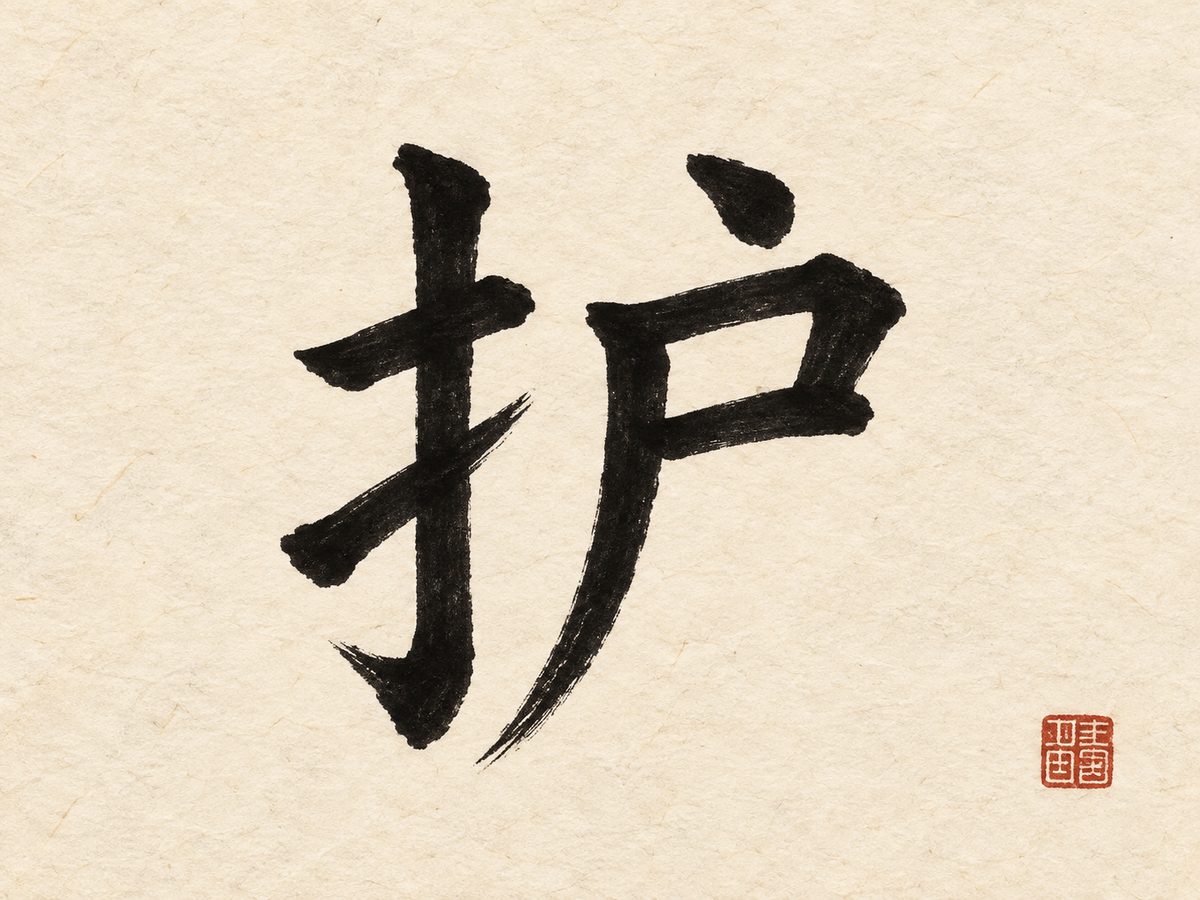
See 护 in seal, brush & cursive Try it
How it's written
护 is seven strokes in two side-by-side parts. On the left stands the hand radical, 扌, three quick strokes (a short horizontal, a hooked vertical, a rising tick) that mark hundreds of Chinese verbs done with the hands: push, pull, hold, hit, protect. On the right is 户 (hù), "door," a single door-leaf drawn as a dot over a flat roofline with one long stroke sweeping down to the left. The door gives the character its sound, and by happy accident its sense: a hand at the door, which is a fair picture of what protecting is.
That picture is modern. The traditional form, 護, is twenty strokes and protects in a completely different way. On its left is 言 (yán), "speech," the radical of words, promises, and arguments; on its right is a component read huò, a hand grasping a bird. When the mainland reformed the script in the mid-twentieth century, it replaced the whole thing with the far simpler hand-and-door. So a reader in Beijing writes protection as a hand at a door, and a reader in Taipei or Hong Kong writes it as words beside a grasping hand.
Two near-misses to know when writing it: swap the door for 广, the "shelter" radical, and you have written kuò, "to expand"; swap the hand for water and you have 沪, which is the one-character abbreviation for Shanghai.
What it means
护 (hù) is "to protect," "to guard," "to shield," and it is a verb before it is a symbol. The everyday word is bǎohù, "protect," the one on signs about the environment and the one a parent uses about a child. Shǒuhù, "guard and protect," is warmer and more personal: a guardian angel is a shǒuhù shén, a "guarding-protecting god." Bìhù is shelter, the protection of a roof or a powerful patron. And hùshēnfú, "protect-body talisman," is the amulet, the thing most people searching this page are really after.
The catch, and it is worth knowing before you put the character on anything, is that a lone 护 leans toward care rather than magic. A nurse is a hùshi, a "protecting scholar"; nursing is hùlǐ; skincare is hùfū, "protecting the skin"; and a passport is a hùzhào, a "protection paper," so called because the state promises to look after you while you carry it. The character is everywhere in modern Chinese, and almost always in the plain sense of looking after something.
English uses one word where Chinese uses at least five, and each pulls a different direction.
| Word | Reading | What it means | Where you meet it |
|---|---|---|---|
| 护 | hù | to protect, guard, shield; to care for | the amulet word (护身符), nurses, passports, "protect the environment" |
| 保 | bǎo | to keep safe, preserve, guarantee | bǎohù (protect), bǎoyòu (bless and protect), insurance, "keep them safe" |
| 守 | shǒu | to guard, keep watch, hold | guardian gods (守护神), the night watch, keeping a promise |
| 佑 | yòu | heaven's help; to bless and protect | prayers: "may heaven protect," bǎoyòu |
| 平安 | píng'ān | safe and sound, at peace | what the charm actually says: peace buckles, temple slips, "travel safe" |
If you want the word for the act of protecting, it is hù. If you want what a Chinese person actually wears or hangs up for protection, it is almost never the verb. It is the wish, píng'ān, "safe and sound," which has its own page here.
- 保护 to protect (the everyday verb: protect the environment, protect a child)
- 护身符 amulet, 'body-protecting talisman'
- 守护 to guard and protect; 守护神, a guardian spirit
- 护士 nurse (literally 'protecting scholar')
- 护照 passport, a 'protection paper'
- 护法 dharma protector; the guardian figures at a temple gate
- 庇护 shelter, refuge; asylum
- 护送 to escort
- 护肤 skincare, 'protecting the skin'
- 护城河 a city moat, 'city-protecting river'; also a business's competitive moat
- 保佑 to bless and protect (of a god or heaven)
- 平安 safe and sound; the wish written on protective charms
Idioms
- 保家卫国“protect the family, defend the country”the soldier's duty in one breath; the phrase on recruitment posters.
- 守望相助“keep watch and help one another”neighbors looking out for each other; mutual aid. (Mencius, Teng Wen Gong I: 出入相友,守望相助)
- 明哲保身“the wise and clear-sighted keep themselves safe”to stay out of trouble; now usually a mild reproach for someone who looks after number one. (Book of Songs, Greater Odes, Zheng Min: 既明且哲,以保其身)
- 官官相护“officials protect officials”the powerful shielding each other from consequences; cronyism.
- 逢凶化吉“meet misfortune, turn it to good”the wish a protective charm makes: that danger, when it comes, turns out well.
Right vs wrong forms
| Form | Type | Note |
|---|---|---|
| 护 | simplified ✓ | The standard mainland form: seven strokes, the hand radical beside a door. What a mainland Chinese reader writes and expects. |
| 護 | traditional ✓ | The classical and Taiwan / Hong Kong form: twenty strokes, the speech radical beside a hand grasping a bird. The Shuowen's form, 'to rescue and watch over.' Denser, and carries the older idea of protecting with words. |
| 扩 (广 instead of 户) | wrong | Not a variant, a different character: 扩 (kuò) means 'to expand.' A stencil that flattens the door's dot-and-sweep into the shelter radical writes it by accident. |
| 沪 (water instead of hand) | wrong | Not a variant: 沪 (hù) is the one-character abbreviation for Shanghai, seen on license plates. Same sound, same door, wrong radical. |
| 护 (mirrored or rotated) | mirrored | Not a variant. A flipped character puts the door on the left and reads as an error to anyone literate. Check against a dictionary glyph at full size before inking. |
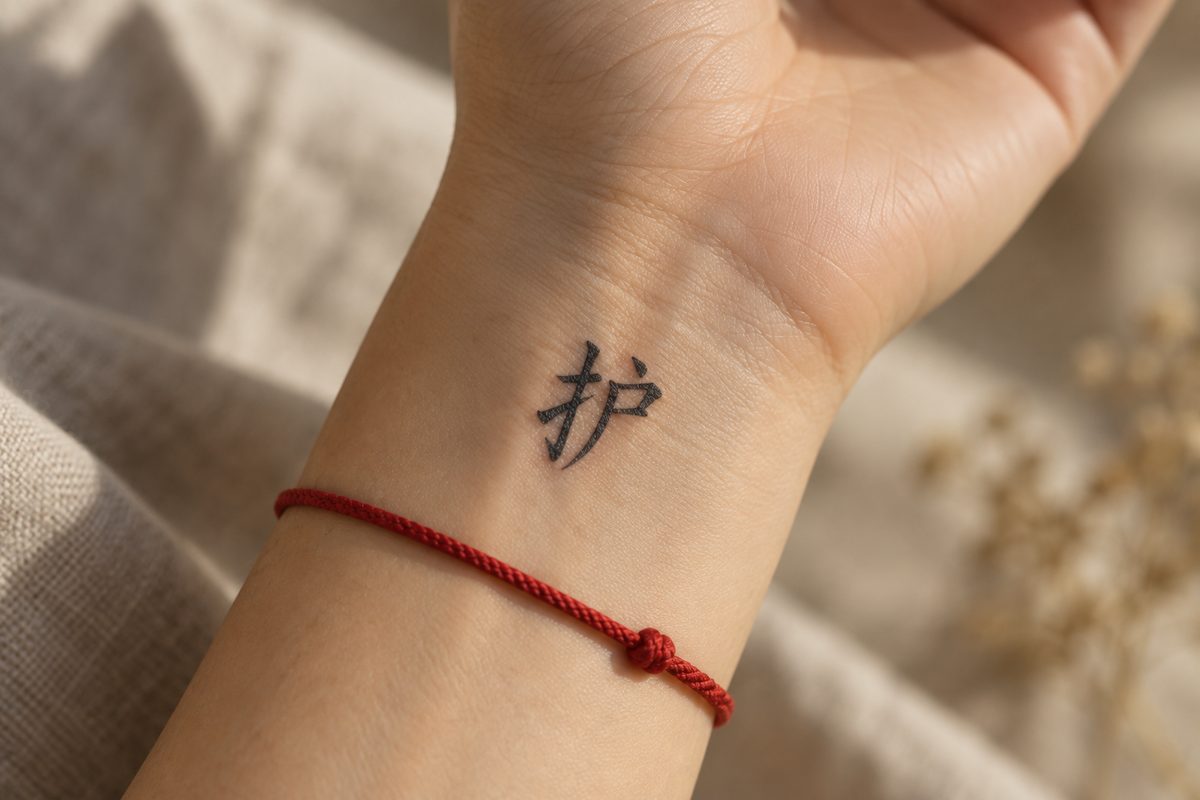
For a tattoo
护 is a clean, quick tattoo, seven strokes with an easy left-right balance, and a Chinese reader will read it correctly as "protect." Whether it is what you mean is a separate question, and it is the one worth asking first.
A lone 护 reads as the verb, and its most common company is nurses, skincare, and passports, so on skin it can look like the first half of a word that never got finished. If the idea is "I am protected" or "keep me safe," the tradition's own choice is píng'ān, "safe and sound," the two characters on every temple slip and jade buckle, and a design that any Chinese speaker will understand at a glance. If the idea is "I protect them," a parent's or a soldier's tattoo, 护 works, and the traditional 護 with its speech radical carries the older meaning of protecting by standing up for someone. If the idea is a guardian, shǒuhù, "guard and protect," is the two-character phrase pop culture uses for exactly that.
Whichever you choose, watch the door. The right-hand 户 must have its dot on top and its long sweep to the left; a stencil that flattens it into 广 has written "expand" instead. Print the design at full size and have someone who reads Chinese confirm it before it goes on; our guide to Chinese tattoo symbols covers the checks.
Before you commit to any character, the eight ways a Chinese tattoo goes wrong covers the failure modes that are not specific to this one, including the stroke-density arithmetic that decides whether a traditional form survives at small sizes.
Protection in life today
The most ordinary word for looking after things
Most of the time, the character for protection is doing quiet, unmagical work. A nurse is a hùshi, and the nurses' station in every Chinese hospital has the character on the sign. Skincare is hùfū, and the shelves of any Chinese pharmacy are labeled with it. Environmental protection is huánbǎo, short for huánjìng bǎohù, the word on every recycling bin. A passport is a hùzhào, a "protection paper," one of the nicer etymologies in the language: the document is the state's promise to look after you abroad. And the moat around an old walled city is a hùchénghé, a "city-protecting river," which is why the ring road around a Chinese city center so often has a moat's name.
Guardians, on screen and off
The warmer word, shǒuhù, "guard and protect," is the one pop culture reaches for. A guardian, of a person or a city or a secret, is a shǒuhùzhě, and a guardian spirit is a shǒuhù shén. Chinese song titles, drama titles, and cartoon titles use it the way English uses "guardian": to promise that somebody, somewhere, is watching over you. It is also the word Chinese fans use when they say they will "protect" a young singer or athlete from the internet, a usage that would have puzzled the Han dictionary and makes perfect sense to anyone under thirty.
What people actually buy for protection
Walk into a temple shop or a jade market and you will not find the character for "protect" on much of anything. You will find the wish instead. The little folded paper slip from a temple, the hùshēnfú, is inscribed with a deity's name or a Daoist talismanic script and the two characters for "safe and sound." The plain jade ring worn at the throat is a píng'ān kòu, a "peace-and-safety buckle," the same wish carved in stone. The silver lock hung around a baby's neck is a "longevity lock," a padlock against early death. The red cord on a wrist is protection with no writing on it at all. Our page on Chinese good luck charms sorts the genuine tradition from the gift-shop rail, what a jade bracelet means decodes the carved motifs, and jade bracelets for protection traces why jade, of all materials, became the stone people wear to be kept safe.
Names
The protecting character itself is rare in names; nobody wants to be called Nurse. Its partners are everywhere. Bǎo, "keep safe," is a common syllable in given names (a boy named Bǎo is a boy his parents want kept), and ān, "peace," the second half of píng'ān, is a favorite name character for exactly the reason this page exists.
Curious what your own name could become in Chinese, chosen for its sound and its
good meaning together? Our Chinese name generator matches the sound
of your name to a real, well-omened character.
Where the character comes from
The Shuowen Jiezi, the first Chinese dictionary, compiled around the year 100, defines 護 in three characters: to rescue and to watch over. It files the character under the speech radical, with the grasping-bird component for the sound. That speech radical is the interesting part. The oldest written idea of protection in Chinese is not a shield or a wall but someone speaking up for you: the guardian who intercedes, the official who argues your case, the patron whose word keeps you safe. The dictionary's second sense, "to supervise," still lives in the word for an escort, hùsòng, and in the old military title for a commander who "oversaw" the troops of several states.
The Han dynasty character, then, protected with words. The hand at the door came later, as a popular simplification that the mainland made official in the mid-twentieth century, keeping the sound (户 is also read hù) and inventing a new picture. Both are in use; they simply tell different stories about what protecting is.
The really old picture belongs to the character's partner, 保 (bǎo), the first half of the everyday word for "protect." The Shuowen glosses 保 as "to nourish" and reads it as a person plus a component for trust. The twentieth-century paleographer Tang Lan, working from the oracle bones, showed that Xu Shen had guessed wrong: the earliest form, three thousand years old, is a drawing of an adult with a child slung on their back. To protect, in the oldest Chinese there is, is to carry a child. Every later sense of the character, to keep safe, to guarantee, to insure, grew out of that picture, and the Book of Documents already uses it that way when it tells a young prince to treat his people as if protecting an infant.
History & roots
The first bodyguards of the door
The oldest protection story in Chinese is about a doorway, and it is preserved by a skeptic. Wang Chong, a first-century philosopher who spent a long book called the Lunheng debunking ghosts, quotes a passage of the Classic of Mountains and Seas that is now lost from the surviving text. In the sea, the passage says, stands Mount Dushuo, and on it a peach tree whose branches twist for three thousand li; in the northeast of its branches is the Gate of Ghosts, through which the ten thousand ghosts come and go. Two spirits stand over the gate, Shentu and Yulü, who inspect the ghosts and seize any that do harm, bind them with a rope of reeds, and feed them to a tiger. So the Yellow Emperor, the text continues, made a ritual of it: carved figures of peach wood, the two spirits and the tiger painted on the door, a reed rope hung beside it to ward off evil.
That is the origin of the Chinese door god, and of a great deal else. Peach wood is still the wood for charms. The painted pair on the door were replaced, in a story a Ming novel tells, by two Tang generals, Qin Shubao and Yuchi Gong, who are the door gods most Chinese families paste up at New Year to this day, with the demon-queller Zhong Kui on single doors. Protection, in this tradition, is a job with a posting: somebody stands at the door.
Protection with an author
The Daoist talisman, the fú, is the other great protective object, and it protects in the way the traditional character does: with words. A fú is a document, brushed in red on yellow paper by an ordained priest in a script that is deliberately not ordinary writing, addressed to the spirit world the way a summons is addressed to a person. Its power comes from who wrote it, not from the paper, which is why the temple slip in a wallet carries a deity's name rather than a lucky shape. A charm is a thing; a fú is an instruction, issued by someone with the authority to issue it. The Shuowen's "to rescue and watch over," filed under the speech radical, is the same idea nineteen centuries earlier.
The guards at the temple gate
Walk into any Chinese Buddhist temple and the first hall you pass through belongs to the Four Heavenly Kings, one for each direction of the compass, enormous and scowling, each with a foot on a crushed demon. Behind them stands Weituo, the armored young general known in Chinese as the Honored Dharma Protector, and behind the Buddha's hall, very often, a red-faced Guan Yu, the general of the Three Kingdoms whom Chinese Buddhism enrolled as a guardian of monasteries. The word for all of them is hùfǎ, "protectors of the law," built on this character. Protection, again, is personnel: the tradition does not trust a building to guard itself.
The child on the back
The Book of Documents, the oldest collection of Chinese political speeches, has the Duke of Zhou instructing a young prince on how to govern a newly conquered people, and the line that stuck is the one about the infant: treat the people, he says, as if protecting a baby, and they will be well and at peace. The character is 保, the child-on-the-back, and the phrase became the tradition's picture of what a ruler owes the ruled. Mencius quotes it, Xunzi quotes it, and a thousand years of officials wrote it into their memorials. It is a strangely tender idea to find at the root of a word that now sells insurance, and it is the reason a Chinese reader, asked to draw "protection," is as likely to draw a parent carrying a child as a hand at a door.
Questions people ask
What is the Chinese symbol for protection?
The character is 护 (hù), 'to protect' or 'guard,' written as a hand beside a door; its traditional form 護 is a speech radical beside a grasping hand, which the first Chinese dictionary glossed as 'to rescue and watch over.' It is the character in hùshēnfú, the word for a protective amulet. Chinese also uses 保 (bǎo, keep safe), 守 (shǒu, guard), and 佑 (yòu, heaven's protection), and the wish written on most charms is 平安 (píng'ān), 'safe and sound.'
How do you say protection in Chinese?
The verb 'to protect' is bǎohù (保护); the character for 'protect' on its own is hù (护), pronounced like 'who' in a falling tone. 'Guard and protect' is shǒuhù, a guardian spirit is a shǒuhù shén, and a protective amulet is a hùshēnfú, literally a 'body-protecting talisman.'
Is the Chinese symbol for protection a good tattoo?
It is legible and clean, but a lone 护 reads as the verb 'protect,' whose everyday company is nurses, skincare, and passports. For 'keep me safe' the tradition's own choice is píng'ān (平安), 'safe and sound,' the two characters on every temple slip and jade peace buckle. For 'I protect them,' 护 or the traditional 護 works well. Either way, make sure the right-hand door 户 keeps its dot and long sweep, or it turns into 扩, 'expand.'
What Chinese symbol protects from evil?
No single character does the job; the tradition uses guardians and objects. Door gods pasted on the front door at New Year descend from Shentu and Yulü, the two spirits who, in a passage of the Classic of Mountains and Seas quoted by Wang Chong, seized harmful ghosts and fed them to a tiger. Peach wood, a reed rope, a Daoist talisman written by a priest, and the jade peace buckle carved with the wish 'safe and sound' are the traditional protective objects. The character on them, when there is one, is usually 平安 or a deity's name, not 护.
What is a Chinese protection charm called?
A hùshēnfú (护身符), a 'body-protecting talisman,' is the general word for any protective amulet. A píng'ān fú is the temple's paper slip wishing you safety, a píng'ān kòu is the flat jade ring worn at the throat, and a fú on its own means the Daoist written talisman, brushed by a priest, whose power comes from the office of the person who wrote it.
What is the difference between hu and bao in Chinese?
Both mean 'protect,' and together they make the everyday verb bǎohù. 护 (hù) is the act of protecting or caring for something, from guarding to nursing. 保 (bǎo) is keeping something safe, preserving it, or guaranteeing it, which is why it also appears in the words for insurance and warranty. Its oracle-bone form, three thousand years old, is a picture of an adult carrying a child on their back.
Sources
- 汉典 zdic: the entry for 护 (strokes, radical, structure)
- 汉典 zdic: the traditional 護 (senses, the Shuowen and Kangxi citations, compounds)
- 汉典 zdic: the entry for 保 (Tang Lan's oracle-bone reading, the child on the back; Shuowen 養也)
- Shuowen Jiezi, chapter 3, the speech radical: 護:救視也。从言蒦聲 (Wikisource)
- Shuowen Jiezi, chapter 8, the person radical: 保:養也 (Wikisource)
- Book of Documents, Announcement to the Prince of Kang: 若保赤子,惟民其康乂 (Wikisource)
- Wang Chong, Lunheng, chapter 65 on ghosts, quoting the Classic of Mountains and Seas on Shentu, Yulü, the peach tree and the tiger (Wikisource)
- Mencius, Teng Wen Gong I: 守望相助 (ctext.org)
- Door gods (Menshen): Shentu and Yulü, then Qin Shubao and Yuchi Gong from the Tang (Wikipedia)
- The Four Heavenly Kings and their hall in Chinese Buddhist temples (Wikipedia)
- Skanda / Weituo, the Honored Dharma Protector (Wikipedia)
- Fulu, the Daoist talismanic script (Wikipedia)
Make Protection your own
See 护 in calligraphy
From ancient seal script to flowing cursive. Pick a look before a tattoo or a card.
 Name
Get a Chinese name
A name matched to the sound of yours, with a meaning that fits.
Start yours Chinese Almanac
Try the Chinese Gender Predictor
A different corner of Chinese culture: the old Qing-palace birth chart, worked out from your lunar birth date, with the math shown and its coin-flip odds honestly weighed.
Open the toolBy Julian 祝君瑜, sourced from the classics and from modern life, updated 2026-09-22