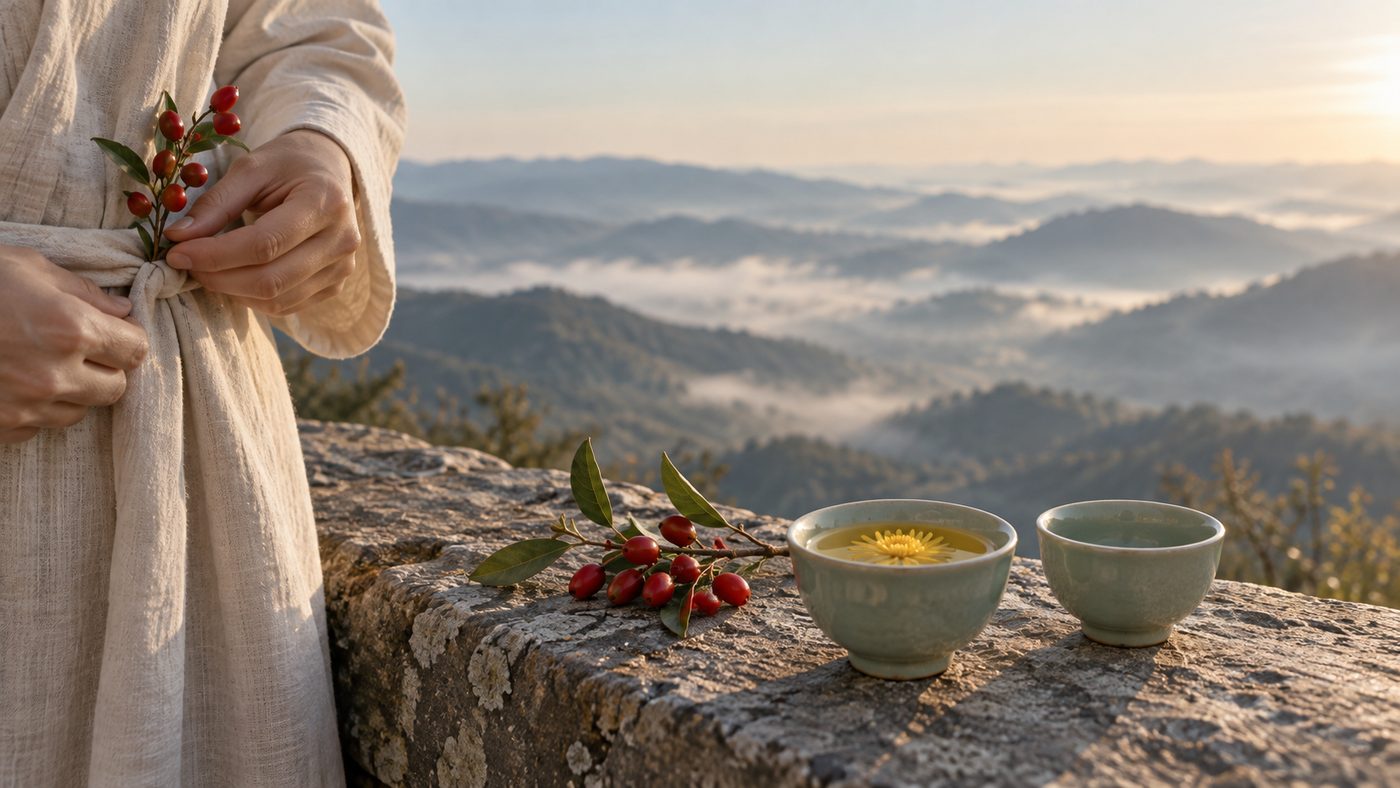
The three things people do on the day come from a single sentence in a sixth-century
collection of strange tales, the Xu Qixie Ji of Wu Jun. A scholar named Huan
Jing has spent years studying under a master of the occult arts, Fei Changfang, who one
day tells him: on the ninth of the ninth your household will meet with disaster. Leave
at once. Have everyone in the family sew a red bag, fill it with dogwood and tie it to
their arm; climb to high ground; drink chrysanthemum wine; and the calamity can be
avoided. Huan Jing does exactly that. The family spends the day on a mountain and comes
home in the evening to find the chickens, dogs, oxen and sheep all dead at once. "They
took your place," says the master. And the book ends the story with a sentence that is
practically a footnote: this, it says, is where the custom of climbing and drinking on
the ninth, and of women wearing dogwood bags, comes from.
It is a good story, and like most origin stories it is younger than the thing it
explains. The Xijing Zaji, which claims to record the Han palace of four
centuries earlier, has a former maid of Emperor Gaozu's consort list the pleasures of
the inner court, and among them: on the ninth of the ninth, wear dogwood, eat the
seasonal cake, drink chrysanthemum wine, and it makes people long-lived. Whether that
really is a memory of the second century BC or a later writer's idea of one, it puts
all three customs together well before anyone had heard of Huan Jing, and without any
disaster to avoid. The dogwood and the wine were there first. The story was fitted to
them.
The dogwood itself deserves a word, because English readers picture the wrong tree. It
is zhuyu, the Asiatic cornel, a shrub with narrow leaves and small oval red
berries that ripen in the ninth month, and it stinks, agreeably, of something medicinal.
That is the reason it was worn. The Fengtu Ji, a third-century gazetteer,
says people broke off a sprig on this day and put it in their hair "to drive off bad air
and hold off the first cold." The ninth month is when the weather turns and people start
falling ill; a strong-smelling herb on your person was the sensible precaution of an age
without much else. The red bag on the arm is the same idea in a sachet.
The wine is slower. The palace maid's account gives the recipe, and the recipe is the
nicest thing on this page: when the chrysanthemums open, pick stems, leaves and flowers
together, mix them into millet and start the ferment; it is ready the following ninth of
the ninth, when you drink it and set the next batch going. Every Double Ninth cup was
begun on the Double Ninth before, which means that for anyone keeping the custom, the
festival has never actually ended. It is one long year-old brew.