The Chinese year

The Hungry Ghost Festival: the month the gates stand open

The Hungry Ghost Festival falls on the fifteenth day of the seventh lunar month, which in 2027 is Monday, August 16. On that night the dead are fed. Families set out food, incense and cups of tea on the pavement outside the front door, burn paper money and paper clothes for their own dead, and leave a share for whoever else is passing, because the belief that gives the month its character is that for these thirty days the gates of the underworld stand open and everyone inside is out. In Chinese the day has two older names, Zhongyuan and Yulan, which belong to two different religions and describe two different things happening on the same night. The English name, and the empty seats in the front row at the show, belong to a third thing that grew over both. This page takes the three in order.

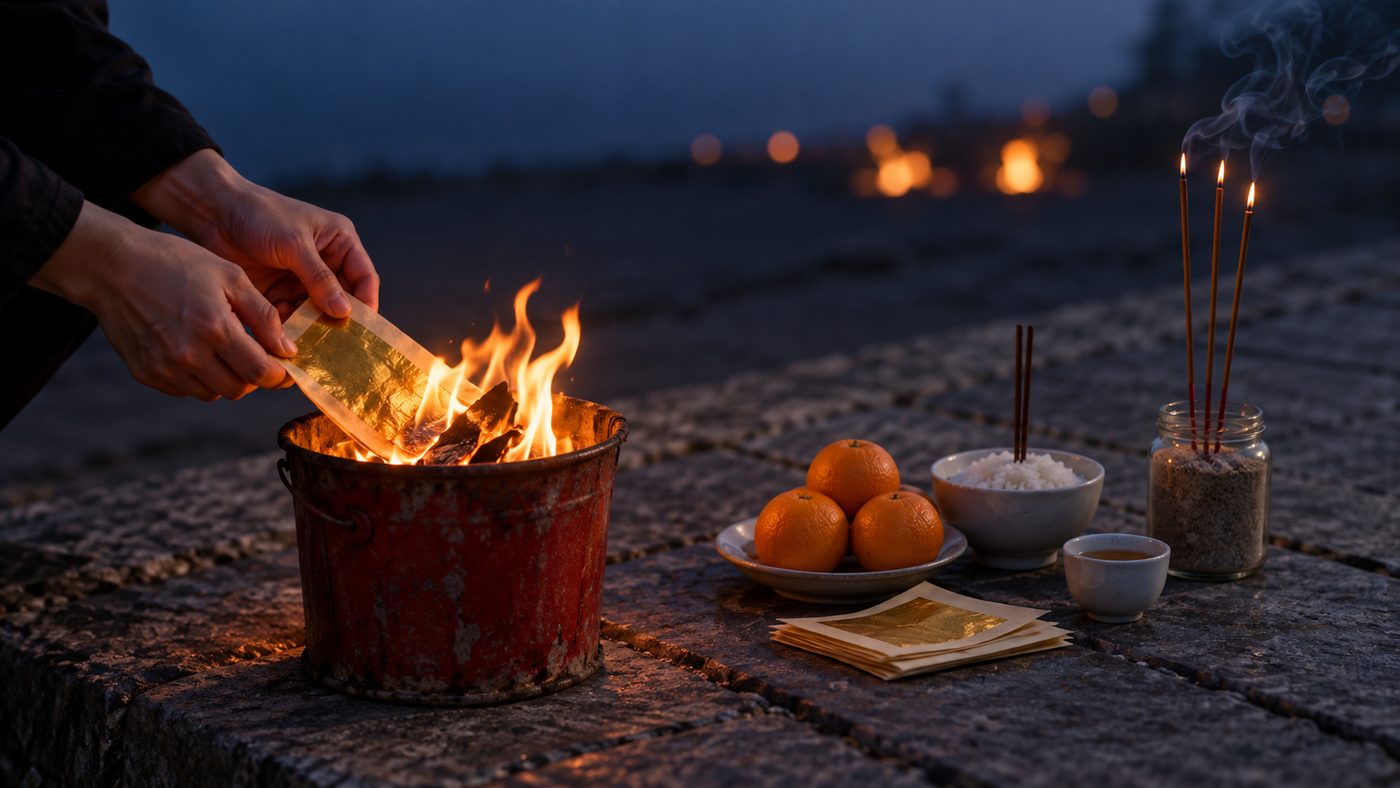
At dusk on a stone pavement, a pair of hands feeds a sheet of gold-foil joss paper into a small fire in a red tin, beside a plate of oranges, a bowl of rice with chopsticks standing in it, and three lit incense sticks pushed into a jar of sand.
The pavement offering: rice, fruit, incense, and paper going into the fire. Illustration.

When it falls, 2020 through 2035

Always the fifteenth of the seventh month on the Chinese calendar, which puts it on a full moon and almost never on the same western date twice. The lunar month runs new moon to new moon, so twelve of them fall short of the solar year and a whole extra month is added every two or three years to catch up; the festival keeps its lunar address and the Gregorian date swings by nearly a month around it. These dates are computed from the same engine that runs our calendar converter. The second column matters in Singapore and Malaysia, where the observance starts on the first of the month, not the fifteenth.

Gregorian date of the Hungry Ghost Festival, and of the first day of Ghost Month, for each year from 2020 to 2035.
Year Hungry Ghost Festival Ghost Month opens
2020 Wednesday, September 2, 2020 August 19
2021 Sunday, August 22, 2021 August 8
2022 Friday, August 12, 2022 July 29
2023 Wednesday, August 30, 2023 August 16
2024 Sunday, August 18, 2024 August 4
2025 Saturday, September 6, 2025 The latest in this table. August 23
2026 Thursday, August 27, 2026 August 13
2027 Monday, August 16, 2027 The next one. August 2
2028 Sunday, September 3, 2028 August 20
2029 Friday, August 24, 2029 August 10
2030 Tuesday, August 13, 2030 July 30
2031 Monday, September 1, 2031 August 18
2032 Friday, August 20, 2032 August 6
2033 Tuesday, August 9, 2033 The earliest in this table. July 26
2034 Monday, August 28, 2034 August 14
2035 Saturday, August 18, 2035 August 4

The bowl: a monk, his mother, and a meal that turns to fire

The Buddhist festival begins with a short sutra, a page or two long, that reached China in the third or fourth century under the name Yulanpen Jing. Its hero is Mulian, one of the Buddha's two chief disciples and the one famous for supernatural power. Having gained that power, the first thing he does is look for his parents, to repay them for raising him, and he finds his mother reborn among the hungry ghosts, starving, "skin and bone held together." He fills his alms bowl with rice and carries it to her. She shields the bowl with her left hand, grabs the food with her right, and before it reaches her mouth it has turned to burning coals. He runs back to the Buddha in tears.

The Buddha's answer is the festival. Your mother's sins are too heavy for one man's power, he says; what can lift them is the concentrated merit of the whole community of monks, and there is one day a year on which that community is at full strength: the fifteenth of the seventh month, when the three months of the summer rains retreat end and the monks gather to confess. On that day, prepare a basin of rice, fruit of a hundred flavors, lamps and oil and bedding, and offer it to the monks of the ten directions on behalf of your parents living and your parents dead for seven generations back. Mulian does, his mother is released, and he asks whether future disciples may do the same. "Very good," says the Buddha. That is the whole text. The word yulanpen is a transliteration nobody has securely explained; the pen at the end is simply the Chinese for the bowl.

By the sixth century it was everyone's festival. The Jingchu Suishiji, a calendar of customs from the middle Yangzi, gives the fifteenth of the seventh month a single line: "monks, nuns, clergy and laity all prepare bowl offerings." The commentary then retells the whole Mulian story, and ends on a detail that shows how far the bowl had already traveled from a bowl: people, it says, had taken to decorating the offerings with carved wood and cut bamboo, with sugar-paste and cut silk shaped into flowers and leaves, "to the utmost of their ingenuity." A meal for monks was becoming a display.

The audit: the night the books are open

The Daoist festival on the same night has nothing to do with a monk's mother. Its name, Zhongyuan, means "middle primordial," and it is one of three: the fifteenths of the first, seventh and tenth months are the Upper, Middle and Lower Primordials, and each belongs to one of the Three Officials, of Heaven, Earth and Water. A scripture in the fifth-century Lingbao canon lays the system out with the precision of a civil service, which is what it is: the Heavenly Official has three palaces, three bureaus and thirty-six offices, the Earth Official three palaces, three bureaus and forty-two offices, the Water Official likewise, "one hundred and twenty offices in all." Three times a year, on those three dates, the officials convene to "audit the ledgers of merit and fault, of life and death," of everyone in heaven and on earth, the enlightened and the ordinary alike.

The seventh month is the Earth Official's, and the Earth Official's portfolio is the dead. A later summary, repeated in every account of the festival since, gives the three their slogans: the Heavenly Official bestows blessings, the Earth Official pardons sins, the Water Official dispels calamity. So the middle date became the day to confess. Daoist priests recited scripture through the night, the faithful asked to have their own entries in the ledger amended, and, because the books being opened were also the books of the dead, the night acquired a second purpose that the Buddhist bowl already served: getting a pardon for the people you had lost. Two religions, two theories, one practical outcome, on one full moon. By the eighth century the Tang administrative code was giving every official one day's leave for the fifteenth of the seventh month, in the same list as the fifth of the fifth and the ninth of the ninth, and nobody was keeping the two religions apart.

Three festivals on one night

It helps to hold the three layers apart, because most of the confusion in English comes from mixing them. The bowl is Buddhist and for your own parents. The audit is Daoist and about your own account. The thing with the empty front row is neither, and is for everybody else.

The Buddhist, Daoist and folk readings of the fifteenth of the seventh month, with their sources, beneficiaries, practices and duration.
Layer Set by Who is served What happens How long
Yulanpen (Buddhist) Yulanpen Sutra, 3rd–4th c.; Jingchu Suishiji, 6th c. The monks, on behalf of one’s own dead parents A bowl of food and fruit offered to the sangha on the day the summer retreat ends; the merit frees the dead from the hungry-ghost realm The fifteenth only
Zhongyuan (Daoist) Sanyuan Pinjie Jing, Lingbao canon, 5th c. The Earth Official, who audits the ledgers of the living and the dead Confession, scripture recitation and a plea for pardon while the books are open The fifteenth, one of three “primordial” dates
Ghost Month (folk) Custom; no scripture sets it Every wandering soul with no one to feed it Food, incense and paper goods set out on the pavement; shows for an audience that is not there; a list of things not to do The whole seventh month, from the first day to the last

Paper boots and a play that ran all week

The best single description of the festival as ordinary people kept it is nine hundred years old. Meng Yuanlao, writing in the 1140s about the Kaifeng of his youth, gives the fifteenth of the seventh month a full entry, and it is recognizably the festival of a Singapore housing estate today. Several days beforehand the markets fill with goods for the dead: paper boots and shoes, paper hats, paper belts with fake gold and rhinoceros horn, sets of clothes in five colors. Households buy sheaves of hemp and millet and tie them to the table legs, "to tell the ancestors the autumn harvest is in." A three-tier frame is built of split bamboo, three to five feet high, woven at the top into the shape of a lamp-holder; this, he says, is what people call the yulanpen, and the paper clothes and paper money are hung on it and burned. The bowl of the sutra had become a bonfire.

The entertainment was also already there. From the seventh day of the month, the night of Qixi, the theater troupes in the pleasure quarters staged the play Mulian Rescues His Mother, and kept staging it every night until the fifteenth, "with the audience doubling each day." The sutra's two pages had grown by then into an evening of hell-touring, demon-fighting spectacle, the version the Dunhuang manuscripts preserve from the ninth century and the one the opera stage would carry into the twentieth. And the state took part. Meng records that the imperial household sent carriages to the Daoist temples to visit the imperial tombs, that the government issued ordination certificates for the day, and that it "burned a mountain of money" at a rite "for soldiers killed in battle and for the lonely souls," the ones with no family to feed them. That is the origin of the pavement offering. The dead you do not know were the state's responsibility first, and then everyone's.

What people do, and what they do not

On the night itself the family dead get a proper meal, laid on a table at home or at the temple: cooked dishes, rice with the chopsticks standing up in it, fruit, tea, and then the paper. Joss paper is folded into ingots and burned in a red tin or a wire basket; "hell money" comes in denominations of a billion; paper shops sell whatever the dead might be missing, from shirts to smartphones, to be sent up in smoke. On the pavement a smaller plate is left, with incense pushed into a jar of sand, for the passing strangers. Nobody eats that one.

The prohibitions are custom, not scripture, and they are the part of the festival that English readers ask about most. The ones you will hear from every family: no swimming, because drowned spirits are said to be looking for someone to take their place; no moving house, no opening a business, no weddings, which is why Chinese wedding venues sit empty for a month; no laundry out overnight, no whistling after dark, no picking up money from the street, no stepping on the offerings, no sitting in the front row at the show. Different households add and subtract. What they share is the logic of a house with guests in it: keep the doors clear, do not make a spectacle of yourself, and be generous with whoever turns up.

One thing the festival is not is frightening. English writing tends to file it under horror, and the name does it no favors, but the tone on the ground is closer to a block party with obligations. The ghosts most people have in mind are their grandparents. The site's pages on the jiangshi and on Zhong Kui, the demon-queller cover the figures who do belong to the scary side of the calendar; neither is what the seventh month is about.

Singapore and Malaysia: the whole month, with a stage

Mainland China keeps the fifteenth quietly, where it keeps it at all. The biggest version of the festival is in the Chinese communities of Singapore and Malaysia, where it is called Zhong Yuan Jie, or simply the seventh month, and where it runs from the first day of the month to the last. Roadside offerings appear from day one. Tents go up in the open spaces of housing estates and industrial parks, each one run by a neighborhood or trade association, with an altar, a paper effigy of the King of Ghosts presiding, a communal dinner for members, and an auction: "auspicious objects," from lumps of charcoal wrapped in gold paper to bottles of liquor to statues of deities, are bid for at prices far above their worth, and the money funds next year's tent and the local temple and charities. The SCCC, Singapore's Chinese cultural center, runs a primer on the festival that describes exactly that cycle.

And there is the getai, the "song stage." Singapore's National Heritage Board dates its pairing with the festival to the 1970s, when open-air pop shows gradually replaced the Chinese opera and puppet theater that used to be staged for the same audience. The audience is the point. A getai runs for hours in a car park, with singers in sequins working through Hokkien, Mandarin, Cantonese and Malay hits, comedians, and a front row of empty plastic chairs that nobody sits in, because those seats are for the guests of honor. It is the Song dynasty's week of Mulian plays, updated to keyboards and LED screens, and the logic has not moved: the visitors are here for a month, and you entertain them.

The names, sorted

Zhongyuan (zhōng yuán) is the Daoist name, "middle primordial," the audit day. Yulan or Yulanpen (yú lán pén) is the Buddhist name, the bowl. Ghost Festival and Hungry Ghost Festival are the English names, coined in the colonial Chinese communities and now standard in Singapore, Malaysia and Hong Kong. Ghost Month is the seventh lunar month as a whole, and Qi Yue Ban, "the middle of the seventh," is what people say at home. Japan's Obon is the same Buddhist bowl, moved to the solar calendar and turned into a homecoming holiday. The one thing the festival is not is Halloween, whose only overlap is that the dead are about; nobody dresses up, and the candy is for the ghosts.

Questions people ask

When is the Hungry Ghost Festival in 2027?

Monday, August 16, 2027. It falls on the fifteenth day of the seventh month of the Chinese lunisolar calendar, so the Gregorian date moves every year, landing anywhere from the very start of August to early September. Across the sixteen years in the table on this page it ranges from August 9 in 2033 to September 6 in 2025. In Singapore and Malaysia the observance runs the whole seventh month, which in 2027 opens on August 2.

When was the Hungry Ghost Festival in past years?

August 27 in 2026, September 6 in 2025, August 18 in 2024, August 30 in 2023, August 12 in 2022, August 22 in 2021. Those dates are in the table above alongside the coming years, computed from the lunar calendar rather than copied, so they agree with our calendar converter to the day.

What is the Hungry Ghost Festival?

The night of the fifteenth of the seventh lunar month, on which the dead are fed. Two older festivals sit underneath it: the Buddhist Yulanpen, a bowl of food offered to the monks so that the merit reaches one’s dead parents, and the Daoist Zhongyuan, the day the Earth Official audits the ledgers of the living and the dead and can be asked for pardon. The folk festival that grew over both is the one most people mean: food and incense on the pavement for any soul that is passing, paper money and paper goods burned for the family dead, and a month in which the gates of the underworld are said to stand open.

Why is it called the Hungry Ghost Festival?

Because of the realm the sutra puts Mulian’s mother in. In Buddhist cosmology the hungry ghosts are beings whose greed in life has left them with huge bellies and throats too narrow to swallow; in the Yulanpen Sutra the monk Mulian finds his dead mother among them, skin and bone, and the rice he brings her turns to burning coals before it reaches her mouth. The festival exists to feed what she could not eat. The Chinese names, Zhongyuan and Yulan, do not mention ghosts at all; "Hungry Ghost Festival" is the English name that stuck in Singapore, Malaysia and Hong Kong.

What is the difference between Zhongyuan and Yulanpen?

Same date, two religions, two ideas. Yulanpen is Buddhist: the fifteenth of the seventh month is the day the monks end their rains retreat, and a meal offered to them then earns merit that can be turned to a dead parent’s account. Zhongyuan is Daoist: the year has three "primordial" dates, the fifteenths of the first, seventh and tenth months, and on the middle one the Earth Official opens the books on everyone, living and dead, so it is the day to confess and ask for a pardon. By the sixth century the two were being kept on the same night by the same people, and they have been one festival in practice ever since.

Is the Hungry Ghost Festival the same as Qingming?

No. They are two of the three days a year the Chinese dead are tended. Qingming, in early April, is for your own dead, at their graves: sweeping, repainting the inscription, a picnic. The Hungry Ghost Festival is for everyone’s dead, and especially for the ones nobody is tending, which is why the offerings go on the pavement rather than at a grave. The third is the Double Ninth, in autumn, which Hong Kong and Macau keep as a second grave-visiting day.

What should you not do during Ghost Month?

The list is custom, not scripture, and it varies by family. The ones you will hear everywhere: do not swim, since drowned spirits are said to look for a replacement; do not move house, open a business or get married; do not hang laundry out or whistle after dark; do not step on or kick the offerings on the pavement; do not pick up money you find in the street; do not sit in the front row at a getai. Most of them come down to the same instinct, which is not to draw attention to yourself while the guests are about.

Can you swim during the Hungry Ghost Festival?

People do, and lifeguards do not close the beaches. The rule against it is one of the best-known Ghost Month customs and comes from the belief that the water-dead need a substitute to be released; it is a folk caution rather than anything the Buddhist or Daoist texts prescribe. Whether you keep it is between you and your grandmother.

Is the Hungry Ghost Festival a public holiday?

No, nowhere. It is a working day in mainland China, Hong Kong, Taiwan, Singapore and Malaysia alike. What Singapore and Malaysia do instead is stretch it: the observance fills the whole seventh lunar month, with roadside offerings from the first day, tents and stages going up in housing estates and industrial parks, and the big dinners and auctions run by the neighborhood associations landing on whichever nights they can book.

What is getai?

Literally "song stage": an open-air variety show, put up on a temporary stage in a car park or a field during the seventh month, with pop songs in Hokkien, Mandarin, Cantonese and Malay, comedians and a great deal of sequins. The National Heritage Board dates the pairing of getai with the festival to the 1970s, when it gradually replaced the Chinese opera and puppet shows that used to be staged for the same audience. The front row of seats is left empty, and the empty seats are the point: the show is for the visitors.

What do people burn?

Paper. Joss paper, the "hell money" with its enormous denominations, and paper versions of anything the dead might want: clothes, shoes, houses, cars, phones, mahjong sets. The Song capital already had a market for it. Meng Yuanlao, remembering Kaifeng in the 1140s, lists paper boots and shoes, hats, belts and sets of colored clothes on sale in the days before the fifteenth, and a three-tier bamboo frame, which he calls the yulanpen, on which the paper clothes and paper money were hung and set alight.

What is the Mulian story?

A monk rescues his mother from hell. Mulian, one of the Buddha’s chief disciples, uses his powers to look for his dead parents and finds his mother reborn as a hungry ghost; he brings her a bowl of rice and it turns to fire in her hand; the Buddha tells him that his own strength is not enough and that only the assembled monks, fed on the fifteenth of the seventh month, can free her. That is the sutra. The story then grew for a thousand years: the Dunhuang manuscripts have a long ninth-century version in which Mulian tours the hells, and in the Song capital the play was staged every night for a week leading up to the festival.
Keep going

Sources

The Yulanpen Sutra, the Lingbao Sanyuan Pinjie Jing, the Jingchu Suishiji with its commentary and the Dongjing Menghua Lu were read directly in the Chinese. Singapore practice is taken from the National Heritage Board and the SCCC. Festival dates in the table are computed by the site's own lunisolar engine rather than taken from a published list.

Stay in the loop.

Chinese mythology, the zodiac, and the meaning behind names and symbols, rooted in the classics and read back to you. No spam. Unsubscribe anytime.