What the day was before the poet is written down in the same sources, and in one that
is older than all of them. Sima Qian's biography of Lord Mengchang, the great
aristocratic patron of the third century BC, begins with his birth. His father had
forty sons, and this one was born to a concubine on the fifth day of the fifth month,
and the father told the mother not to raise him. She hid him and raised him anyway,
and when the boy was grown and finally presented, the father was furious. The son
asked him why a fifth-month child should not be raised. "A child of the fifth month,"
the father said, "will grow as tall as the door and harm his parents." The boy's reply,
that a man receives his fate from heaven and not from a door, is the reason the story is
told; but the belief it records, that the fifth of the fifth is a bad day to be born, is
two hundred years older than the poet's death and has nothing to do with him.
By the sixth century the reasoning was explicit. "The fifth month is commonly called the
evil month," says the Jingchu Suishiji, "and has many prohibitions": do not
air the bedding, do not roof the house. Its commentary quotes a Han book with the rule
that climbing onto a roof in the fifth month makes your hair fall out, and a scholar
who traced the whole set of taboos to a ban of the First Emperor's. Underneath the
superstition is a climate. The fifth lunar month is early summer in the Yangzi valley,
when the heat and the rains arrive together and with them the snakes, scorpions,
centipedes, toads and lizards the tradition calls the five poisons, and the fevers. The
fifth day, in a system that counted by the yang number, was the day the danger peaked.
So you defended the house.
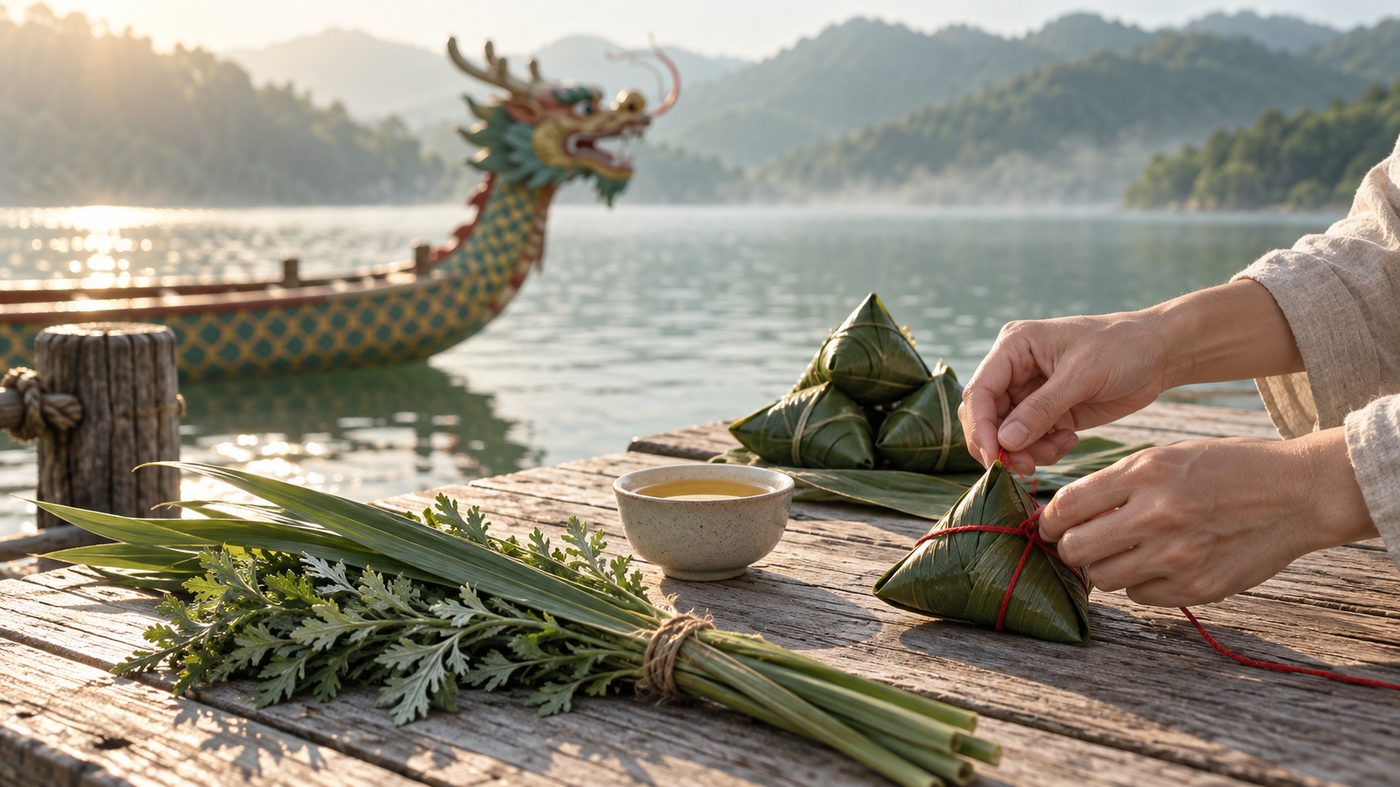
The defenses are the festival. The Jingchu Suishiji calls the day "the
Orchid-Bath festival," after a line in the Songs of Chu about bathing in
orchid water, and lists what people did: they held a contest of gathering herbs; they
"picked mugwort and made it into a figure of a man and hung it above the door, to ward
off poisonous qi"; they put calamus, shaved or chopped, into their wine; they gathered
medicinal plants of every kind. And they tied five-colored silk thread around the arm,
"called bibing, 'wards off weapons', so that a person does not fall to
plague." Each of those is on a Chinese door or wrist today. The mugwort figure was
still being nailed to every door of Kaifeng in the 1140s, according to Meng Yuanlao,
who lists the festival's market goods: mugwort flowers, painted fans, sweets, rice
dumplings, five-colored water balls, calamus, and "on the day, every household lays
them out at the front door." The realgar wine of later custom, arsenic in rice wine
dabbed on children's foreheads, is the same idea with a stronger poison.