The Chinese year

The Qixi Festival: two stars, a bridge of magpies, and a needle in the dark

Qixi is the seventh night of the seventh lunar month, which in 2027 is Sunday, August 8. It is the one night a year on which two stars that stand on opposite banks of the Milky Way, the Weaver Girl and the Oxherd, are allowed to meet, across a bridge the magpies make with their bodies. Shops sell it as Chinese Valentine's Day, and couples keep it that way. That label is about thirty years old. For the two thousand years before it, the festival was called something else, begging for skill, and it belonged not to couples but to girls, who spent the night threading needles in the dark and floating them on water to find out whether the Weaver Girl had given them her hands. Both festivals are on this page. The old one is better.

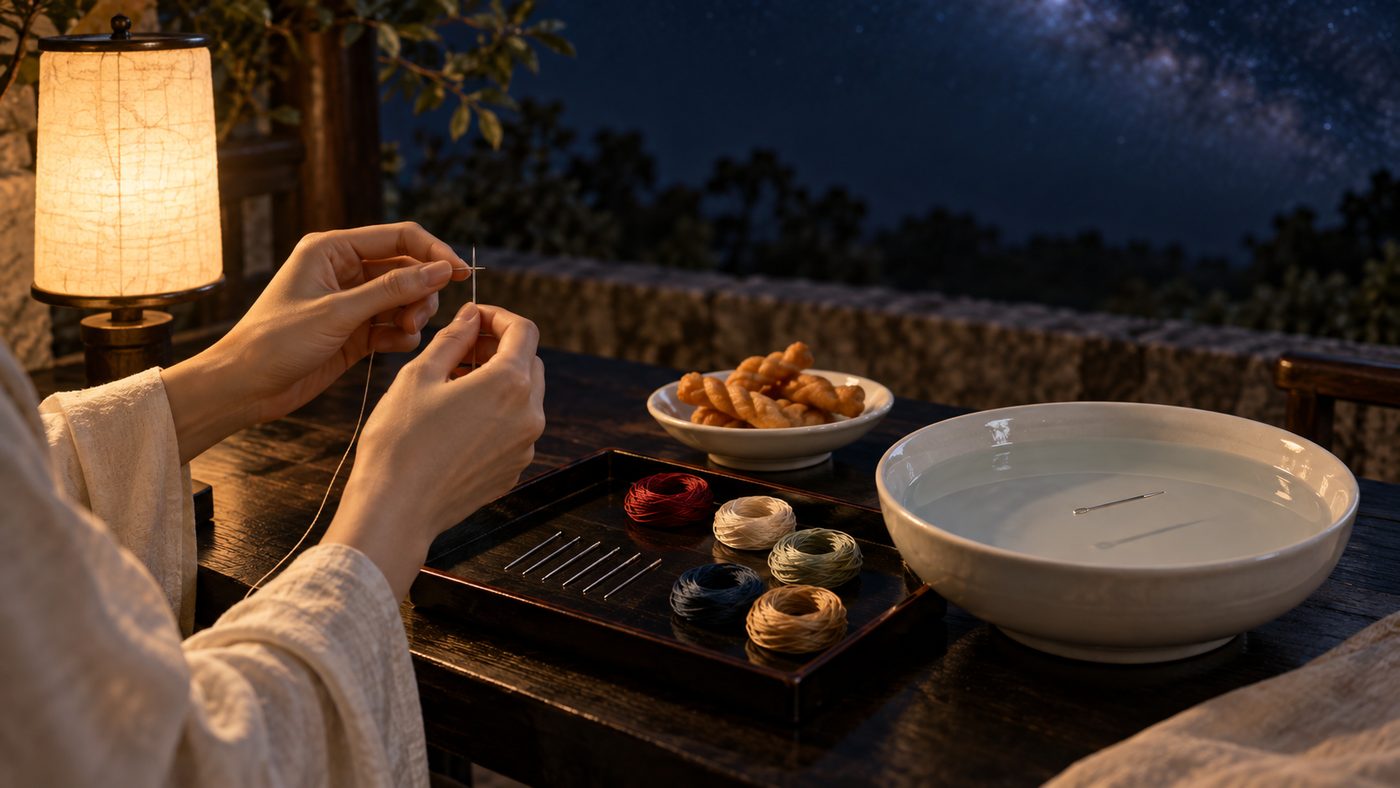
By the light of a single paper-shaded lamp on a dark lacquer table outdoors at night, a pair of hands threads a needle beside a tray of seven needles and coils of silk, a dish of fried dough twists, and a porcelain basin of water with one needle floating on its surface.
Seven needles, the skill pastries, and a needle floated on water to be judged by its shadow. The festival as it was kept for a thousand years. Illustration.

When it falls, 2020 through 2035

Always the seventh of the seventh on the Chinese calendar; on the western one it drifts across August and occasionally into the last days of July, because the lunar months fall short of the solar year and a whole extra month is inserted every two or three years to catch up. These dates are computed from the same engine that runs our calendar converter, past years included.

Gregorian date of the Qixi Festival for each year from 2020 to 2035.
Year Qixi
2020 Tuesday, August 25, 2020
2021 Saturday, August 14, 2021
2022 Thursday, August 4, 2022
2023 Tuesday, August 22, 2023
2024 Saturday, August 10, 2024
2025 Friday, August 29, 2025 The latest in this table.
2026 Wednesday, August 19, 2026
2027 Sunday, August 8, 2027 The next one.
2028 Saturday, August 26, 2028
2029 Thursday, August 16, 2029
2030 Monday, August 5, 2030
2031 Sunday, August 24, 2031
2032 Thursday, August 12, 2032
2033 Monday, August 1, 2033 The earliest in this table.
2034 Sunday, August 20, 2034
2035 Friday, August 10, 2035

Two stars that did no work

Go outside on a clear August night and look up: the Milky Way runs across the sky, and on either side of it, bright and unmistakable, are Vega and Altair. Chinese astronomers named them the Weaver Girl and the Oxherd, and the whole festival is an attempt to explain why two such obvious stars are kept on opposite banks of a river.

The first explanation, though, is not a love story. It is a grievance. The earliest text to name them is a poem in the Book of Songs, "Da Dong," in which a man from the overtaxed eastern states looks up at the heavens and finds them as useless as the court. There is the River of Heaven, he says, and it shines. There is the Weaver Girl, who shifts her place seven times a day and never finishes a bolt of cloth. There is the bright Oxherd, who does not pull a cart. Two well-paid celestial officials, sitting in plain view, producing nothing. There is no romance in it, and the Weaver Girl of the oldest poem is skiving.

The pining arrives in the Han dynasty. One of the Nineteen Old Poems puts the two stars in a single frame: far, far the Oxherd star; bright, bright the girl by the river; her white hands at the loom, the shuttle clacking, no cloth finished all day, and her tears falling like rain. The river between them is clear and shallow, the poem says, and how wide can it be? A brimming strip of water, and they cannot say a word to each other. That poem is the festival's real founding text. It gives the stars a feeling, and it gives the Weaver Girl the thing that would define her for two thousand years, which is not her heart but her hands.

The rest of the furniture arrives in stages. A scholar of the Eastern Han, Ying Shao, is quoted as saying that on the seventh night the Weaver Girl must cross the river, and magpies are made into a bridge for her. By the sixth century a calendar of southern customs states flatly that the seventh of the seventh is the night the Oxherd and the Weaver Girl meet. The tale everyone knows now, in which the Weaver Girl is a daughter of heaven who marries a cowherd on earth, bears him two children, is dragged home by the Queen Mother of the West, and is cut off from her family by a river the goddess scratches across the sky with her hairpin, is a folk tale that grew around the two stars over the following thousand years, and it has been the story since long before anyone thought to sell it.

Begging for skill, and being marked on it

Here is the part the greeting cards leave out. The earliest record of anyone actually doing anything on the seventh of the seventh is a single line in the Xijing Zaji, a book that claims to record the Han court: the palace women always threaded seven-holed needles at the Kaijin Tower on the seventh day of the seventh month, and everyone took it up. That is it. No lovers, no magpies. A needle with seven eyes, a tower, a competition.

The logic is straightforward once you know who the Weaver Girl is. She is the sky's seamstress, and on the one night she is close enough to ask, you ask her for her gift. The festival's traditional name is exactly that: qǐ qiǎo, begging for skill. By the sixth century the ritual has a shape. Zong Lin's calendar of the Jing-Chu region says that on this night the women of a household tie colored threads, thread seven-holed needles, some of them needles of gold, silver or brass, and set out wine, dried meat and melons on a table in the courtyard to beg for skill. Then the exam: if a spider spins a web across the melon, that counts as the Weaver Girl's answer. Skill granted.

Six hundred years later, in the capital of the Northern Song, the whole thing has become an industry. Meng Yuanlao, writing down the Kaifeng of his youth, lists the streets where clay dolls called mohele were sold for the festival, set on carved and painted stands, some dressed in red gauze, some hung with gold and pearls and kingfisher feather. Wealthy families built a "skill-begging tower" of colored silk in the courtyard and laid out the dolls, carved melons, wine, a writing set and needle and thread; the boys composed poems and the girls "presented their skill," burning incense and bowing in rows. The women threaded needles facing the moon. And the spider test had been domesticated: you put a small spider in a box overnight, and in the morning, if the web was round and even, you had skill.

The last and best version comes from a description of Beijing published in 1635. At noon on the seventh, women set out a basin of water in the sun and let it stand until a film formed on the surface. Then each girl dropped an embroidery needle on the water, and it floated, and the test was the shadow it cast on the bottom of the bowl. A shadow like a cloud, a flower, a bird or a beast, or like a shoe or a pair of scissors, meant she had begged skill and got it. A shadow "coarse as a mallet, fine as a thread, or straight as a candle," the book says, was the sign of clumsiness, "and the women sigh, and some of the girls weep." For most of its history, that is what Qixi was: an annual examination in dexterity, with results, taken by the people whose marriage prospects depended on the answer. It was a night about hands, and it could break your heart, but not in the way the retailers mean.
The Xijing Zaji, the Jingchu Suishi Ji and the Dongjing Menghua Lu were read in the Chinese; the 1635 passage, from the Dijing Jingwu Lüe, is quoted from a 2025 China News Service piece that reproduces it.

How it became Valentine's Day

The romance was always there in the poems, and it is the poems that made the modern festival possible. In the eighth century Bai Juyi ended his long ballad of the Tang emperor and his doomed consort with a vow whispered in the Hall of Long Life on the seventh of the seventh, at midnight, with no one near: in the sky, to be two birds flying wing to wing; on earth, two trees with branches grown together. In the eleventh Qin Guan wrote the lyric that every Chinese speaker can finish, "Immortals at the Magpie Bridge," and its last line is the closest thing the festival has to a motto: if two hearts are true for the long run, what does it matter that they are not together morning and night. It is a poem about the two stars. It is also, plainly, a consolation for anyone in a long-distance relationship, and it has been read that way for nine hundred years.

So the raw material was old. The packaging was not. By the 1990s the western Valentine's Day had arrived in Chinese cities with the rest of the imported holidays, and the question "why don't we have one of our own" was in the air. In 1993 an official at the Propaganda Department floated the idea of designating Qixi as China's Valentine's Day, and nothing came of it. The first public event to put the two words together seems to have been a "Seventh Month Seventh Love Festival" staged by the Hebei writers' and artists' federation in 2002. Retailers did not need to be told twice. Within a decade the seventh night was a fixture of the jewelry, restaurant and flower-delivery calendar, and in 2006 the state added the festival to its first national list of intangible cultural heritage, item X-4, which protects the customs of a night that most people now keep by booking a table.

Folklorists have grumbled about this from the start, and their strongest point is a calendar one. If any traditional festival was a lovers' night, it was the Lantern Festival in the first month, the one evening a year when the curfew lifted and unmarried women were out in the crowded streets after dark, which is where the Song lyrics put their chance encounters. Qixi's own customs were a needle and a bowl of water. None of this will change what happens on the seventh of the seventh, and there is nothing wrong with a country deciding it wants a Valentine's Day of its own. The character for love, if you want to write it in a card, has its own page, and so does the god the red thread actually belongs to, Yue Lao, the Old Man Under the Moon, who is not in the Qixi story either. But it is worth knowing that the women who kept this festival for two thousand years would have found the idea of spending it on a man distinctly odd. They were busy.

What to say

七夕快乐

qī xī kuài lè · roughly “chee shee kwai luh” · happy Qixi

The greeting couples use. Between friends it is not really a day for greetings at all; if you want to mark it the old way, the pastry is qiǎo guǒ, "skill fruit," small fried twists of dough that are sold everywhere in the week before.

Questions people ask

When is the Qixi Festival in 2027?

Sunday, August 8, 2027. Qixi always falls on the seventh day of the seventh month of the Chinese lunisolar calendar, so its Gregorian date moves every year and lands somewhere in August, occasionally the very end of July. Across the sixteen years in the table on this page it ranges from August 1 in 2033 to August 29 in 2025.

When was Qixi in past years?

August 19 in 2026, August 29 in 2025, August 10 in 2024, August 22 in 2023, August 4 in 2022, August 14 in 2021. All of them are in the table above, computed from the lunar calendar rather than copied, so they agree with our calendar converter to the day.

What is the Qixi Festival?

The festival of the seventh night of the seventh lunar month, when two stars on opposite sides of the Milky Way, the Weaver Girl (Vega) and the Oxherd (Altair), are said to meet once a year across a bridge of magpies. In Chinese it is qī xī, "seventh night," and its older name is qǐ qiǎo, "begging for skill," because for most of its history it was the night on which girls and women asked the Weaver Girl for dexterity and tested their own by threading needles in the dark. It is marketed now as Chinese Valentine’s Day, a label from the 1990s and 2000s.

What is the story of the Cowherd and the Weaver Girl?

In the version told today, the Weaver Girl is a daughter of heaven who comes down to earth, marries a poor cowherd and has two children; the Queen Mother of the West drags her back to the sky and, when the cowherd follows with the children in baskets, scratches a river across the heavens with her hairpin to keep them apart. That river is the Milky Way. Moved by their grief, the magpies of the world fly up once a year and make a bridge with their bodies, on the seventh night of the seventh month. The two stars really do stand on either side of the Milky Way in the summer sky, which is where the story started.

Is Qixi really Chinese Valentine’s Day?

It is now, because that is how it is sold, but the label is recent and the history is different. The earliest text to mention the two stars, in the Book of Songs, treats them as heavenly officials who do no work, not as lovers. The earliest record of the festival, in the Han dynasty, is of palace women threading needles. From the sixth century to the Qing, the night was called begging-for-skill and was kept by unmarried girls testing their needlework. The phrase "Chinese Valentine’s Day" was floated by officials in 1993, first attached to a public event in Hebei in 2002, and taken up by retailers from there. Some folklorists point out that if any old festival was a lovers’ night it was the Lantern Festival, the one evening a year unmarried women were out in the streets after dark.

What does "begging for skill" mean?

Qǐ qiǎo, the festival’s traditional name. The Weaver Girl is the sky’s seamstress, so on her night girls asked her for her gift and then tested whether they had received it. The tests changed by dynasty: threading a seven-holed needle by moonlight in the Han, setting out fruit in the courtyard and watching for a spider to spin a web across a melon in the sixth century, keeping a spider in a box overnight and checking the web’s roundness in Song Kaifeng, and by 1635 in Beijing floating a needle on a bowl of water that had stood in the noon sun and reading the shape of its shadow on the bottom: a flower, a bird or a pair of scissors meant skill, a shadow "coarse as a mallet or fine as a thread" meant clumsiness, and the account says some of the girls wept.

What do people eat on Qixi?

Qiǎo guǒ, "skill fruit," which is not fruit but small crisp pastries of flour, sugar and sesame, fried or baked and pressed into flower, fish and other shapes, sometimes with a thread through them to hang around a child’s neck. Real fruit was traditionally set out too, as an offering to the Weaver Girl in the courtyard, with the melon doing double duty as the spider’s test bench.

Is Qixi the same as Japanese Tanabata?

Same stars, same night, and a different festival. Tanabata came to Japan from the Chinese Qixi in the eighth century, keeps the seventh of the seventh, and has the same two lovers separated by the river of heaven; Japan then moved it to July 7 on the western calendar and turned it into a festival of paper wishes tied to bamboo. Korea keeps the night as Chilseok. Neither is Chinese Valentine’s Day in the modern commercial sense.

Is Qixi a public holiday in China?

No. It is an ordinary working day on the mainland, in Hong Kong, in Macau and in Taiwan. Since 2006 it has been on China’s national list of intangible cultural heritage, which protects the customs without giving anyone the day off.

How do you say happy Qixi in Chinese?

Qī xī kuài lè, roughly "chee shee kwai luh." It is the greeting used between couples now. If you want the line everyone knows, it is Qin Guan’s, from a Song lyric about these two stars: if two hearts are true for the long run, what does it matter that they are not together morning and night.

Keep going

Sources

The classical texts were read directly in the Chinese except where a note above says otherwise. Festival dates in the table are computed by the site's own lunisolar engine rather than taken from a published list.

Stay in the loop.

Chinese mythology, the zodiac, and the meaning behind names and symbols, rooted in the classics and read back to you. No spam. Unsubscribe anytime.