A question, answered the Chinese way

Where should I move?

The Chinese tradition has never answered this with a city. It answers with a direction and a year, and it has been doing so for at least two thousand years. The oldest rule on record comes from a lost handbook called the Moving Manual, quoted in the first century by the skeptic Wang Chong: "to move toward the Tai Sui is unlucky, and to move with your back to it is also unlucky." Tai Sui, the god of the year, sits in the compass seat of the year's animal, so every year closes one axis. In a Rat year, to take Wang Chong's example, "nobody under heaven may move north or south"; east, west and the diagonals are open. This year, a Horse year, the closed axis runs south to north.

Later practice added two personal layers on top of the year's rule. One is your four good directions, which the Eight Mansions school works out from a kua number fixed by your birth year and sex. The other is your travel horse year, the star the bazi manuals read as the year you move. The finder below prints all three from a birthday. Which city is at the end of the good direction is your business; the tradition only ever claimed to know which way to face.
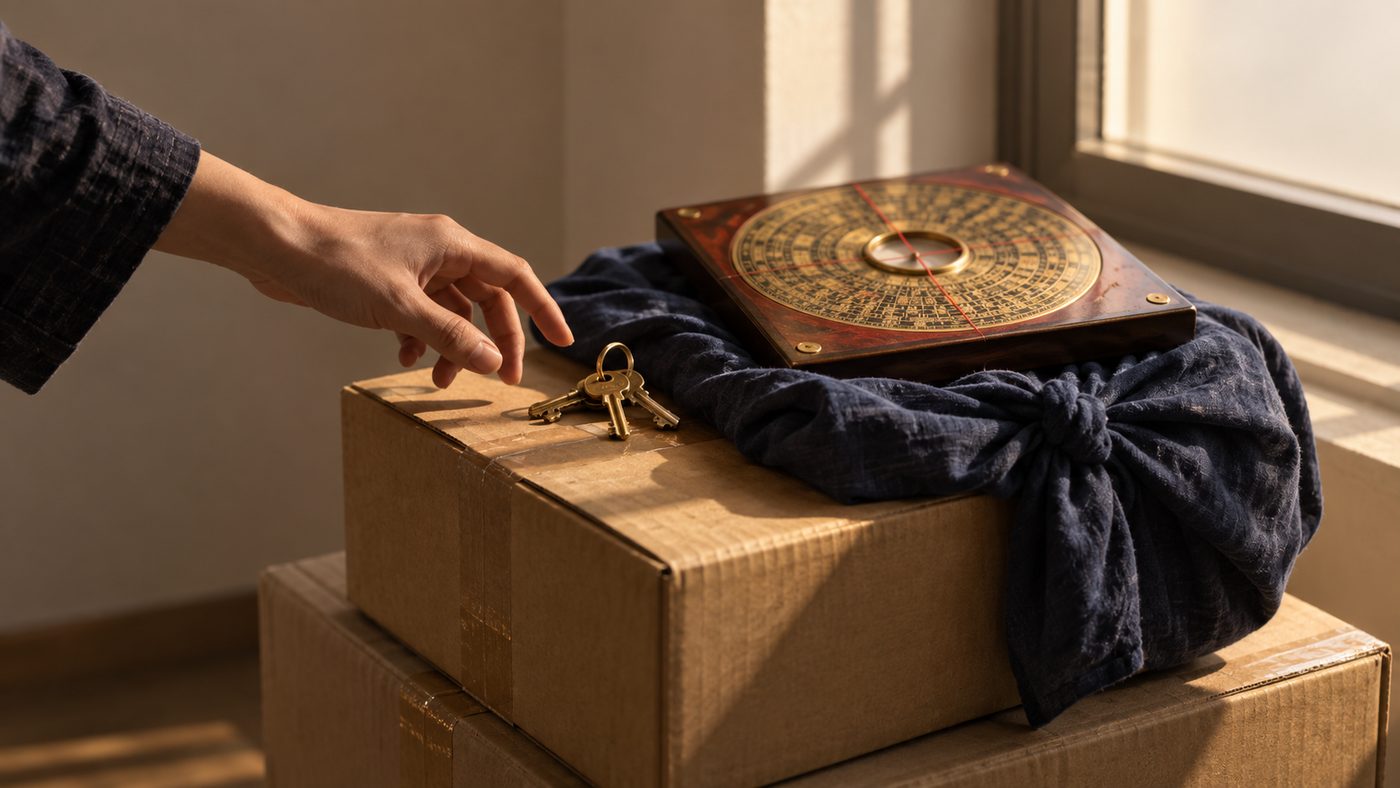
A feng shui compass resting on an indigo cloth-wrapped bundle atop taped moving boxes by a window, a set of brass keys beside it and a hand reaching in, in warm raking light.
A compass on the boxes: the tradition's answer is a direction, not an address. Illustration.

Your directions and your moving year

The kua, the eight directions and the travel horse come from the same tables as the kua calculator and the bazi calculator; years turn at Lichun, the start of spring. Nothing you enter is stored.

Read as

The kua formula is different for men and women; that is the classical formula, not our choice.

The oldest rule: which way the year is closed

Wang Chong quoted the Moving Manual in order to argue with it, which is the only reason it survives. The rule, as he gives it, names two bad moves. Moving toward the Tai Sui is "under the year." Moving away from it, with your back to it, is sui po, "breaking the year." His worked example is a Rat year, with the Tai Sui in the north: nobody may move north or south, and people avoided building houses and marrying along the same line; "moving east or west, or to the four corners, is lucky," because it neither runs into the god nor into the point opposite him.

His objection is the best thing in the chapter. If the Tai Sui is like a magistrate out on the road, he says, would a magistrate really punish only the family carrying its furniture across his path, and not every traveler walking north or south that day? He tells the story of a man who hid under a bridge while the emperor's carriage passed and startled the horses by coming out too soon. Nobody answered him, and the rule outlived him by two thousand years: the sector the year's animal occupies is still marked on every annual feng shui chart, with its opposite as the Year Breaker. The Tai Sui page tells the god's history; here is the axis for the next few years.

Year Animal Tai Sui sits Closed for moving
2026 Horse South South and north
2027 Goat Southwest Southwest and northeast
2028 Monkey Southwest Southwest and northeast
2029 Rooster West West and east
2030 Dog Northwest Northwest and southeast
2031 Pig Northwest Northwest and southeast

Tai Sui years begin at Lichun, the start of spring, around February 4. The compass has twelve animal seats and eight named directions, so animals between two directions are given the nearer one, as on our Tai Sui page.

Your four good directions, and what they were for

The Eight Mansions school, ba zhai, divides people into two groups by a kua number worked from the birth year and sex, and gives each kua four good directions and four bad ones. The finder names all eight. The best is called Sheng Qi, vitality; the worst is Jue Ming, total loss. The kua calculator shows the arithmetic and the full compass.

It is worth being exact about what those directions were for, because this is where most moving advice goes wrong. The school's manual, the Qing-dynasty Ba Zhai Ming Jing, is about houses: which way a building sits, and where its door opens. It says almost nothing about which way a family should travel. Pointing a move at your Sheng Qi direction is a modern extension, the same move practitioners made when they carried the door compass indoors and began aiming beds with it. It is harmless and many people like it. The classical use is the one to apply once you have found a place: whether the house itself belongs to your group, which is how house design reads a building's sitting direction.

The year to go, and the day to carry the boxes in

The travel horse, yi ma, is the bazi manuals' moving star, named for the relay horses of the imperial post. It is placed from the animal of your birth day, and a year of that animal is your horse year: the Sanming Tonghui, the Ming compendium, says that when the year reaches the horse it brings "the joy of office and of moving." In its century that meant a posting to another province, household and all, which is why the same star also marks the career year on should I quit my job.

The last layer is the day. Moving house was one of the handful of irreversible acts the imperial almanac scheduled, alongside marrying and breaking ground, and every almanac page still lists whether a day suits it. The Chinese almanac explains how to read those entries; a day marked suitable for moving in, inside your horse year, in a direction the year has not closed, is the whole of the traditional answer.

What the tradition can say, and what it cannot

It can say

  • Which axis the year closes, by a rule two thousand years old.
  • Your four good and four bad directions, and which year is your horse year.
  • Whether a house you have found suits your group, which is what the directions were built for.

It cannot say

  • Which city. There is no method for that, and anyone offering one invented it.
  • Whether you can afford it, or whether the job, the school or the people are there.
  • That a closed direction is a real risk. Wang Chong did not think so, and he had read the manual.

Questions people ask

What does Chinese astrology say about moving house?

The oldest surviving rule is about direction, not destination. Wang Chong's Lunheng, written in the first century, quotes a Moving Manual: "to move toward the Tai Sui is unlucky, and to move with your back to it is also unlucky." Tai Sui sits in the compass seat of the year's animal, so each year closes one axis. In 2026, a Horse year, that is south and north. Moves along the other directions were fine. Later practice added the travel horse year and a chosen moving-in day from the almanac.

Which direction should I move according to feng shui?

The Eight Mansions school gives everyone four good and four bad directions from a kua number worked out from the birth year and sex. The classical manual, the Ba Zhai Ming Jing, applies them to which way a house sits and where its door opens, not to the direction of travel; using them to choose which way to move from your current home is a modern extension. The finder above prints your four good directions and removes any that fall on the year's Tai Sui axis.

What is a good year to move in Chinese astrology?

Your travel horse year. The horse is placed from the animal of your birth day: Monkey, Rat and Dragon get the Tiger; Tiger, Horse and Dog get the Monkey; Snake, Rooster and Ox get the Pig; Pig, Rabbit and Goat get the Snake. The Sanming Tonghui says that when the year reaches the horse it brings "the joy of office and of moving." The finder prints which of the coming years is yours.

Which direction should I not move in 2026?

South or north. 2026 is a Horse year, which puts the Tai Sui in the south and the Year Breaker opposite it. By the old Moving Manual rule, moving toward either is unlucky. In 2027, a Goat year, the axis turns to southwest and northeast.

Can Chinese astrology tell me which city to live in?

No. It has no method for comparing cities, and a page that claims one is making it up. What it offers is a direction from where you are now, a year, a day to move in, and, once you have found a place, a way to judge whether that house suits you. The city is your decision.

Keep going

  • Kua number calculator works out the number, shows the arithmetic and draws the eight-direction compass.
  • Tai Sui is the god behind the closed axis, and the rest of what the year asks you to avoid.
  • Feng shui house design reads the house once you have found one: which way it sits, and whether it is your group.
  • Cast your chart reads the decade you are in; the written reading has a chapter called "Where to be."

Sources

The finder's tables are the calculators' own, exported at build: the kua for every year from 1900 to 2100 and the Lichun moment that turns it, the eight directions for every kua, and the travel horse map. The rules are from the texts below.

Stay in the loop.

Chinese mythology, the zodiac, and the meaning behind names and symbols, rooted in the classics and read back to you. No spam. Unsubscribe anytime.