A question, answered the Chinese way

Does he like me?

The Chinese tradition will not answer this, and the reason it will not is the interesting part. Chinese astrology has no technique for reading what is going on inside another person, because it does not read people one at a time. It reads relations. Give it two birthdays and it will tell you which of the branch system's named bonds sits between your two signs, and whether that bond is one the old tables approve of. That is a claim about how the pair of you tends to run, not about what he was thinking when he left you on read.

Which is less satisfying than a quiz and considerably more useful, because it is checkable. Four bonds count. Two are good: the trine, three signs four positions apart on the wheel who pull the same way, and the secret friend, a one-to-one alliance each sign gets exactly one of. Two are difficult: the clash, the sign directly opposite yours, and the harm, a quieter friction. Everything else has no formal bond at all and gets read through the two signs' fixed elements. Put both birthdays in below and the engine will tell you which of those you are in, and why.
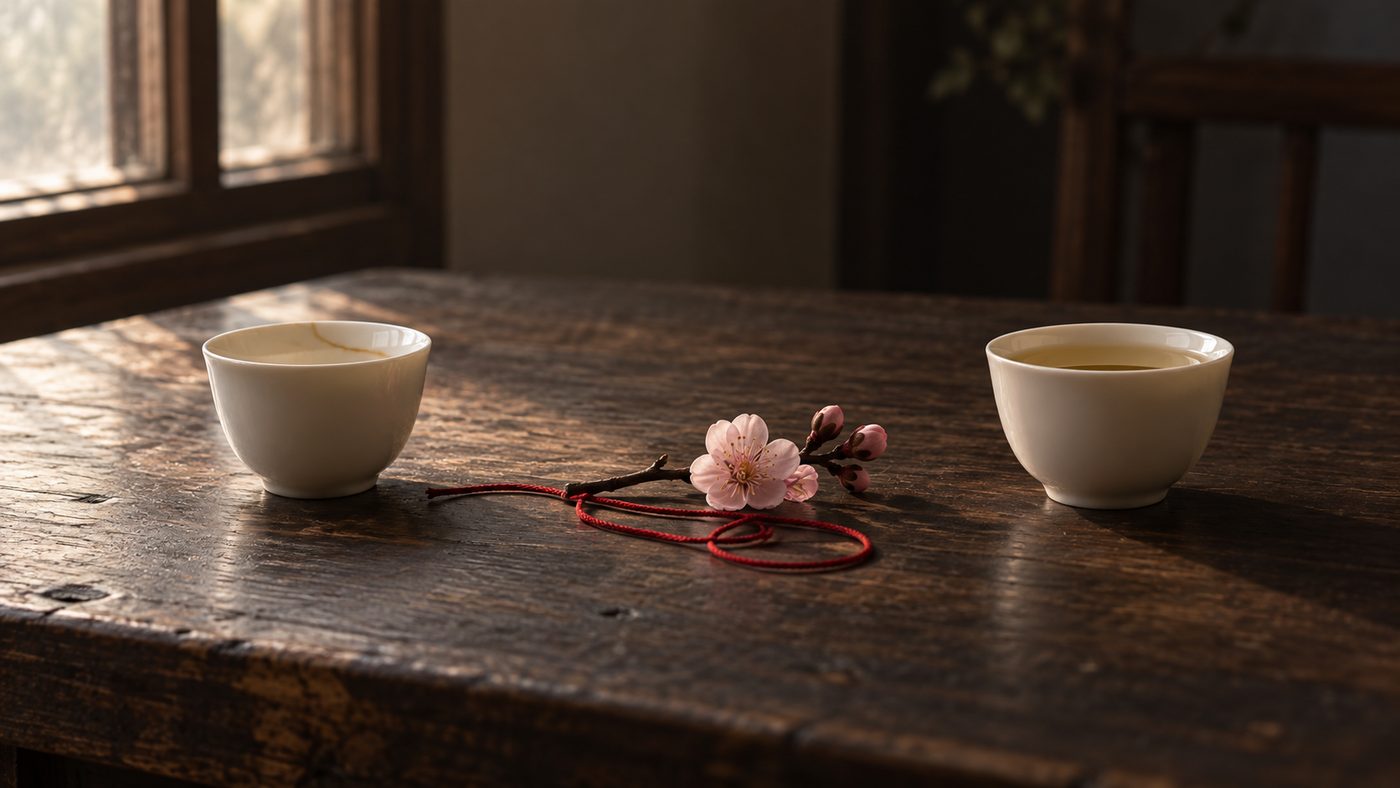
Two porcelain teacups on a dark wooden table in low window light, one full and one barely touched, a sprig of peach blossom lying between them and a length of red cord coiled beside it.
Two cups, one of them barely touched. The tradition reads the space between, not the person. Illustration.

What the branches say about the two of you

Both signs are read by the Chinese New Year rule, so a January or February birthday belongs to the previous animal. The verdict is the branch relation itself, not an opinion. Nothing you enter is stored.

Only know the years? Enter any date in each year; the animal depends on the year and the New Year boundary, not the month.

Worked example

a Dog born July 1994 and a Horse born March 1990 are the Dog and the Horse. Verdict: Best match, san he, the trine. San he, both belong to the Fire trine, signs four apart that pull in the same direction. The full Dog and Horse reading.

What it is actually reading

Your sign is not a personality type. It is a position: one of twelve Earthly Branches, the cycle Chinese timekeeping has used to count years, months, days and hours for three thousand years. Everything the tradition says about two signs getting along is geometry performed on that circle, and it is worth knowing because it means the verdicts are not arbitrary and you can check them yourself.

  • Trine, san he. Signs four apart, forming a triangle: Rat, Dragon and Monkey; Ox, Snake and Rooster; Tiger, Horse and Dog; Rabbit, Goat and Pig. Each triangle is associated with one of the elements and read as pulling in the same direction. This is the strongest approval the system gives.
  • Secret friend, liu he. Six one-to-one pairings, so each sign has exactly one. Quieter than the trine and read as equally good.
  • Clash, liu chong. The sign directly opposite yours, six positions away. Six of these. Read as collision, motion and things not settling, which is not the same as read as doomed.
  • Harm, liu hai. Six pairings of slow friction: obstruction rather than impact. The mildest thing in the tables, and the most over-read online. Every sign's harm, clash and punishment is listed on red flags by sign.
  • No formal bond. The majority of the 66 pairs. Here the reading falls back to the two signs' fixed elements and whether they feed or control one another, which is a much softer claim and should be read as one.

The whole grid is on the compatibility hub, twelve by twelve, with every cell linked, and each of the pair pages takes one pairing apart properly: love, trust, communication, marriage, money, and an honest section on where it breaks. The derivations themselves, if you want to see the tables the engine reads, are on branch relations.

The red thread, the peach blossom, and the god with the bag

There are three things in the tradition that get pressed into service as answers to this question, and all three are worth knowing and none of them does what people want.

The red thread. In a ninth-century tale, a young man in a hurry to marry meets an old man reading a book by moonlight with a bag of red cords beside him. The old man is the registrar of marriages and the cords are what he ties around the feet of two people at birth. Once tied, he says, there is no escaping it, whatever the distance and whatever the feud between the families. The young man asks who his is, is shown a grubby toddler in a vegetable market, and reacts by sending a servant to stab her. Fourteen years later he marries a beautiful young woman who wears a flower ornament on her forehead at all times, because there is a scar under it. That is the actual story, and the god at the center of it has a page of his own. Note what it is about: not whether he likes you, but the total irrelevance of anyone's preferences.

Peach blossom. Taohua is a marker in a bazi chart, derived from which group your day branch falls in, and the years that touch it are read as years when romance and attention turn up. It is a real technique and it is about you: your year, your weather, your visibility. It cannot be pointed at a third party. If you want it worked out, the marriage-timing page prints your marked years from a birthday.

The eight characters. Traditional matchmaking did compare two people properly, and it did it with the full chart rather than the animal: eight characters each, the day pillars checked against one another, the spouse palace inspected. That is the real technique, and the animal-to-animal reading on this page is its popular shorthand. If you want the full version for yourself, the chart casts it from a birthday, hour and place.

What this can tell you, and what it cannot

It can say

  • Which named branch relation stands between your two signs, and that answer is fixed and checkable.
  • What that relation has classically been taken to mean about a pair: where they agree, where they grind.
  • Whether the tables approve, disapprove, or have nothing to say, which is the honest third option and the most common one.

It cannot say

  • Whether he likes you. No technique in the tradition reads a named person's feelings.
  • Whether you should text him. That is not a branch relation, that is a decision.
  • Whether a clash means don't. Plenty of long marriages are clashes, and the tables describe a texture, not an outcome.

One more caution, since this is a page people arrive at when they are anxious: a verdict from a twelve-position cycle is a very coarse instrument, and a good one should feel like a description you recognize rather than a prediction you have to obey. If it does not fit, the tradition's own answer is that the animal is the shorthand and the full chart is the method.

Questions people ask

Does the Chinese zodiac say whether he likes me?

No, and it is worth being clear about that. Chinese astrology has no technique for reading another person's feelings, because it never reads a person in isolation: it reads relations between charts. What it will tell you is whether your sign and his sit in one of the named branch relations, which is a claim about how the two of you tend to run together rather than about what he is thinking this week. The best it offers is a description of the weather between you.

What are the signs of good compatibility in the Chinese zodiac?

Two: the trine and the secret friend. Trine signs sit four positions apart on the twelve-branch wheel and form a group of three that pulls the same way, such as Rat, Dragon and Monkey. The secret friend is a one-to-one pairing, one per sign, such as Rat and Ox. Both are read as strong matches. The relations read as difficult are the clash, which is the sign directly opposite you on the wheel, and the harm, a quieter friction pairing. Everything else has no formal bond and is read through the two signs' fixed elements.

What if we were born in the same year?

Then you share a branch, and the branch system has nothing formal to say about it: no combination, no clash. Eight of the twelve signs are read as simply the same energy twice, which the tradition calls bi he. Four of them, the Dragon, Horse, Rooster and Pig, appear in the old punishment tables as branches read against themselves, so two people of those signs get a mild caution rather than a blank. The finder above handles same-sign pairs.

What is the peach blossom star?

Peach blossom, taohua, is a marker in a bazi chart rather than in the zodiac, derived from the group your day or year branch belongs to. Years that touch it are read as years when romance and attention arrive, for you, regardless of who is in front of you. It is the closest thing the tradition has to a "something is going to happen" signal, and it says nothing at all about a specific person's feelings. The marriage-timing page works it out from a birthday.

Does the red thread mean we are destined?

The story says the old man under the moon ties a red cord around the ankles of two people at birth, and that once tied it cannot be escaped no matter how far apart or how hostile the families. It is a ninth-century tale, and the point of it in the original is uncomfortable: the young man in the story tries to have his destined bride killed and marries her anyway, years later, scar and all. It is a story about not being in control, which is a strange thing to buy as a bracelet.

Keep going

Sources

Stay in the loop.

Chinese mythology, the zodiac, and the meaning behind names and symbols, rooted in the classics and read back to you. No spam. Unsubscribe anytime.