Feng Shui
Feng Shui Living Room: The Bright Hall, and the One Layout That Drains It
How do you feng shui a living room? Chinese practice treats it as the home's bright hall, the space where qi is supposed to gather and settle before it reaches anywhere else, and everything follows from that. Keep it the brightest room you own. Do not let the front door look straight through it to a window or a back door, the layout Chinese practitioners fear most and English guides rarely name. Give the sofa a solid wall behind it and a view of the door. The compass comes last.
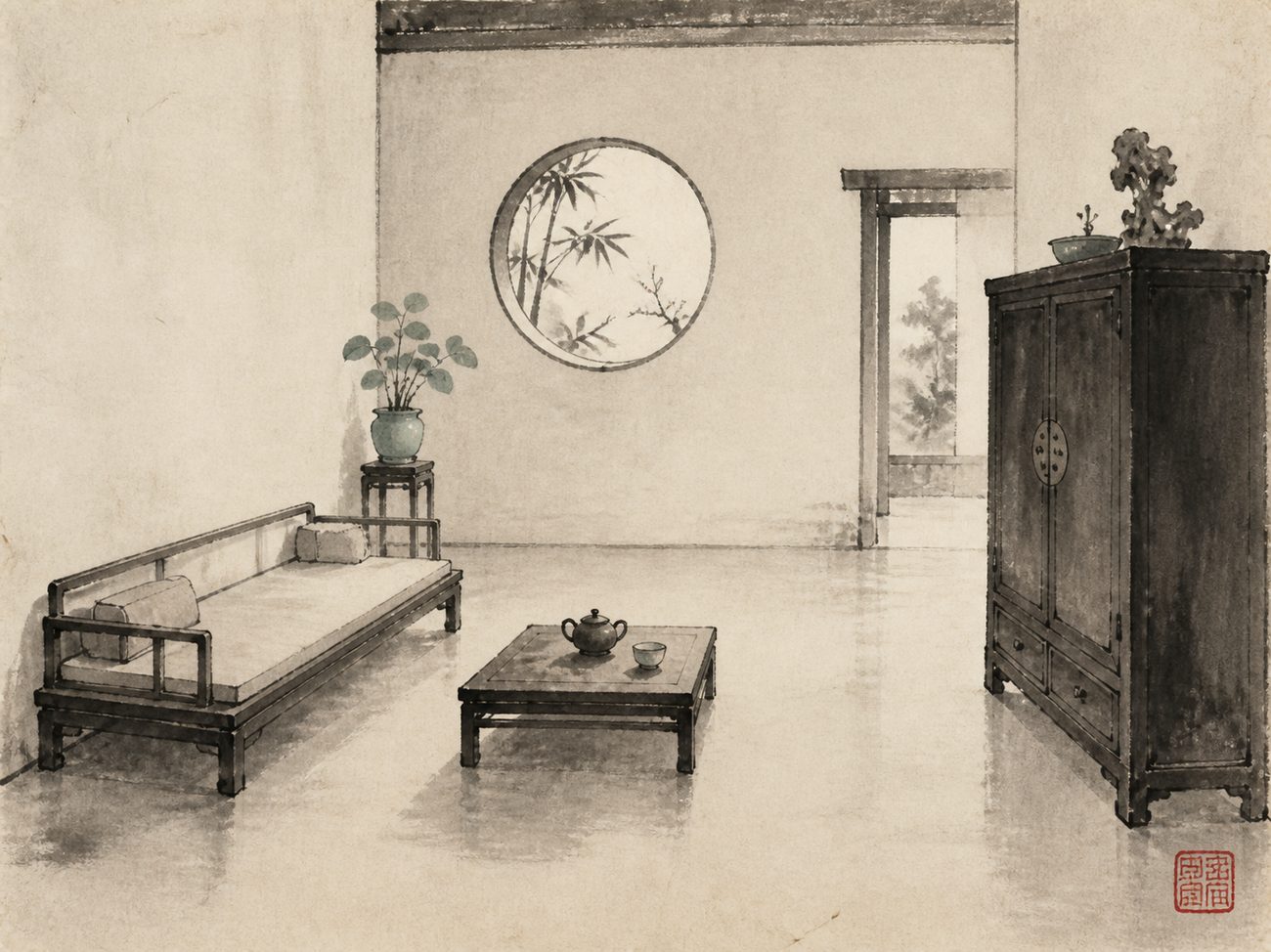
Your living room has a Chinese name, and it explains everything else
Start with the word, because the word does most of the work and almost nobody translates it.
In Chinese practice the living room is the home's bright hall, the mingtang (明堂). The term is borrowed from landscape siting, where it means the open, level ground in front of a site, the place where arriving energy is supposed to pool before it goes anywhere else. That is the whole idea: a current needs somewhere to slow down and settle. A house without such a space is a house that things pass through.
The word has a grander pedigree still. The Bright Hall was where the Zhou sovereign received the feudal lords in audience, ranked by seniority, and Taiwanese property columns cheerfully make the leap for you: your sitting room is the household's version of it. There is a nice honesty in the comparison. The living room is the one room in a modern apartment that outsiders routinely see, which is exactly what the imperial hall was for.
Two practical consequences follow, and they are why Chinese living-room advice looks so unlike the Western kind.
Light comes first. An old household maxim runs bright hall and dark rooms: the living room should be the brightest space in the home, and bedrooms softer. It is a rule about hierarchy rather than lumens, the gathering room getting the daylight and the resting rooms the quiet. A living room with no sunlight at all has its own name in Taiwanese practice, the dark hall problem, and practitioners treat it as a structural defect of the apartment rather than a decorating preference. Their remedies are frank about their own limits: keep the lights on, and if you are still house-hunting, buy something else.
Nothing should run straight through it, which is the next section and the one worth the most to you.
One honest wrinkle first. Practitioners disagree about where a home's inner bright hall sits. Taiwanese interior columns often place it at the entry vestibule, the buffer between the front door and the living room, and call that the throat of the house; others place it at the living room itself. The argument matters less than it looks, since both readings ask for the same two things: light, and somewhere the arriving air is not simply passing by.
The through-draft, which is the thing to actually check
Here is the test. Stand in your front door, look in, and see whether your eye travels in an unbroken straight line to a window, a balcony door, or a back door on the far side. If it does, and nothing sits in the way, Chinese practice has a name for what you are looking at: the through-draft, chuantang sha (穿堂煞).
It is not a marginal rule. When the Taiwanese practitioner Xie Yuanjin lists the taboos of doors and windows, this is number one, ahead of everything else, and the reading is blunt: air enters and leaves without ever settling, so nothing accumulates, and the household's luck drains the way money drains from a pocket with a hole in it. Chinese-language living-room guides lead with it. The English pages that rank for this search mostly do not mention it, which tells you something about where their advice came from.
Nor is it folk invention. It is the oldest sentence in the discipline. The passage that gives feng shui its name, in the Book of Burial, says that qi rides the wind and scatters, and halts when it meets water, and that the ancients gathered it so it would not disperse and checked its movement so it would stop, and therefore called the art wind and water. The commentary carried in the received text quotes the Tang official Yang Yunsong, credited with the Green Satchel Classic, in a line worth having: in the bright hall, treasure water as you treasure blood; inside the hall, avoid wind as you avoid a thief.
Avoid wind as you avoid a thief. A room that runs door to window is that sentence in miniature.
Worth being careful here, because this is where feng shui writing usually cheats. The Book of Burial is about graves and landscape, about where a site sits in the hills, and reading it as a rule for apartment layouts is an extension the classical text does not make. It is the extension Chinese practice does make, and Chinese architecture made it centuries before any consultant did. The courtyard house solved the problem structurally with the spirit screen, a free-standing wall of brick or glazed tile set just inside or outside the gate so that nothing entered on a straight line. The stated reason was that malicious spirits travel only straight and cannot turn a corner. The effect was that wind and sightlines could not either.
So the traditional fix is a screen, and it still is. Xie Yuanjin's list gives the modern versions: an entry vestibule, a partition wall, or a tall cabinet that is neither glass-fronted nor open-shelved, set to break the line. The specification worth remembering is that the blocker has to be wider than the door or window frame it covers, or the line simply goes around it. Renters get the cheap version, a heavy curtain, and a bookcase turned side-on beats both.
Where the sofa goes
Now the furniture, which is where most readers arrive from.
A solid wall behind the seat. Chinese practice calls this having a mountain at your back, using the same word an ordinary speaker uses for a patron or a powerful backer, which tells you how deep the metaphor runs. The main sofa wants a real wall: not a window, not a walkway, not the back of a room divider. Where no wall is available, practitioners improvise a mountain, putting a low console, a bookcase, or a screen behind the sofa and treating that as backing. They are entirely open about the workaround, which is one of the more likable things about this tradition.
The door in view, and off your line. From the main seat you should be able to see who comes in, roughly within the arc your head turns through, without the sofa sitting in the entrance's direct path. American manuals call the correct version the command position. It is the same instinct that makes you take the restaurant seat facing the room, and if that sounds too obvious to be metaphysics, notice that Chinese practice ranks it above the compass work, which is the order most Western feng shui gets backward.
Nothing overhead. No beam crossing the seat, no heavy pendant, and, in the version Taiwanese designers actually write down, no air-conditioning unit blowing on people's heads. The old worry was pressure on the qi of whoever sits there. The newer worry is that sitting under a beam feels faintly oppressive even to people who have never used the word qi. Both parties move the sofa.
A fourth idea runs through Chinese living-room writing and has no English equivalent. Sina Home's guidance on the television wall puts it plainly: the low sofa is water, the tall cabinet opposite it is the mountain, and that pairing is the ideal. What you are looking at is the form school, the branch that reads hills and rivers, shrunk to the scale of a rug. Once you have seen it you cannot unsee it, and it makes the room easier to arrange: the side you sit on stays low and settled, the side you look at stands taller.
Find your directions
Your kua number comes from your birth year and sex, with a calendar wrinkle in early February. The fastest way to get it right is our calculator; then find your row below.
| Kua | Trigram | Group | Best (Sheng Qi) | Health (Tian Yi) | Harmony (Yan Nian) | Steady (Fu Wei) | Avoid (Jue Ming) |
|---|---|---|---|---|---|---|---|
| 1 | Kan ☵ | East | Southeast | East | South | North | Southwest |
| 2 | Kun ☷ | West | Northeast | West | Northwest | Southwest | North |
| 3 | Zhen ☳ | East | South | North | Southeast | East | West |
| 4 | Xun ☴ | East | North | South | East | Southeast | Northeast |
| 6 | Qian ☰ | West | West | Northeast | Southwest | Northwest | South |
| 7 | Dui ☱ | West | Northwest | Southwest | Northeast | West | East |
| 8 | Gen ☶ | West | Southwest | Northwest | West | Northeast | Southeast |
| 9 | Li ☲ | East | East | Southeast | North | South | Northwest |
Kua 5 does not appear: the traditional formula reassigns it, 2 for men and 8 for women, which the calculator handles.
Read your row and take one direction from it. For a living room the useful ones are Sheng Qi, the vitality direction, and Yan Nian, traditionally given to relationships and rest, which suits a room whose whole job is people sitting together. Then remember the thing that trips everyone up: the direction is the way you face when seated, not the corner the sofa stands in. Two people on the same sofa can genuinely want opposite directions, since the East and West groups split the population roughly in half, and the settlement is the same as it is for beds. Give the compass to one of you and the better wall to the other.
Keep the ranking straight, though. A seat facing your best direction with its back to an open doorway is worse than a seat facing your worst direction against a solid wall. The compass is the last adjustment, not the first.
The wealth corner, in the room that defines it
The living room owns this one, because the spot is located by the room's geometry rather than by a compass.
Xie Yuanjin's version: from where you come in, look about 45 degrees off to either side, and the diagonal corner is the bright wealth spot. It wants a right angle or a solid wall behind it, roughly an adult's arm span of width, good light, and something alive in it. It does not want a mirror, a speaker, a laundry pile, or the bin. And it does not want the television, on the reasoning that the spot's whole virtue is stillness while a screen is movement and noise.
Two honest notes. Schools differ on which door you measure from, the home's front door or the living room's own doorway, and both are in print; where the entrance opens straight into the living room, as in most apartments, the two answers land in the same corner anyway. And if your reading elsewhere told you to put a fountain or an aquarium there, that advice is reversed. Our wealth corner guide has the full list of what belongs in the spot and the story of how the water rule got flipped in English, and the plants guide will keep you from buying the living thing under the wrong name.
Which living-room rules are actually old
This site's habit is to label the layers rather than blur them, so here is the sorting.
| The rule | Which layer it comes from |
|---|---|
| The living room is the home's bright hall, open and well-lit | Classical in origin. The bright hall is a siting term from the burial classics; the imperial Hall of Light is older still. Applying it to an apartment is a modern reading of an old idea. |
| Nothing running straight from the door to a window or back door | Classical in principle, since the founding passage is about wind scattering qi, and built into courtyard architecture as the spirit screen. |
| Sofa against a solid wall, entrance in view | Form-school instinct, universal in Chinese practice, and not a line you can point to in a Tang text. |
| No beam or heavy fitting over the seating | Practitioner convention. Universal, unwritten, and agreed on by every school. |
| No mirror facing the front door | Practitioner convention rather than classical ruling. |
| The wealth corner on the diagonal from the door | Standard Chinese household practice, taught everywhere in Chinese and rarely in English. |
| Television placement, screen size, TV wall colors | Modern by necessity. The reasoning behind it is old; the appliance is not. |
| A nine-square grid aligned to your front door | A modern Western method, listed in the standard surveys of the discipline as not based on classical teachings. Our bagua map guide covers where it came from and how it differs from the compass version. |
The mirror rules deserve their sentence. Xie Yuanjin's second door-and-window taboo is a door facing a mirror, on the reading that a real door then confronts its own reflected twin, which the tradition treats as an argument waiting to happen. That is convention rather than classical ruling, and worth labeling as such, exactly as we do about mirrors in the bedroom guide. The practical half is not in dispute: a mirror facing the entrance means the first thing an arriving guest meets is themselves, a strange greeting in any culture.
Color is the layer people reach for first and should reach for last. It is real, it belongs to the five elements, and it works by direction rather than by room; our colors guide maps it properly. A beautifully colored living room with a draft running through it has fixed the least important thing.
When your living room won't cooperate
Open-plan apartments, studios, a sofa that cannot touch a wall, one window facing a light well, a landlord: the tradition expects all of it. Feng shui grew up as the art of reading the site you were given, and both branches of it, the form school and the compass school, were developed by people who could not move a hill.
So work in order. Light first, since it is the cheapest fix and the one Chinese practice ranks highest for this particular room; a lamp in the dimmest corner does more than any ornament. Break the straight line second, using furniture you already own, turned side-on. Get a wall or a wall-substitute behind the main seat third. Take the compass reading last, and only once the first three are settled.
Open plan is the hardest case and the most common, because it removes the one thing a bright hall needs, which is a boundary. The traditional answer is not a wall but the suggestion of one: a rug marking where the sitting area begins, a console behind the sofa, a shelf unit standing at an angle. You are drawing a room the builder declined to draw.
And if you can do none of it, you are where most households in Chinese history lived, in whatever the family had, consulting nobody. What this tradition asks of you is attention: look at where the air comes in, where it leaves, where the light lands, and what stands behind your head when you sit down. Look at a room that carefully and you will improve it, whatever you believe about qi. Get your own directions from the kua number calculator when you want the last ten percent, and rearrange the other ninety first.
Questions people ask
What is the best feng shui layout for a living room?
One where the room is bright, nothing runs straight through it, and the main sofa has a wall behind it and the door in view. That order is deliberate. Chinese practice reads the living room as the home's bright hall, so light comes first, and a living room with no daylight has its own name in Taiwanese practice, the dark hall problem. Second, check whether the front door lines up with a window or a back door across the room; if it does, that is the through-draft, and it is the first thing a practitioner looks for. Third, seat yourself so that you can see the entrance without sitting in its direct path. Only then is it worth taking a compass reading.
Where should a TV be placed in feng shui?
Honestly told: every rule about television placement is younger than the television, so treat all of it as modern convention rather than classical teaching. The convention itself is reasonable and it comes from real form-school logic. Chinese decorating columns describe the low sofa as water and the taller TV cabinet opposite it as the mountain, which is the landscape principle shrunk to furniture, and they advise keeping the TV wall off the room's wealth spot on the grounds that the spot wants stillness while a screen brings noise and movement. Practically: put the TV on the wall the seating faces, not on the diagonal corner from the door, and not where the screen glares back at a window.
What direction should your couch face in feng shui?
There is no single answer, because in the Eight Mansions school direction is personal. Your birth year gives you a kua number, and that number gives you four favorable compass directions and four unfavorable ones, so two people on the same sofa can correctly want opposite things. Point the main seat so that you face one of your four good directions, ideally Sheng Qi or Yan Nian. What matters is the direction you face when seated, not which corner the sofa occupies. And the direction is the last constraint, not the first: a sofa facing your best direction with its back to an open doorway is a worse seat than one facing your worst direction against a solid wall.
Is it bad feng shui for the front door to face a window?
In Chinese practice, yes, and this is the single biggest gap between Chinese and English living-room advice. When the front door lines up with a window, a balcony door, or a back door with nothing in between, the arrangement is called the through-draft, and the Taiwanese practitioner Xie Yuanjin lists it first among his door-and-window taboos, on the reading that air comes in and leaves without ever settling, taking the household's luck with it. The standard remedies are an entry screen, a solid partition, or a non-transparent cabinet placed to break the line, and the blocker has to be wider than the door or window frame to count. Heavy curtains are the renter's version.
What should you avoid in a feng shui living room?
Five things, roughly in order of how seriously Chinese practice takes them. A straight open line from the front door to a window or back door. A room with no daylight, which Taiwanese practitioners call the dark hall problem and treat as a genuine defect rather than a decorating preference. A sofa with its back to a door, a walkway, or a window instead of a solid wall. A beam or a heavy air-conditioning unit directly over where people sit. And clutter or a mirror in the room's wealth corner, the diagonal spot that wants to be still, bright, and backed by a wall. Notice that four of the five are about placement rather than purchases.
Sources
- • Book of Burial (Zangshu), Inner Chapters: the passage that names the discipline (qi scatters on the wind and stops at water, so the ancients gathered it and kept it from dispersing), plus the commentary quoting Master Yang that the bright hall should treasure water like blood and shun wind like a thief (Chinese Wikisource)
- • Yang Yunsong, the Tang-era official credited with the authorship of the Green Satchel Classic, Wikipedia
- • Spirit screen (yingbi / zhaobi): the free-standing screen shielding a courtyard gate, and the belief that malicious spirits travel only in straight lines, Wikipedia
- • Yahoo Real Estate (Taiwan), Xie Yuanjin on the five door-and-window taboos: the through-draft listed first, and a door facing a mirror listed second
- • Yahoo Real Estate (Taiwan), Xie Yuanjin on remedying the through-draft: a false wall or entry vestibule, a cabinet that is neither all-glass nor open-shelved, and the rule that the blocker must exceed the door or window frame
- • Yahoo Real Estate (Taiwan), Xie Yuanjin on living-room wealth placement: the 45-degree diagonal from the entrance, the solid wall behind it, the bright-hall-dark-rooms maxim, and seeing the door from the sofa
- • Yahoo Real Estate (Taiwan), the dark-hall problem: a living room with no sunlight, and why the living room is read as the home's bright hall
- • Gorgeous Space (Taiwan), a room-by-room home feng shui guide: the entry vestibule as the inner bright hall, and the sofa with no beam overhead and support behind
- • Sina Home, on the television wall: the low sofa as water and the tall cabinet as mountain, called the ideal pairing
- • Sina Home, five points on the television wall: the wealth position wants quiet and stillness while a television is noise, which is why the screen is kept off it
- • Mingtang, the Bright Hall: the hall where the Zhou sovereign received the feudal lords in audience by rank (Chinese Wikipedia)
- • Feng shui (the form school and compass school branches, and BTB listed as a westernized method not based on classical teachings), Wikipedia
Get your kua number and full direction chart
Enter your birthday and we work out your kua, your group, and all eight directions, with the February boundary handled for you. Open the calculator