Feng Shui
Feng Shui Plants: What's Lucky, Where They Go, and What's Actually Old
Do plants make good feng shui? Yes, with rare unanimity: a healthy green plant is living Wood, the element of growth, and nearly every school approves of one. Put it where Wood belongs, the east or southeast of your home, and keep it thriving; remove anything dying. The famous lucky species are another story, mostly modern retail with excellent branding. Below, the honest labels, the compass map, and your personal growth direction from your birth year.
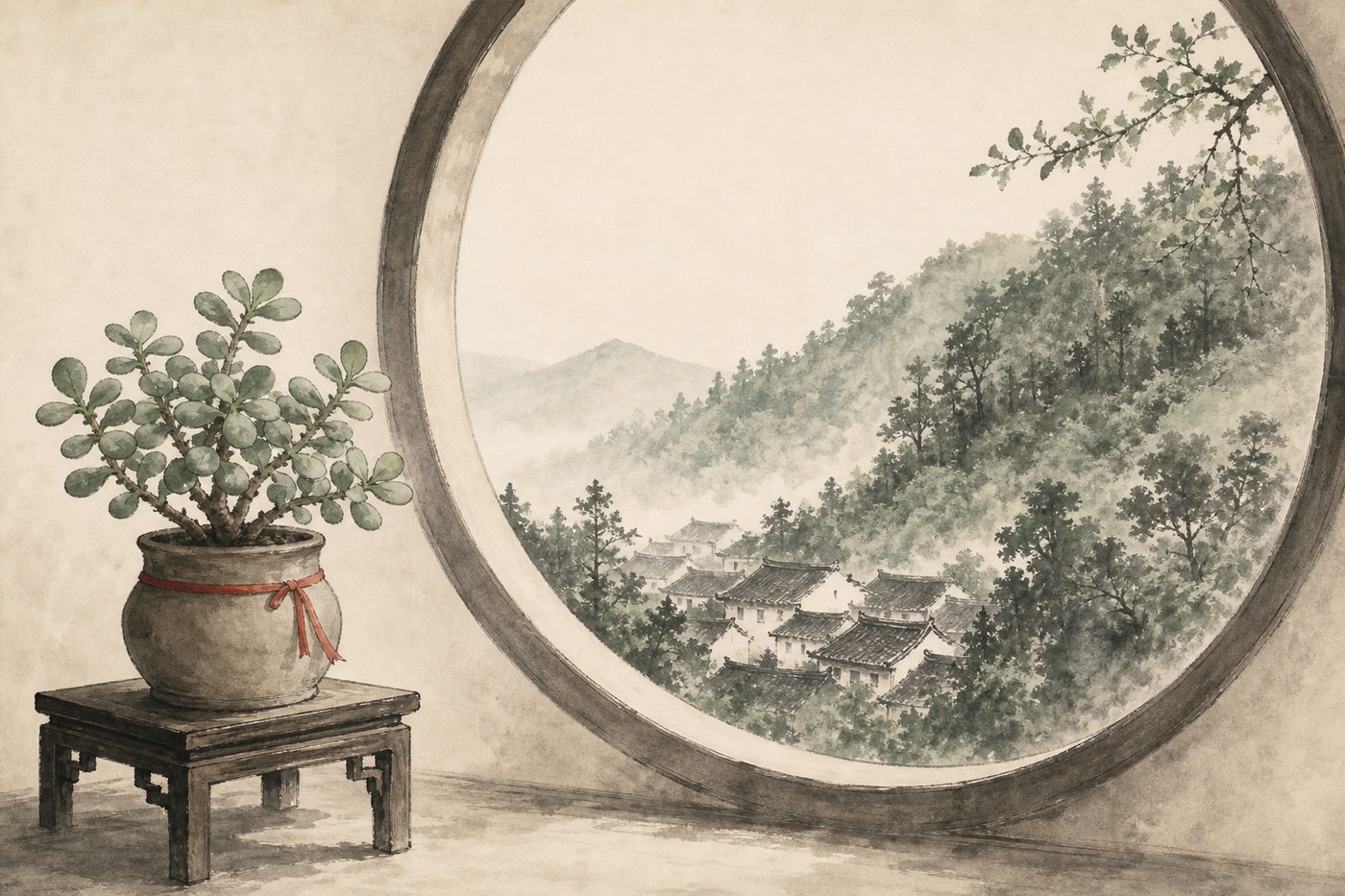
The three plant rules that matter most
Feng shui writing about plants tends to arrive as a list of twelve species with magical résumés. The tradition underneath is simpler and more likable. Three rules do nearly all the work, and none of them requires shopping.
A thriving plant beats a lucky one. In the five-element language of Chinese metaphysics, a living plant is Wood, the element of growth and beginnings, and the luck is in the living part. A supermarket pothos growing with quiet ambition is doing everything a neglected money tree only promises. Whatever else the schools disagree about, and they disagree recreationally, all of them read vigor as good qi and decline as bad.
East and southeast first. Compass feng shui gives every direction an element, and Wood owns two seats: the east and the southeast. A plant placed there is, in the system's eyes, at home. The southeast also carries the tradition's wealth label, which is the entire secret behind every "put a money plant in the southeast corner" tip you have ever read. The full map is below.
Nothing dead, nothing dying, nothing dusty. The one taboo every school shares: a plant in decline. Dying Wood reads as luck running backward, and the dust on a forgotten fake reads the same way. If a plant is past saving, thank it for its service and compost it. The tradition is unsentimental about this in the way gardeners are.
The famous lucky plants, honestly labeled
Now the shelf itself. Walk into any garden center around the Lunar New Year and you will meet the same cast: lucky bamboo tied with red ribbon, a braided money tree, a jade plant fat as a coin purse. Here is where each actually comes from.
| Sold as | What it actually is | Native to | How old the luck is |
|---|---|---|---|
| Lucky bamboo | Dracaena sanderiana, not a bamboo at all | Central Africa | Modern marketing |
| Money tree | Pachira glabra, a swamp tree, usually mislabeled P. aquatica | Central and South America | Braided for export in recent decades |
| Jade plant | Crassula ovata, a succulent | South Africa and Mozambique | A name collision with "money plant" |
Lucky bamboo deserves its own sentence: the plant under the ribbon is a Central African understory shrub that happens to tolerate dim rooms and plain water, is not a bamboo, not Chinese, and not ancient. The money tree's story is better still. The species in the braided pot is a swamp tree from the American tropics, and thanks to an early misidentification in the Taiwanese nursery trade, the plant sold worldwide as Pachira aquatica is usually a lookalike, Pachira glabra. Taiwan built a thriving export business on it anyway: a Central American tree, misfiled in Taiwan, braided for luck. The jade plant at least earns its nickname by sight, round leaves like little coins, though it is a South African succulent that shares the "money plant" title with the Pachira, to everyone's confusion.
None of this makes these plants bad feng shui. A dracaena is as alive as a pine. But if you want species with actual centuries behind them, Chinese tradition keeps a shelf of its own, conspicuously missing from the listicles. Confucius praised the pine and cypress for holding green through the cold: "When the year becomes cold, then we know how the pine and the cypress are the last to lose their leaves," which is the oldest plant endorsement still in circulation. Painters bundled pine, bamboo, and plum into the Three Friends of Winter, first recorded together in a ninth-century poem and named in the Song dynasty, emblems of keeping your character when the season turns against you. Real bamboo against a wall, a potted plum blooming at New Year: that is the old shelf. Its luck is about character rather than cash flow, which may explain the marketing gap.
Wood, the element you're actually buying
The system underneath all of this is the five elements, and plants are the delegation from Wood (mù 木), the element of growth, spring, beginnings, and the color green. Of the five, Wood is the only one you can buy alive. That is the whole reason plants rank among feng shui's favorite remedies: a healthy plant is the element in its most literal costume.
The elements feed and fight in fixed cycles, and two links explain most plant advice you will ever meet. Water feeds Wood, which is why practitioners like plants near water features, and why lucky bamboo growing in a clear vase strikes the system as a tidy arrangement rather than a lazy one. Wood feeds Fire, which is why a plant in the south, Fire's seat, is read as generous rather than misplaced. Metal, meanwhile, cuts Wood, and that is the entire logic behind the practitioner preference for ceramic or wooden pots over metal ones. Is the pot rule classical? No. It is cycle-logic applied by modern consultants: consistent with the old system, invented long after it. That distinction, as ever on this site, is worth a label.
Where plants go, by compass
Spread the compass over your floor plan and the advice nearly writes itself. The Book of Changes commentary that seats the eight trigrams gives the east to Zhen, where "all things are made to issue forth," and the southeast to Xun, which it flatly calls wood and wind. Those two directions are Wood's home ground, so they take plants the way a south window takes sun.
In the modern room-by-room reading, the east governs family and health, and the southeast governs wealth. The wealth label is younger than the compass underneath it, but it is standard in Chinese practice as well as in Western paperbacks, and a healthy plant in the southeast of the home, or of the living room, remains the single most-prescribed plant cure in the repertoire. One honest caution while we are here: some popular Western books locate the "wealth corner" at the far left corner from your front door, with no compass involved. That is a different and much newer school. If your book says far-left corner, it is not describing the system on this page.
Where should plants not go? The cycle-minded will tell you to go easy in the west and northwest, Metal's seats, where Wood is the guest being cut; treat that as convention rather than law. The center of the home, in classical thinking, belongs to Earth and likes to stay open and light, so the middle of the floor plan is the one place a jungle genuinely defeats the room. Your shins had already reached the same conclusion.
Your growth direction, personally
Everything above works from the house's compass. Eight Mansions, the school our kua calculator runs on, adds a personal one. Your birth year gives you a kua number, and your kua gives you eight directions, the best of which is called Sheng Qi (shēng qì 生气), literally the growing breath: the direction of vitality and beginnings. Practitioners like to give that corner something alive, and a flourishing plant is the obvious candidate. The formula is classical; aiming a houseplant along it is a modern practitioner's move; it is also a rather charming one.
Find your directions
Your kua number comes from your birth year and sex, with a calendar wrinkle in early February. The fastest way to get it right is our calculator; then find your row below.
| Kua | Trigram | Group | Best (Sheng Qi) | Health (Tian Yi) | Harmony (Yan Nian) | Steady (Fu Wei) | Avoid (Jue Ming) |
|---|---|---|---|---|---|---|---|
| 1 | Kan ☵ | East | Southeast | East | South | North | Southwest |
| 2 | Kun ☷ | West | Northeast | West | Northwest | Southwest | North |
| 3 | Zhen ☳ | East | South | North | Southeast | East | West |
| 4 | Xun ☴ | East | North | South | East | Southeast | Northeast |
| 6 | Qian ☰ | West | West | Northeast | Southwest | Northwest | South |
| 7 | Dui ☱ | West | Northwest | Southwest | Northeast | West | East |
| 8 | Gen ☶ | West | Southwest | Northwest | West | Northeast | Southeast |
| 9 | Li ☲ | East | East | Southeast | North | South | Northwest |
Kua 5 does not appear: the traditional formula reassigns it, 2 for men and 8 for women, which the calculator handles.
Read the Best column: that is your Sheng Qi. A plant there is the tradition's way of putting a green flag on your particular corner of the map.
The oldest plant feng shui is a forest
Here is the part that reframes the whole subject. For most of feng shui's history, the plant that mattered was not in a pot. It was the wood behind the village.
Across south China, a village was sited against its hillside and the grove was left standing around it, the feng shui wood (fēngshuǐ lín 风水林), held to embrace the settlement and hold its fortune in place. Felling its old trees was taboo, since their health and the village's were considered one ledger. Families preserved the native forest behind their homes and planted useful species into it, fruit trees, banyans, camphors, bamboo, until the groves matured into real woodland. Hong Kong's government botanists have surveyed 116 of these woods, and they are prized today as living museums of the region's native lowland forest, sheltering species the surrounding hills have otherwise lost.
Hold that image next to the ribboned dracaena at the checkout and you have the tradition's full arc. The old layers: plant symbolism about character, the pine outlasting winter; the trigram seats of the east and southeast; whole forests kept standing for a village's luck. The newer layer: the wealth-sector prescriptions of the modern consulting era. The newest: braided trunks, stalk counts, and species with more air miles than their owners. None of it is fraud. The layers are simply different ages, and the plant on your desk is the youngest member of a very old family.
Thorns, fakes, and the plant you forgot to water
The taboo list deserves the same honest sorting. Spiky plants, cactus above all, are the ones modern practitioners warn about: sharp forms are read as sha qi, cutting energy, little arrows bristling at the room. That worry is practitioner convention, not classical ruling, and plenty of consultants soften it to "not in the bedroom, not facing a chair." Round, soft leaves get the opposite press, with the jade plant's coin-shaped foliage as the standard example of a kind shape. If you love your cactus, the honest summary is that the old books have no opinion and the new ones can be negotiated with.
Artificial plants split the room. One camp says a clean silk plant is a harmless symbol; the other says the entire point of Wood is that it is alive, and plastic is a photograph of luck rather than luck. Both camps agree that a dusty, faded fake is the worst object in the whole conversation, managing to be lifeless twice.
The real worst offender, though, is the living plant quietly dying of neglect. Dying Wood is the one thing every school, classical and modern, reads the same way. Notice that this is also the rule that is pure attention: a browning plant is a small, visible record of looking away. The tradition has always been strict about exactly that.
When your windowsill won't cooperate
A north-facing apartment, a dim office, a travel schedule, a cat with opinions about potting soil: real rooms push back, and feng shui grew up expecting them to.
Work with the light you have rather than the symbolism you want. A pothos, a snake plant, or a ZZ plant will thrive in dim corners that would kill a money tree, and a thriving anything outranks a struggling lucky species; that is rule one, and it forgives nearly everything else. If the southeast of your home is a bathroom or a closet, use the southeast of the living room, or simply give your best plant your own Sheng Qi corner from the chart above. And if every plant you have ever owned has died, buy the unkillable one, water it when you remember, and let it be your entire garden. One healthy plant, honestly tended, is the whole teaching in miniature.
The deeper gift is the same one the bedroom guide ends on: this tradition asks you to pay attention to the room you actually live in. A plant makes the exercise visible. It grows when the room and its keeper are doing well, and it says so when they are not, which is more honest feedback than most furniture ever offers. Find your directions with the kua number calculator, give something green your growing corner, and keep it alive. Everything else is commentary.
Questions people ask
What is the best feng shui plant for wealth?
The stock answers are the braided money tree and the jade plant, whose round leaves are read as coins. The honest answer is that placement and health matter more than species: the tradition's wealth sector is the southeast, Wood's own seat, so any vigorous green plant kept thriving there is doing everything the money tree promises. Note, too, that the classical plant shelf tied its symbols to character rather than cash, so the deepest choice is simply a plant you will actually keep alive. A dying money tree is worse feng shui than no plant at all.
How many stalks of lucky bamboo should I have, and where should it go?
The stalk-count menu (two for love, three for happiness, eight for wealth, never four) is modern retail lore, but it is built on real Chinese number culture: eight rhymes with the word for striking it rich, and four sounds like death, a pun taken seriously enough to empty the fourth floor of many buildings. Genuine folklore, recent product. Place the vase as you would any plant: east or southeast, in clean water, out of harsh sun. And know that the plant is a Central African dracaena, not bamboo; the luck is in the gesture, not the botany.
Are fake plants bad feng shui?
Opinion splits. Stricter practitioners say the point of a plant is living Wood, so an artificial one is a picture of the element rather than the element. Softer ones allow a clean, convincing silk plant as a symbol, especially in rooms where nothing real would survive. Both camps condemn the dusty, sun-bleached fake, which manages to signal neglect without even the dignity of being alive. If you use artificial plants, keep them clean and retire them when they fade; if you can keep something real alive, even a modest pothos, the system will always prefer it.
Are cactuses and other spiky plants bad luck?
In modern practice, sharp spines are read as sha qi, hostile cutting energy, so cactuses get warned away from bedrooms, desks, and anywhere that faces a seat. This is practitioner convention rather than classical text; the old books have no opinion on windowsill succulents. Many consultants make peace by assigning cactuses to balconies and outward-facing window ledges, where the spikes are imagined as guards instead of nuisances. If a cactus is the one plant you reliably keep alive, that vigor counts for a great deal; put it where nobody sits in its line and enjoy it.
Is it bad feng shui to keep plants in the bedroom?
The common worry, that plants steal your oxygen at night, is not a feng shui idea and barely a real one: a houseplant's nighttime breathing is trivial next to the person sharing your bed. The feng shui hesitation is different. Some practitioners feel a bedroom should be quiet, restful space, and that a great deal of vigorous growth is the wrong weather for sleep, so they suggest one or two calm plants rather than a jungle. The classical texts, as usual with interiors, say nothing. If a plant helps the room feel cared for and you sleep well, keep it; the rules that actually matter in a bedroom are about the bed.
Sources
- • Shuo Gua (Book of Changes commentary; seats Zhen in the east and Xun in the southeast, and calls Xun wood)
- • Analects, Zi Han 28, on the pine and cypress lasting through the cold year (Legge translation)
- • Wikipedia, Dracaena sanderiana ("lucky bamboo"): a Central African species, and not a bamboo
- • Wikipedia, Pachira aquatica: the braided "money tree" trade and the P. glabra misidentification in Taiwan
- • Wikipedia, Crassula ovata (jade plant): a South African succulent also sold as "money plant"
- • Wikipedia, Three Friends of Winter: pine, bamboo, and plum, first recorded together in a ninth-century poem
- • Hong Kong Herbarium, Fung Shui and Fung Shui Woods: why villages kept and planted their woods
- • Hong Kong Herbarium, An Overview of Fung Shui Woods in Hong Kong: the territory-wide survey of 116 woods
Get your kua number and full direction chart
Enter your birthday and we work out your kua, your group, and all eight directions, with the February boundary handled for you. Open the calculator