Feng Shui
Feng Shui Colors: The Five Elements, Your Directions, and What's Actually Old
Which colors are lucky in feng shui? The honest answer is that no color is lucky on its own. Every color belongs to one of the five elements, and a color becomes right when it matches the place you are putting it or the person living there: greens and blues in the east and southeast, reds in the south, earth tones in the center and the two corners either side of it, white and metallics in the west and northwest, black and deep blue in the north. Below, the classical map, your personal colors from your birth year, and the two colors Western readers most often get wrong.
The three rules that settle most color questions
Search for feng shui colors and you will be handed a chart of moods: green for growth, red for passion, blue for calm. That is not wrong so much as beside the point, because it leaves out the part that does the work. Three rules carry nearly all of it.
A color is not lucky. A color is lucky somewhere. Feng shui has no list of good colors and bad colors, and any page that gives you one has quietly dropped the system. What it has is five colors, each belonging to one of the five elements, and a map of which element owns which direction. Put a color where its element lives and it is doing what the tradition asks. Put it opposite and you are picking a small fight with the compass.
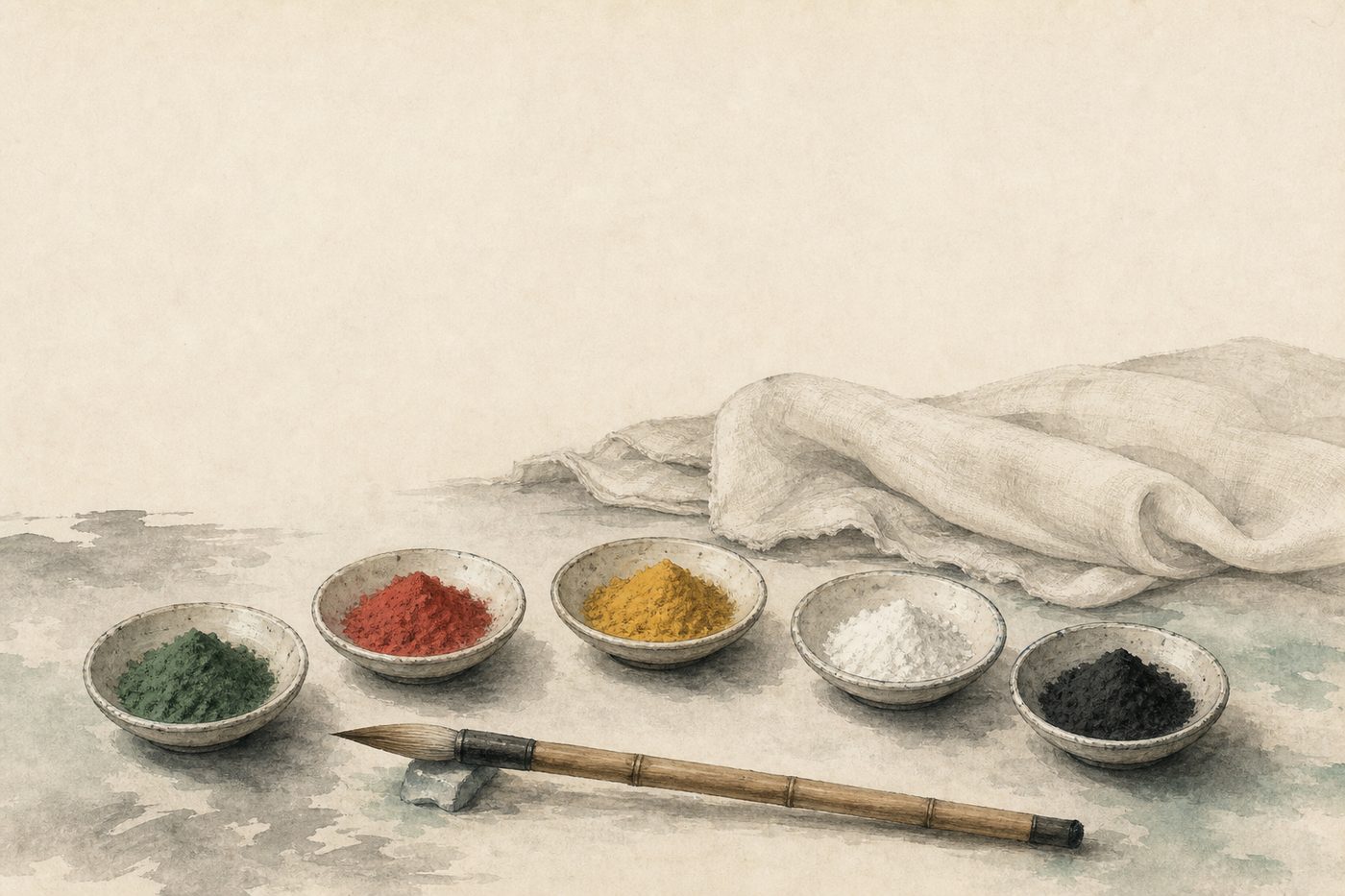
The five colors are the five elements wearing clothes. Green and blue-green are Wood, red is Fire, yellow and earth tones are Earth, white and metallics are Metal, black and deep blue are Water. That mapping predates feng shui by centuries and turns up everywhere in Chinese thought, from medicine to court dress. Learn it once and every color chart you meet afterward becomes readable.
Feed, don't fight. The elements run in two fixed cycles. In the generating cycle each feeds the next: Wood feeds Fire, Fire makes Earth, Earth bears Metal, Metal holds Water, Water grows Wood. In the overcoming cycle each checks another: Wood breaks Earth, Earth blocks Water, Water quenches Fire, Fire melts Metal, Metal cuts Wood. Almost every color prescription in practical feng shui is one of those ten sentences applied to paint. A red accent in an east-facing room is Fire being fed by Wood, which the system likes. A white one in the same room is Metal cutting Wood, which it does not.
The five colors, and what they actually are
The classical system is older and stranger than the paint-chip version, and knowing it makes you harder to sell things.
The ritual texts fix five orthodox colors, the zheng se, and hand them out by direction. The Rites of Zhou sets the roster in its section on the crafts, in a line about the work of painting: the east is called qing, the south chi, the west bai, the north hei; heaven is called xuan, the dark; and the earth is called huang. Everything else, every pink, purple, brown, and mixed green, was a jian se, a secondary color, and carried lower status accordingly. Note that heaven and earth get their own entries in that list, which is a reminder that this was a scheme for organizing the universe some centuries before anyone thought to apply it to a living room.
| Element | Classical color | What that color actually covers | Direction | Season |
|---|---|---|---|---|
| Wood | qing | Both green and blue, a single word for the whole grue range | East, southeast | Spring |
| Fire | chi | Deep red, the orthodox red of ritual | South | Summer |
| Earth | huang | Yellow, and by extension ochre, sand, and brown | Center | Late summer |
| Metal | bai | White, plus silver, gray, and metallic finishes | West, northwest | Autumn |
| Water | hei | Black, and the very dark blues that read as black | North | Winter |
Two of those rows deserve a second look. Qing is the famous one: a single Chinese color word that covers green and blue together, so the same term describes a spring leaf, a mountain in the distance, and a celadon glaze. Every English feng shui chart that writes "green" for Wood is translating a word that never drew that line. And chi is not the red you are picturing. The word modern Chinese uses for red in almost every context is hong, which the classical scheme filed as a secondary color, a reddish-pink. China's signature color spent centuries technically outside the pure five.
Where each color goes
Spread the compass over your floor plan and the assignments follow the trigram seats. The Book of Changes commentary that arranges the eight trigrams gives the east to Zhen, where all things issue forth, and the southeast to Xun, which it calls wood and wind. Those are Wood's two directions, so they take green and blue. South is Fire and takes red. West and northwest are Metal and take white and metallics. North is Water and takes black and deep blue. Earth holds the center, and its yellows and sands also take the southwest and northeast, the two corners the system hands to Earth.
In the room-by-room reading that modern practice layers on top, the east governs family and health, the southeast wealth, the south reputation, the southwest relationships, the west children and creativity, the northwest helpful people and travel, the north career, and the northeast knowledge. That layer is younger than the compass under it, but it is standard now in Chinese practice as well as Western, and it is where advice like "green in the southeast for money" comes from: the southeast is Wood's seat and carries the wealth label, so the color follows.
A caution while the compass is out. Some popular Western books skip the compass entirely and locate the sectors relative to your front door, putting the wealth corner at the far left as you walk in. That is a different and much newer school. If your book says far-left corner, it is not describing the system on this page.
Your colors, from your birth year
Everything above works from the house. Eight Mansions, the school our calculator runs on, adds a person. Your birth year gives you a kua number, your kua gives you four favorable directions and four unfavorable ones, and each of those directions carries an element and therefore a color.
Find your directions
Your kua number comes from your birth year and sex, with a calendar wrinkle in early February. The fastest way to get it right is our calculator; then find your row below.
| Kua | Trigram | Group | Best (Sheng Qi) | Health (Tian Yi) | Harmony (Yan Nian) | Steady (Fu Wei) | Avoid (Jue Ming) |
|---|---|---|---|---|---|---|---|
| 1 | Kan ☵ | East | Southeast | East | South | North | Southwest |
| 2 | Kun ☷ | West | Northeast | West | Northwest | Southwest | North |
| 3 | Zhen ☳ | East | South | North | Southeast | East | West |
| 4 | Xun ☴ | East | North | South | East | Southeast | Northeast |
| 6 | Qian ☰ | West | West | Northeast | Southwest | Northwest | South |
| 7 | Dui ☱ | West | Northwest | Southwest | Northeast | West | East |
| 8 | Gen ☶ | West | Southwest | Northwest | West | Northeast | Southeast |
| 9 | Li ☲ | East | East | Southeast | North | South | Northwest |
Kua 5 does not appear: the traditional formula reassigns it, 2 for men and 8 for women, which the calculator handles.
The practical use is smaller than it sounds and better for it. You do not need to repaint a room in your element. Take your best direction from the chart, and put the color that belongs to that direction on that side of the room: a cushion, a rug, a piece of framed art, the wall behind your desk. Practitioners call this an accent rather than a scheme, and it is how anyone with a lease does feng shui at all.
The best color-coded building in the world
If you want proof that this was applied seriously rather than decoratively, go and look at the Forbidden City, where the roofs are a legible document.
Yellow is Earth, the center, and the emperor's color, so almost every roof in the complex is glazed imperial yellow, which is also why yellow is the color of the Chinese emperor in English usage. There are two famous exceptions, and both are the color system being taken at its word. The Crown Prince's residences were roofed in green, because green is Wood and Wood means growth, which is a rather beautiful thing to say in glazed tile about a boy who is not yet emperor. And the Wenyuan Ge, the imperial library, was roofed in black, because black is Water, and Water puts out fire. A building full of paper got the fire-prevention color on its head.
Whatever you think of the metaphysics, note what that second decision is: a real fire-safety concern, expressed in the symbolic vocabulary available at the time, and applied to the most valuable building in the empire. This is the layer of feng shui that competitor pages skip because it does not sell anything.
Red, and the two colors that trip up Western readers
Red is the one color that behaves the way outsiders expect. It is Fire, it belongs to the south, and beyond the compass it is the general-purpose auspicious color of Chinese life: the Lunar New Year, wedding dress, the envelope cash is given in, the paper the doubled joy emblem is cut from on the double happiness page. Used as an accent it is safe nearly anywhere. Used on all four walls of a bedroom it is Fire at full volume in the room where you are trying to stop thinking, which practitioners uniformly advise against and anyone who has tried it can confirm.
White is where the confusion starts. Inside feng shui, white is Metal, the color of the west and northwest, clarity, precision, autumn, and there is nothing unlucky about it. Outside feng shui, in the older and much stronger system of funerary custom, white is the color of mourning, worn at funerals in the position black holds in the West. Both things are true at once and they do not contradict, because they belong to different systems. A white room is fine. White flowers, white wrapping paper, and white envelopes are not gifts you want to send.
Green has a narrower and funnier trap. On walls it is Wood, growth, spring, the most benign color in the set. On a man's head it is a public accusation: dai lu maozi, "to wear a green hat," is the Chinese idiom for a man whose wife is unfaithful, descended from an older term for a green headwrap. The idiom is completely alive, and it has cost companies real money in giveaway caps that had to be reprinted. Paint the wall green. Do not gift the hat.
What the modern charts add, and where it comes from
Search results will hand you prescriptions the classical layer never made: purple and gold for the wealth corner, pink for the relationship corner, a specific shade for each of the nine flying stars each year. These are not frauds, and most are consistent with the system's own logic. They are simply younger, and the honest thing is to say so.
Purple and gold for money is cycle-logic plus modern association. Purple is a secondary color that reads as Fire-adjacent and expensive, gold is Metal in its flattering form, and the wealth label on the southeast is itself a modern-practice layer, which the wealth corner guide takes apart in full. Pink in the southwest is the same move made with Western color psychology: pink as the relationship color is not a Chinese classical idea at all, it is the global one, borrowed inward. The annual flying-star colors, which change with the year, come from a genuine classical school of feng shui but reach the reader through a very modern publishing cycle. Our own 2026 annual guide works from that school and labels what it is doing.
None of this needs discarding. It needs labeling, which is the one thing the listicles will not do, and which is why a reader who knows the difference between the trigram seats and last year's paint recommendation is already ahead of the market.
When you can't repaint
Most people reading this cannot paint anything. Rentals, shared walls, a landlord with opinions, a partner with stronger ones. Feng shui expects this and always has, because it began as the art of siting a house on the land you already had.
Work the movable layer instead. Textiles carry color as well as walls do and cost nothing to change: a rug, curtains, cushions, a throw, a framed print. Put the color where the compass wants it rather than everywhere, since an accent in the right sector is what the system asks for anyway. Objects count too, and often better than paint: the classic Metal accent in the west is not a white wall but a metal object, and the classic Water accent in the north is a dark bowl or a small mirror rather than a black room.
Then rank your effort. If you only get one move, spend it on the space you use most, and use the direction from your own chart rather than a general prescription. And keep the one rule that survives every school: a room that is cared for reads as good qi and a room that is neglected does not, which no color can fix and no color can fake. The bedroom guide starts from the same place, and the plants guide makes the point in living form. Find your directions with the kua number calculator, put your color where it belongs, and leave the rest of the paint chart to the people selling paint.
Questions people ask
What are the five feng shui colors and what do they mean?
They are the five elements in visible form: green and blue-green for Wood (growth, spring, the east), red for Fire (recognition, summer, the south), yellow and earth tones for Earth (stability, the center), white and metallics for Metal (clarity, autumn, the west), and black and deep blue for Water (depth, winter, the north). The system is older than feng shui itself and comes from five-element thinking, so the same five colors turn up in Chinese medicine, ritual dress, and imperial architecture. A color is not lucky by itself. It is right for a direction, a room, or a person.
What is the luckiest color in Chinese culture?
Red, without much competition. It is the color of Fire, of the Lunar New Year, of wedding dress, and of the envelope money is given in, and Chinese usage treats it as the default festive color the way English treats gold. There is a classical footnote worth knowing: the orthodox red of the old five-color system was chi, a deeper red, while hong, the word modern Chinese uses for red in almost every context, was originally classed as a secondary, less pure color. China's most famous color was technically an impure one for centuries.
What color should I paint my bedroom according to feng shui?
Practitioners overwhelmingly favor quiet, skin-adjacent tones for sleeping rooms, warm off-whites, sand, soft clay, muted greens, rather than a strong element color on all four walls. The reasoning is that a bedroom is for rest, and a saturated Fire red is the wrong weather for it. If you want the system's personal answer, take your kua number from your birth year, find your Yan Nian or Tian Yi direction, and put your element accent on that wall rather than repainting the room. The bedroom guide covers the rules that outrank color entirely, starting with a solid wall behind the headboard.
Is white unlucky in feng shui?
Not in feng shui, where white is simply Metal, the color of the west and northwest and of clarity and precision. But white carries a separate cultural charge that trips up Western readers: it is China's traditional color of mourning, worn at funerals the way black is worn in the West. A white-painted room is fine. A gift wrapped in white, white flowers, or white envelopes are not. The two facts sit in different systems and both are true at once.
Why should you never give a green hat in China?
Because to wear a green hat, dai lu maozi, is the Chinese idiom for having an unfaithful spouse. The phrase descends from an older term for a green headwrap, and it is live enough that it has cost real money: companies have had to repackage green caps for the Chinese market. Green on your walls is entirely auspicious, being Wood and growth. Green on a man's head is a joke at his expense.
Sources
- • Wu Xing (the five phases, their colors, directions, seasons, and the generating and overcoming cycles), Wikipedia
- • Shuo Gua (Book of Changes commentary; seats the trigrams by direction and calls Xun wood), Chinese Text Project
- • Forbidden City, Symbolism: yellow tiles for the emperor, green tiles for the Crown Prince, black tiles on the Wenyuan Ge library, Wikipedia
- • Rites of Zhou, Kaogong Ji: the passage assigning blue-green to the east, red to the south, white to the west, black to the north, dark to heaven and yellow to earth (Chinese Wikisource)
- • Wiktionary: lü maozi, the green hat and its descent from the older green headwrap
- • Shades of yellow, on royal or imperial yellow as the color of the robes worn by the Emperor of China, Wikipedia
Get your kua number and full direction chart
Enter your birthday and we work out your kua, your group, and all eight directions, with the February boundary handled for you. Open the calculator