Feng Shui
Feng Shui Bed Direction: Which Way Your Head Should Point, and Who Says So
In feng shui the bed's direction is the direction your head points, not the direction you face lying down, and that one distinction resolves most of the confusion online. The personal answer comes from your kua number, which sorts everyone into an East group and a West group with four good directions each. Chinese folk practice adds one flat prohibition that the kua system does not: never sleep with your head to the west.
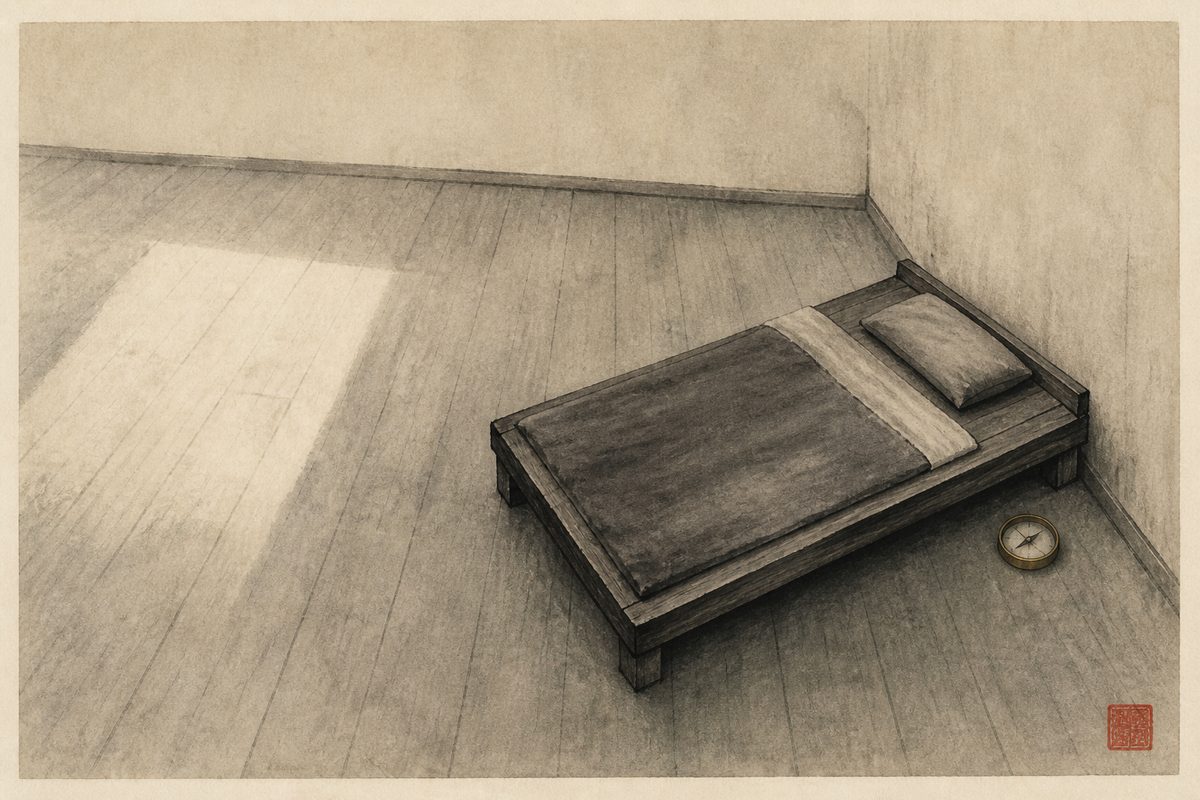
The direction is the head end
Before anything else, one definition, because getting it wrong inverts every answer on this page.
When feng shui talks about a bed's direction it means the end your pillow is on. The Chinese phrase is chuang tou chao xiang, the direction the head of the bed turns toward. If your chart says southeast, the headboard goes against the southeast wall and you spend the night looking back the other way, toward the northwest.
English-language articles collapse this constantly, partly because in English we say a chair "faces" the way a sitter looks, and a bed has no obvious front. A surprising number of charts circulating online have been quietly flipped by somebody reasoning from the sleeper's eyeline. If you take nothing else from this page: pillow first, then compass, held flat at the headboard.
Your four directions
The system that produces a personal answer is called Eight Mansions, and it works from a number you can get out of a birthday.
Feng shui bed direction chart, by kua number
Your kua number comes from your birth year and sex, with a calendar wrinkle in early February. The fastest way to get it right is our calculator; then find your row below.
| Kua | Trigram | Group | Best (Sheng Qi) | Health (Tian Yi) | Harmony (Yan Nian) | Steady (Fu Wei) | Avoid (Jue Ming) |
|---|---|---|---|---|---|---|---|
| 1 | Kan ☵ | East | Southeast | East | South | North | Southwest |
| 2 | Kun ☷ | West | Northeast | West | Northwest | Southwest | North |
| 3 | Zhen ☳ | East | South | North | Southeast | East | West |
| 4 | Xun ☴ | East | North | South | East | Southeast | Northeast |
| 6 | Qian ☰ | West | West | Northeast | Southwest | Northwest | South |
| 7 | Dui ☱ | West | Northwest | Southwest | Northeast | West | East |
| 8 | Gen ☶ | West | Southwest | Northwest | West | Northeast | Southeast |
| 9 | Li ☲ | East | East | Southeast | North | South | Northwest |
Point the head of the bed (where your head rests) toward a favorable direction. Kua 5 does not appear: the traditional formula reassigns it, 2 for men and 8 for women, which the calculator handles.
The eight kua numbers fall into two families. Kua 1, 3, 4 and 9 make up the East group, whose four favorable directions are north, east, southeast and south. Kua 2, 6, 7 and 8 make up the West group, with west, northwest, northeast and southwest. Everyone in a group shares a set, which is why the chart has that neat half-and-half look.
The four are not interchangeable. Each carries a name and a portfolio, and for the bed specifically the tradition has a preference:
- Sheng Qi, vitality, is the strongest of the four. Practitioners usually spend it on the front door or the desk rather than the bed, on the reasoning that you want your most active direction where you are active. - Yan Nian, longevity, covers rest and relationships. This is the conventional pick for a bed, and if you only remember one, remember this one. - Tian Yi, the Heavenly Doctor, governs health. The sensible choice when somebody in the bed is recovering from something. - Fu Wei, stability, is the mildest and the gentlest. A reasonable fallback in a room that will not cooperate.
Two wrinkles that catch people. The formula is different for men and women, so a brother and sister born in the same year can land in opposite groups and want opposite ends of the same room. And the traditional year turns at the spring boundary in early February rather than on January 1, so a birthday in the last week of January belongs to the previous year's count. Our kua number calculator handles both and prints your full eight-direction compass; the same arithmetic is what decides your Chinese zodiac sign.
The rule that overrules the chart
Now the part English pages generally miss, and it is the rule Chinese households actually keep.
Do not sleep with your head to the west.
It is repeated almost without exception across the Chinese home and property internet, and repeated more firmly than any of the eight-direction rules, because it is the kind of thing a grandmother enforces rather than a consultant calculates. Fang.com, one of the largest Chinese property portals, opens an article on it by noting that everybody has heard an older relative say a head to the west is bad and almost nobody can say why.
Which is the interesting part, because the portal then supplies a why, and it does not hold up. The article's stated scientific basis is that the earth turns from west to east, so a head pointing west sleeps against the direction of rotation and recovers less energy in the same number of hours, the way sitting backward on a train tires you out. It adds that the west is felt to be a direction that makes people lazy.
Now go to a second article on the same portal, on the same question. It runs the identical rotation argument and reaches the opposite conclusion: because the earth turns west to east, it says, the head must not point east, since blood will keep rushing that way and ruin your sleep.
Same physics, same publisher, opposite forbidden direction. This is what a folk rule looks like when it has outlived its explanation and keeps recruiting new ones. The taboo is genuinely old and genuinely kept. The science bolted onto it is recent and argues both ways, and you should not let it decide where your pillow goes.
The rule also collides with the compass method, which is worth naming rather than smoothing over. Eight Mansions hands west to the entire West group as one of their four good directions, so a kua 7 is told by the technique that west is favorable and by the household that west is not done. Chinese practitioners settle it the pragmatic way: you have four, take one of the other three. Nobody argues, which tells you something about how these layers coexist. The compass method is a technique. The taboo is a feeling, and in a bedroom the feeling wins.
The north argument
The other question people actually ask is whether the head should point north, and here four traditions give four different answers, which is why the Reddit threads never resolve.
| Tradition | Head to the north | Head to the south | The reasoning it gives |
|---|---|---|---|
| Eight Mansions, East group | Favorable | Favorable | Both are among the group's four; the answer comes from the birth year, not from the direction itself |
| Eight Mansions, West group | Unfavorable | Unfavorable | Same method, opposite group, opposite verdict |
| Chinese folk and home-column practice | Recommended | Recommended | A north-south alignment is said to follow the earth's magnetic field and to run with the body's main blood vessels |
| Indian Vastu Shastra | Avoid | Preferred | A separate tradition with its own directional logic, frequently quoted in English feng shui articles as though it were the same system |
Two honest notes on that table. Row three is the same class of claim as the rotation argument above: Chinese home columns state it confidently, usually in the form that a north-south sleeper has their aorta and vena cava aligned with the earth's magnetic field, and it is not an established physiological finding. It is worth reporting because a great many Chinese readers have heard it; it is not worth rearranging a room for. And row four is the source of a lot of English-language confusion, because Vastu and feng shui are separate traditions from different countries, and blending their direction rules produces advice that neither one would give.
There is also a third personalization method in circulation that neither the English articles nor most kua charts mention. Rather than the kua number, some Chinese practitioners set the head direction from your favorable element in your birth chart: if your chart wants Wood, the head goes east; if it is harmed by Metal, the head must not go west. That is a bazi calculation rather than an Eight Mansions one, and it can disagree with your kua directions entirely. If you want to see your own chart's elements before choosing between the two systems, our bazi calculator works them out.
What the old books actually say about your bed
Almost nothing, and that is the most useful fact on this page.
The oldest surviving Chinese manual on siting a dwelling is the Zhaijing, the Classic of Dwellings. It divides the compass into twenty-four paths, splits them into a yang half and a yin half, and works out the fortune of a house from how those relate. It is unmistakably a feng shui book. Read the upper scroll and you will find the word for dwelling used more than a hundred times.
You will find the word for bed zero times. Not once. Same for the words for lying down and for sleeping quarters.
This is the same pattern our page on the feng shui bedroom finds in the Ba Zhai Ming Jing, the Eight Mansions manual whose surviving edition is prefaced 1790: the classical literature is about doors, gates and which way a building sits, and it is remarkably uninterested in furniture. Aiming a bed at a personal lucky direction is a twentieth-century extension of the method, made by practitioners who carried a door technique indoors. The arithmetic is genuinely old. The bedroom application is younger than your grandmother.
There is a nice footnote attached to the Zhaijing while we are here. It circulates as the Yellow Emperor's Classic of Dwellings, and the imperial editors who cataloged it for the Siku Quanshu did not believe that for a moment: their abstract says the book did not claim him when it was written, and that practitioners of the technical arts attached his name to make their doctrine sound divine. Which is exactly what people have always done with the Yellow Emperor, whose entire career consists of having things attributed to him.
Sitting and facing, and why the bed is not the stove
One more piece of the method, because it explains why bed advice and kitchen advice sound contradictory.
Eight Mansions gives an object two properties: where it sits and what it faces. For most things you want both to be favorable. The stove is the famous exception, and Chinese practice is emphatic about it: a stove should sit on an inauspicious sector and face an auspicious direction, so that it burns away the bad and draws in the good. Our feng shui kitchen page works through that inversion properly.
The bed is the ordinary case. You want it sitting in a good sector of the room and with the head pointing in a good direction, both favorable, no cleverness. If you have read that the stove rule applies to beds, somebody has generalized an exception.
When the room will not cooperate
Most rooms will not. Doors, windows, radiators and the shape of the floor plan usually leave one or two places a bed can physically go, and the odds that either lands on your Yan Nian are not good.
Here is the order of priority that practicing consultants use, and it is the opposite of the order the internet suggests. The physical rules come first: a solid wall behind the headboard, the door visible from the pillow without the bed lying in its direct path, nothing heavy hanging overhead, and the headboard not backing onto a bathroom, a kitchen, a drain or a staircase. Chinese sources treat that last group as a real problem, on the grounds that you should not sleep with running water and moving feet behind your head. Our bedroom page covers those placement rules in full, with the diagram.
Only once the physical layer is settled does the compass layer get a vote. If your best direction is unreachable, take the least bad reachable one, or accept the room and spend your good directions somewhere you can actually use them, which in the classical method meant the front door.
That last sentence is not a consolation prize. It is what the old books were about the entire time.
Questions people ask
Which direction is best for your bed to face?
There is no single best direction for everyone, and any page that gives you one is either using a different system or guessing. In the Eight Mansions method, the one most feng shui practitioners use, your four favorable directions come from your birth year and your sex, and they split the population roughly in half. If your kua number is 1, 3, 4 or 9 you belong to the East group and your good directions are north, east, southeast and south. If it is 2, 6, 7 or 8 you are West group and your good directions are west, northwest, northeast and southwest. Point the crown of your head toward one of your four. For sleep specifically, practitioners usually choose Yan Nian, the longevity direction, whose traditional portfolio is rest and relationships.
Which direction should your head be when sleeping?
Your head, not your feet, is what the direction refers to. This is the single most common misunderstanding in English writing on the subject, and it flips the answer a full 180 degrees. In Chinese the phrase is chuang tou chao xiang, literally the direction the head of the bed turns toward, and it means the end of the bed your pillow is on. So if a chart tells you your best direction is southeast, your pillow goes at the southeast wall and you sleep looking back toward the northwest. Check which way your bed points with a phone compass held flat at the headboard.
Why should you not sleep with your head to the west?
The prohibition is close to universal in Chinese home writing, and the reason given for it is not stable. Fang.com, one of the largest Chinese property portals, runs the argument that the earth turns from west to east, so a head pointing west sleeps against the rotation and recovers less, and adds that the west is felt to be the direction that makes people lazy. The same portal, on a different page, uses the identical rotation argument to forbid a head pointing east instead. That is worth knowing before you move furniture: the taboo is old and widely kept, the physics attached to it is recent and argues both ways. The rule also collides with Eight Mansions, which gives west to the whole West group as one of their four good directions, and Chinese practitioners usually settle it by taking one of the other three.
Is it bad to sleep with your head facing north?
It depends entirely on whose tradition you ask, which is why this is the most argued-about question on the subject. Chinese home columns tend to recommend a north or south alignment on the reasoning that it follows the earth's magnetic field and runs with the body's main blood vessels. Indian Vastu Shastra says the opposite and treats a head to the north as the worst option. Eight Mansions ignores both arguments and simply asks which group you are in, giving north to the East group as a good direction and to the West group as a bad one. The magnetic-alignment argument is folk science rather than an established finding, and it is worth knowing that before you rearrange a bedroom around it.
What if you cannot point the bed in a good direction?
Then take the physical rules over the compass ones, which is what most practicing feng shui consultants do anyway. A solid wall behind the headboard, a clear view of the door without lying in its direct path, and nothing heavy overhead all matter more in practice than which of your four directions the pillow lands on, and they are the rules the older texts actually spend their time on. If the room only allows one workable position, use it, and put the compass work into the desk or the front door instead, which is where the classical method was aimed in the first place.
Sources
- • Fang.com, the scientific basis for never pointing the head of the bed west: the earth turns west to east so a head to the west sleeps against the rotation, the west as the direction that makes people lazy, the recommendation of a north-south alignment following the earth's magnetic field and the body's aorta and vena cava, and the rules that the headboard should be solid rather than empty and must not back onto a bathroom or kitchen
- • Fang.com, which way the head of the bed should point: the same rotation argument used to forbid a head to the EAST, the eight-character favorable-element method as a second personalization system distinct from the kua number, and the rule that the far side of the headboard wall should hold still objects rather than a stove or a sink
- • Fang.com, the most auspicious head direction: the East group and West group destiny split and the direction sets each is given
- • Zhaijing (宅經), the upper scroll at the Chinese Text Project: the twenty-four paths method, the yin and yang halves of the compass, and a text that discusses the dwelling more than a hundred times without once mentioning a bed
- • Zhaijing, the Siku Quanshu editors' abstract at Wikisource: the judgment that the book did not claim the Yellow Emperor as its author when it was written, and that practitioners of the technical arts attached his name to make their doctrine sound divine
- • Vastu shastra, Wikipedia: the Indian architectural tradition, which is a separate system from feng shui and gives different directional prescriptions
- • Feng shui, Wikipedia: the form school and compass school branches, and Black Sect as a westernized method not based on the classical teachings
Get your kua number and full direction chart
Enter your birthday and we work out your kua, your group, and all eight directions, with the February boundary handled for you. Open the calculator