Feng Shui
Feng Shui Entryway and Front Door: The Threshold, the Screen, and the Straight Line
How do you feng shui an entryway? Handle the straight line first. Chinese practice has one dominant worry about a front door, and it is not the color: it is whether you can see clean through the house from outside it, to a back door, a window, or a balcony. Everything else, the threshold you step over, the screen wall just inside, the swept ground in front, is the tradition solving that same problem in different materials.
The Qing manual that most modern Chinese practice descends from says a dwelling is judged on three things: its door, its master bedroom, and its stove. The door is named first, and it is named first in every later restatement of the doctrine. So if you are going to do one part of a home properly, this is the part.
What follows is the entrance as Chinese sources actually treat it, which turns out to be a stranger and more coherent subject than the English version. The English version is mostly a shopping list. The Chinese one is a single argument about lines of sight, repeated in wood, in masonry, in etiquette and in law for about two and a half thousand years.
The entrance has a name, and it is not "hallway"
The Chinese word for the space behind your front door is xuanguan, and it did not start out as an architectural term at all. It started out in Daoist inner alchemy and Chan Buddhism, where it meant the gate to the profound: the point at which a practitioner passes from one state into another. The Yuan-dynasty Daoist Li Daochun defined it as the most mysterious and subtle of mechanisms, which is quite a lot of freight for a place to leave your keys.
The xuan in it is the xuan from the first chapter of the Daodejing, the famous closing line about mystery upon mystery being the gate of all wonders. The word carries dark, deep, and hard to see into, all at once. And the same Zen term traveled to Japan, where genkan became and remains the ordinary Japanese word for the entrance of a house, the sunken step where you take your shoes off.
That history is not decoration. It tells you what the tradition thinks an entrance is: not a corridor but a transition, a place where one condition is exchanged for another. Almost every rule below is an attempt to make that exchange happen slowly enough to be real.
The oldest rule is about your feet
Chinese doorways used to have a beam across the bottom. If you have been to a temple, a palace or an old courtyard house you have stepped over one, probably higher than you expected, and probably while someone told you not to tread on it.
The object is old enough to be in the dictionary, and I mean the first one. The Erya, the oldest Chinese lexicon we have, has a chapter on buildings which defines the sill in four characters, and the commentators gloss it as the crossbar below the door forming the limit between outside and inside. A named boundary, with its own vocabulary, before the first century.
The rule about not standing on it is nearly as old, and it is not superstition in origin. It is court etiquette. The Book of Rites twice tells you how to enter a doorway properly. In the first chapter, an officer or gentleman going in or out of the ruler's gate passes to the right of the center post and does not tread on the threshold. Later, in the chapter on ceremonial dress, a guest entering does not use the middle of the gateway and does not stand on the threshold.
Two independent passages, the same two instructions. Do not walk down the center line of a doorway, because the center is reserved. Do not put your foot on the sill, because the sill is a boundary and you do not stand on a boundary, you cross it. Everything the modern superstition says about stepping on the threshold bringing bad luck is a folk memory of a rule about rank and respect.
The sill also did real work. It braced the door frame, kept out rain and rats, and stopped a toddler wandering into the street. And it acquired a social meaning: the grander the household the higher the sill, which is why Chinese still describes a hard-to-enter institution as having a high threshold. In English we would say a high bar. The Chinese metaphor is the actual piece of wood.
If your flat has no threshold, you have lost nothing structural. But it explains why the tradition treats the doorway as a thing with a top, a bottom and a middle, rather than as a hole.
The straight line is the whole problem
Here is the fault Chinese practitioners look for first, and the one English guides most often miss because it has no English name.
Stand outside your front door and open it. If you can see through the house to a back door, a window, a balcony, or a floor-to-ceiling glass wall, in a clean unbroken line, you have what Chinese sources call the piercing hall. It is treated as the commonest serious defect in a modern apartment, and the reason is easy to state without any metaphysics at all: the house is supposed to gather and hold, and a straight line from the front opening to a rear opening means everything arrives and leaves without stopping. The folk formulation is four short phrases: front open, back open, people and money both gone.
The remedy is the interesting part, because it is never to seal the opening. It is to make the line bend.
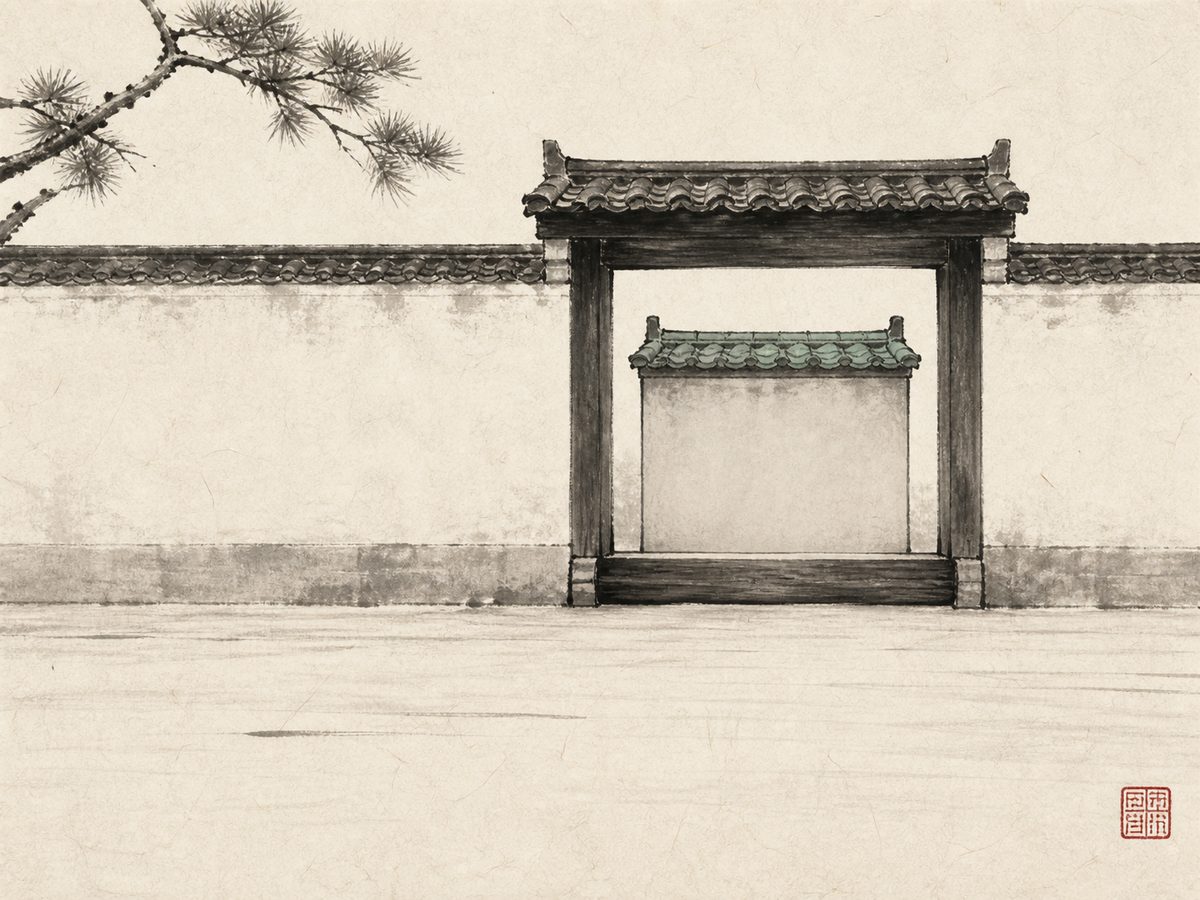
Chinese architecture has been doing this with a single object since at least the Han dynasty: the screen wall, a low free-standing wall built a couple of paces inside or outside a courtyard gate, squarely across the sightline, so that a person entering has to walk around it and a person outside sees only a blank face. It has practical uses. It gives privacy, it blocks wind, and in a walled compound it makes the gate impossible to shoot straight through. It also carries a belief that is stated plainly in the sources and that you can decide for yourself about: malicious things travel only in straight lines and cannot turn a corner.
Your version does not need to be masonry. A shoe cabinet tall enough to break the view, a folding screen, a console table with something solid on it, a half-height partition, or, in a small flat, an opaque curtain hung across the offending sightline. What matters is that the eye stops. A glass-fronted cabinet does not count, and a plant with gaps in it does not count.
This is also the answer to a related complaint, the door that opens straight onto a staircase running down at it, and to the maxim about seeing the cooker from the entrance, which our kitchen guide covers at length. Same fault, same fix, different room.
What is in front of the door counts more than what is behind it
Form-school feng shui has a term for the open ground in front of a dwelling: the bright hall, the mingtang. It is the space where energy is supposed to collect and settle before it goes anywhere, and the qualities the sources ask of it are broad, level, clean, bright, and unhurried. A wide forecourt is a good bright hall. A narrow gap between your door and a neighbor's wall is a poor one. A driveway running at your door like a lane at a target is the classical fault of the road rush, and it is disliked for exactly the same reason as the piercing hall.
Chinese sources split the term in two, and it saves a lot of confusion to know that. There is an outer bright hall and an inner one. The outer is the ground in front of the gate, which is what this section is about. The inner is the first gathering space you reach once you are through the door, which in a modern home is the living room, and which our living room guide treats at length. One idea in two rings: somewhere to pause outside, somewhere to settle inside.
The practical consequences are almost embarrassingly ordinary, which is a point in their favor:
Keep the approach clear and swept. Fix the light. Cut back anything that makes you duck or turn sideways. Do not let the bins live beside the door. If a path comes straight at the entrance, put a curve in it, or a planter, or anything that makes the last few steps turn.
Two situations get asked about constantly. A door directly facing another flat's door across a corridor is a real item in Chinese practice, read as two households confronting each other, and the standard settlement is undramatic: keep yours closed, make yours visibly better kept, and if you like, hang a curtain inside it. A door opening onto a bathroom or a kitchen door is the same complaint with a stronger flavor, and the same answer.
And one thing the tradition does not say: none of this requires you to buy an object. The entire bright-hall doctrine is about space and maintenance.
Which direction the door should face
Now the compass, and it goes last here for the same reason it goes last everywhere on this site: a door with a good bearing and a blocked, dark, piercing-hall approach is a worse door than a badly oriented one you can actually walk through.
The Eight Mansions method splits the compass into four favorable and four unfavorable directions for each person, derived from birth year. The door is the placement practitioners will spend the strongest of the four on. Sheng Qi, the vitality direction, traditionally goes to the front door or the desk rather than the bed, on the reasoning that you want your most active direction where the activity is.
Find your directions
Your kua number comes from your birth year and sex, with a calendar wrinkle in early February. The fastest way to get it right is our calculator; then find your row below.
| Kua | Trigram | Group | Best (Sheng Qi) | Health (Tian Yi) | Harmony (Yan Nian) | Steady (Fu Wei) | Avoid (Jue Ming) |
|---|---|---|---|---|---|---|---|
| 1 | Kan ☵ | East | Southeast | East | South | North | Southwest |
| 2 | Kun ☷ | West | Northeast | West | Northwest | Southwest | North |
| 3 | Zhen ☳ | East | South | North | Southeast | East | West |
| 4 | Xun ☴ | East | North | South | East | Southeast | Northeast |
| 6 | Qian ☰ | West | West | Northeast | Southwest | Northwest | South |
| 7 | Dui ☱ | West | Northwest | Southwest | Northeast | West | East |
| 8 | Gen ☶ | West | Southwest | Northwest | West | Northeast | Southeast |
| 9 | Li ☲ | East | East | Southeast | North | South | Northwest |
Kua 5 does not appear: the traditional formula reassigns it, 2 for men and 8 for women, which the calculator handles.
Read your row, and take the direction the door faces, which is the way you look when you stand inside and open it, not the way you look walking up to the house. Aim for any of your four favorable directions and prefer Sheng Qi if the building allows it.
Then accept the usual complication honestly. A house has one front door and a household usually has several kua numbers, often split across the two groups, so there is no arrangement that serves everybody. The conventional settlement is to calculate the door for the head of the household and spend the other people's good directions on their own rooms, desks and beds, which are things you can actually move. If you want your number, our kua number calculator will work it out from your birth year, using the solar-term year boundary rather than January 1.
Everything people put by the front door, sorted
| The object | What the tradition actually says | What it is really doing |
|---|---|---|
| A mirror facing the door | Genuinely on the classical fault lists, second on some of them. Fine on a side wall at right angles to the door. Our mirror guide has the full case | The first thing every arriving guest meets is themselves |
| A screen, tall cabinet or console | The core remedy, and the oldest one in the discipline | Breaking the sightline through the house |
| Shoes in a heap | Top of every practitioner's fault list, ahead of any ornament | Making the door hard to open, which is the actual complaint |
| A water feature or fish tank | Traditional near an entrance, with a real condition attached: moving water in, not draining away, and never under a staircase | Mostly noise and humidity; the symbolism is genuine but secondary |
| Plants | Liked if healthy and out of the swing of the door; dried, dead or thorny plants are specifically disliked | Filling an awkward corner. A dead plant by a door reads badly in any tradition |
| A wind chime | Modern and Western in this position more often than not | Telling you a door has opened |
| A pair of guardian lions | Old and genuinely Chinese, but a gate custom, not a feng shui rule: a male and female pair outside, facing out, the male on your right as you face the door. Our page on foo dogs has the placement and the history | Announcing that the house means business |
| Wealth ornaments and lucky cats | A retail category, not a classical requirement | Whatever you want them to |
| Good light | Not usually listed as feng shui at all, which is a pity, because everything the bright hall doctrine asks for depends on it | The single cheapest improvement available |
When your entryway will not cooperate
Most homes fail at least one of these, and the tradition is far more relaxed about that than its English translations suggest. There is a working order.
Break the straight line, if you have one. That is the one rule on this page that Chinese practitioners treat as close to non-negotiable, and it can be solved for the price of a shoe cabinet.
Then make the door work: opens fully, lit, clean, clear approach, nothing to trip over. Then clear the ground outside as far as it belongs to you. Then, and only then, take the compass reading, and if your favorable directions are unavailable, spend them somewhere you can, on the bed, the desk, or the stove.
And if you open the door straight onto a wall two feet away, which is the fate of a great many apartments, the classical view is unexpectedly cheerful about it. A blank wall close to the entrance is a screen you did not have to build. Light it, hang something calm on it, and you have the oldest entrance arrangement in Chinese architecture by accident.
Questions people ask
What do you put in an entryway for good luck?
Less than you think, and the tradition is more interested in what you take out. The classical entrance is a place of transition rather than display: a raised threshold to step over, a screen or a turn so you cannot see straight into the house, good light, and clear floor. Chinese practitioners consistently put clutter, shoe piles and anything that makes the door hard to open at the top of the fault list, ahead of every object you could add. If you want to add something, the safe choices are light, a plain solid piece of furniture that gives the space a back, and a place to actually put the shoes. The wealth-attracting ornaments sold for this spot are a modern retail category, not a classical requirement.
What is the best feng shui color for a front door?
There is no single answer and no classical list of forbidden colors, whatever the listicles say. The traditional logic is elemental: pick a color whose element is compatible with the direction the door faces, so a north-facing door leans toward water and metal tones, a south-facing door toward wood and fire tones. Red is the one color with real historical weight, and not as a charm. A vermilion gate was a rank marker, the mark of a wealthy or official household, which is why Du Fu could write in 755 that behind the vermilion gates the meat and wine go rancid while the frozen dead lie in the road. Our page on feng shui colors works through the direction-by-element pairings properly.
What direction should a front door face in feng shui?
One of your four favorable directions, and the door is the one thing practitioners will spend a good direction on before anything else. Your birth year gives you a kua number, and the number splits the compass into four favorable and four unfavorable directions for you specifically. Sheng Qi, the strongest of the four, is traditionally given to the front door or the desk rather than the bed, on the reasoning that you want your most active direction where the activity is. Two honest caveats: the direction measured is the way the door faces when you stand inside looking out, and a household usually contains more than one kua number, so the convention is to calculate for the head of the household and leave it there.
What should you not have facing your front door?
In rough order of how seriously Chinese practice takes it: a back door, a window, or a balcony in a straight line from it, which is the fault called the piercing hall; a staircase running straight down at the door; a mirror square on to it; another flat door directly opposite, especially a bathroom or a kitchen door; and a road, driveway or corridor aimed at the entrance like an arrow. Notice that all five are the same complaint in different clothes. The tradition dislikes a straight uninterrupted line at an entrance and likes anything that makes the arriving energy turn a corner.
Why is it bad if the front door lines up with a window or the back door?
This arrangement has its own name in Chinese, the piercing hall, and it is treated as the single commonest fault in a modern apartment. The reasoning is that the house is supposed to gather and hold energy, and a clean line from the entrance to an opening on the far side means it arrives and leaves without ever settling, which practitioners tie to money that will not stay. The folk version is blunter: front open, back open, people and money both gone. The remedy is never to block the opening, it is to interrupt the sightline, with a screen, a tall solid shoe cabinet, a console with a plant on it, or a curtain. This is the same move Chinese architecture has made for two thousand years with the free-standing screen wall inside a courtyard gate.
How can I make my front door attract money?
By making it work as a door. The practical list that Chinese practitioners actually give is unglamorous: the door opens fully without hitting anything, it is well lit, it is clean and in repair, the number and the bell work, the ground outside is level and swept, and nothing blocks the approach. Behind it, break any straight sightline through the house. The reason this reads as a wealth measure rather than housekeeping is the classical idea of the bright hall, the open space in front of an entrance where energy is supposed to gather before coming in: a wide, clean, level approach is understood as prosperity being able to find you and pause. Our wealth corner guide covers the spot inside the home that the tradition treats separately.
Sources
- • Erya, Explaining Buildings: the sill is called the yu, glossed by the commentators as the crossbar below the door that forms the limit between outside and inside (Chinese Wikisource)
- • Book of Rites, Quli I: a great officer or gentleman entering the ruler's gate passes to the right of the center post and does not tread on the threshold (Chinese Wikisource)
- • Book of Rites, Yuzao: the guest entering does not use the middle of the gateway and does not stand on the threshold (Chinese Wikisource)
- • Daodejing, chapter 1 (Wang Bi recension): mystery upon mystery, the gate of all wonders, the source of the word xuan in xuanguan (Chinese Wikisource)
- • Xuanguan, Chinese Wikipedia: the term's origin in Daoist inner alchemy and Chan Buddhism, Li Daochun's definition of it as the most mysterious and subtle of mechanisms, and its later use for the entrance space of a building
- • Spirit screen (yingbi / zhaobi): the free-standing screen set inside or outside a courtyard gate, tied to the belief that evil spirits cannot move around corners and are therefore blocked from entering through the gate, Wikipedia
- • On the piercing hall (chuantang sha): the door aligned with a rear door, window or balcony so that energy passes straight through, its treatment as the commonest fault in an apartment, and the standard remedies of a screen, a solid shoe cabinet or an opaque curtain
- • The folk saying 'front open and back open, people and money both empty', applied to a door facing a window
- • On the bright hall (mingtang): the open ground in front of a dwelling's gate, read as the place where earth energy gathers, and the preference for it to be broad, level and able to hold rather than channel
- • Ancient Architecture Home (a Chinese heritage-architecture blog), on the door threshold: its structural purpose, the Erya gloss, and the taboo on treading on it recorded from the pre-Qin period
- • Du Fu, Five Hundred Words on the Journey from the Capital to Fengxian (755): behind the vermilion gates meat and wine go rancid, on the road lie the bones of the frozen dead (Chinese Wikisource)
- • The Three Essentials of the Yang Dwelling (Yangzhai Sanyao), the Qing manual attributed to Zhao Jiufeng: the doctrine that a dwelling is judged on its door, its master bedroom and its stove, with the door named first
Get your kua number and full direction chart
Enter your birthday and we work out your kua, your group, and all eight directions, with the February boundary handled for you. Open the calculator