Feng Shui
Feng Shui Kitchen: The Fire Mouth, and Why the Stove Wants a Bad Direction
How do you feng shui a kitchen? Start with the stove, because in Chinese practice the kitchen is not one room among many. It is one of the three things a house is judged on, alongside the front door and the main bedroom. And the rule that governs it will look backwards to you: the stove should sit on one of your unlucky directions and face one of your lucky ones. What faces is the fire mouth, not the appliance. Everything else follows from that.
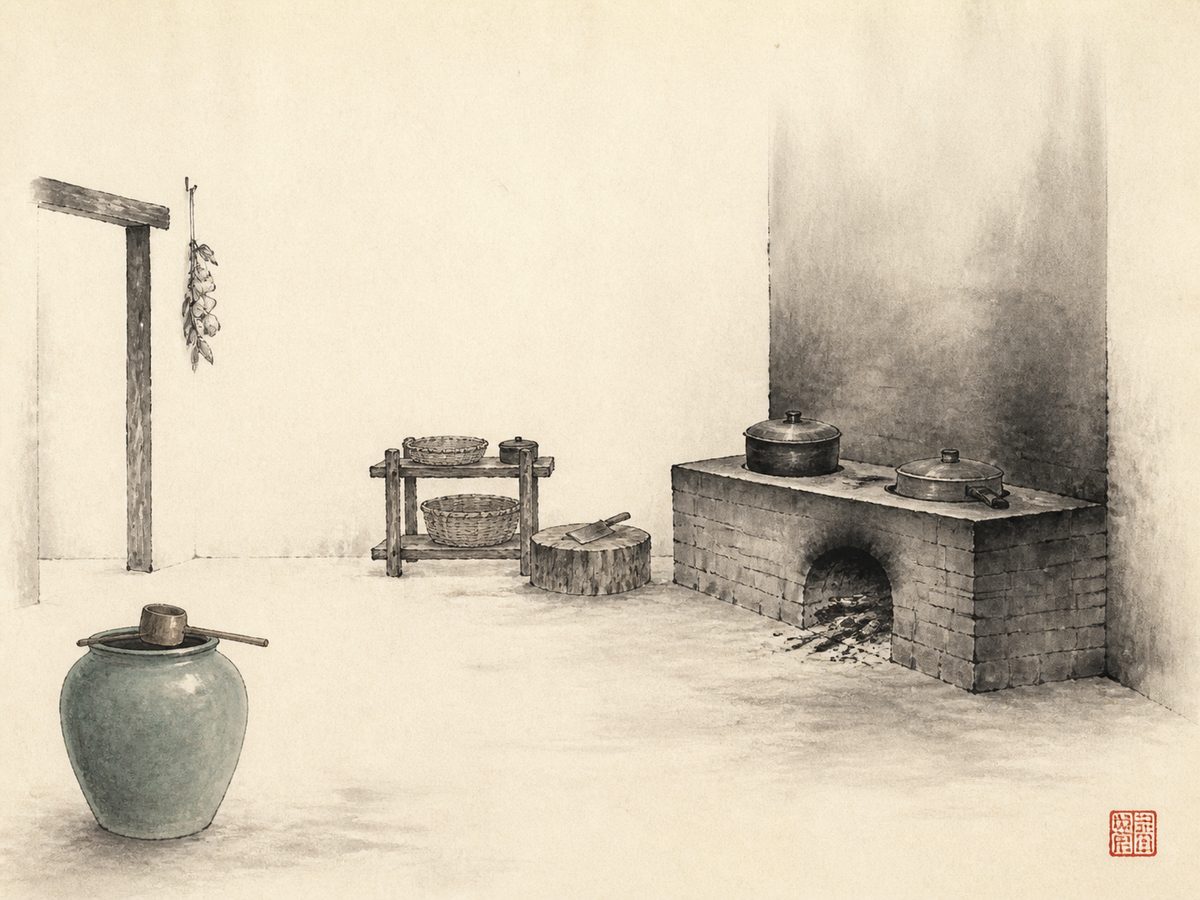
The kitchen is not one room among many
Here is the thing that reorders every English kitchen guide you have read.
Classical Chinese house siting does not work through a long checklist of rooms. It works through three of them. The Qing-dynasty manual known as The Three Essentials of the Yang Dwelling is named for exactly this: a house is judged on its door, its master bedroom, and its stove. Everything else in the building is detail. The door is described as the household's mouth and throat, the passage everything comes in through. The bedroom is where the head of the house sleeps. And the stove is on the list, in the compiler's own reasoning, because eating is the foundation of being alive.
One room in three. Not the dining room, not the study, not the entrance hall. The stove.
That is why Chinese kitchen advice is so much more specific and so much more anxious than the Western kind, and why it treats the appliance rather than the room as the subject. A Chinese consultant walking into your apartment is not evaluating your kitchen. They are evaluating your stove, and the kitchen is merely the box it came in.
There is also a reason the stove in particular got sacred, and it is worth a paragraph even though this page is not going to spend more than that on it. Chinese households kept a Kitchen God above the hearth, a resident deity who watched the family all year and went up at New Year to report on them. The stove was therefore the one appliance in the house with a witness sitting on it. That belief is not the subject here, and it has a page of its own; what matters for layout is the residue it left, which is that Chinese practice treats the stove as a moral and financial object rather than a mechanical one.
The fire mouth, and the rule that runs backwards
Now the part that is genuinely absent from almost every English page on this search, and that changes what you actually do.
Ask a Chinese practitioner which way a stove should face and they will not answer about the stove. They will answer about the fire mouth, huomen (火門): the opening where fuel goes in. On a traditional brick stove this is unmistakable, a hole at the front where you fed in wood or coal. On a modern range it is the control side, the face with the knobs, the side you stand at to cook. That, not the back of the unit and not the direction the cook happens to be looking, is what the tradition means by the stove's orientation.
And now the rule, which is stated in Chinese sources as flatly as a law: the stove sits on an inauspicious direction and its mouth faces an auspicious one. Sit on the bad, face the good.
Read that twice, because it inverts everything else in the discipline. For a bed, a desk, or a sofa you want the favorable direction, full stop, as our page on bed direction sets out. For a stove you deliberately place the body of the thing on one of your four unfavorable directions, so that its mouth can point at a favorable one. The geometry makes the reason obvious once you see it: the mouth points opposite the seat, so a stove sitting on a good direction is necessarily a stove pointing its mouth at a bad one, which is precisely the thing to avoid. Chinese guides spell out the consequence in a single line: if it sits on the auspicious side, the fire mouth must be aimed at the inauspicious one, and then you have ruined it.
There is a second, older logic underneath the geometry, and it is the one I find persuasive. Fire is the element that consumes. Sitting the stove on your worst direction puts your worst direction under the fire, to be burned off. You are not avoiding the bad quarter. You are cooking on top of it.
Find your directions
Your kua number comes from your birth year and sex, with a calendar wrinkle in early February. The fastest way to get it right is our calculator; then find your row below.
| Kua | Trigram | Group | Best (Sheng Qi) | Health (Tian Yi) | Harmony (Yan Nian) | Steady (Fu Wei) | Avoid (Jue Ming) |
|---|---|---|---|---|---|---|---|
| 1 | Kan ☵ | East | Southeast | East | South | North | Southwest |
| 2 | Kun ☷ | West | Northeast | West | Northwest | Southwest | North |
| 3 | Zhen ☳ | East | South | North | Southeast | East | West |
| 4 | Xun ☴ | East | North | South | East | Southeast | Northeast |
| 6 | Qian ☰ | West | West | Northeast | Southwest | Northwest | South |
| 7 | Dui ☱ | West | Northwest | Southwest | Northeast | West | East |
| 8 | Gen ☶ | West | Southwest | Northwest | West | Northeast | Southeast |
| 9 | Li ☲ | East | East | Southeast | North | South | Northwest |
Kua 5 does not appear: the traditional formula reassigns it, 2 for men and 8 for women, which the calculator handles.
Read your row, take the four unfavorable directions from it, and put the stove body on any of them. Then check that the control side points into one of your four favorable directions, ideally Tian Yi, the health star, which is the one traditionally wanted for anything to do with food and medicine. The usual complication applies: two people in the same household can have opposite good directions, and the conventional settlement is to calculate the stove for whoever does the cooking, on the grounds that they are the one standing in it.
And keep the ranking honest. A stove pointed at your best direction with a window behind it and a sink beside it is a worse stove than one on the wrong bearing against a solid wall. The compass is the last adjustment here, exactly as it is everywhere else on this site.
Water and fire, which is the one everybody has
If the fire mouth is the rule nobody in English tells you, the water-fire clash is the rule everybody has and nobody explains.
The stove is fire. The sink is water. The refrigerator, in the Chinese reading, is water too, and so is the washing machine that ends up in a lot of apartment kitchens. Chinese guides state the problem in four characters that translate to something like water and fire will not tolerate each other, and the practical version is a short list: the stove should not be directly opposite the sink, should not be immediately beside it, and should not be directly opposite the refrigerator either.
Taiwanese design columns tie the arrangement to an unsettled household and to money that does not stay. The version a kitchen fitter would give you is less mystical and points the same way: a burner within splashing distance of a tap is a burner that gets put out, and steam and open flame are poor neighbors. When a metaphysical rule and a safety inspector agree, the rule tends to be old for a reason.
Three remedies are standard, in ascending order of effort. Put the two on different runs of counter, ideally at a right angle rather than facing off across a galley. Leave a working stretch of counter between them, which most cooks want anyway. Or, if the layout is fixed, put something wooden in between: a wooden board, a wooden utensil rack, a chopping block. The reasoning is the productive cycle of the five elements, where water feeds wood and wood feeds fire, so a wooden object standing between them turns a collision into a relay. Whether or not you believe the cycle, the physical effect is a barrier and a bit of distance, which is what the rule wanted.
The same elemental logic explains the one placement Chinese practice actively likes. The kitchen itself is best in the east or southeast of the home, because those are the wood quarters, and a fire room set in a wood quarter is being fed. It is one of the rare feng shui rules that is genuinely constructive rather than avoidant.
Five things that are actually about the building
The rest of the classical kitchen list is not about the compass at all. It is about structure, and every item is the same worry wearing a different hat: a stove needs support, privacy, and nothing on top of it.
A solid wall behind it. Chinese practice calls a supported position having a mountain at your back, and it wants one for the stove as much as for a bed or a desk. Taiwanese columns name two modern failures of this directly: the fashionable island hob, standing free in the middle of the floor with nothing behind it, and the stove installed in front of a window, which they gloss as the mountain is empty and the treasury leaks white. If you are choosing a kitchen layout and you take one thing from this page, take this one. It is the easiest to get wrong at the showroom and the hardest to fix afterward.
Not visible from the front door. This is the one with the classical quotation attached: open the door and see the stove, and much wealth is spent, cited to The Three Essentials of the Yang Dwelling. The stove is being read as the household's treasury, and a treasury on view from the entrance is a treasury that drains. The remedy is the same one Chinese architecture has always used against a straight line, which is to interrupt it. Courtyard houses did it with a spirit screen inside the gate, on the belief that malicious things travel only straight and cannot turn a corner. Your version is a partition, a tall solid cabinet, or a curtain hung across the kitchen doorway.
Nothing overhead. No structural beam crossing above the stove. The stated worry is pressure on the cooking fire; the version practitioners write down is that it makes the woman of the house ill, which tells you something about who was assumed to be standing there. The modern reading is the same one that applies to a beam over a bed: it is faintly oppressive to stand under, and everybody feels it whether or not they have a word for it.
Away from the bathroom. Not sharing a wall with the toilet, not directly beneath an upstairs bathroom, and not sitting over a drainage run. This is the water-fire clash again with hygiene added, and it is the one rule on the list where the ancient and the modern objection are almost the same sentence.
Not at the center of the home. A kitchen in the exact middle of the floor plan is called fire burning the central hall, and it is treated as a defect of the apartment rather than a matter of taste, associated with digestive and heart complaints. There is no elegant fix. Where you can, cook elsewhere in the plan; where you cannot, the honest answer is that this is one of the things a floor plan decides for you.
Which kitchen rules are actually old
The house habit is to label the layers rather than blur them, so here is the sorting for this room.
| The rule | Which layer it comes from |
|---|---|
| The stove is one of the three things a house is judged on | Classical. It is the organizing doctrine of a Qing-dynasty manual, and the stove's inclusion is argued from the fact that eating is the foundation of life. |
| The fire mouth faces a favorable direction while the stove sits on an unfavorable one | Compass-school doctrine, Eight Mansions. Fully worked out, internally consistent, and dependent on your birth year. |
| Open the door and see the stove, and much wealth is spent | Quoted in Chinese sources as a maxim from the Qing manual, and repeated in every Chinese kitchen guide since. |
| Stove and sink must not face or adjoin | Five-element reasoning, universal in Chinese practice, and agreed on by every school. Not a line you can point to in a Tang text. |
| A solid wall behind the stove | Form-school instinct, the same rule applied to beds and sofas. Universal and unwritten. |
| Kitchen best in the east or southeast | Five-element reasoning, wood feeding fire. Standard Chinese teaching, rarely mentioned in English. |
| No beam over the stove | Practitioner convention. Universal, and agreed on by schools that agree on little else. |
| The kitchen as the household's treasury | Standard modern Chinese practice, taught everywhere in Chinese and almost nowhere in English. |
| A nine-square grid aligned to your front door putting the kitchen in a life area | A modern Western method, listed in the standard surveys of the discipline as not based on classical teachings. Our bagua map guide covers where it came from. |
The last row deserves its sentence, because it is the main reason English and Chinese kitchen advice do not sound like each other. The Western grid method assigns the kitchen a life theme depending on where it lands in a nine-square overlay, which produces advice about the kitchen and your career or your relationships. Chinese practice does not do this. It asks where the fire mouth points and what is behind the stove, and then it stops.
When your kitchen won't cooperate
Most kitchens are already built, and most of us are not moving a gas line. So work in order, cheapest first.
Break the sightline from the front door, if there is one, with furniture you already own or a curtain. Get something behind the stove if it is standing free or backed onto a window, even if that something is a solid splashback panel and a shelf. Separate the stove and sink by whatever distance the counter allows, and if the answer is none, put a wooden board between them and stop worrying about it. Take the compass reading last, once the rest is settled, and get your directions from the kua number calculator.
If you are renting, you will not win most of these, and that is fine. This tradition grew up as the art of reading a site you were handed, and both of its branches, the form school and the compass school, were developed by people who could not move a hill either. What it actually asks of you is attention: notice what stands behind you when you cook, what the fire is pointed at, what is directly overhead, and how far the water is. The bedroom guide applies the same three questions to the other room on the classical list of three, and the wealth corner guide covers the spot in the living room that Chinese practice treats as the other half of the household's money.
And the one thing worth spending money on, if you ever get to choose a kitchen from scratch: put the stove against a real wall. Every other rule on this page has a workaround. That one does not.
Questions people ask
Where should a stove be placed in a feng shui kitchen?
Against a solid wall, out of sight of the front door, not next to or opposite the sink, and not under a beam or a window. Then, and only then, the direction. The classical rule is that the stove sits on an unfavorable compass direction while its fire mouth faces a favorable one, which is the reverse of how you place a bed. In a modern kitchen the fire mouth is the control panel side, the side you stand on to work. If you can satisfy only one thing, satisfy the solid wall behind it: Chinese practice treats an unsupported stove, the kind you get with a fashionable island hob, as a defect it has a name for.
Why can't the stove face the sink in feng shui?
Because it is the plainest possible clash of elements. The stove is fire and the sink is water, and Chinese guides say so in four characters that need no translation into theory: water and fire do not tolerate each other. The concern is not only symbolic. Practitioners tie it to an unstable household and to money that does not stay, and the version aimed at kitchen fitters is more prosaic, that steam and splash reaching a flame is a genuinely bad idea. The standard remedies are to move one of them, to put the two on different runs of counter, or to place something wooden between them, on the logic that water feeds wood and wood feeds fire, so the wood becomes a translator between two things that otherwise fight.
Is it bad feng shui to see the kitchen from the front door?
Yes, and this is one of the oldest lines on the subject. Chinese sources quote it as a maxim from the Qing manual The Three Essentials of the Yang Dwelling: open the door and see the stove, and much wealth is spent. The reading is that the stove is the household's treasury, since it is where food and therefore livelihood is produced, and a treasury in plain view of the entrance is a treasury that leaks. Taiwanese design columns give it a blunter name, exposing the treasury. The remedy is the same one Chinese architecture has used for two thousand years for every straight-line problem: put something in the way. A partition, a tall cabinet that is not glass-fronted, or a curtain across the kitchen doorway.
Which direction should a kitchen face in feng shui?
There are two answers and they are asking different questions. The room itself is traditionally liked in the east or southeast, on five-element grounds: those are wood directions, wood feeds fire, and a fire room in a wood quarter is being fed rather than fought. The direction that actually gets calculated, though, is not the room's, it is the fire mouth's, and that one is personal. Your birth year gives you a kua number, and the number splits the compass into four favorable and four unfavorable directions for you specifically. The stove goes on the bad ones and points at the good ones.
What should you avoid in a feng shui kitchen?
In rough order of how seriously Chinese practice takes it: a stove in plain view from the front door; a stove next to, opposite, or across from the sink or the refrigerator; a stove with a window rather than a wall behind it, or nothing behind it at all; a stove directly under a beam; a kitchen sharing a wall with, or directly beneath, a bathroom; and the kitchen sitting at the exact center of the home, which practitioners call fire burning the central hall and treat as a structural defect rather than a preference. Notice that six of the seven are about position, and none of them requires you to buy anything.
Sources
- • The Three Essentials of the Yang Dwelling (Yangzhai Sanyao), the Qing manual attributed to Zhao Jiufeng: the doctrine that a dwelling is judged on its door, its master bedroom and its stove, and the reasoning that the kitchen matters because eating is the foundation of life
- • The fire-mouth (huomen) doctrine: the stove's orientation is read from the mouth where fuel enters, and the Eight Mansions rule that the stove must sit on one of the four inauspicious stars while its mouth faces one of the four auspicious ones, since a stove sitting on a good direction necessarily points its mouth at a bad one
- • Gorgeous Space (Taiwan), fourteen faulty stove layouts: the stove at the home's center as fire burning the central hall, the stove visible from the front door as exposing the treasury, open the door and see the stove and much wealth is spent, the stove adjacent to a bathroom, under a beam, with no backing, with a window behind it, opposite the refrigerator, and adjacent to the sink as water and fire not tolerating each other
- • Gorgeous Space (Taiwan), twelve kitchen arrangements for prosperity: the kitchen read as the household's treasury, and the placement logic for the stove, sink and refrigerator
- • On the stove and sink clash and its remedies, including separating the two and placing a wooden element between them on the logic that water feeds wood and wood feeds fire
- • Book of Burial (Zangshu), Inner Chapters: the passage that names the discipline, qi scattering on the wind and stopping at water (Chinese Wikisource)
- • Spirit screen (yingbi / zhaobi): the free-standing screen shielding a courtyard gate, and the belief that malicious spirits travel only in straight lines, Wikipedia
- • Feng shui (the form school and compass school branches, and BTB listed as a westernized method not based on classical teachings), Wikipedia
Get your kua number and full direction chart
Enter your birthday and we work out your kua, your group, and all eight directions, with the February boundary handled for you. Open the calculator