Feng Shui
Feng Shui Mirrors: Facing the Bed, Facing the Door, and the One You Should Never Hang
Are mirrors bad feng shui? Not as a class, no. Chinese practice objects to three specific placements and is relaxed about the rest: not facing the bed, not facing a door, and not in the wealth corner. Everywhere else a mirror is a useful tool for light and space. The one genuinely serious rule is about a different object entirely, the eight-trigram mirror hung outside a house, which has etiquette attached and has started real quarrels between neighbors.
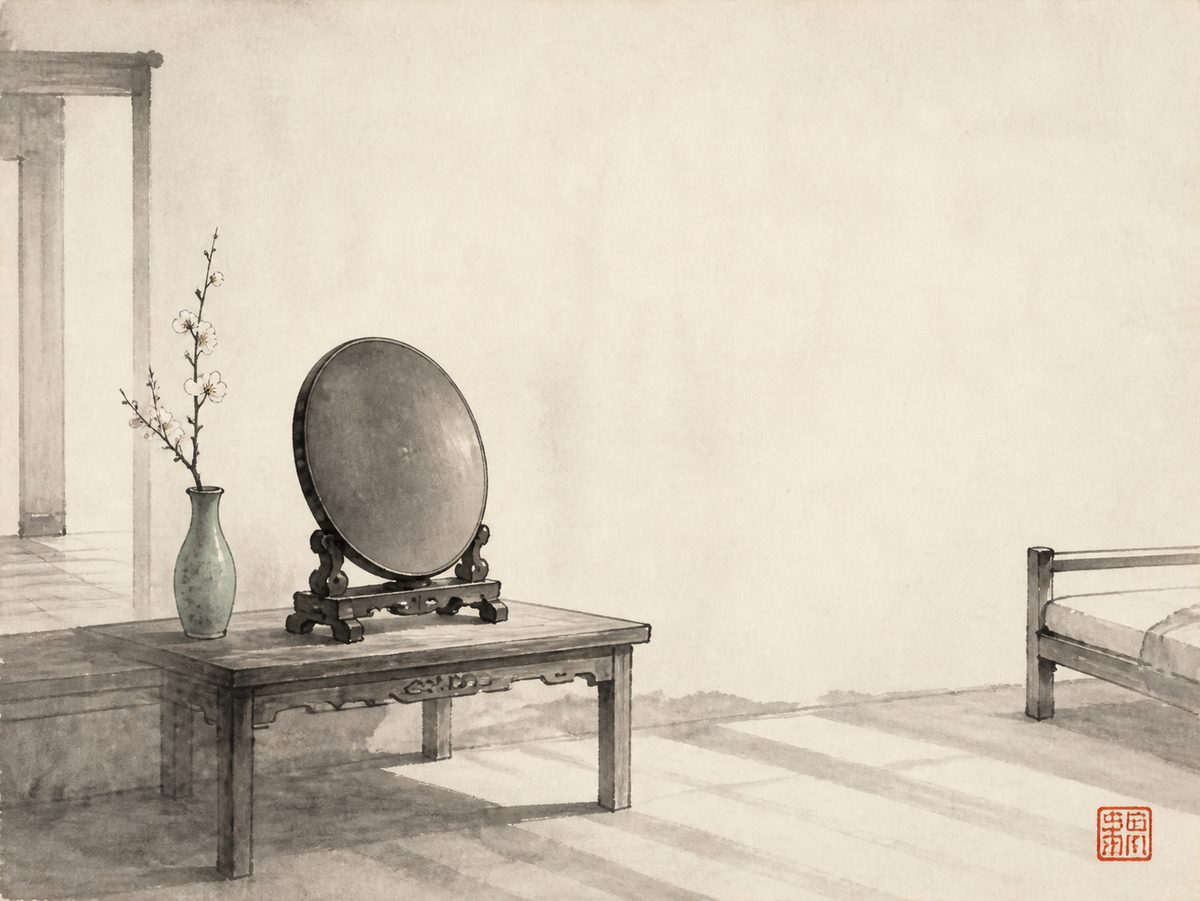
Mirrors are not the problem. Three placements are.
English feng shui writing has managed to give a lot of people the impression that mirrors are dangerous objects to be rationed. Chinese practice does not think this. It objects to a small number of specific positions, it is enthusiastic about one, and about all the rest it is relaxed, which is why Chinese apartments are full of mirrors and nobody is anxious about it.
The three to avoid are the bed, a door, and the wealth corner. That is close to the whole of it for the inside of a home, and the reasoning for each is worth having, because once you know the reason you can judge the borderline cases yourself instead of memorizing a list.
Then there is a fourth object which is not really a mirror in the domestic sense at all, the eight-trigram mirror hung on the outside of a building, and that one has a genuine etiquette attached. It is the part of this subject that Chinese sources treat most seriously and English sources barely mention, so it gets its own section below.
One honest note before any of it. Mirrors are almost entirely absent from the classical siting literature. The Book of Burial, the text that gives the discipline its name, is about wind and water and the shape of the land, and it has nothing to say about your hallway. Mirror rules are practitioner convention, mostly late, layered onto an object that carries genuinely ancient symbolism for reasons that have nothing to do with interior arrangement. That is not a debunking. It is a request that we label the layer, which is the habit of this site.
The bed, which is the one people actually search for
Stand at the foot of your bed. If a mirror, a mirrored wardrobe door, or a large dark television screen is looking back at you, you have the arrangement Chinese practice objects to most consistently.
The traditional reason is about sleep and the soul. A sleeper's spirit is understood to be loose and wandering, and a mirror in front of the bed gives it a shock when it comes back. Hong Kong and Taiwanese columns add a second layer that is worth knowing because it is the version many Chinese households actually repeat: a mirror reflecting the bed is said to invite unwanted romantic entanglement into a marriage, and it is blamed for friction between couples as well as for poor rest.
And then there is the reason that requires no metaphysics at all, which the Taiwanese design columns cheerfully print alongside the other two. You wake at three in the morning, half conscious, and something moves in the dark at the end of the bed, and it is you. Anybody who has slept in a hotel room with a badly placed mirror knows the exact feeling. When a rule about a wandering spirit and a rule about being startled by your own reflection produce the identical piece of furniture advice, arguing about which is true is not a good use of anyone's evening.
The remedies, in order of cost: move the mirror; turn it around; put it on the inside of a wardrobe door, which is what most Chinese bedrooms do and which solves the problem completely; or, in a rental where the mirror is fixed to the wall, hang a cloth or a curtain over it at night. That last one is the standard renter's answer in Chinese sources and it is not considered a fudge.
Bed placement itself, which matters more than the mirror does, is covered in the bedroom guide.
Doors, and the twin
The second placement is a mirror facing a door, and the tradition means it in two directions.
A mirror facing a bedroom door creates a door confronting a door, because the reflection is read as a second doorway standing opposite the real one. Chinese sources treat a door-against-door condition as a quarrel condition, associated with sharp words between people in the house. It is one of the tidier pieces of reasoning in the discipline: two mouths facing each other.
A mirror facing the front door is the version listed among the classic taboos of doors and windows, where the Taiwanese practitioner Xie Yuanjin puts it second on his list. The metaphysical reading is that the arriving energy of the household bounces straight back out. The reading that survives translation better is that a mirror at the entrance means the first thing every arriving guest meets is themselves, which is a strange way to greet somebody in any culture.
Neither of these is classical ruling. Both are practitioner convention, and this page labels them as such, exactly as the living room guide does when it meets the same rule from the other direction.
A side wall in an entryway is different, and is fine. A mirror set at right angles to the door, so that it brightens a dark hall without confronting the entrance, is normal in Chinese homes and nobody objects.
The wealth corner, and the one placement everybody has backwards
The third no is short. The wealth corner, the diagonal spot from the living room entrance, is supposed to be still, bright, solidly backed, and quiet. A mirror there is specifically listed among the things that do not belong, alongside a speaker, the laundry, and the bin, on the grounds that the spot wants settling and a mirror wants moving. The full list of what does belong there is in the wealth corner guide.
Which brings up the mirror advice that is repeated most often in English and is the least well grounded: that a mirror reflecting your money, your cash register, or your wealth area doubles it. In the wealth corner's case that is the reverse of what Chinese sources say.
But there is a real version of the doubling idea, and it is worth knowing because it is one of the very few mirror placements Chinese practice actively likes. A mirror positioned to reflect the dining table, and the food on it, is read as doubling the household's abundance. That one is genuinely traditional, it is easy to arrange, and it is the answer to give anyone who asks whether mirrors can be lucky. Aim it at dinner, not at the bank.
The eight-trigram mirror, and the etiquette nobody mentions
Now the object that is not really furniture.
Walk through an older neighborhood in Taipei or Hong Kong and you will see small round mirrors set in octagonal wooden frames, painted with the eight trigrams, hung above doorways and on balconies. This is the bagua mirror, and it is not decoration and not an indoor object. It is a piece of defensive equipment, hung on the outside of a building, aimed at one specific external thing: a road running straight at your door, a utility pole planted in front of your window, the sharp corner of the building opposite pointed at your flat like a blade.
There are three kinds and they are not interchangeable. Chinese sources are precise about the difference, and this is the part that gets lost entirely in English:
- The convex mirror deflects and disperses. It is the one for a road aimed at your door, a lamp post, a utility pole, a sharp corner. It pushes. - The concave mirror gathers and absorbs. It is used to draw back something felt to be leaking away rather than to repel something arriving. It pulls. - The flat mirror does both, receiving and reflecting, and it is the standard choice against a building edge, a straight road, or a neighboring block's corner, hung with the glass facing outward.
Getting this wrong is not neutral inside the system's own logic: a concave mirror hung where a convex one belongs is understood to be drawing in exactly the thing you meant to push away.
And then the etiquette, which is the reason this section exists. Practitioners list four rules for these mirrors and three of them are about other people. The mirror should be consecrated before it works. It must never be hung indoors or pointed at a person. Its reflection must never fall on an image of a deity, which is treated as plain disrespect. And the reflected light must never shine into somebody else's home, because within this system that is not a neutral act. You are not blocking the problem. You are turning it onto your neighbor.
Chinese-language sources say so bluntly, and the consequences are not theoretical. Discussions in Hong Kong and Taiwan are full of households who found a neighbor's bagua mirror aimed at their windows, hung one back in response, and ended up in a standoff that the writers describe as ruining relations on the whole floor. There is a whole small genre of online advice on what to do when a neighbor's mirror is pointed at your house.
So the practical summary is short. If you are considering one of these, the first question is not which type to buy. It is what is on the other side of the reflection.
Where the mirror rules actually come from
The layer sorting for this topic is unusually stark, so it is worth setting out plainly.
| The rule | Which layer it comes from |
|---|---|
| A mirror should not face the bed | Practitioner convention, and the most consistent one in modern Chinese practice. Not traceable to a classical siting text. |
| A mirror should not face a door | Practitioner convention. Listed among the standard door-and-window taboos by named modern practitioners, not by the burial classics. |
| No mirror in the wealth corner | Standard modern Chinese household practice, taught widely in Chinese and rarely in English. |
| A mirror reflecting the dining table doubles abundance | Traditional folk practice, and one of the few positive mirror rules in the repertoire. |
| The bagua mirror deflects an external problem, and its three shapes do different jobs | A real and internally consistent practitioner system, with clear rules and a working etiquette. Not classical text. |
| A mirror multiplies money if it reflects your cash | Modern, largely English-language, and in the wealth corner's case the reverse of what Chinese sources say. |
| Mirrors as protective and truth-revealing objects | Genuinely ancient, and about something else entirely. See below. |
That last row is where the interesting material actually lives, and it is worth the detour, because it explains why a mirror was ever thought to be powerful in the first place.
Bronze mirrors were among the most important objects in Han-dynasty burials. They were hung at the entrance of a tomb to keep malign things from getting in, and set inside the chamber for a reason recorded in a lovely phrase, to break the darkness and take the light. Some of the finest of them carry a pattern of T, L and V shapes that scholars read as a diagram of the cosmos; the Chinese name for it means compass and set-square, after the instruments Fuxi and Nüwa are shown holding in Han art as they measure out heaven and earth.
And out of that comes the demon-revealing mirror, the zhaoyaojing, the mirror that shows a creature's true shape no matter what form it has taken. It runs from Tang tales through to the moment in Journey to the West where a Bodhisattva's mirror pins a demon's original form in place, and it is still a live phrase in modern Chinese for anything that exposes what somebody really is.
That is the ancient Chinese mirror: a cosmic diagram, a lamp for the dead, and an instrument of truth. None of it is about where to hang the thing in your hallway. The domestic rules came much later and from practitioners rather than from texts, which does not make them worthless, but does mean they should be labeled honestly rather than dressed in borrowed antiquity.
What to actually do
Short version, in the order worth doing it.
Check the foot of the bed first, since that is the one rule Chinese practice is genuinely united on, and it is the one your own nervous system will thank you for. Move it, turn it, or cover it at night. Check whether anything reflective looks straight at a doorway, and if so shift it to a side wall, where it does the useful job of throwing light into a dark hall without confronting anything. Keep the living room's diagonal wealth corner unreflective. Put one where it faces the dining table, if the room allows, and enjoy the fact that the tradition is for once telling you to add something rather than remove it.
And if you were thinking about an eight-trigram mirror for a road or a pole outside, hold that thought until you have worked out where its reflection lands. That is the whole rule, and unlike most of what is on this page it involves somebody other than you.
Both branches of the discipline, the form school and the compass school, were built by people reading the site they were given, which is worth remembering here more than anywhere. A mirror is the cheapest way to change what a room does with light, and light is the thing Chinese practice ranks highest for the living room. Most of the time a mirror is not a metaphysical hazard. It is a window you can hang anywhere.
Questions people ask
Why shouldn't a mirror face the bed in feng shui?
Yes, this is the most consistently repeated mirror rule in Chinese practice, and unusually the traditional and the practical explanations converge. The metaphysical version is that a sleeper's spirit is loose and easily startled at night, and a mirror facing the bed gives it something to be startled by. Hong Kong and Taiwanese columns add a second reading, that a mirror reflecting the bed invites unwanted romantic entanglements, and they connect it to poor sleep and friction between couples. The practical version is the one everybody has experienced: you half wake at three in the morning, see movement in the glass, and it is you. The standard remedies are to move the mirror, to turn it to the wall, to put it inside a wardrobe door, or, if it is fixed, to hang a cloth or a curtain over it at night.
Where should you not put a mirror in feng shui?
Four places. Facing the bed, for the reasons above. Facing a bedroom door or the front door, because the reflection creates a door confronting its own twin, which the tradition reads as an argument waiting to happen, and because a mirror at the entrance means the first thing an arriving guest meets is themselves. In the wealth corner, the diagonal spot from the living room entrance, which wants stillness and a solid backing rather than reflection. And directly facing an image of a deity or an ancestral tablet, which is treated as straightforwardly disrespectful. Everywhere else, Chinese practice is far more relaxed about mirrors than English feng shui writing suggests.
What is a bagua mirror and how do you use it?
It is a small mirror set in an eight-trigram frame, hung on the outside of a building to deflect a specific external problem: a road running straight at the door, a utility pole, a sharp building corner pointed at your windows. It is not decor and it is not for indoors. Practitioners are strict about this and list four rules: it should be consecrated to work, it must never be hung inside the house or pointed at a person, it must never reflect toward an image of a deity, and the reflected light must never fall on someone else's home, because that is understood as handing your problem to your neighbor. There are three kinds, and they do different jobs.
What is the difference between a convex, concave, and flat bagua mirror?
They are three different tools and Chinese sources are precise about it. The convex mirror pushes away: it scatters and deflects an incoming problem, and it is the one used against a road aimed at your door, a lamp post, a utility pole, or a sharp corner. The concave mirror pulls in: it gathers and absorbs, and it is used to draw back something felt to be leaking away rather than to repel something arriving. The flat mirror does both, reflecting and receiving, and it is the standard choice against a building edge, a straight road, or the corner of a neighboring block, hung with the glass facing outward. Choosing the wrong one is not neutral in this system: a concave mirror hung where a convex one belongs is understood to be inviting in the very thing you meant to push away.
Do mirrors really double wealth in feng shui?
There is one placement where Chinese practice genuinely says something like this, and it is not the one usually repeated in English. A mirror positioned so that it reflects the dining table, and the food on it, is read as doubling the household's abundance, and it is one of the few actively encouraged mirror placements in the tradition. The version that gets repeated in English, that a mirror reflecting your cash register or your wallet or the wealth corner multiplies money, is not classical and in the wealth corner's case it is the reverse of what Chinese sources say, since that spot is supposed to stay still and backed rather than reflective. If you want the mirror to do something useful for you, aim it at the table.
Sources
- • Gorgeous Space (Taiwan), the four bagua-mirror taboos: it should be consecrated; the reflected light must not shine into other people's homes and so redirect the sha onto them; the reflection must not face an image of a deity; and it must never be hung indoors or pointed at a person
- • The three types of eight-trigram mirror and their distinct functions: the flat mirror both receives and reflects and is used against a building edge, a straight road or a block corner with the glass facing outward; the concave mirror gathers and absorbs; the convex mirror deflects and disperses, and is the one used against a road aimed at the door, a lamp post, a utility pole or a sharp corner
- • HK01 (Hong Kong), six mirror placement taboos: a mirror reflecting the bed as a cause of poor rest and unwanted romantic entanglement, and a mirror facing a bedroom door creating a door-against-door condition read as quarrels within the household
- • 100 Interior Design (Taiwan), mirror placement and door-facing taboos with remedies, including covering a fixed mirror with cloth or a curtain at night, and the mirror reflecting the dining table as doubling the household's abundance
- • Bagua mirror (八卦鏡), Chinese Wikipedia: the object, its trigram frame, and its use as an exterior deflector
- • Han bronze mirrors (汉代铜镜): the practice of placing mirrors in tombs, hung at the tomb entrance to keep malign things out and set inside the chamber to break the darkness and take light
- • The Han TLV or 'compass-and-square' mirror (规矩镜) read as a diagram of the cosmos, its T, L and V marks named for the compass and set-square, the instruments Fuxi and Nüwa are shown holding to measure heaven and earth
- • The demon-revealing mirror (照妖镜): the tradition of a mirror that shows a creature's true form, from Tang literature through the episode in Journey to the West where the Bodhisattva's mirror fixes a demon's original shape
- • Yahoo Real Estate (Taiwan), Xie Yuanjin on the five door-and-window taboos, with a door facing a mirror listed second
- • Feng shui (the form school and compass school branches, and BTB listed as a westernized method not based on classical teachings), Wikipedia
Get your kua number and full direction chart
Enter your birthday and we work out your kua, your group, and all eight directions, with the February boundary handled for you. Open the calculator