Chinese Zodiac · The five

Chinese zodiac elements: which one is yours, and which of three things you mean

Your Chinese zodiac element comes from your birth year, the same place your animal comes from. Five elements take turns, Wood, Fire, Earth, Metal and Water, two years each, running alongside the twelve animals, which is why 2026 is not just a Horse year but a Fire Horse year and 1990 was a Metal Horse year. The whole trick is the last digit of the year: 0 and 1 are Metal, 2 and 3 Water, 4 and 5 Wood, 6 and 7 Fire, 8 and 9 Earth. A January or early-February birthday takes the previous year's digit, and the finder below handles that.

Then it gets interesting, because three different things get called "your element" and most pages quietly mix them. This one keeps them apart, lists every sign with every element and its years, explains why a Fire Horse is also a red horse, and tells the one story in which an element demonstrably changed the population of a country.

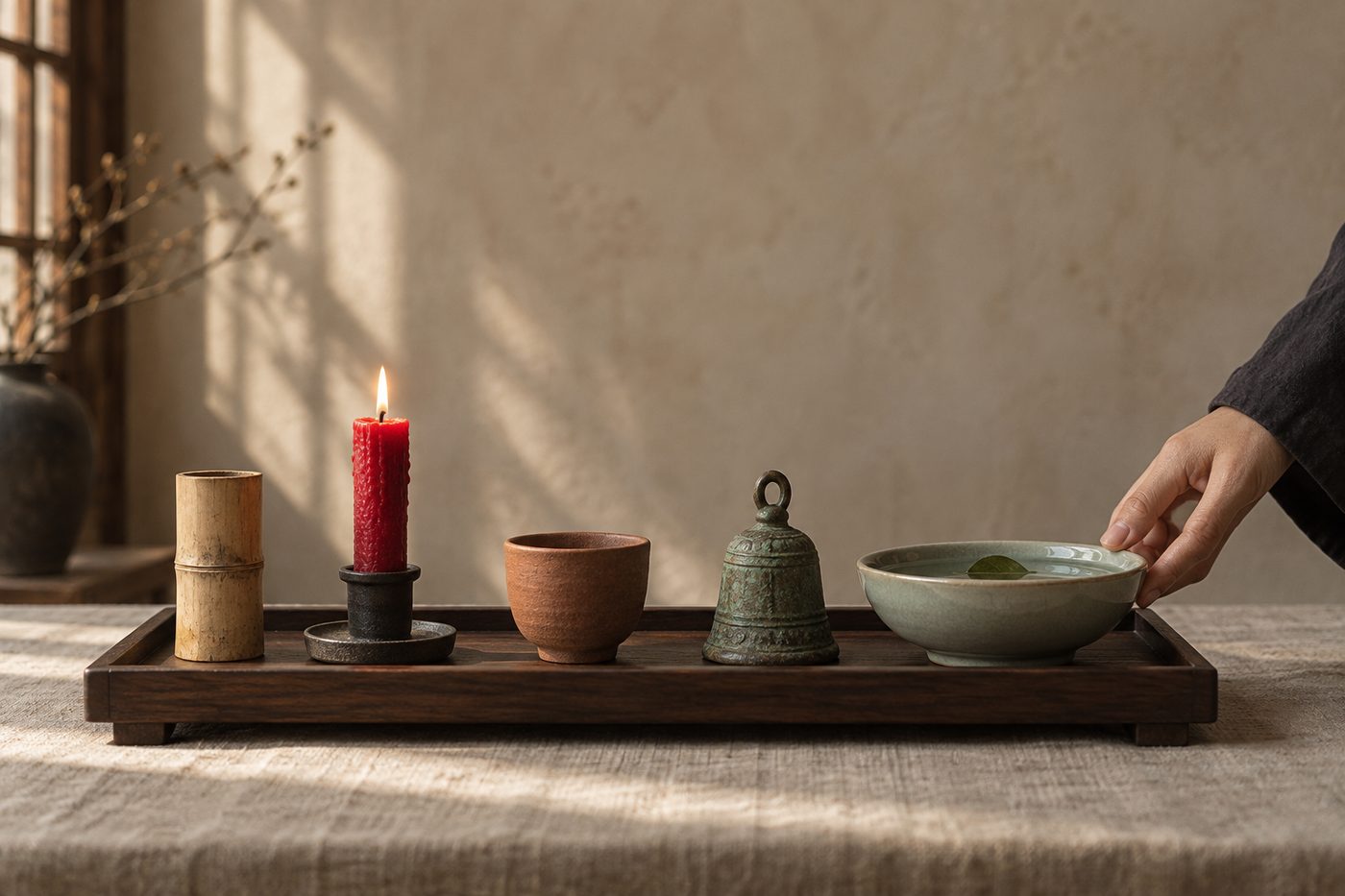
A low walnut tray on linen holds a short piece of bamboo, one lit red candle, a small unglazed clay cup, a patinaed bronze bell and a shallow celadon bowl of water with a single leaf, lit from the left, while a hand in a dark linen sleeve touches the bowl's rim.
Wood, fire, earth, metal, water: five materials, two years each. Illustration.

Chinese zodiac element calculator

Your birth date returns your sign and its element, the one a Chinese astrology chart calls the year element, with the yin or yang, the year's name in the sixty-year count, and the third element hardly anyone mentions. Add a time if you were born on the Lichun day itself. Nothing you enter is stored.

The last digit does all the work

Chinese years are named with two characters. The second is one of twelve earthly branches, and each branch has an animal, which is where your sign comes from. The first is one of ten heavenly stems, and each stem has an element, which is where your element comes from. The Huainanzi, a Han compendium finished before 139 BC, settles both in a single sentence of its chapter on the heavens: jia and yi are wood, bing and ding fire, wu and ji earth, geng and xin metal, ren and gui water, and it assigns the twelve branches in the same breath. Ten stems, five elements: each element gets two stems, a yang one and then a yin one.

Because there are exactly ten stems and our years are counted in tens, the stem of a year is fixed by its last digit, and so is its element. 1984 was jiazi, the first name in the sixty-year cycle, so every year ending in 4 has the first stem, jia, and is Wood; every year ending in 5 has the second, yi, and is also Wood; and so on round the table below. Even years are yang, odd years yin. You can do it in your head at a wedding.

The last digit of a year, the heavenly stem it fixes, that stem's polarity and element, and an example year.
Year ends in Stem Yin or yang Element For example
0 geng Yang Metal 1990, a Metal Horse
1 xin Yin Metal 1991, a Metal Goat
2 ren Yang Water 1992, a Water Monkey
3 gui Yin Water 1993, a Water Rooster
4 jia Yang Wood 1984, a Wood Rat
5 yi Yin Wood 1985, a Wood Ox
6 bing Yang Fire 1986, a Fire Tiger
7 ding Yin Fire 1987, a Fire Rabbit
8 wu Yang Earth 1988, an Earth Dragon
9 ji Yin Earth 1989, an Earth Snake

Read down the element column and you get the five in their generating order, Wood, Fire, Earth, Metal, Water: wood feeds fire, fire leaves ash, ash bears metal, metal condenses water, water grows wood, and the years walk that circle two steps at a time. The one place the digit lets you down is January and the first days of February. The Chinese year starts at Chinese New Year, and a birth before that date belongs to the previous year, digit and all; there is a section on that below, and the finder above already knows.

Three different things get called your element

Here is the thing the quick charts leave out. Ask three Chinese-speaking relatives what element you are and you can get three honest, different answers, because the tradition attaches an element to a year in three places at once.

The first is the year element, the one this page is mostly about: the element of the stem, Fire in "Fire Horse." It changes every two years and is what an English-language horoscope means. The second is the sign's own element, which comes from the branch and never changes: in that same Huainanzi sentence, the Tiger and Rabbit are wood, the Snake and Horse fire, the Monkey and Rooster metal, the Pig and Rat water, and the four signs that close the seasons, the Dragon, Goat, Dog and Ox, are earth. A Horse is a Fire sign in every Horse year whatsoever, and a Metal Horse is a Metal year on a Fire animal. The third is the nayin, the "received sound," a poetic element that each pair of consecutive years shares and that the Ming manual Sanming Tonghui spends thirty sections on. It is the one your grandmother's almanac used, and it is the one that produces the lovely absurdity in the table: every Fire Horse year, 1906, 1966, 2026, is by its sound "water of the heavenly river." Fire by the stem, Fire by the branch, Water by the sound.

Every Horse year from 1930 to 2038 with its year name, its year element and polarity, the Horse's own fixed element, and its nayin.
Horse year Name Year element Sign's element Sound (nayin)
1930 gengwu Metal Horse (yang) Fire Earth by the roadside (Earth)
1942 renwu Water Horse (yang) Fire Willow wood (Wood)
1954 jiawu Wood Horse (yang) Fire Metal in the sand (Metal)
1966 bingwu Fire Horse (yang) Fire Water of the heavenly river (Water)
1978 wuwu Earth Horse (yang) Fire Fire in the sky (Fire)
1990 gengwu Metal Horse (yang) Fire Earth by the roadside (Earth)
2002 renwu Water Horse (yang) Fire Willow wood (Wood)
2014 jiawu Wood Horse (yang) Fire Metal in the sand (Metal)
2026 bingwu Fire Horse (yang) Fire Water of the heavenly river (Water)
2038 wuwu Earth Horse (yang) Fire Fire in the sky (Fire)

Which is right? All three, for different jobs, and the honest answer to "what is my element" is "which one do you want?" The year element is the everyday one and the finder leads with it. The sign's own element is what the compatibility rules are built on, since the trines of allied signs are element families. The nayin is identity in the old style, the way a surname is. None of the three is the element a bazi reader means when they say "you are Water," and that is the last section of this page.

Why a Fire Horse is a red horse

In Seoul, 2026 is not the Fire Horse year. It is the year of the red horse, and the red is doing the same job. A researcher at the National Folk Museum of Korea, Park Ock-soo, put it plainly on the radio in the first week of January: the year is called the red horse because the stem byeong (bing, in Mandarin) meets the branch o, the Horse, and byeong is fire, and fire is red. Korean usage names the year by the stem's color rather than its element, which is why 2024 was a blue dragon there and a Wood Dragon here.

The colors are not a Korean invention; they are older than the animals. The Book of Rites has a calendar chapter, the "Yueling" or Monthly Ordinances, that names the days of each season by stem and then dresses the ruler to match. In the first month of spring, in James Legge's 1885 translation, "its days are kiâ and yî," jia and yi, and the Son of Heaven "is dressed in the green robes, and wears the azure gems." In the first month of summer "its days are ping and ting," bing and ding, and he "rides in the vermilion carriage, drawn by the red horses with black tails, and bearing the red flag. He is dressed in the red robes." Yellow robes on the wu and ji days at the center of the year, white robes and white horses for geng and xin in autumn, black robes and "iron black horses" for ren and gui in winter. Green, red, yellow, white, black: wood, fire, earth, metal, water. The red horses were pulling the ruler's carriage two thousand years before anyone was born under one.

Which brings us to Japan, and the one time an element measurably changed a country. The Japanese call the bingwu year hinoeuma, the fire horse, and a belief attached to it during the Edo period that women born in it were hot-tempered and would, in the phrase the sociologist Kikkawa Tōru quotes, eat their husbands alive. The story hung on Yaoya Oshichi, a greengrocer's daughter born in the Fire Horse year of 1666 who set a fire to reach the man she loved, and puppet theater kept it alive for two centuries. Then it met modern contraception. In 1965 Japan recorded about 1.82 million births. In 1966, the fire horse year, it recorded 1.36 million, and in 1967, 1.94 million; the fertility rate went 2.14, 1.58, 2.23. Those are the government's own figures, from the vital statistics kept by the health ministry, whose own summary of the century's births singles out the special movement around the 1966 hinoeuma as the one blip in an otherwise smooth curve. A quarter of a year's babies, moved by a stem.

Two things are worth saying flatly. First, the Chinese manuals do not do this: the Sanming Tonghui glosses bingwu as water of the heavenly river and says nothing about temper, and no classical text assigns a personality to a year. The Fire Horse's reputation is Japanese folklore, and the modern "Fire Horse personality" you will read online is newer than that. Second, it is probably over. Kikkawa's argument about 2026 is that a country where not having children is already the default has no room left for a superstition to move the number. That is an argument, not yet a result; the count will be in by the end of 2027. If you were born in 1966 you have carried a rumor for sixty years. It was never in the books.
Every sign, every element: the sixty

Twelve animals against five elements gives sixty combinations, and since the stems and branches step forward together, every one of the sixty actually occurs, once each sixty years. The table lists the two years in living memory that carry each pairing, 1924 to 2043, two full cycles from jiazi to guihai. Find your animal's row and your element's column; the year name beneath is the pair the finder gives you, and the sound is the third element from the section above. Each animal links to its sign page, which lists every one of its years with exact start and end dates.

The twelve zodiac signs by row and the five elements by column: in each cell the two years from 1924 to 2043 that carry that sign with that element, the year's name, and its nayin.
Sign WoodFireEarthMetalWater
Rat Water sign 1924 · 1984 jiazi · metal in the sea 1936 · 1996 bingzi · water in the ravine 1948 · 2008 wuzi · thunderbolt fire 1960 · 2020 gengzi · earth on the wall 1972 · 2032 renzi · mulberry wood
Ox Earth sign 1925 · 1985 yichou · metal in the sea 1937 · 1997 dingchou · water in the ravine 1949 · 2009 jichou · thunderbolt fire 1961 · 2021 xinchou · earth on the wall 1973 · 2033 guichou · mulberry wood
Tiger Wood sign 1974 · 2034 jiayin · water of the great stream 1926 · 1986 bingyin · fire in the furnace 1938 · 1998 wuyin · earth of the city wall 1950 · 2010 gengyin · pine and cypress wood 1962 · 2022 renyin · gold-leaf metal
Rabbit Wood sign 1975 · 2035 yimao · water of the great stream 1927 · 1987 dingmao · fire in the furnace 1939 · 1999 jimao · earth of the city wall 1951 · 2011 xinmao · pine and cypress wood 1963 · 2023 guimao · gold-leaf metal
Dragon Earth sign 1964 · 2024 jiachen · fire of the covered lamp 1976 · 2036 bingchen · earth in the sand 1928 · 1988 wuchen · wood of the great forest 1940 · 2000 gengchen · white-wax metal 1952 · 2012 renchen · long-flowing water
Snake Fire sign 1965 · 2025 yisi · fire of the covered lamp 1977 · 2037 dingsi · earth in the sand 1929 · 1989 jisi · wood of the great forest 1941 · 2001 xinsi · white-wax metal 1953 · 2013 guisi · long-flowing water
Horse Fire sign 1954 · 2014 jiawu · metal in the sand 1966 · 2026 bingwu · water of the heavenly river 1978 · 2038 wuwu · fire in the sky 1930 · 1990 gengwu · earth by the roadside 1942 · 2002 renwu · willow wood
Goat Earth sign 1955 · 2015 yiwei · metal in the sand 1967 · 2027 dingwei · water of the heavenly river 1979 · 2039 jiwei · fire in the sky 1931 · 1991 xinwei · earth by the roadside 1943 · 2003 guiwei · willow wood
Monkey Metal sign 1944 · 2004 jiashen · water in the spring 1956 · 2016 bingshen · fire at the foot of the mountain 1968 · 2028 wushen · earth of the great highway 1980 · 2040 gengshen · pomegranate wood 1932 · 1992 renshen · metal of the sword edge
Rooster Metal sign 1945 · 2005 yiyou · water in the spring 1957 · 2017 dingyou · fire at the foot of the mountain 1969 · 2029 jiyou · earth of the great highway 1981 · 2041 xinyou · pomegranate wood 1933 · 1993 guiyou · metal of the sword edge
Dog Earth sign 1934 · 1994 jiaxu · fire on the mountaintop 1946 · 2006 bingxu · earth on the roof 1958 · 2018 wuxu · wood of the plain 1970 · 2030 gengxu · metal of hairpin and bracelet 1982 · 2042 renxu · water of the great sea
Pig Water sign 1935 · 1995 yihai · fire on the mountaintop 1947 · 2007 dinghai · earth on the roof 1959 · 2019 jihai · wood of the plain 1971 · 2031 xinhai · metal of hairpin and bracelet 1983 · 2043 guihai · water of the great sea

Two patterns fall out of the table. Every animal's five elements arrive in the generating order, Wood, Fire, Earth, Metal, Water, twelve years apart, so a Wood Rat of 1984 was followed by a Fire Rat in 1996 and a Metal Rat in 2020. And the yin animals, the Ox, Rabbit, Snake, Goat, Rooster and Pig, only ever meet yin stems, while the Rat, Tiger, Dragon, Horse, Monkey and Dog only meet yang ones; the two counts move in step, so a yang animal cannot land on a yin year. That is why there are sixty pairings and not a hundred and twenty.

January, February, and which year is yours

The element and the animal change together, and they change at Chinese New Year, which falls anywhere from late January to mid-February. Somebody born on January 20, 1966 is a Wood Snake, not a Fire Horse, because the Horse year did not start until January 21; somebody born on February 10, 2026 is a Wood Snake for the same reason, since this year's Horse arrived on February 17, 2026. The finder applies the exact date for every year from 1900 to 2100, and the sign chart on the zodiac hub prints each year's start.

There is a second rule, and it is the older one. Astrologers casting a bazi chart begin the year not at the new moon but at Lichun, the start of spring on the solar calendar, around February 4. That is the boundary the Book of Rites itself uses: three days before it, Legge's translation has the Grand Recorder tell the ruler, "On such and such a day is the inauguration of the spring. The energies of the season are fully seen in wood." The element turns with the season, not with the moon. When the two rules give different answers for your birthday, which happens for a birth between the two dates, the finder says so and names both years; the year-boundaries page has both dates for every year as a free dataset, and the Lichun page explains why two rules exist at all.

What the year element is, and what it is not

A birth chart in the Chinese tradition is eight characters: a stem and a branch for the year, the month, the day and the hour. Your zodiac element is the first of the eight. It is real, it is yours, and it is one eighth of the information, shared with everyone born in the same twelve months. When a bazi reader says "you are Water," they are not looking at the year at all. They are looking at the stem of the day you were born, the day master, which is the character the whole reading is built around, and which changes every day rather than every two years. A Fire Horse born on a ren day is a Water person with a Fire year, and the reader will treat the year as the weather they were born into.

So the year element is a good answer to "what are you," at a wedding, in a horoscope, on a red envelope. It is not the answer to "who are you," and the tradition never said it was. The five elements in a chart are counted, weighed and balanced against one another; the five as a system sort everything from seasons to dynasties into the same five drawers. Your birth year is one card from one drawer. The full chart casts the other seven from your birth date and time and says which one is you. Cast it; it takes a minute. The year element takes a wedding.

Questions people ask

How do I find my Chinese zodiac element?

Take the last digit of your birth year: 0 or 1 is Metal, 2 or 3 is Water, 4 or 5 is Wood, 6 or 7 is Fire, 8 or 9 is Earth. So 1990 is a Metal year and 1966 a Fire year. The one catch is a January or early-February birthday: the Chinese year begins at Chinese New Year, so a birth before that date belongs to the previous year and takes the previous year's digit. The finder on this page applies that cutoff and gives the animal and the element together.

What are the 5 elements of the Chinese zodiac?

Wood, Fire, Earth, Metal and Water, in that order, which is the generating order (each produces the next). Each element covers two consecutive years, a yang year and then a yin year, so the five take ten years to go round; the twelve animals take twelve. The two cycles only line up the same way every sixty years, which is why there are five kinds of every sign and why the Fire Horse of 1966 did not come back until 2026.

What is the order of the Chinese zodiac elements?

Wood, Fire, Earth, Metal, Water, then Wood again. That is the order the years run in and the order in which each element is said to generate the next: wood feeds fire, fire leaves ash, ash bears metal, metal condenses water, water grows wood. There is a second order, the overcoming order, which the years do not follow; both are on the five-elements page.

How do I check my birth element, and is it yin or yang?

Your birth element is the element of your birth year, and its polarity follows the year too: every even-numbered year is yang and every odd-numbered year is yin, because the ten stems alternate yang, yin, yang, yin and the count started on a yang stem in an even year. So 1984 was a yang Wood year and 1985 a yin Wood year; 2026 is yang Fire and 2027 yin Fire. Type your birth date into the finder above and it prints the element with its polarity.

What element is 2026 in the Chinese zodiac?

2026 is a Fire Horse year, bingwu in the sixty-year count. It begins at Chinese New Year, February 17, 2026; astrologers who cast birth charts begin it at Lichun, February 4, 2026. The last Fire Horse year was 1966, and the next will be 2086.

What is a Fire Horse in the Chinese zodiac?

A Fire Horse is anyone born in a Horse year whose stem is Fire: 1966, 2026. The reputation attached to it, that Fire Horse women are hot-tempered and dangerous to marry, is a Japanese folk belief from the Edo period, not anything the Chinese manuals say; in Japan it cut births by a quarter in 1966, from about 1.82 million the year before to 1.36 million. No Chinese classical text assigns a temper to any year.

What are the colors of the Chinese zodiac elements?

Wood is green (or blue-green), Fire red, Earth yellow, Metal white, Water black. The pairing is in the Book of Rites, whose calendar chapter dresses the ruler in green robes on the wood days of spring, red robes on the fire days of summer, yellow at the center, white in autumn and black in winter. Korean and Japanese usage still names years by the color: 2026 is the red horse year in Seoul and the hinoeuma, the fire horse, in Tokyo.

Do the Chinese zodiac elements affect compatibility?

Popular guides say two people whose year elements sit next to each other in the generating order (Wood and Fire, say) get on, and two in the overcoming order (Wood and Earth) clash. That is a reading of the cycles, not a classical rule about marriage: the traditional match verdicts are about the animals, the branch relationships of trine, secret friend and clash, which the compatibility checker on this site applies to all 66 pairs. Treat the element pairing as a footnote to the animal pairing, not the other way round.

Is my Chinese zodiac element the same as my bazi element?

No. The zodiac element is the element of your birth year, one character out of the eight in a full chart. In bazi the character that stands for you is the day master, the stem of the day you were born, which has nothing to do with the year. A Fire Horse can be a Water day master. The full chart casts all eight from your birth date and time and says which one is you.

Keep going

  • The Chinese zodiac is the branch half of the year name: the twelve animals, a finder, and the chart of every year's start date.
  • The five elements as a system: the oldest list, the correspondence table of seasons, directions and colors, and every page on this site that carries one.
  • The five elements in a bazi chart are the mechanics: the two cycles worked in full, and why counting your elements does not tell you what you are.
  • The sexagenary cycle lists all sixty year names with their sounds and years, and finds the name of any date.
  • Heavenly stems and earthly branches are the twenty-two characters behind both the element and the animal, each glossed from the Han dictionary.
  • The 2026 Horse year reads all twelve signs against this year's Fire Horse, tai sui included.
  • The day master is the element a bazi reader actually means by "you."

Sources

The Huainanzi, Book of Rites and Sanming Tonghui passages were read in the Chinese; the English lines from the Book of Rites are James Legge's (1885), and the one-line renderings of the other two are our own plain English, not a published translation. The Japanese figures are the government's vital statistics as tabulated by its population institute, rounded to the nearest ten thousand in the text. Every table on this page is generated from the site's calendar engine: the digit table is checked against the engine on every year from 1900 to 2100 when the page is built, the twelve signs' elements against the Huainanzi sentence, and the sixty pairings against two full cycles of the year table.

Stay in the loop.

Chinese mythology, the zodiac, and the meaning behind names and symbols, rooted in the classics and read back to you. No spam. Unsubscribe anytime.