Chinese Symbol
Chinese Symbol for Health: Meaning, Origin, and Tattoo
The Chinese symbol for health is 康 (kāng), and the honest first thing to say is that it does not mean "healthy" the way the English word does. It means at ease, unobstructed, well, a body and a life with nothing blocking them. The everyday modern word for health needs two characters, 健康 (jiànkāng), and the classical word needed two as well: 康寧, well-being and peace, which the Book of Documents lists third among the Five Blessings. If you want one character on a card, a scroll, or your arm, 康 is the one. It is also, as we will see, probably not the one you actually want.
- Strokes
- 11
- Radical
- 广 (shelter; Kangxi 53), the roof-and-wall stroke wrapping the top left
- Formation
- Phono-semantic compound: 庚 supplies the sound, under the 广 shelter
Trace 康 yourself, or watch it drawn
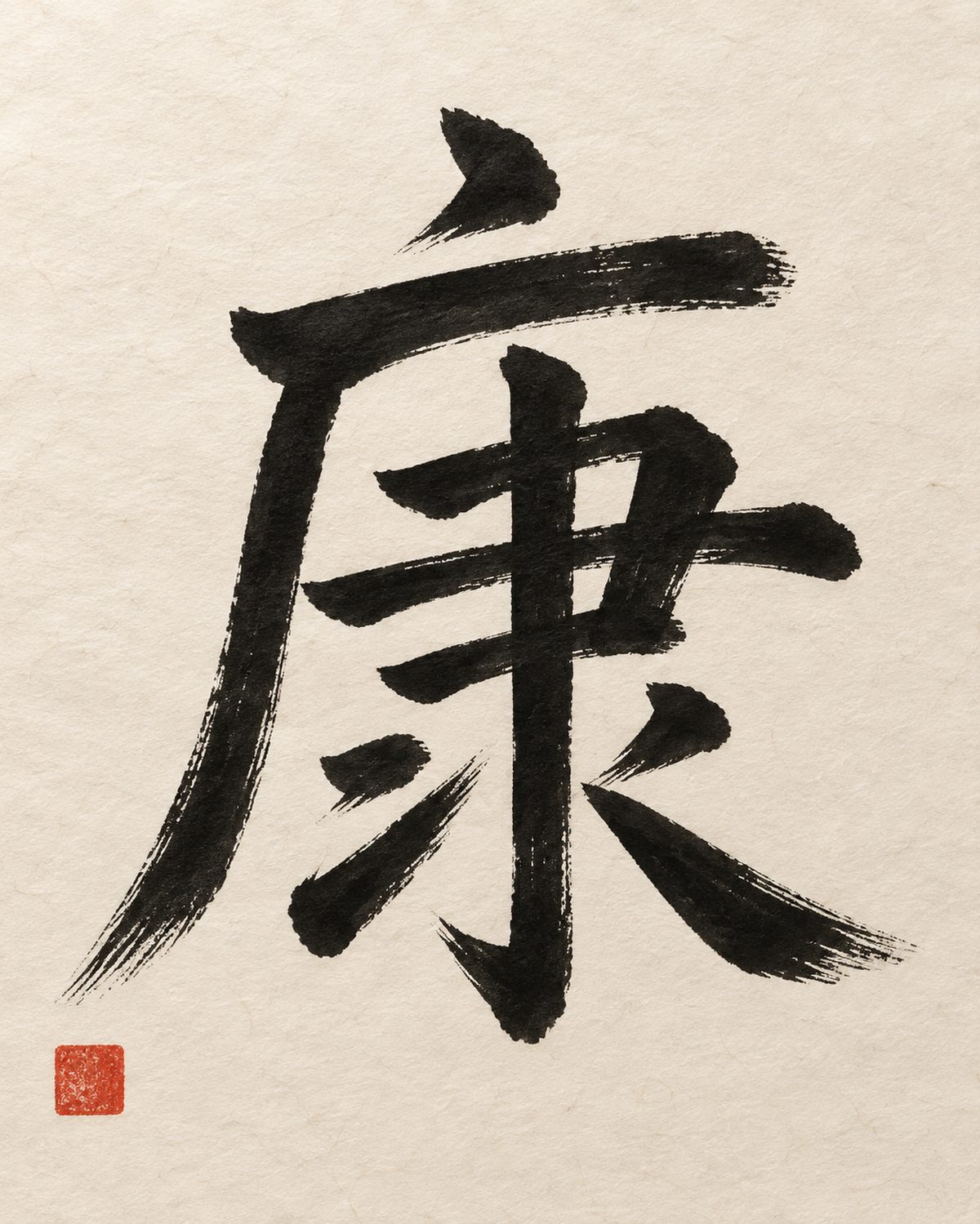
See 康 in seal, brush & cursive Try it
How it's written
康 has eleven strokes and comes apart into two pieces that are easy to see once you know they are there.
Across the top left is 广, the shelter radical, a single dot above a horizontal stroke that turns down the left side. It is the Kangxi radical for buildings and roofed spaces, and it caps the characters for a shop, a courtyard and a government seat. It is doing the work of a category marker here: this is a character about a covered, settled, well-ordered space.
Underneath and to the right sits the rest: a horizontal bar with a vertical driven through it, and four short strokes fanning out at the bottom left and right like grain coming off a threshing floor. That lower element derives from 庚 (gēng), the seventh of the Heavenly Stems, which is here for its sound rather than its meaning, and those four falling strokes are the visual signature to look for when you are checking a rendering.
The character is identical in simplified and traditional Chinese. Nothing was changed in the 1950s reform, which means a scroll, a seal or a tattoo of 康 reads the same in Beijing, Taipei, Hong Kong and Singapore. That is unusual and worth knowing: several of the near-misses on this page do differ across the strait, and 康 does not.
What it means
Start with the gap, because it explains everything else on this page. English has one word, health, that covers the whole territory: not ill, physically strong, in good shape, and the general state of a body. Chinese splits that territory between two characters that mean quite different things and only became a single word by being stuck together.
康 (kāng) is the at ease half. Its range runs through well, peaceful, easy, smooth, abundant. A broad open road with nothing on it is a kangzhuang road. A reign with no famine and no war is kāng. A person who is kāng is not so much free of disease as free of obstruction: nothing is pressing on them. This is why the character turns up in the vocabulary of blessing rather than of medicine, in ankang, peace and health, in kangfu, recovery, and in the phrase you write to somebody's grandmother at New Year.
健 (jiàn) is the vigorous half, and it is the more physical of the two. The Shuowen Jiezi, the first Chinese dictionary, finished around 100 CE, defines it in a single word meaning a match for, equal to, able to stand up against. It is built from the person radical with an element supplying the sound, and what it carries is not "not sick" but "capable of the work." A jian'er is an athlete or a strapping young soldier. Jianshen is going to the gym, literally strengthening the body. Jianwang means forgetful, which looks like a contradiction until you realize it is describing a robust forgetting, a talent for it.
Put the two together and you get 健康, the word on every Chinese doctor's paperwork, every insurance form and every packet of biscuits claiming to be good for you: vigorous plus at ease, the body that works and the life with nothing blocking it. Each half on its own is an adjective looking for a noun. Together they are the thing.
- 健康 health; healthy (the ordinary modern word, and it needs both characters)
- 康复 to recover, to recuperate; rehabilitation
- 安康 peace and good health (the formal blessing, the one written on a card)
- 身体健康 'may your body be healthy', the standard New Year wish to an older relative
- 小康 moderately comfortable, well-off; a classical term for a decent society, revived as a national policy slogan
- 康庄大道 a broad open road; a clear path forward
- 亚健康 'sub-health': not ill but not well, a Chinese category with no English equivalent
- 健身 to work out; the gym, literally 'strengthening the body'
- 养生 nurturing life: the whole Chinese tradition of health as daily regimen
- 康乐 well-being and leisure; the word on Hong Kong's public recreation departments
Idioms
- 康庄大道“an open, level, great road”a clear and promising path ahead. Said about a career, a policy, or a country, and almost always approvingly. (Records of the Grand Historian, chapter 74, where the king of Qi opens 康莊之衢, a broad thoroughfare, for the scholars he is courting)
- 天行健,君子以自强不息“heaven moves with strength; the noble person accordingly strengthens himself without ceasing”the image-text of the first hexagram of the Book of Changes, and the single most quoted sentence containing 健. Half of it is Tsinghua University's motto. (Book of Changes, Qian hexagram, the Image)
- 身体健康,万事如意“a healthy body, and ten thousand affairs as you wish them”the standard four-plus-four New Year greeting to someone older than you. Health first, everything else after.
- 小康之家“a household of small comfort”a family that is comfortable without being rich. The phrase goes back to the Book of Rites, where 小康 is the lesser, achievable social order set against the perfect one, and it was revived as national policy language in the 1980s. (Book of Rites, Liyun)
Right vs wrong forms
| Form | Type | Note |
|---|---|---|
| 康 | simplified ✓ | Eleven strokes. Identical to the traditional form: the 1950s reform left this character alone, so it reads the same everywhere Chinese is written. |
| 康 | traditional ✓ | The same eleven strokes. Worth stating plainly because so many characters on this site differ across the strait and this one does not. |
| 庚 (the phonetic alone) | wrong | Not a variant. 庚 (gēng) is the seventh Heavenly Stem, a calendar sign, and it is what is left of 康 when the 广 shelter across the top is dropped or cropped. A tattoo that loses the shelter stops meaning well-being and starts meaning a slot in a sixty-year cycle. |
| 糠 / 慷 / 廉 | wrong | Same body, different left side: 糠 (chaff, with the rice radical), 慷 (fervent, with the heart radical), 廉 (incorrupt, a different character under the same shelter). None means health. The distinguishing features are the bare 广 across the top left with nothing to its left, and the four short strokes fanning off the bottom. |
| 健 alone | wrong | Not wrong as a character, wrong as a word. 健 on its own is an adjective fragment meaning vigorous or robust, and a Chinese reader seeing it by itself on skin will read it as half of something. If you want one character, use 康. |
| 康 (mirrored or rotated) | mirrored | Not a variant. A flipped or rotated glyph off a low-resolution stencil reads as an error to anyone literate. Check against a dictionary glyph at full size before inking. |
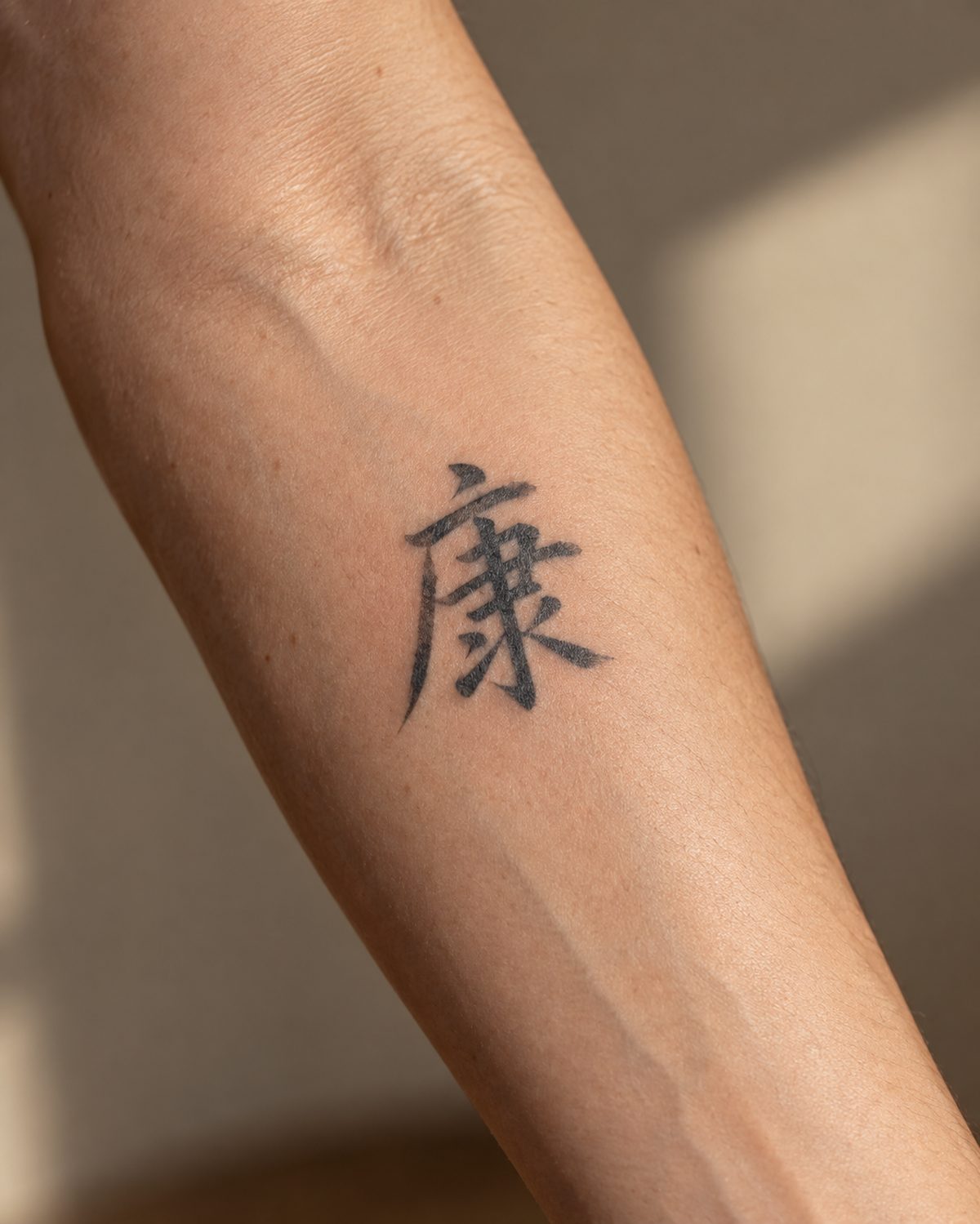
For a tattoo
This is the section to read twice, because "health" is one of the requests most likely to go wrong in a tattoo studio, and it goes wrong in a specific and avoidable way.
Do not get 健康 as a two-character tattoo unless you have thought hard about it. It is the correct word, and that is the problem: it is the clinical word. To a Chinese reader, two characters reading 健康 on someone's forearm has roughly the register of the English word "wellness" tattooed in a clinical sans-serif. It is the word on a hospital form. Some people want exactly that, and fair enough. Most people asking for "the Chinese symbol for health" do not know that is what they are asking for.
If you want one character, 康 is the right one. It reads as well-being, ease and peace, it is identical in simplified and traditional, it has eleven strokes, which is enough to look like something and few enough to stay legible as it ages, and it carries a warm blessing register rather than a medical one. A Chinese speaker reading 康 on someone's arm will read it as may you be well, which is almost certainly what was meant.
Consider whether you actually want longevity instead. A large share of the people who ask for health want the idea of a long, unbroken, well-lived life, and the character for that is 壽, which has a two-thousand-year history as a decorative motif, a hundred stylized variant forms, and a place on every birthday bowl in China. It is the more beautiful character and the more traditional gift. This page would rather send you there than sell you 康.
Things to check before the needle. Ask your artist to work from a dictionary glyph at full size, not from a stencil scaled down off a search result. Look for the 广 shelter across the top left and the four short strokes fanning off the bottom: those are the features that separate 康 from the characters below, and they are the first things to disappear at small sizes. And have it checked by a literate reader, not a translation app, which will happily return a compound when you asked for a character.
Before you commit to any character, the eight ways a Chinese tattoo goes wrong covers the failure modes that are not specific to this one, including the stroke-density arithmetic that decides whether a traditional form survives at small sizes.
Health in life today
健康 is everywhere in modern Chinese, and mostly in the places you would expect and one you would not.
The expected ones first. The health code, jiankang ma, was the QR pass that governed who could enter a building in China between 2020 and 2022, and for two years it was probably the most-looked-at pair of characters in the country. Yajiankang, "sub-health," is a medical and pop-psychology category with no exact English equivalent: not ill, not well, the state of a person who is exhausted, sleeping badly and getting through the week on wolfberries in a thermos. Yangsheng, nurturing life, is the whole industry of Chinese wellness, and its most visible modern form is a young office worker with a flask of goji-and-chrysanthemum tea, a joke about themselves that became a market.
康 on its own belongs to a warmer register. It is a blessing word. Shenti jiankang, "may your body be healthy," is the second thing said at a Chinese New Year greeting after wishing someone money, and for older relatives it is the first. Ankang is the more formal version and the one written on a card. It is also, quietly, a naming character: 康 is a real Chinese surname, borne most famously by the Qing emperor whose reign name was Kangxi, peaceful and flourishing, the same Kangxi whose dictionary of 1716 is still the reference every character on this site is checked against.
And then the one you would not expect. The red packet of instant noodles on the shelf of every Chinese convenience store, Kang Shifu, Master Kang, is named with this character. Whether an instant noodle is the ideal ambassador for the concept of well-being is a question the brand has managed to keep everybody from asking for thirty years.
Where the character comes from
The oldest dictionary does not gloss 康 directly, and it is better to say so than to guess. What the Shuowen Jiezi does give us, in its grain section, is a neighbor: the character for the husk of grain, which it analyzes as standing grain plus hulled rice, with 庚 supplying the sound. That is the same 庚 sitting under the shelter in 康, and the four strokes fanning off the bottom of 康 look, to most modern paleographers, like exactly what they look like: chaff coming off the threshing floor.
Where the sense went after that is the interesting part, and for that we have usage rather than a dictionary gloss. By the time of the Book of Documents, the compilation of speeches and proclamations that is the oldest layer of Chinese prose, 康 is already doing the work of settled well-being. In the Great Plan chapter, the Five Blessings are enumerated: first long life, second wealth, third 康寧 (kangning), fourth a love of virtue, and fifth a death that comes at the proper end. That third entry is usually translated "health and peace," and the pairing is the point. Nobody in the classical vocabulary thought of health as a separate department from a life that was not being disturbed.
Note also where health sits on that list. Third. Behind long life, and behind money. The Book of Documents is not sentimental about this, and neither is the tradition that follows it.
The other half of the modern word has a cleaner pedigree. 健 gets its own Shuowen entry, and its most famous appearance is older still: the image-text of the first hexagram of the Book of Changes, which reads heaven moves with strength, and the noble person accordingly never stops strengthening himself. That sentence is why 健 does not mean "not ill." It means the kind of ceaseless motion the sky does. Its second half, never ceasing to strengthen oneself, is the opening half of Tsinghua University's motto, and has been about the closest thing China has to a national one for a century.
History & roots
If you want to know what the Chinese tradition actually thought health was, the place to go is not a medical text but the third chapter of the Zhuangzi, written some time in the fourth or third century BCE and titled Yangsheng zhu, the principle of nurturing life. It is four pages long and it contains a butcher.
Cook Ding cuts up an ox for Lord Wenhui, and the sound of his blade keeps time like music. The lord is amazed at his skill. The cook puts down the knife and corrects him: what I care about is the Way, which goes beyond skill. When I first cut up oxen, he says, all I could see was the whole ox. After three years I no longer saw the whole ox. Now I meet it with my mind and not with my eyes, and the blade goes where the openings already are. A good cook changes his knife once a year, because he cuts. An ordinary cook changes it once a month, because he hacks. I have had this knife nineteen years and its edge is as sharp as if it came off the whetstone, because I find the spaces and go through them.
And the chapter frames all of it with a single prescription, delivered before the butcher arrives: follow the middle course as your constant, and you can protect the body, keep life whole, care for your parents, and live out your years.
That is the classical theory of health, and it is a theory about not forcing things. Not medicine, not exercise, not abstinence. Find where the body and the world already open, and go through there. Two and a half thousand years later the industry that grew out of that chapter still bears its name, yangsheng, the words on the sign of every Chinese health-tea shop and massage parlor in the world.
Questions people ask
What is the Chinese symbol for health?
The single character is 康 (kāng), which means well-being, ease and freedom from obstruction rather than 'not ill.' The ordinary modern word for health is not one character but two, 健康 (jiànkāng), combining 健 (vigorous, capable) with 康 (at ease). The classical word was also two characters, 康寧, health and peace, which the Book of Documents lists as the third of the Five Blessings, behind long life and wealth.
Is there a single Chinese character that means health?
Not exactly, and that is the most useful thing to know before you put one on anything. 康 is the closest and it is what to use if you need one character, but it means at ease and well rather than healthy. Chinese expresses health as a compound: 健康 in modern usage, 康寧 in the classics. Anyone offering you one character as a straight translation of the English word is smoothing over a real difference.
How do you say health in Chinese?
Jiànkāng (健康), with the first syllable falling and the second high and level. The character on its own, kāng, is pronounced with a high level tone and sounds close to the English 'kahng.' To wish someone health you say shēntǐ jiànkāng, 'may your body be healthy,' which is the standard thing to say to anyone older than you at New Year.
Is the Chinese symbol for health a good tattoo?
康 works well as a single-character tattoo: it is identical in simplified and traditional Chinese, eleven strokes is legible at most sizes, and it reads to a Chinese speaker as a warm wish for well-being. The two-character 健康 is more accurate as a translation and much worse as a tattoo, because it is the clinical word, closer in register to 'wellness' on a hospital form. Many people asking for health actually want 壽, longevity, which has a far richer decorative tradition.
What is the Chinese symbol for good health and long life?
Those are two different characters and the tradition keeps them apart. Long life is 壽 (shòu), the character on birthday bowls and the one with a hundred stylized variant forms. Health is 康 (kāng). The pair appears together in the classical blessing 福壽康寧, fortune, long life, health and peace, which is the full four-part version of the wish and a common inscription on gifts.
Sources
Make Health your own
See 康 in calligraphy
From ancient seal script to flowing cursive. Pick a look before a tattoo or a card.
 Name
Get a Chinese name
A name matched to the sound of yours, with a meaning that fits.
Start yours Chinese Almanac
Try the Chinese Gender Predictor
A different corner of Chinese culture: the old Qing-palace birth chart, worked out from your lunar birth date, with the math shown and its coin-flip odds honestly weighed.
Open the toolBy Julian 祝君瑜, sourced from the classics and from modern life, updated 2026-09-23