Chinese Symbol
Chinese Symbol for Forever: Meaning, the Eight Strokes, and Tattoo Notes
The Chinese symbol for forever is 永 (yǒng, said like "yong" with a dipping tone), and China's oldest dictionary defines it in a single word: long. Underneath the character is a river seen from above, the main channel running on while smaller streams branch away. It is also the most-practiced character in Chinese calligraphy, because its five strokes contain every basic movement a brush can make.
- Strokes
- 5
- Radical
- 水 (water); dictionaries file 永 under the water radical, Kangxi 85
- Formation
- Pictograph (象形)
Trace 永 yourself, or watch it drawn
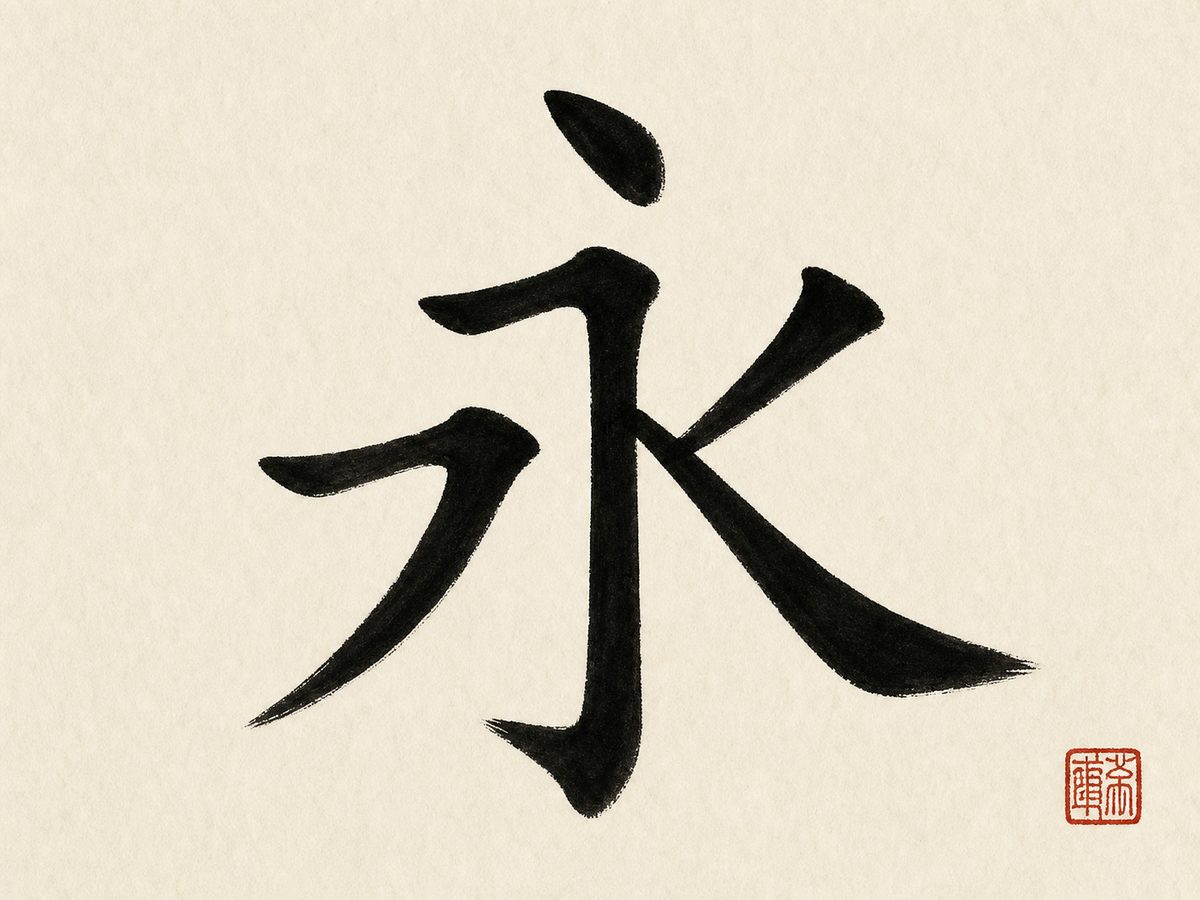
See 永 in seal, brush & cursive Try it
How it's written
永 has five strokes, and they go in this order. First, a single dot floating alone at the top, touching nothing. Second, a short horizontal that starts left of center, turns, and falls away to the lower left. Third, the long central vertical, the spine of the character, ending in a small hook that flicks up off its foot. Fourth, a left-falling sweep on the left side. Fifth, a broad right-falling press on the right, thickening as it goes.
What you end up with is a dot above a spine with one wing on either side, and the two wings are deliberately unalike: the left one sweeps, the right one presses. Cover the top dot with a finger and what remains is very nearly 水 (shuǐ), water. That is not a coincidence. Both characters are drawings of the same thing, which the etymology section gets into below.
Five strokes make 永 one of the easiest characters in this collection to write, and one of the hardest to write well. Those five strokes contain eight distinct brush movements, which is the reason every calligraphy student in China has copied this character more times than any other. That story is further down the page.
What it means
永 (yǒng) means forever, eternal, perpetual, and behind all of those it means something plainer: long. Long in space, as a river is long, and long in time, which is the sense that took over. The word covers duration itself rather than a good long life, which is the job of 寿 (shòu), or of being alive, which belongs to 生 (shēng). If a thing simply keeps going, it is 永.
Here is the honest complication, and it matters if you are thinking about a tattoo. In modern Chinese, 永 does not stand alone in a sentence. It behaves as a prefix, waiting for a second syllable, and the three it most often takes divide the work neatly between them. Yǒngyuǎn is the everyday adverb, the one in "I'll love you forever." Yǒngjiǔ is the official word, the one on permanent residence permits and permanent magnets. Yǒnghéng is the noun, eternity, the register of philosophy, gravestones, and love songs. Put 永 in front of a negative and you get yǒngbù, "never," the emphatic kind that shows up in oaths.
It also does gentle work at the end of life. A death is a yǒngbié, a "forever parting," and to die is to enter yǒngmián, "eternal sleep." Chinese habitually softens the subject of dying by talking about duration instead, the same instinct that turns burial clothes into "longevity clothes" on the 寿 page. The character for forever is one of the language's kindest euphemisms.
- 永远 forever, always (the everyday adverb)
- 永久 permanent, perpetual (the official and legal word)
- 永恒 eternal; eternity (the noun of philosophy and love songs)
- 永生 eternal life; immortality
- 永别 to part forever; the parting at a death
- 永眠 eternal sleep, a gentle word for dying
- 永不 never, not ever (emphatic, the register of oaths)
- 永存 to endure, to live on
- 永葆 to keep forever, as in keeping one's youth
- 永续 continuing without end; the standard Chinese word for sustainable
Idioms
- 永垂不朽“forever hanging down, never rotting”eternal glory; the standard formula on Chinese war memorials and obituaries. (Inscribed by Mao Zedong on the Monument to the People's Heroes, Beijing, 1955)
- 一劳永逸“one labor, forever at ease”solve it properly once and never have to touch it again; the Chinese case for doing a job right. (Traced by Taiwan's Ministry of Education idiom dictionary to Yang Xiong's Han-dynasty memorial against receiving the Chanyu)
- 永无止境“forever without a stopping point”endless; said of learning, greed, and roadworks alike.
- 永结同心“forever tied of one heart”may you be united as one for life; the standard Chinese wedding blessing.
- 永志不忘“forever recorded, never forgotten”to keep something in mind permanently; used of debts of gratitude and of grief.
Right vs wrong forms
| Form | Type | Note |
|---|---|---|
| 永 | simplified ✓ | The one and only standard form. 永 was never simplified, so mainland China, Taiwan, Hong Kong, and Singapore write it identically, and it is also the standard form in Japanese and Korean. There is no version decision to make. |
| 水 | wrong | 永 without its top dot is 水 (shuǐ), water. The two are related historically and nearly identical on the page, so a stencil that loses the dot changes the word. Check that the dot is separate and floating, touching nothing. |
| 泳 | wrong | Adding the three-drop water radical on the left gives 泳 (yǒng), the verb 'to swim.' It looks plausible and is a real character, which makes it a genuine trap rather than an obvious error. |
| 永 (flipped or rotated) | mirrored | Not a variant. The character is not symmetrical: the left side is a falling sweep and the right side is a broad press. A mirrored stencil reads as wrong immediately to anyone who knows the character, which is everyone who took primary school in Chinese. |
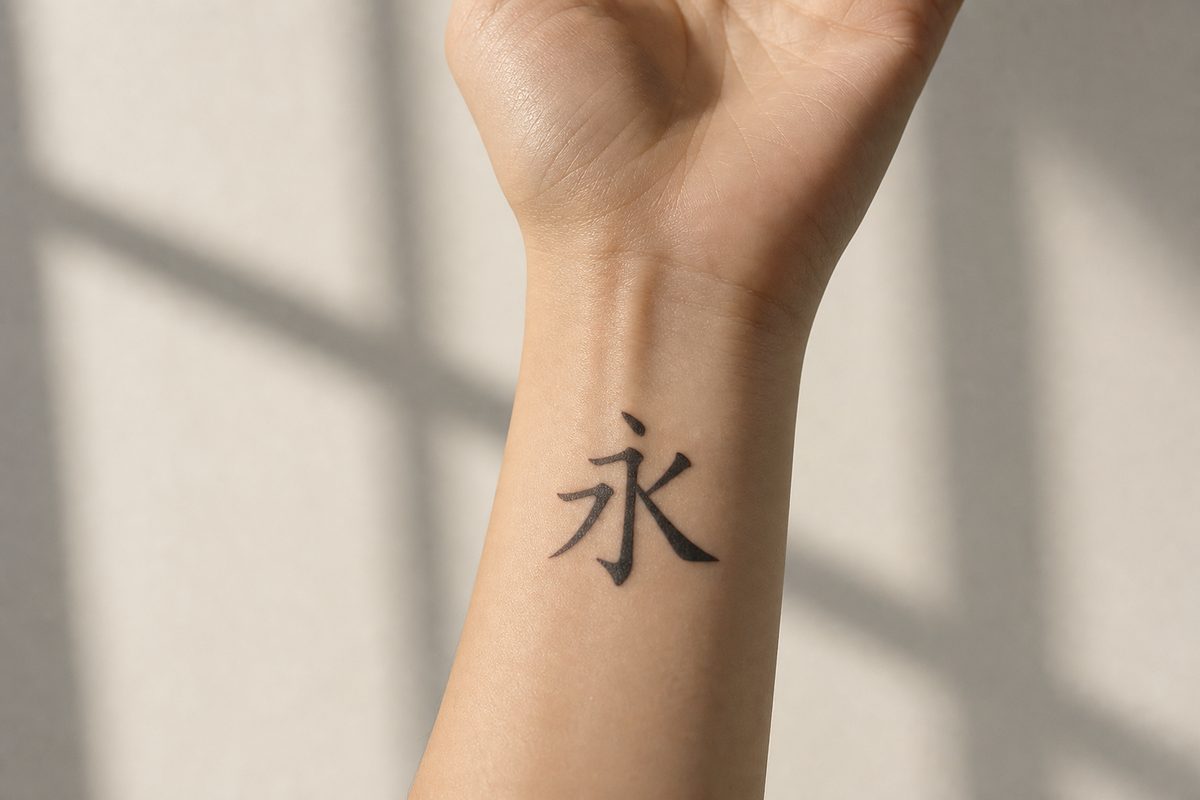
For a tattoo
永 is one of the safer characters in Chinese to put on skin, for three reasons. It was never simplified, so mainland China, Taiwan, Hong Kong, and Singapore all write it identically, and Japan and Korea use the same form as well. It has only five strokes, which means it stays legible at small sizes and will not blur into a smudge in ten years, unlike characters with a crowded middle. And it is unambiguous: any Chinese reader who sees it alone will read "eternal, forever" without hesitating, because a single character displayed on its own is a normal thing in Chinese art and everyone knows how to read one.
Two honest cautions. First, 永 is not a standalone word in a Chinese sentence. As calligraphy it says forever perfectly well, but if what you want is the noun "eternity" as it would be used in speech, that is yǒnghéng, two characters, not one. Ask yourself whether you want a word or an emblem, because 永 is firmly the second. Second, watch the dot. Remove it and you have 水, water, a different character entirely, and adding a water radical to the left instead gives you 泳, "to swim," which is a real word and not the one you meant. Low-resolution stencils lose small strokes.
One thing to know going in: this is the character every Chinese schoolchild copies first. A Chinese viewer will register that, roughly the way an English reader registers a tattoo in Copperplate. Most read it as informed rather than naive, but you should know what you are saying. Keep it upright and unmirrored, since the left sweep and the right press are not symmetrical and a flipped stencil is obvious, print at full size, and have someone who reads Chinese check the design before the needle comes out.
Before you commit to any character, the eight ways a Chinese tattoo goes wrong covers the failure modes that are not specific to this one, including the stroke-density arithmetic that decides whether a traditional form survives at small sizes.
Forever in life today
Forever, the bicycle
For most of the twentieth century, the most famous 永 in China had two wheels. A Shanghai factory that started building bicycles around 1940 relaunched its brand on New Year's Day 1951 as Yǒngjiǔ, "Forever." By 1952, as Shanghai Daily's account of the company records, it was turning out more than 28,000 bikes a year, better than a third of the national total. In the 1970s and 1980s a bicycle was one of the "three big things" a family saved for before a wedding, alongside a sewing machine and a watch, and in the countryside a borrowed Forever was what the groom rode to fetch the bride. The brand still exists and still sells more bicycles in China than anyone. A great many Chinese people's first association with the character for eternity is a heavy black frame with a rear rack.
Eight characters on a stone
The most-read instance of the character stands in the middle of Tiananmen Square. The front of the Monument to the People's Heroes carries eight large characters that Mao Zedong wrote out in June 1955, rendered in English as "Eternal glory to the People's Heroes." The third character is 永. The phrase behind it, yǒng chuí bù xiǔ, is the standard Chinese formula on war memorials and obituaries, and it literally says "forever hanging down, never rotting," an image of something suspended in view of posterity rather than something merely remembered.
The line on the wedding banner
At weddings the character turns up in a four-word blessing, yǒng jié tóng xīn, "forever tied of one heart," written on red banners, printed on envelopes, and engraved inside rings. You will usually find it sharing a wall with the doubled joy emblem 囍, which announces the marriage while this phrase makes the promise about it. English wedding language reaches for "always." Chinese reaches for a knot.
The word people actually say
In daily speech the character lives inside yǒngyuǎn. Chinese pop lyrics run on it, as does the phrase yǒng bù fàngqì, "never give up," which is what a Chinese coach shouts and a Chinese motivational poster says. And a much drier compound has quietly become one of the most-used words of the past decade: yǒngxù, "continuing without end," is the standard Chinese translation of "sustainable," so every corporate sustainability report in the country is built on the character for forever.
In names, and in the reigns of emperors
As a given-name element, 永 is a simple, unfussy wish that whatever follows it lasts. Emperors used the same wish at scale, since a Chinese reign was labeled with an era name chosen as a slogan for the years ahead, and 永 was a popular ingredient. The Yongle Emperor, who moved the capital to Beijing and built the Forbidden City, ruled under 永乐, "perpetual happiness." The Orchid Pavilion gathering, which the next section is about, is dated to the ninth year of the Yonghe era. It is worth noticing that these were bets rather than descriptions. Emperors who named their years "eternal" got, on average, about as long as everyone else.
Curious what your own name could become in Chinese, matched to its sound and a good
meaning? Our Chinese name generator builds one for you.
Where the character comes from
The Shuowen Jiezi, the first Chinese dictionary, compiled around the year 100, gives 永 one word of definition and then a picture: "Long. It depicts the lengthwise course of water." Then it quotes a line of poetry as proof, and the line it picks is from the Book of Songs: "the Jiang runs long." The oldest dictionary in China explains eternity by pointing at the Yangtze.
永 also heads its own section in that dictionary, a rank the Shuowen reserves for characters that other characters are built out of. Two readings of the oracle-bone form are current, and both survive in the reference works. In the first, the character is a river seen from above, one main channel running on while tributaries branch off it. In the second, it is a person swimming in water, which would make 永 the original form of 泳 (yǒng), the modern verb "to swim." The two are less far apart than they look, since either way you are being told about a body of water big enough to be a problem.
The river reading has an elegant piece of evidence going for it: 永 has a mirror twin. Flip it and you get the element behind 派 (pài), the character for a branch, a tributary, and by extension a faction or a school of thought. One picture, drawn two ways: the water running long, and the water dividing. Chinese wrote its word for "forever" and its word for "splitting into camps" out of the same river.
History & roots
The eight strokes hidden in one character
Chinese calligraphy is taught through a single character, and this is the one. The method is called the Eight Principles of 永, and the claim behind it is neat enough to sound invented: every basic movement the brush makes in standard script is present in this one five-stroke character, so a student who can write 永 correctly has the whole alphabet of the brush in their hand.
Five strokes, eight movements, because a stroke can carry more than one. The central vertical, for instance, holds both the long descent and the hook that flicks off its foot, and each of those is trained separately. Note what the eight are called.
| The movement | Pinyin | Literally | Where it is in 永 |
|---|---|---|---|
| 侧 | cè | leaning to the side | The floating dot at the top |
| 勒 | lè | reining in a horse | The short horizontal below it |
| 努 | nǔ | drawing a crossbow | The long central vertical |
| 趯 | tì | jumping | The hook flicking off the vertical's foot |
| 策 | cè | the horsewhip | The short upward flick on the left |
| 掠 | lüè | skimming past | The long left-falling sweep |
| 啄 | zhuó | a bird pecking | The short left-falling stroke on the right |
| 磔 | zhé | dismembering | The broad right-falling press |
These are not the names of shapes. They are the names of actions, most of them violent, several of them borrowed from riding, archery, and butchery. Chinese calligraphy theory describes the brush as a body doing something rather than a pen making a mark, and this vocabulary is where a beginner first meets that idea. You do not draw the vertical. You draw a crossbow.
Who invented the method is honestly unsettled. The reference literature traces its ancestry to the Seven Powers, a set of stroke principles credited to Lady Wei Shuo of the Eastern Jin, who was Wang Xizhi's own teacher. Tang-dynasty writers including Liu Zongyuan and the great calligrapher Yan Zhenqing left texts in praise of the Eight Principles, and a Yuan-dynasty treatise by Li Puguang set them out in full. Popular tellings hand the credit to Wang Xizhi himself, or to his descendant the monk Zhi Yong, and nobody holds the receipt. What is certain is that by the Tang the method was established enough to be written about admiringly, and it has been the first exercise in Chinese calligraphy ever since.
China's most famous piece of writing opens with this character
In 353 the calligrapher Wang Xizhi hosted forty-two friends at the Orchid Pavilion in what is now Shaoxing for a spring purification gathering. Wine cups were floated down a winding stream, and whoever the cup stopped in front of had to produce a poem or drink a forfeit. Twenty-six of them managed thirty-seven poems between them, and Wang, by the traditional account well into the wine, wrote a preface to the collection on the spot. The Lantingji Xu is generally held to be the finest piece of calligraphy ever written in Chinese, and the story goes that Wang tried repeatedly to write it out again the next day and could never match the drunk version.
Its first two characters are 永和, the era name, and the opening line reads "in the ninth year of the Yonghe era." The most revered object in the history of Chinese writing begins with the character for forever, which is the sort of coincidence calligraphers have never quite been able to leave alone.
The original did not last. Emperor Taizong of Tang wanted it badly enough that his agent Xiao Yi obtained it from the monk who was keeping it by deception, and when Taizong died it went into his tomb at Zhaoling with him. Everything anyone has admired for the last fourteen centuries is a copy of a copy, which is a strange fate for the masterpiece that opens with the word "forever."
The monk who wore out the threshold
Wang Xizhi's seventh-generation descendant became a monk, took the name Zhi Yong, and settled at Yongxin Temple near Shaoxing during the Sui dynasty. Both his religious name and his temple's name carry 永, which is either a coincidence or a family with a strong sense of theme.
The traditional accounts, which have been repeated in Chinese calligraphy literature for well over a thousand years, say he spent some thirty years in an upper room copying the Thousand Character Classic, and produced eight hundred complete copies in regular and cursive script side by side, distributing them to temples across the east of the country. The brushes he wore out filled five baskets, and rather than discard them he buried them and called the spot the Retired Brush Mound. So many people came to beg a piece of his writing that the temple threshold had to be sheathed in iron to stop it being worn through, and the phrase for that, the "iron threshold," survives in Chinese as a way of describing a doorway everyone is trying to get past. These are traditional stories rather than documented fact, and they have grown in the telling. They are also exactly the kind of story a culture invents about the character for forever, which is that permanence is a thing you get by repetition until the equipment gives out.
A river you cannot get across
Return to that line of poetry the Shuowen quotes. It comes from a short poem in the Book of Songs, the oldest anthology in Chinese, and the poem is not about eternity at all. It is about a man who wants a woman he cannot reach, and it measures the distance in water: the Han is too wide to swim, and, in Jade Almanac's reading of the line, "the Jiang runs long, and no raft will cross it."
That is the character in its first recorded outing. Not a philosopher's eternity and not a promise on a wedding banner, but the length of a river standing between a man and what he wants. The sense that came later, the one on the memorial and the permanent residence permit, is the same idea with the water taken out.
Questions people ask
What is the Chinese symbol for forever?
The Chinese symbol for forever is 永 (yǒng), which means forever, eternal, and perpetual. The oldest Chinese dictionary defines it simply as "long" and explains the shape as a picture of water running its lengthwise course, so the word for eternity started as the length of a river. It has five strokes and is written identically in simplified and traditional Chinese.
Is the Chinese character for forever the same in simplified and traditional Chinese?
Yes. 永 was never simplified, so mainland China, Taiwan, Hong Kong, and Singapore all write it exactly the same way, five strokes, and Japan and Korea use the same form. That makes it a low-risk choice for calligraphy and tattoos compared with characters that changed sharply under simplification, such as 寿 and 壽 on the longevity page.
How do you say eternity in Chinese?
The noun is yǒnghéng (永恒), literally "forever constant," and that is the word you would use in a sentence about eternity. The character 永 on its own is not a standalone word in modern Chinese; it works as a prefix. The everyday adverb "forever" is yǒngyuǎn (永远), as in "I will love you forever," and the formal word for permanent is yǒngjiǔ (永久).
Why do Chinese calligraphy students practice the character 永?
Because its five strokes contain all eight basic brush movements of standard script, a teaching method known as the Eight Principles of 永. The eight are named for actions rather than shapes: leaning, reining in a horse, drawing a crossbow, jumping, the horsewhip, skimming, pecking, and dismembering. A student who can write 永 correctly has practiced every fundamental stroke, which is why it is the first exercise in Chinese calligraphy.
Is 永 a good tattoo for forever?
It is one of the safer choices. It is identical in simplified and traditional Chinese, has only five strokes so it stays legible small, and any Chinese reader will read it as "eternal" on sight. Two cautions: it is an emblem rather than a word you would speak, so if you want the spoken noun "eternity" that is yǒnghéng, two characters. And guard the top dot, because without it the character becomes 水, water. Always have a Chinese reader check the stencil.
Sources
- Wiktionary: 永 (glyph origin as a pictogram of a long river with tributaries, the alternative swimming reading and relation to 泳, readings and senses)
- Shuowen Jiezi, 永部: 永,長也。象水坙理之長。《詩》曰:江之永矣 (Chinese Wikisource)
- Wikipedia: Eight Principles of Yong, the eight strokes and the Seven Powers of Lady Wei Shuo
- Wikipedia: Lantingji Xu, the Orchid Pavilion gathering of 353 and the fate of the original
- Wikipedia: Monument to the People's Heroes, Mao Zedong's 1955 inscription
- Wikipedia: Yongle Emperor, whose era name 永樂 means 'perpetual happiness'
- Shanghai Daily: The Forever bike that ruled the streets of Shanghai (brand history and 1952 output)
- Wiktionary: 永結同心, the wedding blessing
- Dictionary of Chinese Idioms, Taiwan Ministry of Education: 一勞永逸, traced to Yang Xiong's Han-dynasty memorial
Make Forever your own
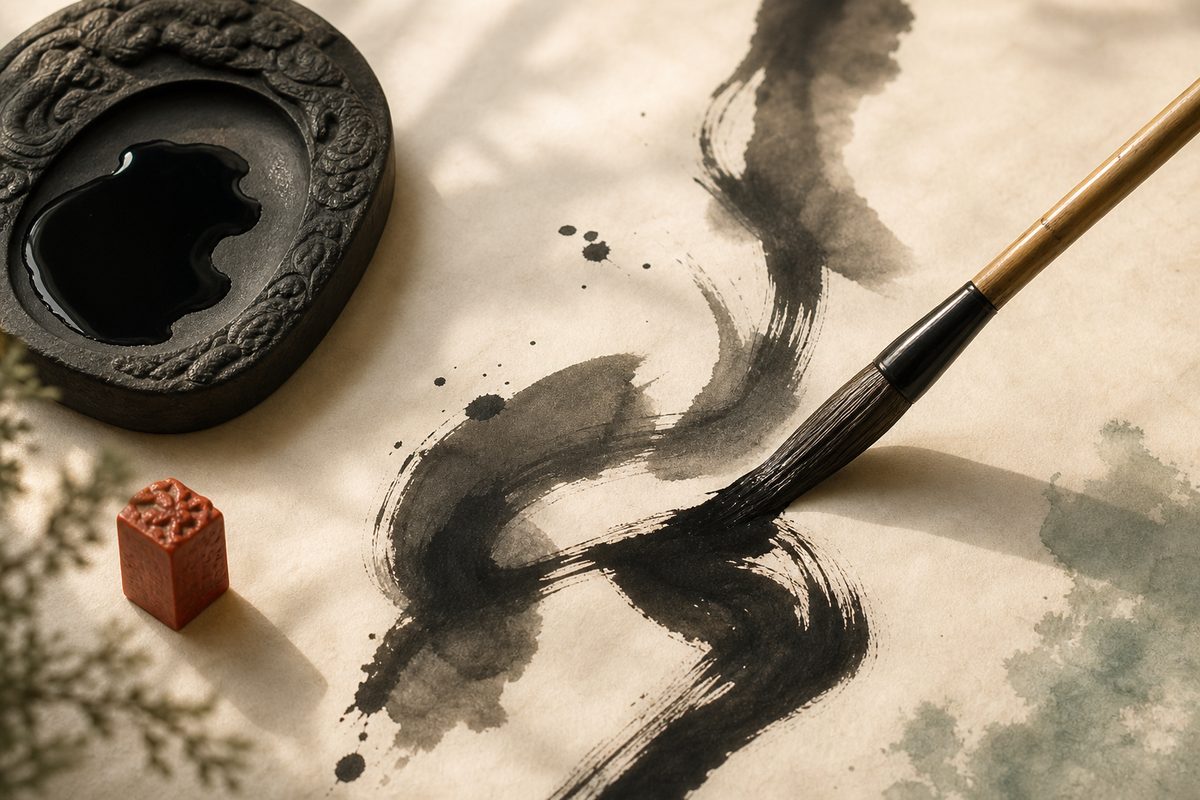
See 永 in calligraphy
From ancient seal script to flowing cursive. Pick a look before a tattoo or a card.
 Name
Name Get a Chinese name
A name matched to the sound of yours, with a meaning that fits.
Start yours Chinese Almanac
 Try the Chinese Gender Predictor
A different corner of Chinese culture: the old Qing-palace birth chart, worked out from your lunar birth date, with the math shown and its coin-flip odds honestly weighed.
Open the toolRelated: longevity, life, water, double happiness, love
By Julian 祝君瑜, sourced from the classics and from modern life, updated 2026-07-27