For a long time Chinese clothes did not button at all. They wrapped and tied, with
sashes and cord ties. Fabric knot buttons crept in slowly. Deng’s outline
has a few cloth buttons in the Tang, on armor and close-fitting everyday clothes, and the
paired knot-and-loop settling into shape under the Song and Yuan, mostly as the plain
straight button. Two researchers at Wuhan Textile University, Hao Xiao’ang and Yin
Zhihong, put it the same way in a 2020 paper: cloth braid buttons appear in Song dress
and have become decorative by the Yuan.
Then the Ming took a detour into metal. Ming women’s jackets fastened with interlocking
buttons of gold and silver, each set a button, a loop and two small plates to sew them
on, which Hao and Yin found designed as a single picture: closed, the button and loop
make one flower, and the two plates become butterflies circling it. When the Jiangxi Provincial Museum’s Ming princess jewelry went on show at the Fengxian
District Museum in Shanghai in 2022, the buttons were shown as jewelry, and the museum
noted that gold, jade and gem-set buttons on women’s jackets were a Ming fashion. On a
standing-collar jacket only one or two pairs went at the collar, and the rest of the
front was still tied. Hao and Yin argue that these collar buttons helped bring in the
high collar, later the mandarin collar, and the jacket buttoned down the front, and
laid the ground for the cloth knot buttons that followed.
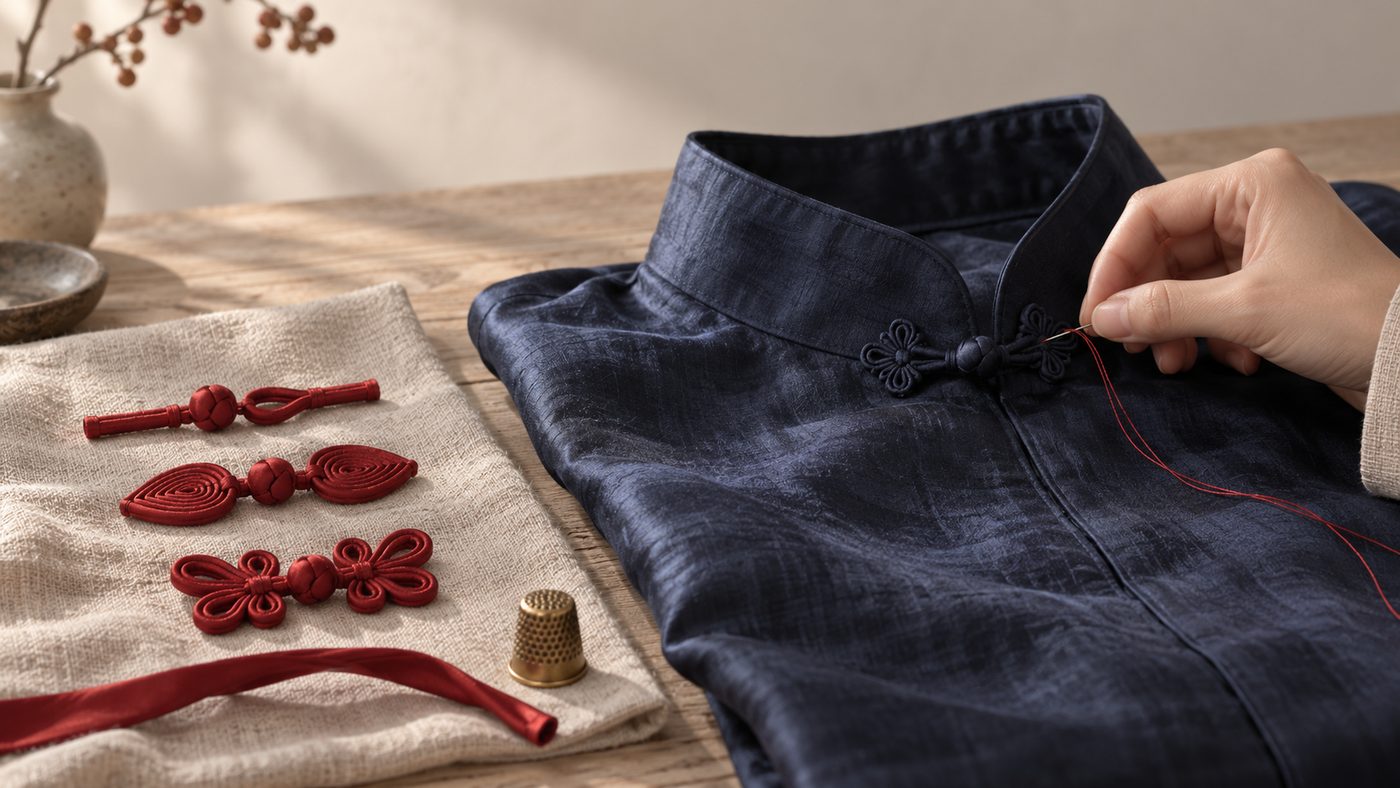
Cloth came back and took over. In Deng’s account the Ming and Qing are the great age of
the pankou, and after the middle of the Qing the flower buttons multiply: pipa,
butterfly, plum blossom, ruyi, the longevity character. The museum record bears out the
ordinary end of it. A Han Chinese woman’s jacket of 1875 to 1900 in the Victoria and
Albert Museum fastens down the right side with five loop and knot buttons; a turquoise
1920s jacket in the same collection has five, shaped as leaves. The qipao took the
button with it into the twentieth century. On a 1930s Hong Kong qipao in the V&A, the
collar buttons are flowers and the ones down the side are spirals, all in blue satin to
match the trim, with a modern press stud hidden among them. The museum’s note says
such buttons were designed to match the fabric and trim, in flowers, insects and lucky
symbols.