The thread

The red string of fate: where it comes from, who ties it, and what to do with the bracelet and the tattoo

The red string of fate is a Chinese idea, about twelve hundred years old, that the two people who will marry are already tied together by an invisible red cord, and that no distance, feud or difference of rank can untie it. In the ninth-century story that started it, the cord is tied around the feet by an old man with a book and a bag, the god of marriage the Chinese call the Old Man Under the Moon. Japan borrowed the thread, moved it to the little finger, and gave the world the version it knows from anime. Somewhere along the way the string also became a bracelet and a tattoo, and got tangled with two other red strings that have nothing to do with it. This page unpicks the knot.
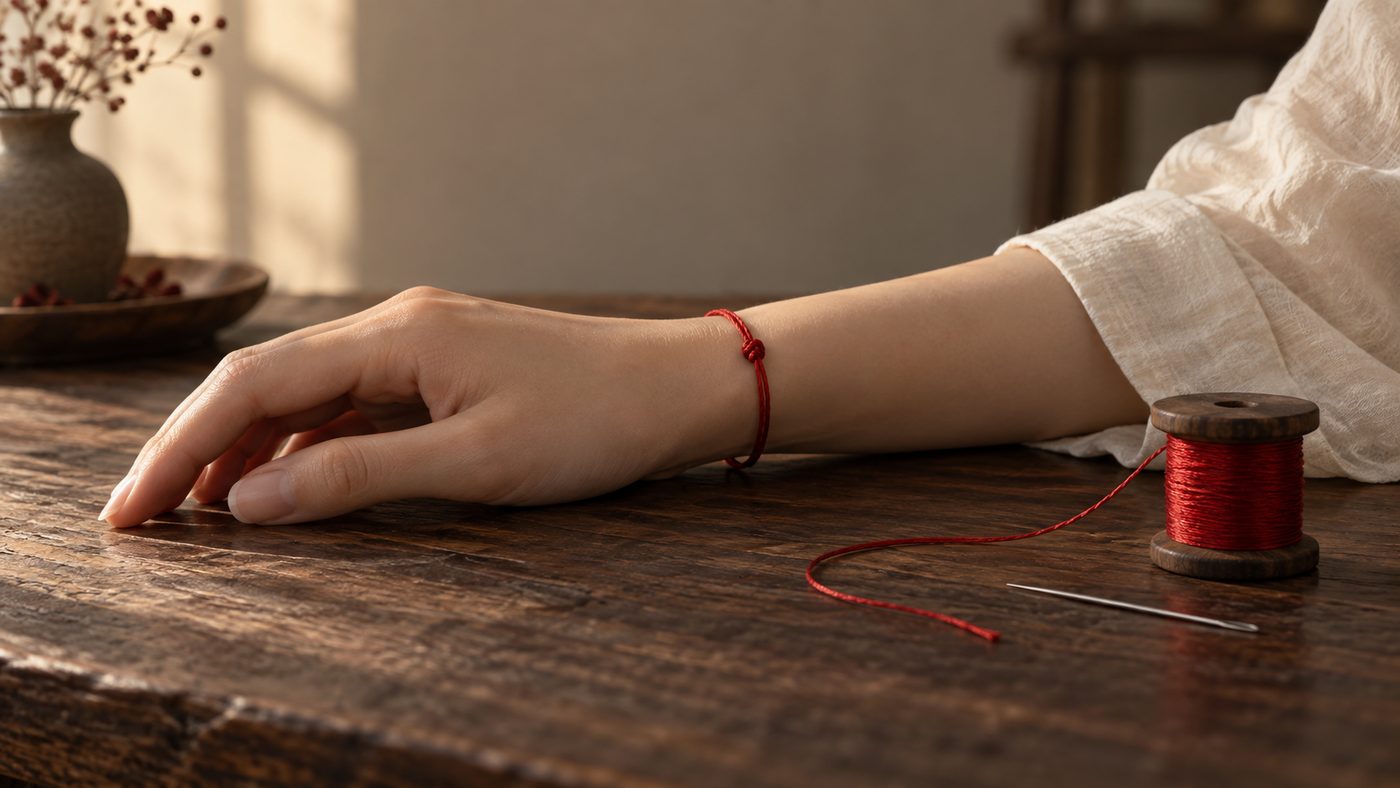
A thin red silk cord tied in a small knot around a wrist resting on dark wood, a spool of red thread and a needle beside it, soft side light and a shallow blur behind.
The thread as most people now wear it: on the wrist. The story ties it lower. Illustration.

Where the string comes from

The whole belief rests on one short story, "The Inn of Betrothal," written by Li Fuyan in the 830s and preserved in the great Song anthology Taiping Guangji. A young man named Wei Gu, traveling to meet a prospective bride, arrives at an inn before dawn and finds an old man reading a book by moonlight on the steps. The book, the old man says, is the register of marriages, and the bag beside him holds red cords, for tying the feet of future husbands and wives: once tied, however far apart they are born, they cannot escape each other. Wei Gu asks about his own bride and is shown a ragged three-year-old in the arms of a blind vegetable seller. He is so appalled that he sends a servant to stab her. Fourteen years later he marries a beautiful young woman who always wears a flower ornament between her eyebrows, and learns in due course what it covers. The full story, with the original text and what the god is actually called in it, is on our page on Yue Lao, the Old Man Under the Moon. Two facts from it matter here: the cord is red, and it goes on the feet.

The image took about a century to become a proverb and a thousand years to become a bracelet. By the eighteenth century it was ordinary speech: in Dream of the Red Chamber, a mother explaining marriage to two teenage girls says that the Old Man Under the Moon needs only one red thread tied round the feet to bind two people, and quotes the saying every Chinese speaker still knows, that a marriage fated across a thousand miles is drawn by a single thread. Note the feet again. In twelve hundred years of Chinese telling, nobody's little finger is involved.

Three red strings that are not the same string

Search for a red string bracelet and you will be sold three different traditions in one listing. They look identical on a wrist and mean entirely different things.

The string Where it goes What it is for Where it comes from
Chinese red string of fateThe feet, in the story; the wrist, in the shopMarriage: the person you will end up with is already tied to youA Tang story of the 830s; the god Yue Lao ties it
Japanese akai itoThe little finger (older telling: a man’s thumb to a woman’s little finger)Soulmates, destined meeting; the anime versionBorrowed from China; the finger placement is Japanese
Chinese zodiac-year cordThe wrist or waist, left for men and right for women, worn until it frays offProtection in the year of your own sign, when you are said to offend the yearFolk remedy for the Tai Sui; no love in it at all
Kabbalah red stringThe left wristAgainst the evil eyeJewish folk custom; a scarlet thread in Genesis 38, a rabbi’s advice in the 1490s, a celebrity fashion in the 1990s

The confusion has a history of its own. The Kabbalah string went global on the wrists of Madonna and half of Hollywood in the late 1990s; the Japanese thread went global on the little fingers of anime characters in the same decade; and the Chinese cord had already been on the wrists of every child in a zodiac year for as long as anyone can remember. Three red threads arrived on Western wrists within a few years of each other, and the internet did what it does. If you are buying one, decide first which of the three you mean.

How the ankle became a little finger

Japan took the Chinese image and did what Japan does with borrowed images: made it smaller and more precise. The akai ito, the "red thread," runs from one little finger to another, or in the older telling from a man's thumb to a woman's little finger, and it belongs to the destined pair rather than to a god: nobody in the Japanese version is keeping a register. The little finger is now so standard that most Chinese illustrators draw it there too, and the ankle survives only in the texts. If you want to know why the pinky, the honest answer is that nobody knows; the popular explanation, that a vein runs from the little finger to the heart, is a piece of folk anatomy repeated because it sounds right.

From manga the thread went everywhere. Its biggest single vehicle is Your Name, Makoto Shinkai's 2016 film, in which a braided red cord passes between the two leads across years and a swapped pair of bodies, and the heroine's grandmother explains that braiding cord, tying a knot and the passage of time are all one word, musubi, "binding." It was, until 2020, the highest-grossing Japanese film ever made, and it is where a large share of the people searching for this page first saw a red string do its work. The Chinese original is stranger and darker, involves a hired killer, and ends with a woman who has spent fourteen years hiding a scar. It is also, if you read it, a better story.

The red string tattoo

It is one of the few Chinese-origin tattoos that needs no characters at all, which is part of its appeal. The standard designs are a thin red line circling the base of the little finger like a ring; the same line around the ankle; a small red bow with its two ends running off the edge of the skin, unfinished, because the other end belongs to someone else; and a matching pair, one bow on each of two people, or one continuous line that only completes when two wrists are held together. The single-line versions are tiny and age well. The bow needs a good artist, because a bow in red ink that blurs is a smudge.

Two choices to make with your eyes open. First, placement decides which tradition you are quoting: the little finger is Japanese, the ankle is Chinese, and both are correct, so choose the one whose story you actually like. Second, if you want a character with it, the right one is not "love." The Chinese word for the fated pull between two people is yuán 缘, the affinity that makes a meeting destined, and the full word for a fated marriage is yīnyuán, which is what the proverb about the thousand miles is about. The two characters the story itself uses for the cord, chì shéng, "red cord," are what a literate Chinese reader would recognize as the source. You can see any of them brushed properly in the calligraphy generator before you take the design to an artist, and our guide to Chinese tattoo symbols covers how to get a character checked. Red pigment is the ink artists most often warn about for skin reactions; ask yours before you book.

The red string bracelet

The bracelet is the newest of the three objects and the one with the fewest rules, because the story it comes from never mentions a wrist. A red string of fate bracelet is a thin red cord, usually a single strand with a sliding knot, sometimes with one gold bead or a small charm; couples buy them in pairs. Which hand: there is no classical answer, so the convention that has grown up is the left, nearest the heart, and that is the whole of the tradition. How long: until it wears through, which is the rule the zodiac-year cord has always had, and the romantic bracelet inherited it. Do not cut it off; let it go on its own.

The zodiac-year cord is the one with real rules, and it is worth knowing them so you do not mix the two up. It is worn in the year of your own sign, when the almanac tradition says you offend the year, and the folk prescription is red, worn against the skin, ideally given by someone else, on the left wrist for a man and the right for a woman, from New Year until it frays. Our page on Tai Sui has the reasoning and a finder that tells you whether this year is yours. And if what you want is a charm rather than a thread, the page on Chinese good luck charms sorts the real ones from the gift-shop rail, red cord included.

When is your string tied?

The Tang story says nobody gets to read the register. What the tradition does read is timing: a bazi chart marks the years when the peach-blossom star and the spouse star are active, which practitioners treat as the seasons a marriage is made. Your birthday casts the chart; the reading of when is in it.

Those two markers have a page of their own: when will I get married prints the marked years from a single birthday and is honest about the one thing the old books refuse to give you, which is a date.

Nothing you enter is stored on this page; the chart page casts it fresh.

Asking about one particular person rather than about a season? Does he like me takes two birthdays and gives the branch relation between the two signs, which is the nearest thing the tradition has to an answer, and it is not the answer people expect.

Questions people ask

›What is the red string of fate?

A Chinese belief, first written down in a ninth-century Tang story, that the two people who will marry are already joined by an invisible red cord tied by the god of marriage, the Old Man Under the Moon. In the story he ties it around their feet, and says that once tied it cannot be escaped, whatever the distance, rank or enmity between the two families. The image passed into a Chinese proverb, "a marriage fated across a thousand miles is drawn by one thread," and into Japan, where the cord moved to the little finger and became a stock device of manga and anime.

›Is the red string of fate Chinese or Japanese?

Chinese in origin, Japanese in its most famous form. The Tang story from around the 830s has the cord tied at the ankles by a Chinese marriage god. Japan borrowed the idea, tied it to the little finger (or from a man’s thumb to a woman’s little finger in the older telling), and gave it the name akai ito, "red thread," which is how most of the world met it: on a pinkie, in a cartoon. Both versions are real; they are different stages of the same idea.

›What does a red string of fate tattoo mean?

That your person is out there and already connected to you, or, as a matching tattoo, that the two of you are the ends of one cord. The usual designs are a thin red line circling the little finger or the ankle, a small red bow, or a single line running off the edge of the skin. If you want the Chinese-accurate version, the string goes at the ankle, which is where the Tang story ties it; the little finger is the Japanese version. Both are correct in their own tradition, and neither requires a Chinese character, though the character for fated affinity, yuan, is the one that fits.

›Which hand do you wear a red string bracelet on?

It depends which red string you mean. The Kabbalah string is worn on the left wrist. The Chinese zodiac-year cord follows the old rule of left for men and right for women, and is worn until it falls off on its own. The red string of fate bracelet, the romantic one, has no classical rule at all because the story ties feet, not wrists; most people wear it on the left, nearest the heart, and that is as much tradition as there is.

›Is the red string bracelet the same as the Kabbalah red string?

No, though they look identical. The Kabbalah string is a Jewish folk charm against the evil eye, worn on the left wrist and made famous by celebrities in the 1990s. The Chinese red string of fate is about marriage and is tied, in the story, by a god; the Chinese zodiac-year cord is a protection worn in the year of your own sign. Three traditions, one piece of red thread.

›Can you find out who is on the other end of your red string?

The Tang story says no: the old man can see the register and you cannot, and the hero’s attempt to cheat it fails. What the Chinese tradition does offer is timing, not names: a bazi chart marks the years when the peach-blossom star and the spouse star are active, which practitioners read as the seasons when a marriage is likely to be made. That is a reading of when, not who.

Sources and further reading

Related

Stay in the loop.

Chinese mythology, the zodiac, and the meaning behind names and symbols, rooted in the classics and read back to you. No spam. Unsubscribe anytime.