Chinese Symbol
Chinese Symbol for Fire (火): Meaning, the Element, and Origin
The Chinese symbol for fire is 火 (huǒ, said like "hwaw"), and it is exactly what it looks like: a small picture of a flame, a burning core with a spark thrown off on either side. It is one of the oldest characters in the language and one of the Five Elements, the phase Chinese cosmology files under the south. And in the last few years it has quietly become the everyday word for going viral.
- Strokes
- 4
- Radical
- 火 (fire; it is its own radical, Kangxi 86)
- Formation
- Pictograph (象形)
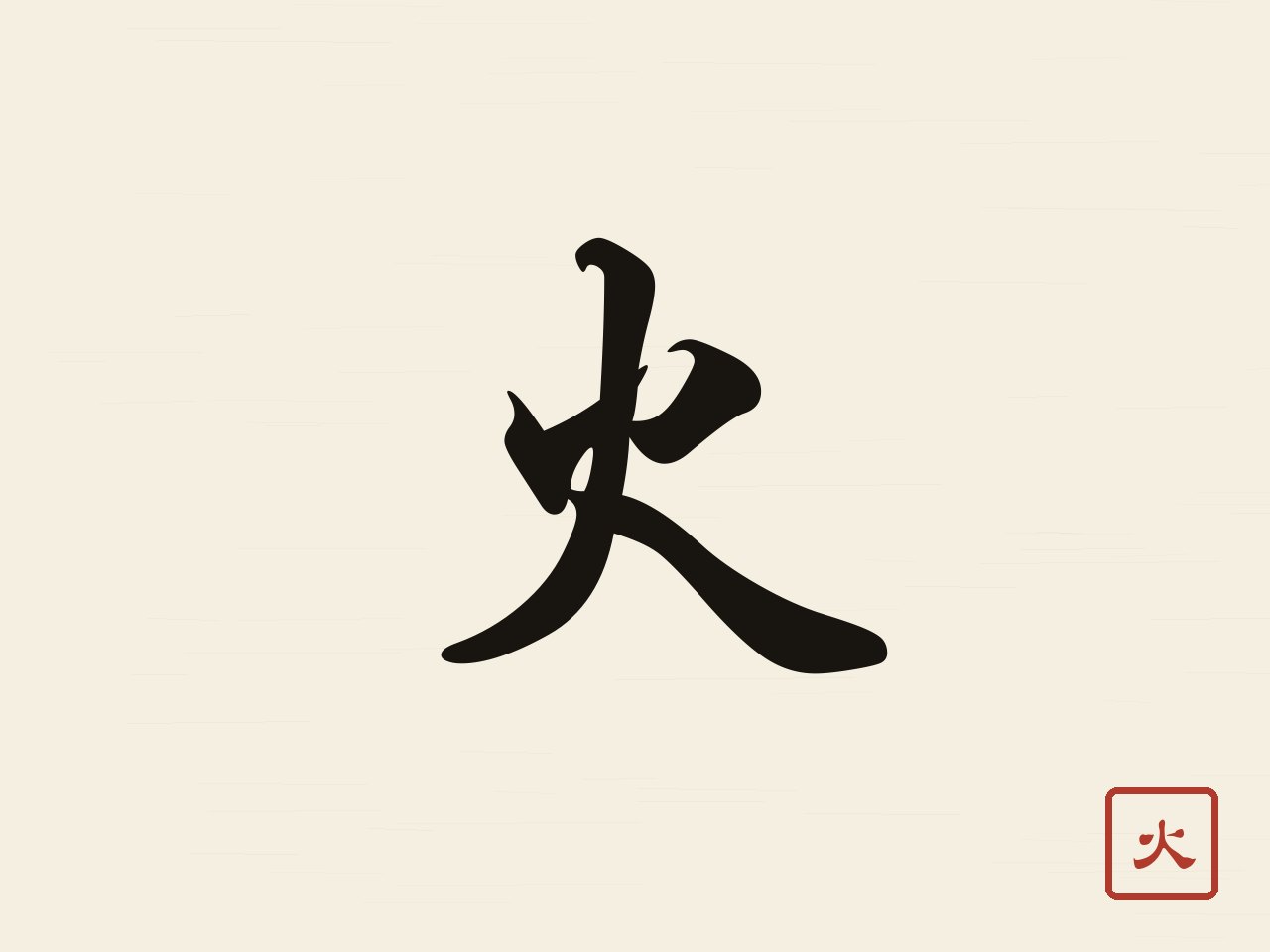
Trace 火 yourself, or watch it drawn
See 火 in seal, brush & cursive Try it
How it's written
火 is four strokes, and unusually you can more or less see the thing it draws. At the bottom is 人, the character for a person with its legs spread, though here it is really the body of the flame. Above its shoulders sit two short strokes, a dot on the left and a small slash on the right, and those are the sparks flying off. Put them together and you have a fire with embers leaping from it. Watch the one trap: give the base a single flat line across the top instead of two separate sparks and you have written 大, "big," a completely different character. 火 is identical in simplified and traditional Chinese, so there is only ever one form to learn. One more thing worth knowing: when 火 ducks underneath another character it flattens into four little dots, 灬, which is the same fire still burning at the bottom of 热 (hot), 煮 (to boil), and, oddly, 熊 (bear).
What it means
火 (huǒ) is the plain word for fire and flame, and from there it fans out the way fire does. It is heat and burning; it is the fire element of Chinese cosmology; and it is anger, the "fire" that rises in you when you lose your temper, exactly as in English. It reaches into medicine and the internet too, as the rest of this page will show.
The reason 火 turns up everywhere from horoscopes to feng shui is that it is one of the wǔxíng, the Five Phases or Elements, the five-part system Chinese thought uses to sort the whole world. Each element has a direction, a season, a color, and a set of relationships with the others:
| Element | Direction | Season | Color | It generates | It controls |
|---|---|---|---|---|---|
| Wood 木 | East | Spring | Green | Fire | Earth |
| Fire 火 | South | Summer | Red | Earth | Metal |
| Earth 土 | Center | Late summer | Yellow | Metal | Water |
| Metal 金 | West | Autumn | White | Water | Wood |
| Water 水 | North | Winter | Black | Wood | Fire |
Fire's line is the one that matters here: south, summer, red, born from wood and giving birth to earth, able to melt metal but put out by water. If you have a fire element in your bazi chart or a fire direction in feng shui, this is the character doing the work. Its opposite number is water, the element that quenches it.
- 火焰 flame
- 火灾 a fire, a blaze (as a disaster)
- 着火 to catch fire; to be on fire
- 火车 train (literally 'fire-cart')
- 火锅 hotpot (literally 'fire-pot')
- 火柴 match (literally 'fire-wood')
- 火山 volcano (literally 'fire-mountain')
- 上火 to get 'internal heat' (TCM); to get inflamed or irritable
- 火气 temper, anger (literally 'fire-energy')
- 火热 fiery hot; passionate, intense
Idioms
- 星星之火,可以燎原“a single spark of fire can burn the whole plain”a small beginning can grow into something unstoppable. (an old proverb, made famous by Mao Zedong's 1930 essay of that title)
- 火上浇油“to pour oil on the fire”to make a bad situation worse; to inflame things.
- 水火不容“water and fire cannot share a roof”utterly incompatible; two things or people that cannot coexist.
- 如火如荼“like fire, like white reeds in flower”in full, blazing swing; flourishing and intense.
- 火眼金睛“fire eyes, golden pupils”sharp, penetrating eyes that see through any disguise or deception. (of Sun Wukong, from Journey to the West)
Right vs wrong forms
| Form | Type | Note |
|---|---|---|
| 火 | simplified ✓ | The standard form everywhere, identical in simplified and traditional Chinese: four strokes, and it was never simplified. When it sits at the bottom of another character it flattens into the four-dot form 灬 (as in 热, hot), but that is the same radical, not a different character. |
| 大 (sparks merged into a bar) | wrong | Not a real variant, but the classic slip. If the two top sparks are drawn as a single flat horizontal line, 火 (fire) becomes 大 (big), an entirely different and very common character. Keep the two top strokes separate. |
| 火 (flipped or rotated) | mirrored | Not a variant. A mirrored or rotated 火 from a low-resolution stencil reads as an error to anyone literate. Check against a dictionary at full size before inking. |
For a tattoo
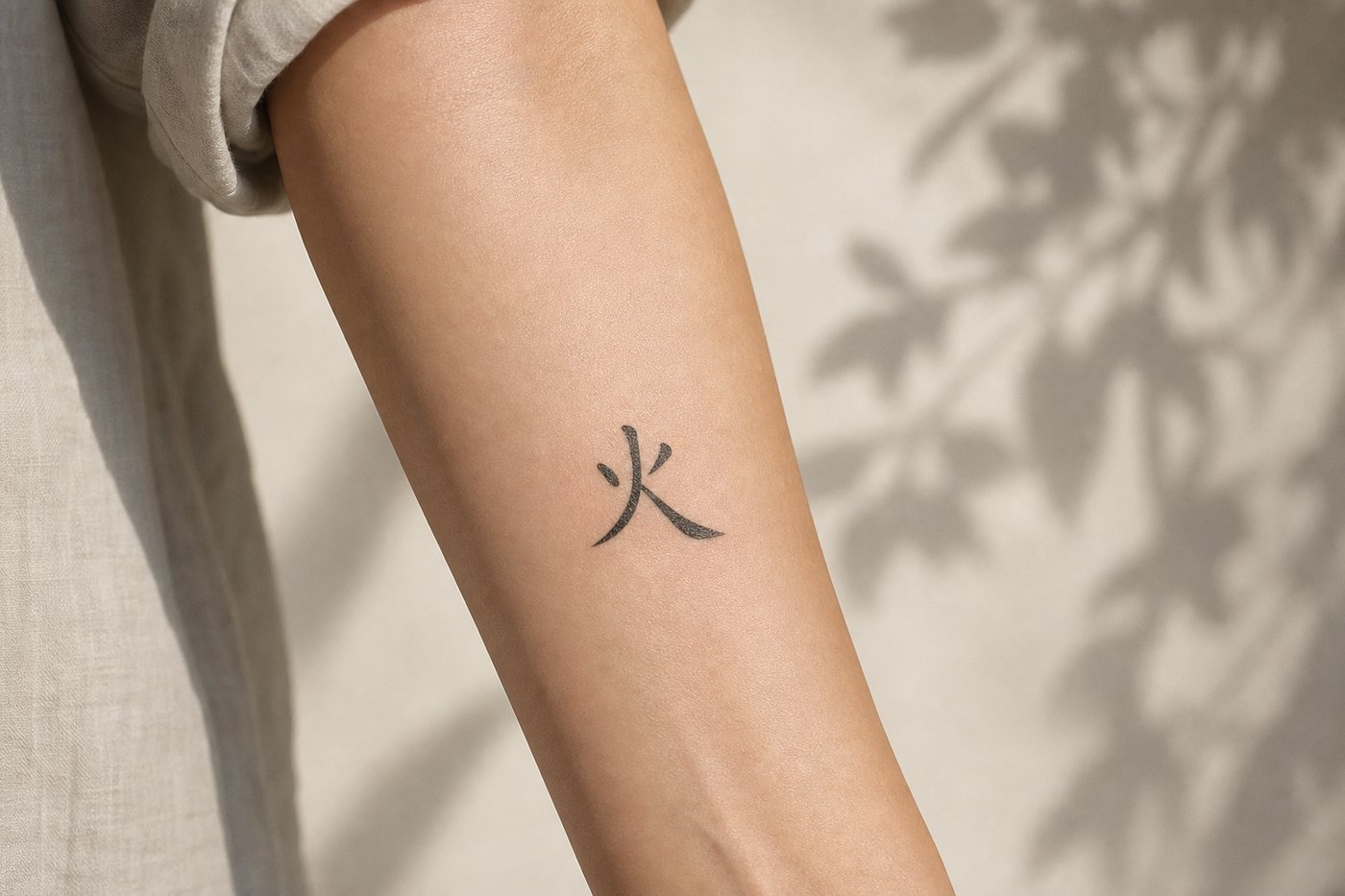
火 is a clean, strong choice for a tattoo, especially as one of a set: people often ink the Five Elements together, or pick the single one that matches their bazi chart. It is only four strokes, it is identical in simplified and traditional Chinese, and its little flame shape genuinely suits skin. Two small things to keep in mind. First, do not let the two top sparks merge into a single flat line, which would turn 火 (fire) into 大 (big); a good artist working from a clear reference will not, but check. Second, decide whether you mean it as the plain word "fire" or as the element, since to a Chinese reader 火 quietly carries both, plus a hint of "temper." As always, print it at full size and have someone who reads Chinese confirm the design before the needle comes out.
Before you commit to any character, the eight ways a Chinese tattoo goes wrong covers the failure modes that are not specific to this one, including the stroke-density arithmetic that decides whether a traditional form survives at small sizes.
Fire in life today
The word for going viral
The most alive thing 火 does today has nothing to do with actual flames. To say something huǒ le, "caught fire," is the standard Chinese way to say it went viral, blew up, became the thing everyone is talking about. A hit song, a street-food stall, an overnight-famous influencer: all of them huǒ. Turn the heat up and you get bàohuǒ, "explosively on fire," for a genuine sensation. It is the same instinct English has when it calls something "hot" or says a clip "blew up," but Chinese picked the purest version, the fire itself. A character a Shang priest used for a sacrificial blaze is now what a teenager types about a meme.
The fire inside you
Chinese medicine and everyday speech share a second, bodily fire. When you eat too much fried food, stay up too late, or get stressed, you are said to shàng huǒ, to have your internal fire "rise": the traditional explanation for a sudden crop of mouth ulcers, a sore throat, or a short fuse. The cure is "cooling" foods and an early night. It is folk medicine, but it is so woven into daily life that a Chinese friend will tell you in complete seriousness that your breakout means you need to put out some fire. The same 火 sits in huǒqì, "fire-energy," the word for a hot temper, and in a heap of plain compounds besides: huǒchē, "fire-cart," is a train; huǒguō, "fire-pot," is hotpot; huǒchái, "fire-wood," is a match.
A fire god on Mars
When China landed its first rover on Mars in 2021, it named the machine Zhùróng, after 祝融, the ancient Chinese god of fire, a figure said to have brought fire down to the human world. The choice was a small poem in itself: the Chinese name for Mars is Huǒxīng, the "fire star," so a fire god was sent to walk the fire planet. It is the oldest layer of the character meeting the newest, a bronze-age flame deity riding a spacecraft.
Curious what your own name could become in Chinese, matched to its sound and a
good meaning? Our Chinese name generator builds one for you.
Where the character comes from
The oldest dictionary treats 火 as a picture and a piece of cosmology in the same breath. The Shuowen Jiezi, compiled around the year 100, glosses it first as huǐ, a blaze, and then adds the line that shows how deep the Five Elements run in Chinese thought: 火 is "the phase of the south, blazing and rising." Before it is a letter or a word, fire is already a direction. The oracle-bone forms from three thousand years ago show the same shape we still write, a central flame with sparks, which makes 火 one of those rare characters that has barely changed across the entire recorded history of the writing system. What a Shang diviner scratched onto a turtle shell for "fire," you can still read today.
That stability made 火 a workhorse of the writing system, a building block for a small vocabulary of heat. Stack two fires and you get 炎, "blazing," the character also used for inflammation; three of them, 焱, is a mass of sparks. Slide a single 火 underneath the roof radical 宀 and you get 灾, the oldest and bleakest of the compounds: a fire inside the house, which is the Chinese character for "disaster."
History & roots
The man who drilled fire
Every culture keeps a story about where fire came from, and China's is unusually kind to the inventor. Where Greece has Prometheus stealing fire from the gods and being punished forever, China has Suìrén, "the fire-maker," a culture hero who simply worked it out. Watching a bird peck at a tree until sparks flew, the legend says, he learned to make fire by drilling one piece of wood against another, and taught the trick to everyone. For that he is counted among the Three Sovereigns, the trio of mythic inventors, alongside Fuxi, who gave people the eight trigrams, and Shennong, who gave them farming. Fire, in the Chinese telling, was not stolen. It was worked out, and shared.
The phase of the south
Fire's real career in Chinese culture is as one of the Five Elements, and there it is anything but random. Fire is the south, the direction of the midday sun; it is summer, the season of the greatest heat; its color is red, which is one reason red became the color of luck and celebration; and its organ is the heart, its emotion joy. Its relationships are a small logic puzzle that runs the whole system: wood feeds fire, fire makes earth as ash, fire melts metal, and water kills fire. That last pair, shuǐ huǒ bù róng, "fire and water cannot share a roof," became the everyday Chinese phrase for two people or ideas that simply cannot coexist. When a feng-shui consultant talks about a room's fire energy, or a bazi reading calls someone a fire person, this old grammar is what they are speaking.
A single spark
Fire also gave Chinese one of its most quoted lines about how small things become large ones. The proverb xīngxīng zhī huǒ, kěyǐ liáoyuán, "a single spark can start a prairie fire," is ancient, but it became a slogan in the twentieth century when Mao Zedong took it as the title of a 1930 essay arguing that a tiny, struggling movement could one day sweep a country. Today it is used for anything that starts small and spreads: a rumor, a trend, a protest. The other famous fire belongs to Sun Wukong, the Monkey King, whose eyes were forged in a furnace into huǒyǎn jīnjīng, "fire eyes, golden pupils," able to see through any disguise. Fire, in the Chinese imagination, is both how a revolution starts and how you spot a liar.
The bird of the south
Fire even has its own animal in the sky. Long before the twelve zodiac creatures, Chinese astronomers split the heavens into four quarters, each guarded by a mythic beast, the Four Symbols: the Azure Dragon of the east, the White Tiger of the west, the Black Tortoise of the north, and, for the south and for fire, the Zhūquè, the Vermilion Bird, a blazing red phoenix-like creature of summer and flame. When you meet a red bird painted on an old temple ceiling or a Tang-dynasty tomb wall, that is fire wearing feathers. Closer to home, fire is also the thing a family is not meant to let go out. Xiānghuǒ, "incense-fire," is the smoke that rises from offerings to the ancestors, and by extension it means the continuity of a family line itself; to "cut off the incense-fire," duàn le xiānghuǒ, is the old phrase for a lineage ending with no descendant left to tend the flame. Fire, at its most tender, is the small light a household keeps burning for the people who came before.
Questions people ask
What is the Chinese symbol for fire?
It is 火 (huǒ), a four-stroke pictograph of a flame with a spark on each side. It means fire and flame, and it is also one of the Five Elements (五行) of Chinese cosmology, the element of the south, summer, and the color red. It is written identically in simplified and traditional Chinese. In modern slang, 火 (huǒ) also means 'viral' or 'hugely popular.'
Is fire yin or yang in Chinese thought?
Fire is the most yang of the Five Elements: active, hot, bright, and rising, the opposite of yin water, which is cool, still, and sinking. Within the system fire belongs to the south, summer, and the color red, and its nature is expansion and heat. This is why a person with strong fire in their bazi chart is read as outgoing and energetic.
Is there a Chinese god of fire?
Yes: 祝融 (Zhùróng), the ancient god of fire and of the south, said to have brought fire to humankind. China named its first Mars rover 'Zhurong' after him in 2021, a fitting choice since the Chinese name for Mars is 火星 (Huǒxīng), the 'fire star.' A separate legend credits the culture hero 燧人 (Suìrén) with inventing fire-making by drilling wood.
What is fire in Mandarin?
Fire in Mandarin is 火, pronounced huǒ (a third, dipping tone), roughly 'hwaw.' The same character is the fire element in Chinese astrology and feng shui, appears in everyday words like 火车 (huǒchē, train) and 火锅 (huǒguō, hotpot), and in slang means 'to go viral.'
What does the fire element mean in Chinese astrology?
In Chinese astrology and bazi, fire (火) is one of the Five Elements and is linked to the south, summer, the color red, the heart, and the emotion of joy. A fire element in a chart suggests warmth, drive, and visibility. Fire is generated by wood and generates earth, it melts metal, and it is controlled by water, the relationships that let a reading balance a person's chart.
Sources
- Wiktionary: 火 (pictograph origin, radical, Five Elements, modern slang)
- Shuowen Jiezi entry for 火: 南方之行,炎而上 (hancibao.com)
- Wuxing (Five Phases): fire's direction, season, and cycles (Wikipedia)
- Three Sovereigns and Five Emperors: Suiren the fire-driller (Wikipedia)
- China names its first Mars rover Zhurong, after the fire god (Space.com)
- Four Symbols: the Vermilion Bird of the South represents fire (Wikipedia)
Make Fire your own
See 火 in calligraphy
From ancient seal script to flowing cursive. Pick a look before a tattoo or a card.
 Name
Name Get a Chinese name
A name matched to the sound of yours, with a meaning that fits.
Start yours Chinese Almanac
 Try the Chinese Gender Predictor
A different corner of Chinese culture: the old Qing-palace birth chart, worked out from your lunar birth date, with the math shown and its coin-flip odds honestly weighed.
Open the toolRelated: water, dragon, strength, prosperity
By Julian 祝君瑜, sourced from the classics and from modern life, updated 2026-07-22