A question, answered the Chinese way

What are the red flags in a relationship, sign by sign?

The Chinese tradition kept a formal list of them, and it is shorter and stranger than the ones in psychology articles. It has three entries. The clash is the sign directly opposite yours on the twelve-branch wheel. The harm is a slow-friction pairing, one per sign. The punishment is a set of three small groups, plus four signs that punish themselves. Each harm and each punishment has a name in the Ming compendium the tables come from, the Sanming Tonghui, and the names are the most useful part: "the harm of envy," "the punishment of ingratitude," "the harm of the young overriding the old." They read like a list of the ways a relationship goes wrong, because that is what they are.

The difference from a modern list is where the flag sits. A psychology article flags a person: love-bombing, contempt, a partner who never apologizes. These tables never flag a person. Every entry is a relation between two signs, so the red flag lives in the pairing, and your sign on its own is never one. The book is also franker about its own limits than most advice columns: the chapter on clashes says they are "mostly ill," then adds that some are "a blessing of the greatest kind." Below is every sign's list, and a check that reads the flags between any two birthdays.
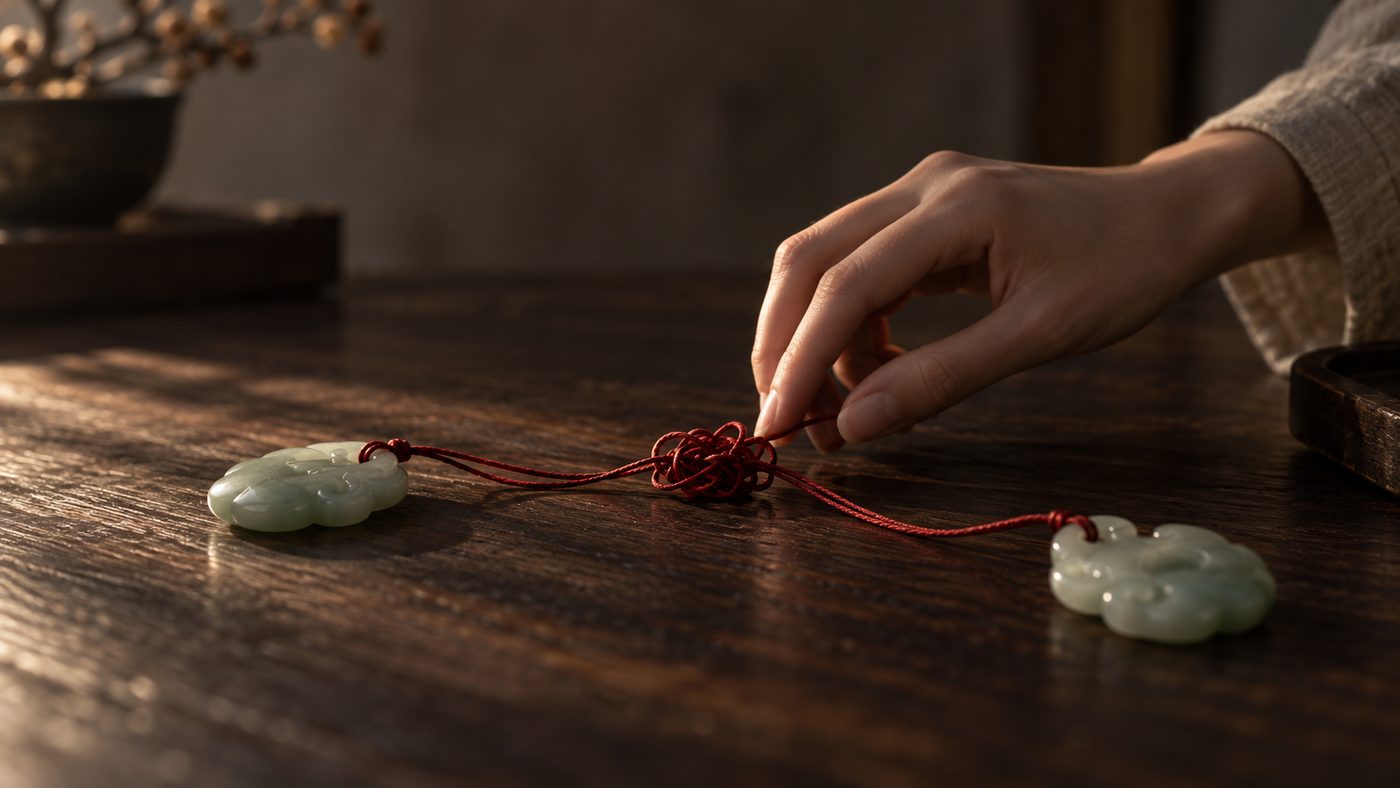
Two small carved jade pendants on a dark wooden table, their red silk cords snarled into one tight knot between them, and a hand reaching in to pick at the knot in low side light.
The knot is between the two, not in either one. Illustration.

Check the flags between two birthdays

Signs are read by the Chinese New Year rule, so a January or February birthday may belong to the previous animal. Every flag the tables hold is listed, not just the strongest. Nothing you enter is stored.

Of the 78 possible pairings, same-sign pairs included, 20 carry at least one flag. The other 58 carry none.

Every sign's red flags

Each sign gets one clash and one harm, and either a punishment group or a self-punishment. The pattern behind the harm is worth noticing in every row: your harm sign is always the secret friend of your clash, the one who takes your opponent's side.

Rat

  • Clash: the Horse, directly opposite on the wheel.
  • Harm: the Goat, the harm of powerful houses. The Goat is the Horse's secret friend.
  • Punishment: the Rabbit, the punishment of discourtesy.

Ox

  • Clash: the Goat, directly opposite on the wheel.
  • Harm: the Horse, the harm of the official and the ghost. The Horse is the Goat's secret friend.
  • Punishment: the Dog and Goat, the punishment of leaning on power.

Tiger

  • Clash: the Monkey, directly opposite on the wheel.
  • Harm: the Snake, the harm of presuming on rank. The Snake is the Monkey's secret friend.
  • Punishment: the Snake and Monkey, the punishment of ingratitude.

Rabbit

  • Clash: the Rooster, directly opposite on the wheel.
  • Harm: the Dragon, the harm of the young overriding the old. The Dragon is the Rooster's secret friend.
  • Punishment: the Rat, the punishment of discourtesy.

Dragon

  • Clash: the Dog, directly opposite on the wheel.
  • Harm: the Rabbit, the harm of the young overriding the old. The Rabbit is the Dog's secret friend.
  • Self-punishment: another Dragon. Two of the same sign get a mild caution, not a blank.

Snake

  • Clash: the Pig, directly opposite on the wheel.
  • Harm: the Tiger, the harm of presuming on rank. The Tiger is the Pig's secret friend.
  • Punishment: the Tiger and Monkey, the punishment of ingratitude.

Horse

  • Clash: the Rat, directly opposite on the wheel.
  • Harm: the Ox, the harm of the official and the ghost. The Ox is the Rat's secret friend.
  • Self-punishment: another Horse. Two of the same sign get a mild caution, not a blank.

Goat

  • Clash: the Ox, directly opposite on the wheel.
  • Harm: the Rat, the harm of powerful houses. The Rat is the Ox's secret friend.
  • Punishment: the Ox and Dog, the punishment of leaning on power.

Monkey

  • Clash: the Tiger, directly opposite on the wheel.
  • Harm: the Pig, the harm of rival talents. The Pig is the Tiger's secret friend.
  • Punishment: the Tiger and Snake, the punishment of ingratitude.

Rooster

  • Clash: the Rabbit, directly opposite on the wheel.
  • Harm: the Dog, the harm of envy. The Dog is the Rabbit's secret friend.
  • Self-punishment: another Rooster. Two of the same sign get a mild caution, not a blank.

Dog

  • Clash: the Dragon, directly opposite on the wheel.
  • Harm: the Rooster, the harm of envy. The Rooster is the Dragon's secret friend.
  • Punishment: the Ox and Goat, the punishment of leaning on power.

Pig

  • Clash: the Snake, directly opposite on the wheel.
  • Harm: the Monkey, the harm of rival talents. The Monkey is the Snake's secret friend.
  • Self-punishment: another Pig. Two of the same sign get a mild caution, not a blank.

What the old names say

The Sanming Tonghui is a sixteenth-century compilation, and its chapters on these relations are where the tradition's view of what goes wrong between two people is most explicit. Three things in them are worth knowing.

The harm is betrayal by alliance. The chapter on the six harms explains them by the clash. The Rat fears the Horse, which sits opposite it; the Goat goes and makes an alliance with the Horse; so the Goat harms the Rat. In the book's phrase, a harm forms when "the favor of the combination is not yet made and the grudge is already born." Then it names the six: the harm of powerful houses (Rat and Goat), of the official and the ghost (Ox and Horse), of presuming on rank (Tiger and Snake), of the young overriding the old (Rabbit and Dragon), of rival talents (Monkey and Pig), and of envy (Rooster and Dog). It is the most over-read relation online, and the book itself reads it as friction rather than disaster.

The punishment grows out of closeness. The chapter on the three punishments opens with a line from the Yinfu Jing, "kindness is born of harm, and harm of kindness," and derives the punishments from the combinations. Then it draws the moral itself: punishment arising inside a union is "like a husband and wife who join and then do each other harm." The three groups are named for the way each goes wrong. Tiger, Snake and Monkey form the punishment of ingratitude, because each turns on what feeds it; the book's worst-case portrait is someone who praises you to your face and slanders you behind your back. Ox, Dog and Goat form the punishment of leaning on power. Rat and Rabbit form the punishment of discourtesy: water feeds wood, and the two still refuse each other any deference.

The clash is not a verdict. The seventh position around the wheel is the clash, the same arithmetic by which the seventh heavenly stem "kills" the first. The chapter calls clashes "mostly ill" and then spends much of its length on exceptions, including clashes it calls a blessing of the greatest kind. The full derivations of all three relations are on the branch relations page, and the mechanisms audit counts how many of the 66 pairings carry any classical mark at all.

What this can tell you, and what it cannot

It can say

  • Which of the classical warnings stand between two signs. The answer is fixed and you can check it on the wheel.
  • What kind of friction the old books meant by each: opposition, a sided alliance, closeness that curdles.
  • That a pairing carries no flag at all, which is the most common answer.

It cannot say

  • Whether a person is safe to be with. That is behavior, and no birth year tells you about it.
  • Whether to leave. A clash describes a texture, and plenty of long marriages are clashes.
  • Anything at the level of a full chart. Traditional matchmaking compared eight characters each, not two animals.

If what brought you here is a relationship that frightens you, a zodiac table is the wrong instrument, and the modern red-flag lists are right about the things that matter: control, contempt, isolation, fear. The old tables are a way to talk about friction between two people who are both acting in good faith. They were never meant for anything else.

Questions people ask

What are the red flags in Chinese zodiac compatibility?

Three relations between signs are formally flagged in the classical tables. The clash is the sign directly opposite yours on the twelve-branch wheel, six positions away. The harm is a quieter friction pairing, one per sign. The punishment is a set of three groups (Tiger, Snake and Monkey; Ox, Dog and Goat; Rat and Rabbit) plus four signs that punish themselves (Dragon, Horse, Rooster and Pig). Each of the six harms and three punishments has its own name in the Ming compendium the tables come from, the Sanming Tonghui.

Which Chinese zodiac signs should not be together?

The tradition does not ban any pairing. It flags six clashes (Rat and Horse, Ox and Goat, Tiger and Monkey, Rabbit and Rooster, Dragon and Dog, Snake and Pig) as the strongest friction, and the same book that lists them says a clash can be a blessing as easily as a disaster, depending on the rest of the chart. A flag in these tables is a description of where two people grind, never a rule against marrying.

What is the harm relationship in the Chinese zodiac?

The harm, liu hai, is the sign that makes friends with your enemy. Each sign's harm partner is the secret friend of the sign that clashes with it: the Rat clashes with the Horse, the Goat is the Horse's secret friend, so the Goat harms the Rat. The Sanming Tonghui explains it in almost exactly those terms, and gives each of the six harms a name, from "the harm of powerful houses" (Rat and Goat) to "the harm of envy" (Rooster and Dog).

What is self-punishment in Chinese astrology?

Four branches, the Dragon, Horse, Rooster and Pig, appear in the punishment tables against themselves. The book's reason is that each carries its own element at full strength: the Dragon is water's storehouse, the Horse fire at its height, the Rooster metal at its hardest, the Pig water rising. Too much of one thing, it says, brings trouble on itself. In practice it is read as a mild caution for two people of the same one of those four signs.

Is my sign a red flag?

No sign is. Every flag in the tables is a relation between two signs, which is the point this page is built on: the tradition locates the problem in the pairing rather than in either person. Your sign has one clash, one harm, and a punishment group or a self-punishment, like every other sign, and more pairings carry no flag at all than carry one.

Keep going

  • Chinese zodiac compatibility has the twelve-by-twelve grid, the green flags as well as the red, and a full page on every pairing.
  • Does he like me? reads the same two birthdays for the single strongest relation, in one line.
  • Branch relations prints the clash, harm and punishment tables in full, with the derivations.
  • Cast your chart reads the full eight characters, which is what matchmakers actually compared.

Sources

The relations are the calculator's own tables, read at build; only the classical names of the harms and punishments are typed in, and the build checks each name against a relation the engine already holds.

Stay in the loop.

Chinese mythology, the zodiac, and the meaning behind names and symbols, rooted in the classics and read back to you. No spam. Unsubscribe anytime.