Chinese Symbol
Chinese Symbol for Freedom: Meaning, History, and Tattoo Tips
The Chinese symbol for freedom is 自由 (zì yóu, roughly "dzuh yo"), two characters that read, quite literally, "from oneself": acting on your own say-so rather than someone else's, and it is written identically in simplified and traditional Chinese. The surprise is its past. For most of its eighteen hundred years on record, ziyou was not a right anyone demanded. More often it was a charge a parent leveled at a willful child.
- Strokes
- 11
- Characters
- 自 (self; Kangxi 132) + 由, which dictionaries file under 田 (field; Kangxi 102)
- Formation
- Two-character compound: 自 (self) + 由 (from, following)
Trace 由 yourself, or watch it drawn (the half tattoo stencils most often get wrong)
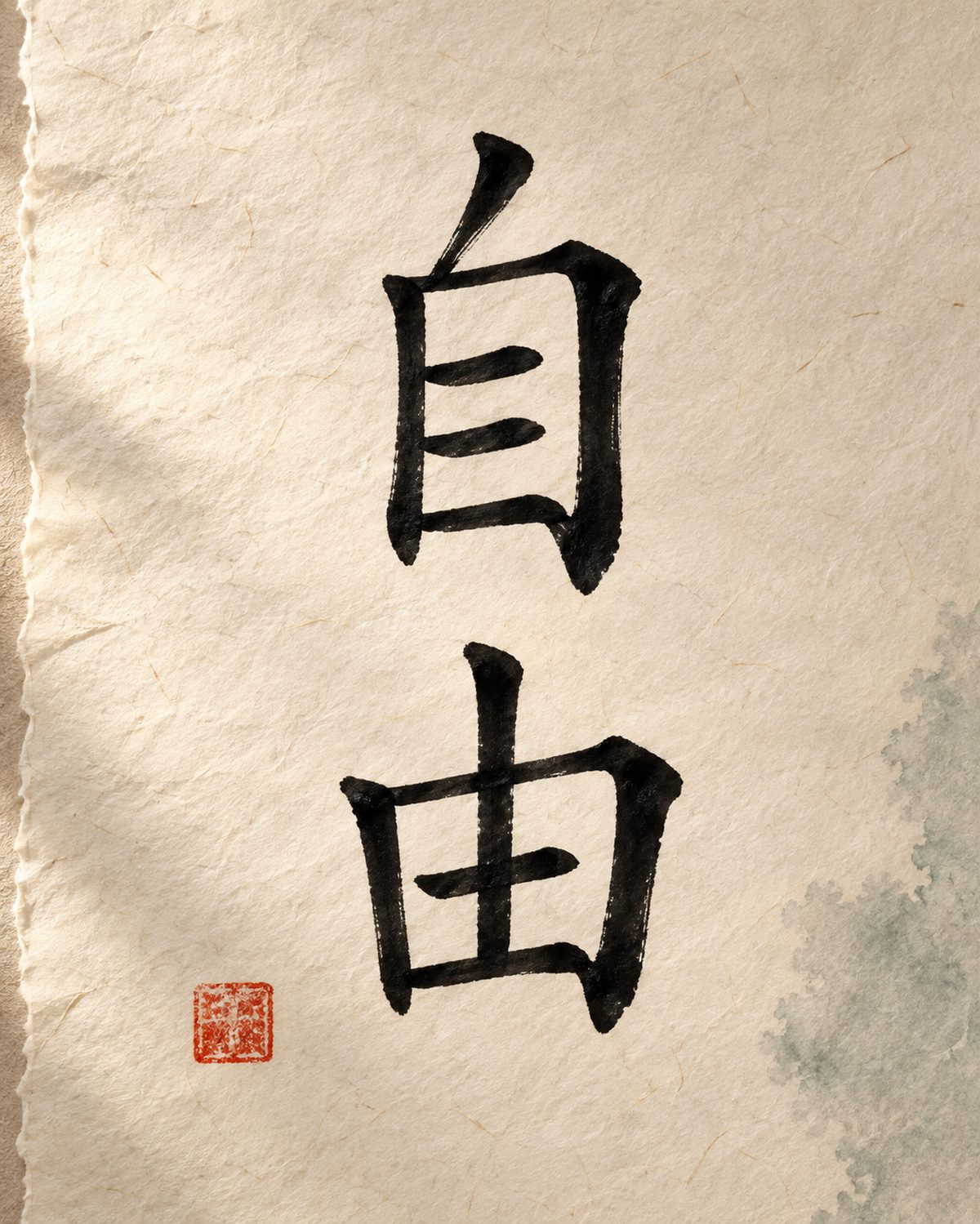
See 自由 in seal, brush & cursive Try it
How it's written
Eleven strokes in total, six for the first character and five for the second, and both are shapes most learners meet in their first month.
自 (zì), self. A short slanting tick on top, then a tall, narrow box closed at the bottom with two short horizontal strokes inside it. Write the tick first, then the left side, then the top-and-right in one turning stroke, then the two inner bars, then the base that closes the box.
由 (yóu), from. This is 田, the field, a box split into four cells, with one change: the central vertical pushes up through the lid and out the top. Order: the left side, the top-and-right turning stroke, the middle horizontal, the long central vertical, and finally the bottom stroke that seals the box. That poking-up vertical is the whole character. Move it, lose it, or let it run out the bottom and you have written a different word, which is why the tattoo section below spends so long on it.
A popular memory trick reads the second character as a shoot pushing up out of a field, the thing that springs from the soil. It is a good mnemonic. It is not quite an etymology, as the next section explains. If you would like to see the pair brushed in seal script or running hand, our calligraphy tool will draw it in each style.
What it means
Take the word apart and it is almost a stutter. Both halves can mean "from." The first, zì, is "self" and also "from" (as in "from ancient times"). The second, yóu, is "from, by way of, following," and an old Chinese dictionary of synonyms, the Erya, glosses it simply with the first. So ziyou is something like "self-following," or "going by your own way," which is a fair definition of freedom in any language. It covers both of the English words: freedom and liberty have one Chinese translation between them, so "freedom of speech" and "the Statue of Liberty" share the same two characters.
That is the modern, formal word. Chinese has older and gentler ways to say "free," and they are the ones to know if you want the feeling rather than the political noun:
| Word | Pinyin | Where it comes from | What it means | Reach for it when |
|---|---|---|---|---|
| 自由 | zìyóu | Han-dynasty poetry; the modern sense from the 1900s | freedom, liberty; the right to act on your own will | you mean freedom as a principle or a right |
| 自在 | zìzài | Buddhist writing | at ease, unconstrained, comfortable in your own skin | you mean inner ease, not politics |
| 逍遥 | xiāoyáo | the first chapter of the Zhuangzi | free and easy wandering; drifting with nothing to hold you | you mean a carefree way of life |
| 解放 | jiěfàng | modern political usage | liberation; being set free from something | you mean an act of release, usually collective |
The everyday Chinese speaker slides between them without thinking. A child let out of school for the summer is zizai. A poet who quits his post to grow beans is xiaoyao. A country is jiefang, and a citizen has ziyou. The neighbor that shares the most territory with freedom on this site is peace, and the two often share a banner.
- 自由行 independent travel, a trip without a tour group
- 财务自由 financial freedom, enough money never to need a job
- 言论自由 freedom of speech
- 自由职业 freelancing (literally a free profession)
- 自由泳 freestyle swimming
- 自由落体 free fall, in physics
- 车厘子自由 cherry freedom: being able to buy imported cherries without checking the price (2019 slang)
Idioms
- 自由自在“free by oneself, at ease by oneself”carefree and unconstrained; the everyday phrase for a life with no leash (Platform Sutra (Tang); Jingde Record of the Transmission of the Lamp, ch. 23; Journey to the West, ch. 5)
- 无拘无束“no restraint, no binding”completely unrestricted, free as you please (Journey to the West, ch. 2)
- 逍遥自在“wandering freely, at ease”leisurely and carefree, answerable to no one (Li Zhi, A Book to Burn (Ming))
- 身不由己“the body does not follow oneself”acting against your own will; not free to choose. The second character of freedom, working alone as 'following' (Romance of the Three Kingdoms, ch. 74)
- 海阔天空“the sea wide, the sky empty”boundless open space; also talk that ranges without limit. The title of Beyond's 1993 freedom anthem (Zha Shenxing (Qing poet); the late-Qing novel Wenming Xiaoshi, ch. 42)
Right vs wrong forms
| Form | Type | Note |
|---|---|---|
| 自由 | simplified ✓ | The standard word, identical in simplified and traditional Chinese (and written the same way in Japanese). Use this. |
| 自繇 | traditional | Yan Fu's deliberate 1903 spelling in his translation of Mill's On Liberty. A real historical form, but no modern reader writes it; not for a tattoo. |
| 自甲 | wrong | The vertical in the second character runs out the bottom instead of the top. Reads 'self armor.' |
| 自申 | wrong | The vertical runs out both ends. A real character (to state; the ninth earthly branch), so it will not look obviously broken. |
| 目由 | wrong | The tick is missing from the first character, which turns 'self' into 'eye.' |
| 白由 | wrong | Only one bar inside the first character's box, which turns it into 'white.' |
| 由自 | mirrored | The characters in the wrong order. Top to bottom or left to right, self always comes first. |
| 逍遥 (逍遙) | simplified ✓ | Not a spelling of freedom but the poetic alternative: Zhuangzi's 'free and easy wandering.' Traditional form in brackets. A good choice if you mean the feeling rather than the right. |
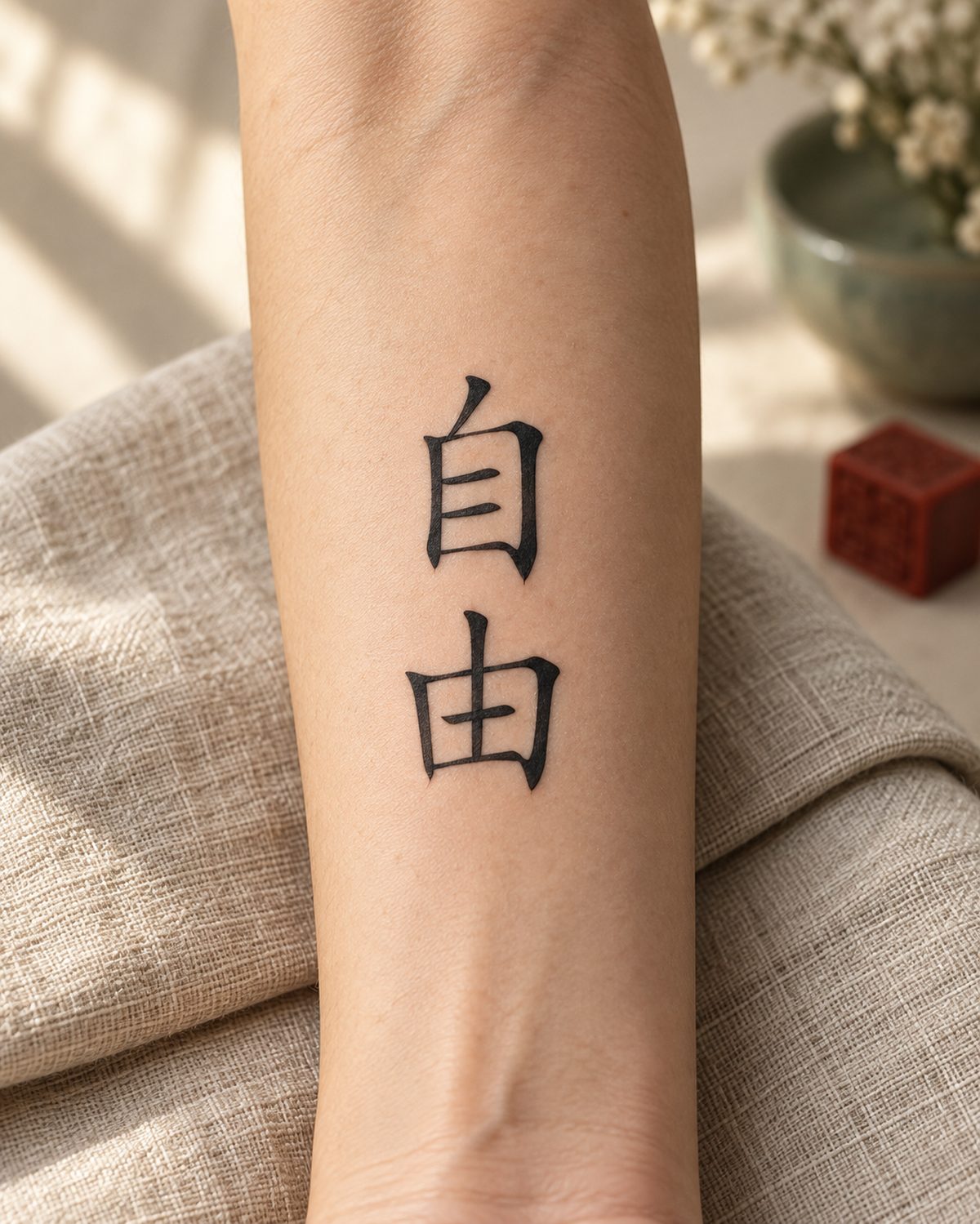
For a tattoo
Freedom is a perennial tattoo request, and the good news is that it is a safe one. The characters are common, the meaning is unambiguous, and they are written the same way in simplified and traditional Chinese, so there is no version to choose. What goes wrong is small and permanent, and nearly all of it lives in the second character.
Check the vertical in the second character. It must poke up through the top of the box and stop at the bottom edge. If it runs out the bottom instead, the character becomes 甲 (armor, or "first-rate"). If it runs through both top and bottom, it becomes 申 (to state, and the ninth earthly branch). If it does not leave the box at all, it is the field, and your arm says "self field." These are real characters, so a spell-checker will not catch them.
Check the first character's tick and bars. It needs the small slanting tick on top and exactly two bars inside the box. Drop the tick and you get 目, the eye. Keep the tick but draw only one bar and it reads 白, white.
Keep the order. Top to bottom if the design runs down your spine or forearm; left to right if it runs across. Self comes first, then "from." Mirrored stencils are the other classic accident; if the design was flipped for transfer, check it on the skin before the needle starts.
Consider what it says to a Chinese reader. Ziyou is a public, political noun, the word on banners and in constitutions, so on skin it reads roughly the way LIBERTY in capital letters would. If what you mean is the feeling rather than the principle, the older xiaoyao, the "free and easy wandering" of the Zhuangzi, is the choice a Chinese reader would find more personal and more poetic. Either way, print the characters from a real font at the size you plan to ink, and ask someone who reads Chinese to look at the stencil.
Before you commit to any character, the eight ways a Chinese tattoo goes wrong covers the failure modes that are not specific to this one, including the stroke-density arithmetic that decides whether a traditional form survives at small sizes.
Freedom in life today
"Cherry freedom" and the freedom to eat
Modern Chinese has turned the grandest word in political philosophy into a joke about groceries, and it did so almost overnight. Around the Spring Festival of 2019 a viral essay lamented that a 26-year-old earning ten thousand yuan a month still could not afford to eat imported cherries, and the internet coined chelizi ziyou, "cherry freedom," for the ability to buy the expensive fruit without checking the price. Sixth Tone reported the meme spreading as a wry measure of the cost of living, and it spawned a formula: shixian X ziyou, "achieve X freedom." The World of Chinese has cataloged the family since: milk-tea freedom and fried-chicken freedom (for the dieter who has given both up), dressing freedom (to wear what you like without comment), transportation freedom (owning a car, or simply getting a train ticket home at New Year). In early 2020, with deliveries halted, people mourned the loss of luosifen freedom, the right to a bowl of the famously pungent snail noodle soup.
The joke works because the word is so heavy. Attaching the vocabulary of constitutions to a carton of fruit is the same move as an English speaker declaring a "human right" to brunch.
Financial freedom and the freedom to travel
Two compounds carry the word through ordinary life. Caiwu ziyou, financial freedom, is the Chinese version of the early-retirement dream, and it is the ceiling of the cherry scale: first cherries, then a car, then enough money never to work again. Ziyou xing, "free travel," is what a travel agency calls a trip without a tour group, and it is how a generation that grew up on packaged coach tours now describes going abroad on its own terms. A freelancer is a "free-profession" worker, freestyle swimming is "free swimming," and a physics student learns ziyou luoti, free fall.
The song
In the Cantonese-speaking world, one song owns the word. Boundless Oceans, Vast Skies, a 1993 ballad by the Hong Kong rock band Beyond, has lyrics that celebrate Nelson Mandela's release from prison. Two months after it came out, the band's singer Wong Ka Kui suffered a fatal head injury during a shoot in Tokyo; he was 31. As the critic Krish Raghav traced for The China Project, the song has been sung for decades since, during the 2008 Sichuan earthquake and at rallies in Hong Kong and Taipei. Its title is a four-character idiom for open sea and empty sky (it is in the idioms below), and Raghav calls it "a rare, enduring anthem."
Where the phrase comes from
The first character has the most charming origin on the page. The Shuowen Jiezi, the first great Chinese dictionary (around 100 CE), defines it in two words: it is the nose, and the shape is a picture of a nose. The Qing scholar Duan Yucai, annotating the entry, noted that by his day almost nobody used the character to mean "nose" anymore; the senses "self" and "from" had taken over. The nose still has the last word, though. When a Chinese speaker wants to say "who, me?" they do not point at their chest. They point at their nose.
The second character is a mystery, and an unusually well-documented one. It is not in the Shuowen at all. The Kangxi Dictionary of 1716 quotes an early Shuowen commentator surnamed Xu on the point: the Shuowen has no entry for it, only a related, longer form meaning new growth sprouting from a fallen tree, which later writers shortened. The character does turn up earlier than the dictionary, on Shang oracle bones and Western Zhou bronzes (the character database at Zdic lists twenty oracle-bone examples), but scholars have never agreed on what those early drawings depict. So the honest answer to "what is the picture in 由?" is that nobody knows. The field-and-sprout story you will find online is half right by accident: there is a sprout in the old dictionary's stand-in form, but there was never a field.
What is certain is that for most of history yóu was a busy little function word meaning "from," "by," or "the cause of," which is why the same character sits inside the ordinary word for "reason." Freedom was, in effect, built from two prepositions.
History & roots
A mother's rebuke
The first famous ziyou in Chinese literature is a scolding. It comes from the ballad known as Southeast Fly the Peacocks, preserved in the sixth-century anthology New Songs from a Jade Terrace and set, according to its preface, at the end of the Han dynasty, around 200 CE. A young official named Jiao Zhongqing is devoted to his wife, Liu Lanzhi; his mother cannot stand her. In two consecutive lines the mother makes her case. The girl has no manners, she says, and does whatever she pleases on her own authority. And you, she tells her son, what makes you think you get your own way? That second charge is the word: ziyou, having your own say. It ends, as ballads do, with the couple dead and two birds calling over their graves. For centuries after, "free" in Chinese leaned toward "willful," which is exactly the reputation Yan Fu would later have to fight.
The poet who could not pick a flower
The same word could also be soft and sad. In the last years of his life the poet Liu Zongyuan was serving out a political exile as governor of Liuzhou, in the far south, when a friend passed through a nearby county and sent him a poem. Liu wrote back four lines: a green river under a mountain, a traveler moored in a magnolia-wood boat, a spring wind full of longing, and the poet wanting to gather duckweed flowers to send his friend and finding himself bu ziyou, not free to. He was an official who could not leave his post. No law was broken and no slogan was raised. A man simply could not walk down to the river.
Riding the wind is not enough
The deepest Chinese idea of freedom is older than the word and does not use it. The Zhuangzi, a Daoist classic of the fourth century BCE, opens with a chapter Burton Watson translated as "Free and Easy Wandering," and its hero is a bird whose wings hang across the sky like clouds. The chapter then makes a sly point about the sage Liezi, who could ride the wind and come home after fifteen days. Impressive, the text allows, but Liezi still depended on something: the wind. The truly free person rides the nature of heaven and earth itself, and so depends on nothing at all. Right after comes a story about the hermit Xu You, to whom the sage-king Yao offered the whole empire. Xu You declined. A wren nesting in the deep forest, he said, needs no more than one branch. The hermit who turned down China was named, of all things, You, written with the same character as the second half of ziyou.
The monkey with nothing to do
At the start of chapter five of Journey to the West, the Monkey King has been bought off with exactly what he demanded: the grand title Great Sage Equal to Heaven, a mansion, and two offices of attendants. He has no duties, no salary he cares about, three meals a day and a bed at night, and the novel describes him as ziyou zizai, free and at his ease, wandering the palaces making friends with the stars. The celestial court finds this alarming. An idle monkey, a Daoist immortal at court warns, will make trouble. So they give him a job guarding the peach orchard of immortality, which is roughly like putting a raccoon in charge of the trash cans, and before the chapter is out he has eaten the peaches.
Yan Fu's extra strokes
The modern word arrived through a translator who did not quite trust it. In 1903 Yan Fu, the scholar who translated Thomas Huxley and Adam Smith for Chinese readers, published his version of John Stuart Mill's On Liberty under the title The Boundaries Between the Group and the Self. In the translator's notes he faced the obvious problem. The Chinese word, he wrote, usually carried bad senses: recklessness, license, having no scruples at all. Those were later accretions, he argued; the original meaning was only that a person is not held back by outside things. As proof he quoted Liu Zongyuan's duckweed line, the one above, and said that was exactly the sense he meant.
Then he did something no translator would dare today. He changed the spelling. Throughout the book he wrote 自繇, borrowing an older character that ancient texts used interchangeably with you, to mark the new abstract noun as a different thing from the old willfulness. And he gave it a limit in the same breath: once people live in a group, he wrote, one person's freedom must take other people's freedom as its boundary. The spelling did not catch on. The idea did. Three years earlier Liang Qichao had already written, in his essay Young China, that when the young are free the nation is free, and within a generation the scold-word of the peacock ballad had become the name of a right.
Questions people ask
What is the Chinese symbol for freedom?
The Chinese word for freedom is 自由 (zì yóu), two characters meaning roughly 'from oneself': acting on your own will. It translates both 'freedom' and 'liberty.' The first character, 自, originally a picture of a nose, means self; the second, 由, means from or following. It is written the same way in simplified and traditional Chinese.
Is there a single Chinese character for freedom?
No. Freedom always takes two characters in Chinese: 自由 (zì yóu) for freedom as a principle or right, or the older 自在 (zì zài, at ease) and 逍遥 (xiāo yáo, free and easy wandering, from the Zhuangzi) for the feeling. Neither half of 自由 means freedom on its own; alone they mean 'self' and 'from.'
Is the Chinese symbol for freedom a good tattoo?
Yes, 自由 is a common, correct and unambiguous tattoo, identical in simplified and traditional Chinese. The main risk is the second character: its central stroke must poke out the top of the box only. Running out the bottom gives 甲 (armor), out both ends gives 申, and not at all gives 田 (field). To a Chinese reader 自由 reads as a public word, like LIBERTY; 逍遥 (xiāo yáo) is the more personal, poetic alternative.
How do you say freedom in Chinese?
Freedom is zì yóu, pronounced roughly 'dzuh yo': a falling tone on the first syllable, a rising tone on the second. The same characters 自由 are read jiyū in Japanese and jayu in Korean, because all three languages share the word in its character form.
What does freedom mean in Chinese philosophy?
The classic Chinese idea of freedom comes from the Zhuangzi (4th century BCE), whose first chapter, 'Free and Easy Wandering' (逍遙遊), argues that even the sage Liezi, who could ride the wind, was not truly free because he depended on the wind; the free person depends on nothing. The word 自由 itself was mostly negative ('willful') until Yan Fu's 1903 translation of Mill's On Liberty argued for its original neutral sense: not being held back by outside things, with other people's freedom as its limit.
Sources
- Shuowen Jiezi and Duan Yucai's commentary on 自 (via Zdic)
- Kangxi Dictionary entry for 由, quoting Xu Xuan that the Shuowen lacks it; oracle-bone and bronze forms (via Zdic)
- Dictionary entry for 自由 with classical citations (Zdic)
- Southeast Fly the Peacocks (Wikisource, Chinese original)
- Liu Zongyuan, reply poem to Censor Cao (Complete Tang Poems, j. 352; Wikisource)
- Yan Fu, translator's notes to The Boundaries Between the Group and the Self (On Liberty), 1903 (Wikisource)
- Zhuangzi, Free and Easy Wandering (Wikisource, Chinese original)
- Journey to the West, chapter 5 (Wikisource, Chinese original)
- Liang Qichao, Young China (Wikisource, Chinese original)
- Sixth Tone, Viral 'Cherry Freedom' Meme Critiques China's Cost of Living (2019)
- The World of Chinese, On Food Liberty (2020)
- Krish Raghav, 'Forgive me for loving freedom': The enduring Hong Kong rock anthem, The China Project (2019)
Make Freedom your own
See 自由 in calligraphy
From ancient seal script to flowing cursive. Pick a look before a tattoo or a card.
 Name
Get a Chinese name
A name matched to the sound of yours, with a meaning that fits.
Start yours Chinese Almanac
Try the Chinese Gender Predictor
A different corner of Chinese culture: the old Qing-palace birth chart, worked out from your lunar birth date, with the math shown and its coin-flip odds honestly weighed.
Open the toolBy Julian 祝君瑜, sourced from the classics and from modern life, updated 2026-09-24