Chinese Symbol
Chinese Symbol for Hope: Meaning, Origin, and Tattoo Notes
The Chinese symbol for hope is 望 (wàng, said like "wahng"), and it hides a small, moving picture. The oldest dictionary in China explains the character as a person watching the road for someone who has gone away, hoping to see them come back. Hope, in Chinese, is not really a warm feeling. It is a posture: standing still, eyes on the distance, waiting for a return.
- Strokes
- 11
- Radical
- 月 (moon)
- Formation
- Phono-semantic compound
Trace 望 yourself, or watch it drawn
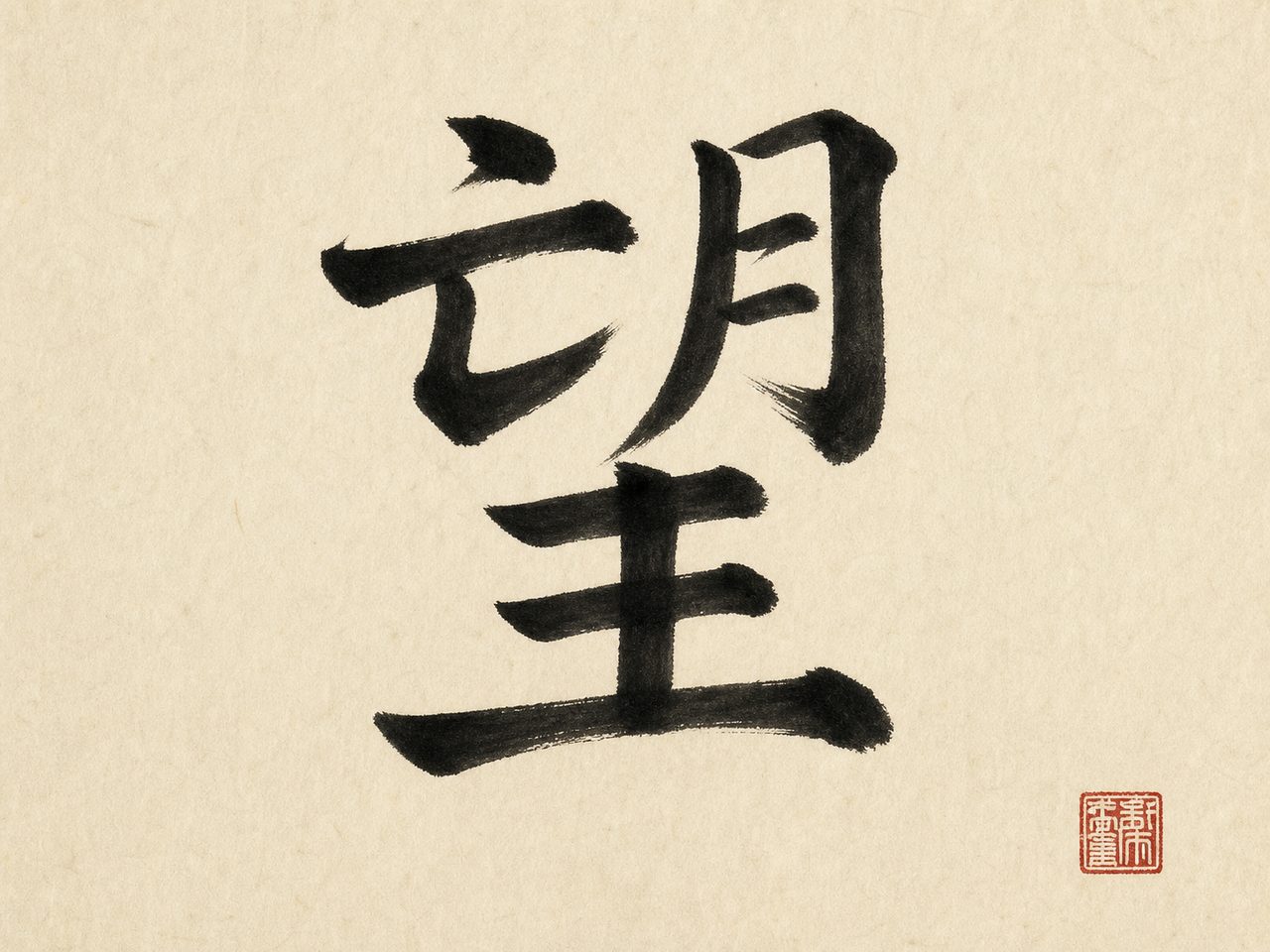
See 望 in seal, brush & cursive Try it
How it's written
望 runs to eleven strokes and stacks a small scene. The base is 王, the character for king: three level strokes pinned by one upright. The top half splits in two. On the left sits 亡 (wáng), which on its own means "to lose" or "to be gone"; on the right sits the moon, 月. Taken as parts, the character reads something like gone, moon, and a standing figure beneath, which turns out to be very close to its real history, worked out below. The one thing to keep straight as you write it is that top-right element: it is the moon 月, with two short strokes inside, not the sun 日, which has only one. It is identical in simplified and traditional Chinese, so there is no second version to learn.
What it means
望 (wàng) gathers a cluster of linked senses that all point the same way: to gaze into the distance, to look toward, to hope, to expect. The same character even names the full moon, the round one you tip your head back to see. Under all of them sits a single gesture, looking toward something far off that you want.
If you are writing "hope" in an ordinary sentence, though, a Chinese speaker reaches for the two-character word 希望 (xīwàng), plain "hope" as a noun or a verb. The lone character 望 is the more literary and more visual one, the one you would carve, paint, or ink. So the honest answer to "the Chinese symbol for hope" depends a little on what you are after:
| Character | Pinyin | What it really means | Best for |
|---|---|---|---|
| 望 | wàng | To gaze afar; to look toward, to hope | A single symbol for hope, with a "watching for it" feeling |
| 希望 | xīwàng | Hope, as an everyday noun or verb | Writing "hope" in a normal Chinese sentence |
| 愿 | yuàn | A wish, a heartfelt vow, willingness | A wish or vow, as in a birthday wish |
| 盼 | pàn | To long for, to look forward eagerly | Eager, impatient longing for what is coming |
What makes 望 worth the deeper look is that it is really the root of a whole vocabulary of longing, and it runs in both directions at once. That is the story the rest of this page tells.
- 希望 hope (the everyday word, noun and verb)
- 期望 to expect; expectation, high hopes
- 渴望 to crave; to long for (literally 'thirst-hope')
- 盼望 to look forward to; to hope for
- 愿望 a wish; a desire
- 失望 disappointment; to be let down (literally 'lose-hope')
- 绝望 despair (literally 'cut-off hope')
- 展望 to look ahead; an outlook, a prospect
- 名望 reputation; prestige, standing
- 望远镜 telescope (literally 'gaze-far-glass')
Idioms
- 望梅止渴“gaze at plums to quench thirst”to comfort yourself with a hope not yet within reach; to feed on anticipation. From Cao Cao's thirsty army and the plum grove ahead. (A New Account of the Tales of the World (世说新语, Jiajue))
- 望子成龙“to hope one's child becomes a dragon”to place high hopes on a child's success; the defining ambition of the Chinese parent.
- 望穿秋水“to gaze until the autumn waters run dry”to await someone with aching, worn-out longing; to look for them until your eyes give out.
- 望眼欲穿“gazing until the eyes would pierce through”to look forward to something with anxious, straining impatience.
- 大失所望“greatly to lose what was hoped for”to be bitterly disappointed; for a hope to fall badly short.
Right vs wrong forms
| Form | Type | Note |
|---|---|---|
| 望 | simplified ✓ | The standard modern form, and identical in simplified and traditional Chinese: 望 was never simplified, so mainland China, Taiwan, Hong Kong, and Singapore all write the same eleven strokes. There is no simplified-versus-traditional choice to make. |
| 忘 (chosen instead of 望) | wrong | The trap next door. 忘, also read wàng, is the 亡 element sitting over the heart 心, and it means 'to forget,' the near-opposite of hope. The two look and sound alike enough that a sloppy reference can swap them. If you want hope, make sure the bottom half is 王 (king), not 心 (heart). |
| 望 (flipped or rotated) | mirrored | Not a real variant. Low-resolution stencils sometimes come out mirrored or rotated, and a reversed 望 reads instantly as an error to anyone literate. Check against a dictionary at full size before inking. |
For a tattoo
望 is a striking and genuinely meaningful choice for a tattoo, and it is written identically in simplified and traditional Chinese, so there is no regional version to weigh. Two cautions are worth taking. The first is the character living right next door: 忘, also read wàng, which means "to forget." It is the same 亡 sitting on top of the heart 心, and it looks and sounds close enough to 望 that a careless stencil or a low-resolution reference could hand you "forget" where you meant "hope." Check yours against a dictionary. The second is a choice rather than an error: on its own, 望 leans toward "gaze, look toward" every bit as much as "hope," so some people prefer the unambiguous two-character word 希望 (xīwàng), which reads plainly as "hope" to any Chinese speaker. Neither is wrong. 望 is the more poetic and more compact; 希望 is the more literal. As ever, print the design at full size and have someone who reads Chinese confirm it before the needle comes out.
Before you commit to any character, the eight ways a Chinese tattoo goes wrong covers the failure modes that are not specific to this one, including the stroke-density arithmetic that decides whether a traditional form survives at small sizes.
Hope in life today
The photograph that built nineteen thousand schools
The most famous act of hope in modern China is a single photograph. In 1991 a photographer named Xie Hailong, traveling through rural Anhui for a young charity, caught an eight-year-old named Su Mingjuan looking up from her school desk, pencil in hand, with a pair of enormous, fiercely determined eyes. The image, known ever after as "Big Eyes," became the face of 希望工程, Project Hope, the education fund the China Youth Development Foundation had launched in 1989 to keep poor rural children in school. The photo did what no statistic could. By China Daily's count, Project Hope had by 2016 raised some 13 billion yuan and built more than nineteen thousand primary schools. The girl in the picture went to college on the program she had come to stand for, took a job at a bank, and has given money back to it every year since. Hope, in China, is not only a character to hang on a wall. It is a line item that put roofs on schools.
The dragon every parent is hoping for
The most-repeated hope in Chinese life is the one parents hold for a child, and it has its own four-character phrase: wàng zǐ chéng lóng, "hoping your child becomes a dragon." The dragon is the imperial one, the old emblem of the very highest success, and the phrase carries the full, sometimes crushing weight of a family's expectations funneled onto one kid and one exam. It is said with pride and with a wince, often in the same breath. A whole modern vocabulary of exhausted over-parenting has grown up around it, but the wish underneath is the ancient one: a parent watching, quietly hoping the child gets further than they did.
From hoping to giving up, in one character
Here is the quiet genius of 望: bolt a second character onto it and you can dial hope up or down the entire emotional range. Add "rare" and you get xīwàng, hope itself. Add "expect" for qīwàng, expectation; add "thirst" for kěwàng, to crave; add "look" for pànwàng, to look forward. Then the character turns and goes the other way. Lose what you hoped for and you have shīwàng, disappointment; lose it entirely and you reach juéwàng, despair, which reads, with brutal literalness, as "cut-off hope." One small character holds the whole arc from longing to defeat, which may be the most honest thing any language has said about hope.
Curious what your own name could become in Chinese, built from its sound and a
good meaning? Our Chinese name generator does exactly that.
Where the character comes from
The character is older and stranger than its tidy modern shape lets on. On the bronze and oracle-bone forms of three thousand years ago, 望 is a single vivid drawing: a person standing upright on the ground, with one enormous eye raised, staring off into the distance. It is body language turned into writing, the whole posture of looking-out for something. Only later was the moon 月 added, giving the watcher something to fix on, and the element 亡, "gone," folded in to carry the sound.
The Shuowen Jiezi, the first Chinese dictionary, compiled by Xu Shen around the year 100, records exactly what that figure is watching for. It defines 望 with a short line, chū wáng zài wài, wàng qí huán yě: "one who has gone away is abroad, and those at home gaze for their return." That is the oldest definition of hope in the Chinese record, and there is nothing abstract about it. Hope is a household standing at the edge of the village, watching the road, waiting for someone to come home.
There is a second thread twisted into the character, and it explains that moon. In the earliest writing the sense "full moon" belonged to a closely related graph, 朢, and 望 slowly absorbed it, until one character carried both "to watch and long for" and "the moon at its fullest." Watching and the full moon have been braided together in this single shape from very early on, which is why so much of what follows happens by moonlight.
History & roots
Watching the road, turned to stone
Because 望 means watching for a return, Chinese folklore fills up with women who never stopped watching. Scattered across the country, from a granite outcrop above Hong Kong to hills in half a dozen provinces, stand rocks called 望夫石, "the wife who watches for her husband." Each carries the same story. A woman climbs to a high place day after day, in many versions with a child on her back, to watch the sea or the road for a husband gone to war or trade, and she watches so long and so faithfully that she turns to stone still facing the horizon. The Hong Kong one, Amah Rock, is a fifteen-meter pillar that really does resemble a woman with a baby, and women still visit it. It is hope in its most literal and most heartbreaking form: longing made permanent, a person who became the act of waiting.
The moon you are both looking at
望 also names the full moon, and the two meanings feed each other. To look at the round moon, in Chinese poetry, is to hope across distance, because the person you miss is, wherever they are, under the same moon tonight. The most memorized poem in the language turns on exactly this. Li Bai's four-line "Quiet Night Thought" ends: "I raise my head and gaze at the bright moon; I lower it and think of home." The verb in that third line, the raising of the head to the moon, is 望. A thousand years of homesick students, soldiers, and travelers have looked up at a full moon and hoped along the same line.
That braid of moon and longing has grown its own festival. On the fifteenth night of the eighth lunar month, when the moon comes up at its roundest and brightest, China keeps the Mid-Autumn Festival, and the round moon is the entire point of it: in Chinese a round shape means completeness and reunion, tuányuán, so the full moon overhead stands for a family made whole. Those who can get home gather in the yard to gaze up at it together; those who cannot look at the same moon from wherever they are stranded and think of the people they miss. It is 望 written into a holiday, several hundred million people on one night all looking up and hoping in the same direction.
The plum grove that wasn't there
The most surprising thing hope ever did in the Chinese record is win a battle, and the story is set down in the fifth-century anecdote collection A New Account of the Tales of the World. The warlord Cao Cao was marching an army through waterless country and the men were folding from thirst. So he sent word down the line that just ahead lay a great grove of plums, sour-sweet and heavy with fruit. At the mere thought, the text says, every soldier's mouth ran with water, and on the strength of that imagined fruit the army kept moving until it reached a real spring. The phrase it left behind, wàng méi zhǐ kě, "gazing at plums to quench thirst," is what Chinese still says for comforting yourself with a hope not yet in reach. Sometimes, the story notes with a straight face, the hope by itself is enough to get you to the water.
Questions people ask
What is the Chinese symbol for hope?
It is 望 (wàng), an eleven-stroke character meaning to gaze into the distance, to look toward, and to hope. Its oldest dictionary definition describes a household watching the road for someone who has gone away, so the character is literally the posture of hoping for a return. It is written the same in simplified and traditional Chinese. For 'hope' in an ordinary sentence, Chinese uses the two-character word 希望 (xīwàng).
Is there a single Chinese character for hope, or is it two characters?
Both exist, for different jobs. The single character is 望 (wàng): the literary, visual one you would carve or ink, though it also carries the sense of 'gaze into the distance.' The everyday word, the one used in normal speech and writing, is the two-character 希望 (xīwàng), which reads unambiguously as 'hope.' For a symbol or tattoo, people usually choose 望; for a sentence, 希望.
What is hope in Chinese?
The ordinary word is 希望 (xīwàng), used as both noun and verb, as in 'I hope' or 'a hope.' It is built on the single character 望 (wàng), which means to gaze toward or look forward to something far off. So 希望 is the everyday word, and 望 is the older, single-character root it grows from, the one that also names the full moon.
Is the Chinese symbol for hope a good tattoo?
It can be, with two checks. First, do not confuse 望 (hope) with the look-alike 忘 (also wàng), which means 'to forget': make sure the bottom of the character is 王, not the heart 心. Second, decide whether you want the single character 望, which also means 'to gaze afar,' or the fully unambiguous two-character word 希望 (xīwàng). 望 is identical in simplified and traditional Chinese, so there is no regional version to get wrong.
What does the Chinese character wàng mean?
望 means to gaze into the distance, to look toward, to hope or expect, and, as a noun, the full moon and one's reputation (as in míngwàng). The senses share one image: looking toward something far away. Its oracle-bone form shows a person standing with a raised eye, watching the horizon, and the Shuowen dictionary glosses it as gazing for the return of someone who has gone away.
What is the Asian symbol for hope?
It is a Chinese character, 望 (wàng), since there is no writing system shared across Asia to draw one from. The trap with this word is a different one from the usual script confusion: hope in ordinary Chinese is two characters, 希望 (xīwàng), not one. 望 alone carries the older sense of gazing at something far off, which is exactly why it works as a single-character design and why it does not read as the everyday noun.
Sources
- Wiktionary: 望 (glyph origin, radical, strokes, meanings)
- Shuowen Jiezi entry for 望 (hancibao.com): 出亡在外,望其還也
- Amah Rock (望夫石), the husband-gazing stone (Wikipedia)
- Li Bai, 'Quiet Night Thought' (静夜思): 举头望明月 (Wikipedia)
- 望梅止渴, from A New Account of the Tales of the World (世说新语, via Gushiwen)
- Project Hope (希望工程) and Su Mingjuan, the 'Big Eyes' photo (China Daily)
- Mid-Autumn Festival: the full moon, reunion (团圆), and moon-gazing (Wikipedia)
- Wiktionary: 忘 (wàng), 'to forget', the look-alike of 望
Make Hope your own
See 望 in calligraphy
From ancient seal script to flowing cursive. Pick a look before a tattoo or a card.
 Name
Name Get a Chinese name
A name matched to the sound of yours, with a meaning that fits.
Start yours Chinese Almanac
 Try the Chinese Gender Predictor
A different corner of Chinese culture: the old Qing-palace birth chart, worked out from your lunar birth date, with the math shown and its coin-flip odds honestly weighed.
Open the toolBy Julian 祝君瑜, sourced from the classics and from modern life, updated 2026-07-22