Chinese divination and physiognomy

Chinese palm reading 手相: the rare marks the old manuals name, and the ones they never did

Chinese palm reading has its own rare lucky signs, and they are not the ones on the Western lists. The old manual names some seventy marks, among them the Jade Pillar line, the Hidden Virtue line, a fish, a seal, a well, and rings around the wrist called jade bracelets, each with a verse saying what it promises. It has no healer's mark and no marriage line. All of it is folk tradition, not a forecast.

Palm reading, shouxiang, is the hand branch of xiangshu, the reading of form, and a sister of Chinese face reading; the manuals print the two side by side and tell the reader to check one against the other. A reading moves from large to small. First the shape and feel of the whole hand, then the three great lines, then the eight palaces the palm is divided into, and only at the end the small marks this page is mostly about, which are what everyone actually wants to find on their own hand.
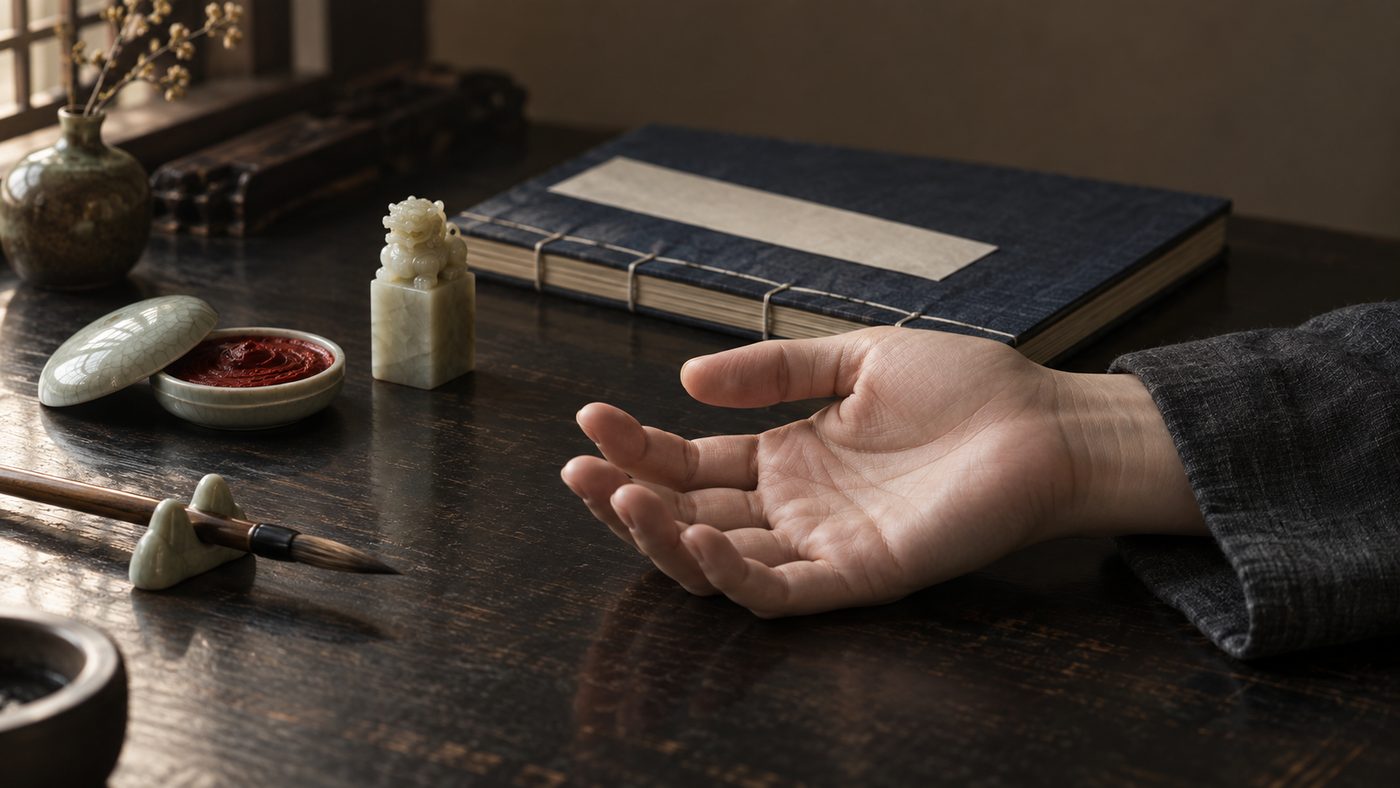
An open hand resting palm up on a dark scholar's desk in window light, beside a closed thread-bound book with an indigo cover, a jade seal, a dish of red seal paste and a brush.
The manuals treat the palm as a page: read the grain first, then the marks. Illustration.

The rare lucky signs, as the Chinese manual names them

The fullest catalog is in the Shenxiang Quanbian, the great compendium of physiognomy, whose palm chapter the Qing emperors' own encyclopedia of 1726 reprinted whole. Its table of contents runs to some seventy named marks before it gets to the theory, each drawn as a little figure and followed by a four-line verse. Most of the figures did not survive into the digital copy. The verses did, and so did a shorter list in the Taiqing Shenjian, a second manual preserved in the imperial library. The table below takes the marks a modern reader is most likely to go looking for.

Rare marks in classical Chinese palm reading: where each sits, what the manual claims for it, and the nearest Western sign.
Mark Where on the hand What the manual claims Nearest Western sign Source
Jade Pillar line 玉柱纹 yùzhù wén A line running straight up the palm toward the fingers Courage and a sharp mind; the verse promises high office by middle age Fate line Shenxiang Quanbian
River pattern 川字纹 chuānzì wén Three separate strokes like the character for river; the verse puts it on all five fingers Long life: men to rival Pengzu, the Chinese Methuselah, women the Queen Mother of the West None Shenxiang Quanbian
Cross 十字纹 shízì wén In the palm Wealth and honor for life, a seat in the high hall; a steady salary Mystic cross Taiqing Shenjian; Shenxiang Quanbian
Well 井纹 jǐng wén A small grid in the palm, best at the center Blessings; one well or two brings wealth measured in fields None Taiqing Shenjian; Shenxiang Quanbian
Fish 鱼纹 yú wén A fish-shaped figure in the palm, sometimes with its tail toward a finger A post at court, brothers at peace; rich if the tail runs into a finger Fish sign Shenxiang Quanbian
Seal 印纹 yìn wén A seal-shaped figure anywhere in the palm; the manual draws several shapes Trustworthy, spared disaster from childhood, afraid of no ghost or spirit; square and clear in the center, early success in the exams None Shenxiang Quanbian
Tortoise 龟纹 guī wén A shell-like pattern in the palm A general or a minister None Shenxiang Quanbian
Hidden Virtue line 阴德纹 yīndé wén Rising from the palace the manual calls the self Kind, compassionate, fond of good works done unseen; danger passes them by Closest thing to a healer's mark Shenxiang Quanbian
Jade Bracelet lines 玉钏纹 yùchuàn wén Unbroken rings around the wrist Loved and respected; the more rings the higher the honor, but only if they close Bracelet lines (rascettes) Shenxiang Quanbian; Taiqing Shenjian
Mole in the center of the palm 掌心黑子 zhǎngxīn hēizǐ The middle of the palm Clever and rich; food and money without end None Shenxiang Quanbian; Taiqing Shenjian
Whorls on all ten fingertips 十指旋螺 shízhǐ xuánluó The fingerprints, every one a spiral Honor and rank None Shenxiang Quanbian

Read down the third column and a pattern shows. Almost nothing on it is about money in the modern sense. The promises are office, rank, a post at court, a long life, a good name: the ambitions of a man sitting the civil service examinations, which is who these books were written for. When the manual wants to say rich it says so plainly, and it reserves that for a handful of marks, the well and the palm-center mole among them.

Two marks have a second life worth knowing. The river pattern is a charm on the fingers, where the verse promises the life span of Pengzu, who is supposed to have lived eight hundred years; the Taiqing Shenjian gives the very same name to three lines on the forehead and reads them as worry and mourning. Same shape, opposite verdict, different body part. And the jade bracelet lines come with a condition the Western rascettes do not: the manual insists the rings must go all the way round, and a broken ring proves nothing at all.

Is there a healer's mark in Chinese palm reading?

In Western palmistry the healer's mark, also sold as the medical stigmata or the Samaritan lines, is a little cluster of three or four short vertical lines on the pad under the little finger, read as a born talent for healing or looking after people. The honest answer from the Chinese side is short: the old manual does not have it. Of the seventy-odd marks in the palm chapter of the Shenxiang Quanbian, not one is read as a gift for medicine, and nothing in that chapter mentions healing at all.

What it has instead is a close cousin in spirit. The Hidden Virtue line, which the verse says rises from the palace of the self, marks a person who does good without being seen: kind, compassionate, fond of reciting the sutras, and passed over by danger because of it. A neighbor in the same list, the Rich Blessing line, is read as someone who pities the poor and gives freely. Neither says anything about talent. Both are about character, and specifically about the kind of goodness nobody gets credit for, which is a rather Chinese way of describing the person you would want at a sickbed.

If you open a modern Chinese palm book you will find a medicine line sitting exactly where the West puts the healer's mark, under the little finger, on a pad the book calls the Mercury mount. That is not an ancient Chinese survival. It is the Western sign translated, planet and all, and it tells you more about the twentieth-century trade in palmistry books than about the tradition.

The marriage line, and where the old manual looks instead

The Western marriage line is one or more short horizontal lines on the outer edge of the palm, between the base of the little finger and the heart line; count them for the number of serious relationships, read their length for how long each lasts. Once again the classical manual has no such thing. There is no line for marriage anywhere in its palm chapter.

It files marriage the way Chinese divination files most things, by address. The palm is divided into the eight trigrams of the Book of Changes, and the manual assigns the Zhen trigram's palace to wives and concubines, and to a man's standing in the world. Marks in that palace are read as news about the marriage: a fish in the wife's position means a faithful wife. Around it sits an extraordinary run of what the manual calls peach blossom lines, the flower-and-willow line, the mandarin-duck line, the stealing-blossoms line, every one of them read as appetite getting a man into trouble. It is worth saying plainly that the whole section is written by men, about wives, for men choosing them.

Modern Chinese palm books do show a marriage line, on the Mercury mount under the little finger, which is the Western line again. Birth-chart readers take the same palace-and-mark approach as the old palm manual, reading marriage from a spouse palace in the chart; our page on when you will get married works that out from a birth date instead of a hand.

Which hand? The manual reads both and compares them, and several of its verdicts depend on a mark appearing on the left, the right, or both. The rule everyone quotes, men left and women right, is a general Chinese convention rather than a palm rule. An old acupuncture manual quotes it from the Tang physician Sun Simiao for choosing which of a patient's fingers to measure, and palm readers took it up later.

The line straight across: the broken palm

One mark has more living weight in Chinese culture than all the rest of the table put together. Most palms carry a head line and a heart line as two separate creases. On some, the two run together as a single line straight across the hand, and Chinese folk belief calls that a broken palm, duanzhang. The belief falls hardest on women, because on a woman it was read as a danger to her husband.

The belief was strong enough in Taiwan to carry a prime-time drama. In August 1996 the network CTV premiered Duanzhang Shunniang, the story of a woman with the line, shunned as bad luck because a broken-palmed woman is supposed to bring death to her husband. The United Daily News, looking back on it, calls the show a gentle and firm answer to an absurd superstition. The old palm manual has its own severing line with a proverb attached, broken on the left and not the right and you lose half your kin, broken on both and brothers never meet again. It is usually taken to mean the same crease, though the manual's drawing of it is lost.

Here is what is actually known. The single crease turns up in roughly 1.5 to 3 percent of people and is more common in East Asian populations, so in a Chinese-speaking city of a million there are fifteen to thirty thousand broken palms going about their lives. Doctors note it because it is somewhat more frequent alongside certain conditions, but it predicts nothing on its own and plenty of people with it have no condition at all. The old English name for it, the simian line, has been dropped for being insulting. So has the other belief, or it should be.

How the old manual reads a hand

The marks come last. The manual starts with a carpenter's comparison: the lines in a hand are like the grain in timber, and just as a board with a fine grain is prized, a hand with fine lines is a fine piece of material. Fine and deep lines are good, coarse and shallow ones poor, and a hand with no lines at all is the lowest reading there is. Then it reads the whole hand. Long, slender hands are kind and generous, short thick ones grasping; a palm soft as a silk pouch is very rich; a palm red as if sprayed with blood is noble, a yellow one like dust lowly. Chinese medicine reads a person by color too, on the face and zone by zone, and face mapping traces where that chart came from.

The three great lines come next, and here the manual gives them a cosmology rather than the Western names. The top line answers to heaven, stands for the ruler and the father, and settles rank. The middle line answers to humankind, the worthy and the foolish, and settles wealth. The bottom line answers to earth, the minister and the mother, and settles how long you live. In fairness to the skeptic, a later section of the very same chapter assigns the three lines different jobs and adds, rather disarmingly, that the only way to get a true reading is to check the palm against the face.

The palm itself is then mapped with the eight trigrams, the reading of the trigrams coming first and the five elements second, with the center of the palm called the Bright Hall and read for whatever is about to happen. The three fleshy pads under the fingers are the three peaks, and they divide a life into thirds of twenty-five years each, one pad for youth, one for the prime of life and one for old age. Whichever peak stands highest and fullest is when your luck is supposed to arrive.

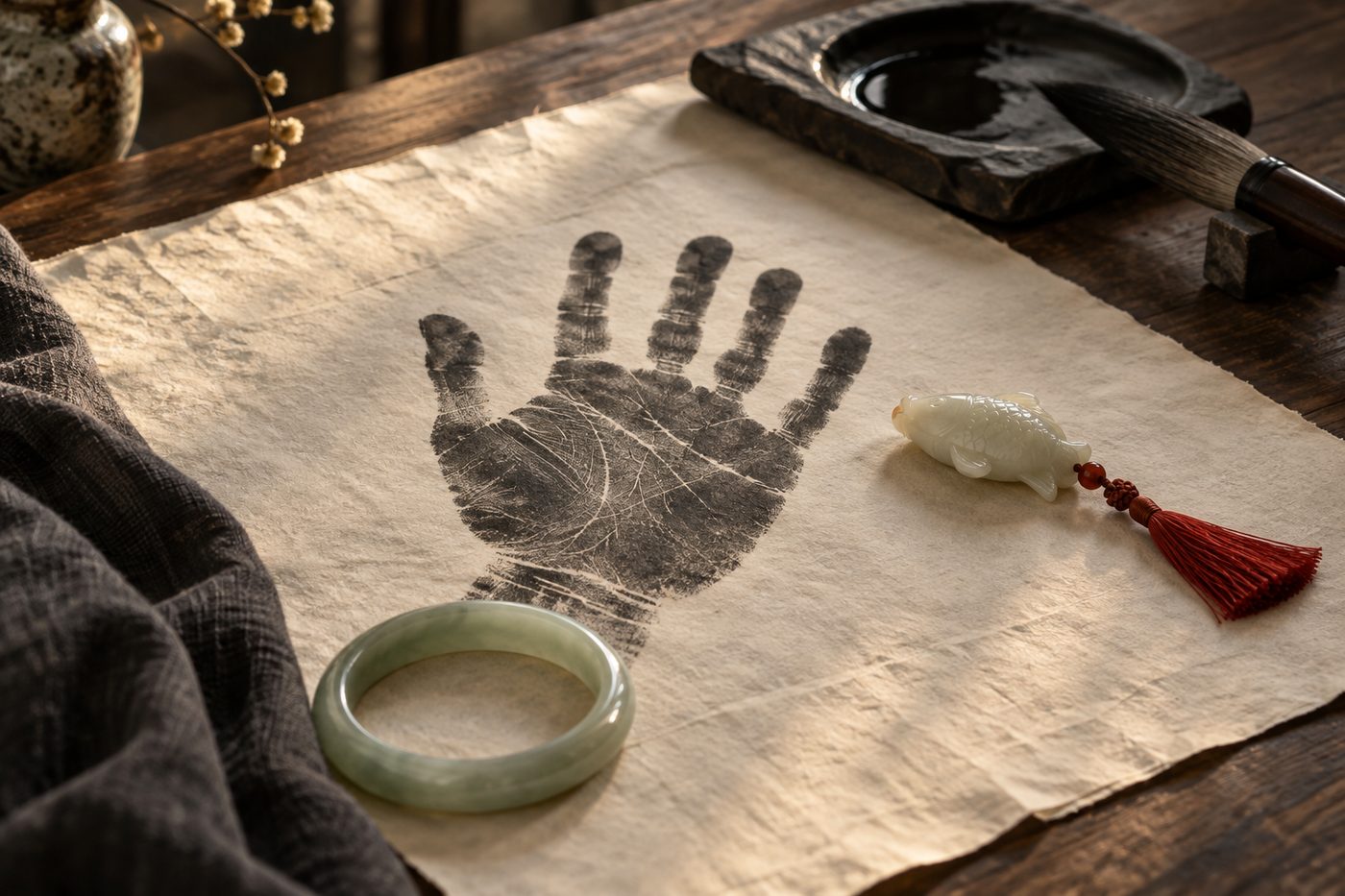
A black ink print of an open hand on rice paper, a celadon jade bangle below its wrist and a small white jade fish beside it, with an inkstone and brush at the edge.
Grain, rings and a fish: the manual reads a hand the way a scholar reads a rubbing. Illustration.

Even the fingertips get a reading. Whorls on all ten, the spirals a fingerprint examiner would recognize, are listed as a sign of honor and rank, which puts a fair share of any police database in line for high office.

Reading a hand without seeing the face

The manual's favorite story about hands is about not seeing a face. It tells how the Daoist sage Chen Tuan went to pay his respects at the house of a dead official, where the only child, a girl of ten or so, knelt before the altar holding an incense burner. Chen came out and told people he had not seen her face, but from the way her hands held the censer her hand was very noble: a boy with those hands would have gone straight into the Hanlin Academy, and a girl would marry into the highest rank. Years later the emperor matched her with a senior minister who had no wife, and within days she was a titled lady. It is a story told by physiognomists about a physiognomist, so weigh it accordingly.

The most famous hands in Chinese history are in the official record rather than the manuals. The Records of the Three Kingdoms describes Liu Bei, founder of the kingdom of Shu, as a man whose arms hung down past his knees and who could see his own ears without turning his head. The palm manual picks him up and adds the moral: arms reaching past the knees mark a hero of the age, arms that stop short of the waist a life of poverty. Generations of readers of the novel Romance of the Three Kingdoms have met those long arms, and not one of them has measured their own.

The manual also carries a section on hands credited to Xu Fu, the Han physiognomist who, the historian Sima Qian records, looked at the future general Zhou Yafu and told him he would rise to the top of the state and then starve to death. He laughed. Both parts came true. It is the most unnerving story in the whole literature, and it is about a face.

Is Chinese palm reading real?

No study has ever shown that the lines of a hand predict a character or an event, and the practice cannot even agree with itself: the same Chinese chapter gives the three great lines two sets of meanings, and Western schools contradict each other line by line. The objection is also much older than modern science. In the third century BCE the philosopher Xunzi wrote a chapter titled Against Physiognomy whose central line ranks the three ways of judging a person: the form is worth less than the heart, and the heart less than the path a person chooses. He wrote it about faces, and it covers hands.

The palm manual, to its credit, ends up somewhere near him. Its section on temperament says that to know the ground of the palm is to know the ground of the heart, and then spends the rest of the section describing character rather than fate: deep lines for a deep, hard-to-read mind, broken ones for someone diligent one day and idle the next. Read that way, as a very old vocabulary for looking at people, it is harmless and often charming. Read as a verdict on anyone, including a woman with one line across her palm, it is worth exactly what Xunzi said.

If what you want is the part of this tradition that can be checked, it is the birth chart rather than the hand. A bazi chart takes a date instead of a photograph, and every step of its arithmetic is published.

Questions people ask

What is the rarest line in palmistry?

The only palm line anyone has actually counted is the single crease, one line running straight across the palm where most people have two. Medical surveys put it at roughly 1.5 to 3 percent of people, more often in East Asian populations, and it is the line Chinese folk belief calls the broken palm. Every other "rare" sign, the mystic cross, the healer's mark, the star, has never been surveyed, so any claim about how rare it is has no number behind it. The old Chinese palm manual does not rank its marks by rarity at all; it ranks them by what they promise, and its grandest ones, like the Jade Pillar line and the tortoise mark, are promised to future ministers and generals.

What is a healer's mark?

In Western palmistry the healer's mark, also called the medical stigmata or the Samaritan lines, is a small cluster of three or four short vertical lines on the pad under the little finger, read as a gift for healing or caring for others. It has no counterpart in classical Chinese palm reading: the palm chapters of the Shenxiang Quanbian, as reprinted in the Qing imperial encyclopedia, name some seventy marks and not one of them is about healing. The nearest Chinese idea is the Hidden Virtue line, read as compassion and good deeds done without being seen. Modern Chinese palm books do list a medicine line under the little finger, but that is the Western mark given a Chinese name, not an old tradition.

What are the wealth signs on the palm?

In the Chinese manuals the wealth signs are specific and a little mercantile. A small grid called the well (one or two of them promise wealth measured in fields), a cross in the palm (rich and honored for life, says the Taiqing Shenjian), a mole in the very center of the palm (clever and rich), and lines named for coins, the coin-string and the precious-coin line, which bring in goods and money. The manual also reads the palm itself: thick, soft and full at the edges with a hollow center is rich, thin and dry is poor. The "billionaire mark" and "money triangle" of Western and Indian palmistry videos are not in the Chinese texts under any name.

Which palm do you read for a marriage line?

Western palmists disagree about which hand to use, and many read the dominant one, looking at the short horizontal lines on the outer edge of the palm below the little finger. The classical Chinese manual has no marriage line to read: it looks for marriage in a spouse palace on the hand and in marks inside it, and it compares left and right hands rather than choosing one. The familiar "men left, women right" rule is a general Chinese convention, used in medicine to choose which finger to measure, and popular palm readers borrowed it. If you want one answer, read both hands, which is what the old text does.

What does a simian line mean in Chinese palm reading?

The single crease, where the head and heart lines run together as one line straight across the palm, is called duanzhang, the broken palm, in Chinese folk belief. The belief falls on women: on a woman it was read as bad luck for her husband, and that belief was prominent enough in Taiwan to carry a 1996 prime-time drama, Duanzhang Shunniang, about a woman shunned for it. Medically it means nothing on its own. It occurs in about 1.5 to 3 percent of people, is more common in East Asian populations, and is not predictive of any condition. The old name "simian line" has fallen out of medical use because it is pejorative.

Is Chinese palm reading different from Western palmistry?

Yes, in its map of the hand. Western palmistry reads a set of named lines (life, head, heart, fate) and mounts named for planets. The classical Chinese manual reads the three great lines as heaven, man and earth, divides the palm into the eight trigrams of the Book of Changes with a center called the Bright Hall, reads the three pads under the fingers as early, middle and late life in spans of twenty-five years, and catalogs seventy-odd named marks with a verse for each. Modern Chinese palm books mix the two freely, which is why a modern Chinese palm chart may show a Mercury mount beside the trigrams.

Is palm reading real?

No study has shown that the lines of the hand predict character or events, and the schools contradict each other: the same Chinese manual assigns the three great lines two different meanings in two different sections. The objection is also old. In the third century BCE the Confucian philosopher Xunzi argued that judging a person by their form is worth less than judging their heart, and less again than judging the way they choose to live. Even the palm manual hedges, telling the reader to check any palm against the face and saying that to know the ground of the palm is to know the ground of the heart. Read it as a two-thousand-year-old vocabulary for looking at people, not as a forecast.

Sources

  • • Gujin Tushu Jicheng (the Qing imperial encyclopedia, 1726), Bowu, Yishu dian, juan 640: the palm juan of the Shenxiang Quanbian, with the named marks, the three great lines, the eight trigram palaces, the Hidden Virtue and Jade Bracelet lines, and the Chen Tuan anecdote: source
  • • Taiqing Shenjian, juan 5 (Siku Quanshu text): the cross, the wells, the palm-center mole, the jade bracelet lines, and the river pattern on the forehead: source
  • • Xunzi, chapter 5, "Against Physiognomy" (3rd century BCE): source
  • • Records of the Three Kingdoms, juan 32, the biography of Liu Bei (arms reaching below the knees): source
  • • Shiji, juan 57, the house of Zhou Bo (Xu Fu reads Zhou Yafu): source
  • • Moxibustion at the Gaohuang point, an old acupuncture manual quoting the Qianjin fang on measuring the man's left and the woman's right middle finger: source
  • • United Daily News, Bao Shiguang: the 1996 CTV drama Duanzhang Shunniang and the broken-palm belief: source
  • • Single transverse palmar crease: prevalence and the retired name "simian line": source
  • • Shouxiang (palm reading), the Chinese-language overview, including the modern Chinese list of lines with Western mount names: source
  • • Palmistry: the standard English overview, including the conflicting schools and the scientific assessment: source

The sister art

Chinese face reading

The three courts and twelve palaces the palm manual tells you to check a hand against.

The computable half

Cast your bazi chart

The same tradition read from a birth date instead of a hand, with the arithmetic shown.

Marriage, from a birthday

When will I get married?

The spouse palace and the marked years, read from your birth chart rather than your palm.

The birth-date systems

Chinese astrology, mapped

The zodiac, bazi, zi wei dou shu and the kua number, and how accurate any of them is.

Stay in the loop.

Chinese mythology, the zodiac, and the meaning behind names and symbols, rooted in the classics and read back to you. No spam. Unsubscribe anytime.