Chinese palm reading

The life line: what the Chinese manual reads in it, and what it never promised

The life line is the crease that curves around the base of your thumb toward the wrist. Chinese palm reading calls it the earth line, and one old manual does say it governs whether a life is long or short. A later section of the same chapter gives it to wealth instead. Of the three studies that measured life lines against age at death, two found no link. A short life line is not a short life.

Every palm carries three great creases, and the Chinese tradition reads them as a small cosmos: heaven at the top, nearest the fingers, humankind in the middle, earth at the bottom. The earth line is the one that starts between thumb and index finger and sweeps down around the fleshy pad of the thumb. Chinese palm books today mostly call it by a translated Western name, shengming xian, life line, and keep earth line as the old one. This page is about the gap between those two names, and about the question most people bring to it.
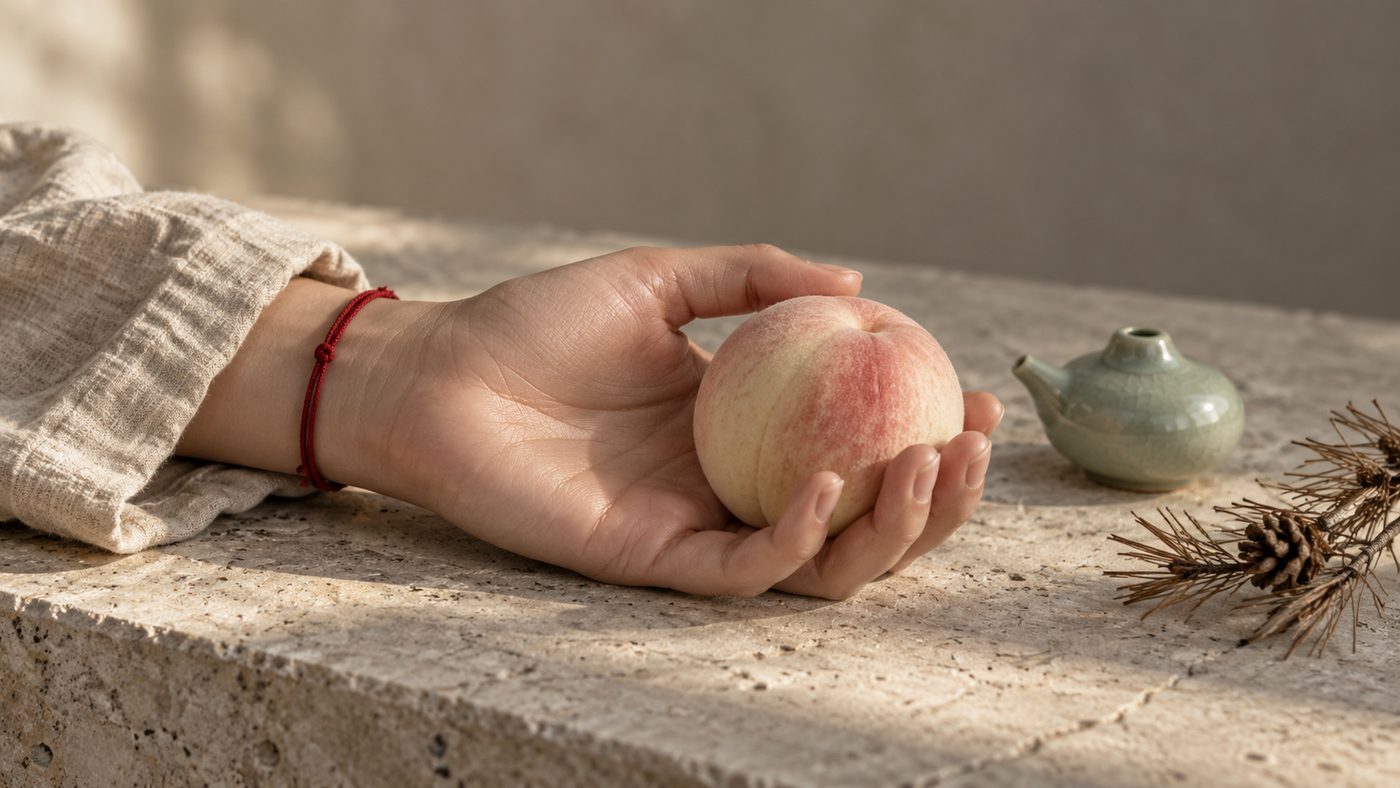
An open left hand resting palm up on pale stone in side light, the crease around the base of the thumb catching the light, a red silk cord at the wrist and a white peach in the fingers beside a celadon water dropper.
The earth line runs round the pad of the thumb; the peach is the old Chinese emblem of a long life. Illustration.

What the old manual says about the earth line

The fullest classical account is the palm chapter of the Shenxiang Quanbian, the great compendium of physiognomy, which the Qing emperors' encyclopedia of 1726 reprinted whole; a second manual in the imperial library, the Taiqing Shenjian, carries the same passage almost word for word. It sets out the three lines as a hierarchy. The top line answers to heaven, stands for the ruler and the father, and settles your rank. The middle line answers to humankind and settles whether you will be rich or poor. The bottom line answers to earth, stands for the minister and the mother, and governs whether your life is long or cut short. So the Western idea that this crease speaks to the length of a life has a genuine Chinese counterpart, and it is centuries old.

What the manual wants from the three lines is clarity rather than length. Three lines that are clean and bright, with no other line breaking through them, are what it calls the mark of a blessed life. Fine and deep lines are good, coarse and shallow ones poor, and a palm with no lines at all is the lowest reading in the book.

Then, a few pages later, the same chapter changes its mind. A section on what it calls the three powers describes the three great lines again, says that everyone has them, high or low, and explains where they come from: they form in the womb, as the unborn child clenches its fists over its ears, which the text calls very hard work. This time the earth line is the second line and it governs wealth, not years. The section ends with the most sensible advice in the whole chapter: to get a true reading, check the palm against the face. The face has its own three-part split into heaven, humankind and earth, which our page on Chinese face reading sets out band by band.

The life line read three ways: Western palmistry, the classical Chinese manual (Shenxiang Quanbian palm chapter, Taiqing Shenjian), and modern Chinese palm books.
Question Western palmistry Classical Chinese manual Modern Chinese palm books
What it is called The life line The earth line, lowest of the three great lines 地纹 dì wén Shengming xian, life line, a translation of the Western name; earth line kept as the old name
What it governs Vitality, health and major changes; older books said length of life In one section, whether a life is long or short; in a later section, wealth Vitality and health, explicitly not lifespan
A short line Usually read now as low stamina or a life of change, not an early death Not discussed by length Less energy in reserve, not fewer years
A broken line An illness, accident or upheaval, timed by where the break falls Any line broken, however fine, marks something flawed and left unfinished Borrowed from Western readings
A double line A sister line, read as protection or a second source of strength Not named Sister line, borrowed from Western readings
Timing a life Ages marked along the line; schools disagree on the scale Not on this line: three pads under the fingers, twenty-five years each Mostly follows the Western books
Which hand Often the dominant hand, or both compared Both hands, compared Often men left, women right, a convention borrowed from medicine

Does a short life line mean a short life?

This is the question behind most searches for the life line, so here is the plain answer first: no, and it has been tested. The claim in its Western form goes back to Cheiro, the society palmist of the early twentieth century, who held that the length of the line showed your natural span of life, accidents aside. That is a measurable claim, and three teams have measured it.

In 1974 two researchers writing in the Journal of the American Medical Association measured the line on 51 bodies, partly to see whether insurers might use it to estimate life expectancy. They found no significant link. In 1990 a team in the Journal of the Royal Society of Medicine measured 100 patients at autopsy, 63 men and 37 women, and reported a real correlation between the length of the line and age at death. The newspapers enjoyed that one, and a tabloid duly announced that your lifeline really does tell how long you will live. The study's lead author, P. G. Newrick, told an interviewer that he did not believe in palmistry before the study and still did not after it.

In 2019 three researchers at the University of Adelaide settled the tie. They measured the life line on 60 donated bodies, aged 39 to 99 at death, using exactly the 1990 method, a piece of string laid along the crease and then straightened against a ruler, and with a sample large enough to catch a correlation far weaker than the one reported in 1990. They found none, in men or women, on either hand. Their best guess for the 1990 result was the sample itself: an autopsy series is likely to include accidental deaths, which no palm line could be expected to predict.

Chinese palm writers reached the same place by a different road. A Hong Kong newspaper's guide to the earth line puts it flatly: the length of the line does not show the length of your life, it shows the strength of your vitality. That is now the standard reading on both sides. If your line looks short, nothing in the evidence suggests you should count your years by it.

Where the Chinese manual looked for a long life instead

The striking thing about the classical manual is that when it wants to talk about life and death, it rarely measures this line at all. It lays the palm out like a compass, with the eight trigrams of the Book of Changes as eight palaces, and the life line curves around the palace called Gen, the pad at the root of the thumb. The manual gives Gen two jobs: fields and houses, and the grave. A worried reader needs to know what the manual says next, so here it is, with the reassurance afterward.

The manual describes what it calls coffin lines, small marks that it says appear in the Gen palace one year at a time. One means delays and trouble, two mean mourning clothes, three a run of disasters, and four death within days. A Gen palace gone dark is read the same way, and an old saying it quotes warns that Gen should never look like a bare white board. In the same breath it reads a dark vein running from the outer edge of the palm into Gen as a wound from a tiger, which tells you something about the world these books were written in and how seriously to take them in yours.

The other place the manual reads a life span is the fingernails. Thin nails, it says, mean a short life and thick nails a long one; in the chapter on nails, firm thick nails promise old age. And among the lucky marks it lists a life-prolonging line, filed beside the line of hidden virtue as a sign of blessing. None of this has ever been tested. It is worth knowing because it shows how the tradition actually thought: long life was a matter of the whole hand, its flesh, color and nails, never of one crease measured with a string.

The oldest Chinese objection to all of it still stands. In the third century BCE the philosopher Xunzi argued, in a chapter titled Against Physiognomy, that judging a person by their form is worth less than judging their heart, and that both are worth less than the path they choose. It covers hands as well as faces, and it covers this line.

Broken, double or chained: the marks on the line

Western palm books spend most of their space on what happens along the line. A break is read as an illness, accident or upheaval, dated by where the gap falls; a second line running beside the first, the sister line, as protection or reserve strength; a chained stretch as a period of poor health; an island as a time of strain. Many modern books soften a break when a short overlapping line bridges it.

The classical Chinese manual has none of this vocabulary for the life line. What it has is one rule for every line on the hand: a line, however fine, that has been broken marks something flawed and left unfinished. It is the flip side of its praise for three clear, unbroken great lines, and it is a judgment about fortune and character, not a medical timetable. The sister line and the chained line in modern Chinese palm books are imports, translated along with the Western names. On the line straight across the palm that Chinese folk belief does take seriously, the broken palm, our hub on Chinese palm reading has the history and the evidence.

Reading age on the life line

Western palmists time events by marking ages along the line, usually starting near the index finger and moving down toward the wrist. They do not agree on the scale, so the same point on the same hand can be read as thirty by one book and forty by another, which is a useful thing to remember before reading much into a mark.

The Chinese manual times a life somewhere else again. The three fleshy pads under the fingers, which it calls the three peaks, divide a life into three spans of twenty-five years: the pad under the index finger for youth, the one under the middle finger for the prime of life, the one toward the little finger for old age. Whichever stands highest and fullest is when your fortune is supposed to arrive. It is a kinder system than a line with a date on it, since it promises everyone a good stretch somewhere. And if you are counting your years the Chinese way, you are probably a year or two older than you think: the Chinese age calculator works out by how much.

Which hand: left, right, or both

You have a life line on each palm, and they are rarely twins. Western palmists often read the dominant hand as the life you are making and the other as what you were born with. The classical Chinese manual simply reads both and compares them; several of its verdicts depend on a mark appearing on the left, the right, or both. The rule everyone quotes, men left and women right, comes from Chinese medicine, where it decided which of a patient's fingers a physician measured, and palm readers borrowed it. The hub's section on the marriage line traces where it came from.

If you want the part of this tradition that can actually be checked, it is the birth chart rather than the hand. A bazi chart takes a date and time instead of a crease, and every step of its arithmetic is published.

Questions people ask

Does your life line tell you how long you will live?

No. Three studies have measured life lines against age at death. A 1974 study of 51 bodies in the Journal of the American Medical Association found no link. A 1990 study of 100 autopsies in the Journal of the Royal Society of Medicine found one, and its lead author said he still did not believe in palmistry. A 2019 study of 60 donated bodies in Adelaide repeated the 1990 method and found no correlation at all. Most palm readers today, Western and Chinese, read the line for vitality rather than years.

Is my life line on my left or right hand?

Both. Everyone has a life line on each palm, the crease that curves around the base of the thumb toward the wrist, and the two are rarely identical. Western palmists often read the dominant hand as the life you have made and the other as what you were born with. The classical Chinese manual reads both and compares them. The rule of men left, women right that Chinese palm readers often quote comes from medicine, where it decided which finger a physician measured, not from the palm manual.

What does life line in palm mean?

In Western palmistry the life line, which curves around the ball of the thumb, is read for vitality, health and the big turns in a life. In Chinese palm reading the same crease is the earth line, the lowest of three great lines that stand for heaven, humankind and earth. One section of the classic manual says it governs whether a life is long or short; a later section of the same chapter says it governs wealth. Neither claim has ever been borne out by evidence.

How do you calculate age on the life line?

Western palmists mark ages along the line, usually starting near the index finger and moving toward the wrist, but they do not agree on the scale, so the same point can be read as thirty by one book and forty by another. The classical Chinese manual does not time a life on this line at all. It reads the three fleshy pads under the fingers as three spans of twenty-five years, youth, the middle years and old age, and expects good fortune in whichever span has the fullest pad.

What does a short life line mean?

Not a short life. The early twentieth-century palmist Cheiro did claim that the length showed natural life span, but no study since has supported it, and Chinese palm writers today say plainly that the length shows the strength of your vitality, not the length of your years. If a short line worries you, the evidence says it tells you nothing about your years.

What does a broken life line mean?

Western palmists read a break as an illness, accident or upheaval, timed by where the gap falls, and often soften it when a second line overlaps the break. The classical Chinese manual has one general rule for every line: a line, however fine, that is broken marks something flawed and left unfinished, while three great lines that are clear and unbroken mark a blessed life. It is a statement about character and fortune, and no medical study supports reading a break as a forecast of illness.

Sources

  • • Gujin Tushu Jicheng (the Qing imperial encyclopedia, 1726), Bowu, Yishu dian, juan 640: the palm juan of the Shenxiang Quanbian, with the three great lines, the three powers section, the eight palaces, the coffin lines and the fingernails: source
  • • Taiqing Shenjian, juan 5 (Siku Quanshu text): the three lines as heaven, man and earth, the life-prolonging line and the nails: source
  • • Lucas, Dhugga and Henneberg, "Predicting longevity from the line of life: is it accurate?", Anthropological Review 82(2), 2019, which also reviews Wilson and Mather (JAMA 229, 1974) and Newrick, Affie and Corrall (J R Soc Med 83, 1990): source
  • • Newrick, Affie and Corrall, "Relationship between longevity and lifeline: a manual study of 100 patients", Journal of the Royal Society of Medicine 83, 1990: source
  • • Hong Kong Economic Times (etnet), on the earth line as the life line and its length as vitality rather than lifespan, 2023: source
  • • Shouxiang (palm reading), the Chinese-language overview, with the modern Chinese list of Western-named lines: source
  • • Xunzi, chapter 5, "Against Physiognomy" (3rd century BCE): source
  • • Palmistry: the standard English overview, including Cheiro and the scientific assessment: source

The whole hand

Chinese palm reading

The rare marks the old manual names, the healer's mark and the marriage line.

Check it against the face

Chinese face reading

Heaven, humankind and earth again, as three bands across the face.

The computable half

Cast your bazi chart

The same tradition read from a birth date instead of a hand, with the arithmetic shown.

Counting the years

Chinese age calculator

Your age the traditional way, which starts at one and adds a year at the new year.

Stay in the loop.

Chinese mythology, the zodiac, and the meaning behind names and symbols, rooted in the classics and read back to you. No spam. Unsubscribe anytime.