Chinese palm reading

The heart line: what it means for love, and what the Chinese manual read in it instead

The heart line is the crease that runs across the top of your palm, just below the fingers. Western palmistry reads it for love: where it ends, how deep it runs, whether it breaks. Chinese palm reading calls it the heaven line, and the old manual reads it for something else entirely: your rank, your standing, and your father. Love, in that book, lives somewhere else on the hand.

Every palm carries three great creases, and the Chinese tradition reads them as a small cosmos, heaven at the top, humankind in the middle, earth at the bottom. The heaven line is the highest of the three, the one that starts at the outer edge below the little finger and runs toward the index finger. Open a modern Chinese palm book, though, and you will find it called ganqing xian, the emotion line, with heaven line kept as the old name. That second name is a translation of the Western one, and this page is about the distance between the two.
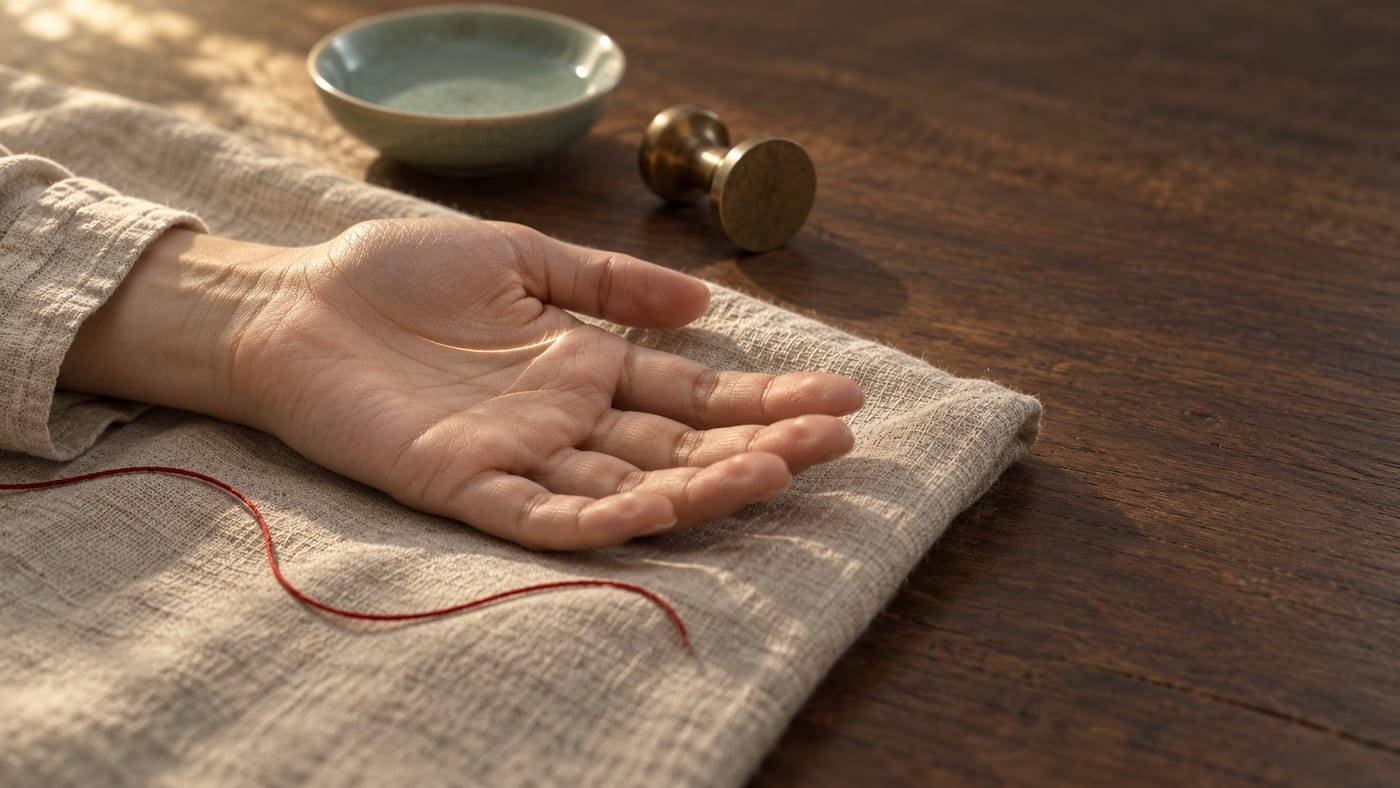
A relaxed open hand resting palm up on natural linen in raking afternoon light, the crease just below the fingers catching the light, a celadon dish and a bronze seal behind it and a red silk thread by the fingertips.
The heaven line is the one the light catches, just under the fingers; the seal is for the rank the old manual read in it, the red thread for the love the West reads. Illustration.

What the heart line means in Western palmistry

Most of what you read about the heart line online goes back, directly or by way of a dozen copies, to one man. Cheiro, born William John Warner in 1866, was the society palmist of his day, and in Palmistry for All, published in 1916, he says the line of heart "relates purely to the affectionate disposition." He reads it almost entirely by where it begins under the fingers, which is to say, where most modern books say it ends.

Under the middle of the index finger, he says, you get the most loyal lover on the hand: idealistic, firm in their affections, rarely a divorce statistic. Farther out toward the edge of the index finger the idealism tips into blind worship of the person loved, and suffering to match. Between the index and middle fingers he finds a calmer but very deep nature, undemonstrative and capable of great sacrifice, a person who does not expect a partner to be a god or a goddess. Under the middle finger the line turns selfish: reserved, determined to win the person they want and then not very tender once they have.

The rest of his reading is about the line's texture. A very long line warns of jealousy. A chained one, or one crossed by a crowd of little lines, means flirtation and inconstancy. A thin line with no branches means coldness. A fork at the start, one branch under the index finger and one between index and middle, is about the best thing he can find to say about anyone. And a broken heart line, he writes, is a certain sign that some terrible tragedy in the affections will overwhelm the person at some point. He adds, a little reassuringly, that it is not often found.

That is the whole Western system in miniature, and nearly every heart-line chart you will meet is a simplified copy of it, usually with the darkest readings quietly dropped.

What the old Chinese manual says about the heaven line

The fullest classical account is the palm chapter of the Shenxiang Quanbian, the great compendium of physiognomy, which the Qing emperors' encyclopedia of 1726 reprinted whole; another manual in the imperial library, the Taiqing Shenjian, carries the same passage almost word for word. It sets out the three great lines as a hierarchy, and the top line comes first. It answers to heaven, stands for the ruler and the father, and settles whether you will be noble or humble. The middle line settles wealth, the bottom one, which the West calls the life line, how long you live.

So where a Western palmist looks at this crease and asks whom you will love, the Chinese manual looked at it and asked where you stand: in the state, in the family, under your father. It is a heart line for a society organized by rank, and for a reader who was assumed to be a man choosing a career and, later on the same pages, a wife.

A few pages later the same chapter describes the three lines a second time, in a section on what it calls the three powers, and gives them slightly different jobs. Here the heaven line is the first line, it sits in the palace of fire, and it governs your foundation, the ground you start from. That is still a long way from romance. The section closes with its most sensible advice: to get a true reading, check the palm against the face, which has its own three bands of heaven, humankind and earth, set out on our page on Chinese face reading.

The heart line read three ways: Western palmistry (Cheiro, 1916), the classical Chinese manual (Shenxiang Quanbian palm chapter, Taiqing Shenjian), and modern Chinese palm books.
Question Western palmistry Classical Chinese manual Modern Chinese palm books
What it is called The heart line, or line of heart The heaven line, highest of the three great lines 天纹 tiān wén Ganqing xian, the emotion line, a translation of the Western name; heaven line kept as the old one
What it governs Love and the emotional nature In one section, rank, the ruler and the father; in a later section, your foundation in life Love and feeling, as in the West
Where it ends Under the index finger, between index and middle, or under the middle finger, each a different kind of lover Not discussed Borrowed from Western readings
A very long or very short line Very long: jealousy. Short: cooler affections Not discussed by length Long: sensitive. Short: cool, slow to fall in love
A broken line A tragedy in love, by the old books Any line broken, however fine, marks something flawed and left unfinished Borrowed from Western readings
Marriage Read from small lines below the little finger, near this one Not on this line: read from the palace of the Zhen trigram A marriage line, borrowed from the West

Where the Chinese manual looked for love instead

If you came here to find out about your love life, the old manual would send you to a different part of the hand. It lays the palm out like a compass, with the eight trigrams of the Book of Changes as eight palaces, and it files wives and marriage under the palace of the Zhen trigram. Marks found there are read as news about the marriage. The hub page's section on the marriage line walks through that palace and the long run of peach-blossom lines around it.

The heaven line does turn up in one marriage verse. Among the named marks in the same chapter is one called the silver river, and the verse attached to it says, as far as the machine-punctuated text lets anyone read it, that a silver river shattered across the heaven line means harm to a wife and a second marriage. It is the nearest the manual comes to a heart line in the Western sense, and it is a warning to husbands rather than a reading of anyone's heart.

The Chinese tradition's other answer to the love question is not on the hand at all. Birth-chart readers look for a spouse palace in a chart cast from a date and time, and our page on when you will get married works that out from a birthday, which at least has the advantage that everybody's arithmetic comes out the same.

Where the line comes from

The Chinese manual has a theory about this, and it is rather touching. Everyone has the three great lines, it says, high or low, because they form in the womb, made as the unborn child clenches its fists over its ears, which the text calls very hard work.

Half of that is right. The creases do form in the womb. A 1971 study of how palm creases form, by R. S. Bali and Ramesh Chaube in a German journal of morphology and anthropology, is cited for the finding that they appear around the second month of pregnancy, before the fetus begins moving its fingers, so the fists come later than the lines. A heart line is a fold in the skin where the hand bends, laid down long before anyone has a heart to break, and no study has tied its shape to how a person loves.

When the heart line and head line run together

On some hands there is no separate heart line. It merges with the head line into a single crease straight across the palm, and this is where the two traditions, for once, agree that something dramatic is going on. Cheiro called it an intensely self-concentrated nature and warned that such people were dangerous lovers and husbands to trifle with. Chinese folk belief calls the same crease the broken palm and, on a woman, read it as a danger to her husband. Both are about as well founded as each other. The hub's section on the broken palm has the history, the Taiwanese television drama it inspired, and how common the crease actually is.

The emotion line in modern Chinese palm reading

Modern Chinese palm books took the Western heart line wholesale, name, endings and all, and then added a twist of their own: health. A 2022 feature on the Taiwanese television network TVBS's health site, quoting the fortune-teller Jian Shaonian, reads an island in the emotion line below the ring finger as a sign of strong short-sightedness, and then, by way of the old medical idea that both the heart and the eyes belong to fire, as a reason to watch your heart after forty. The same piece reads a very long line as emotional sensitivity and a short one, stopping under the middle finger, as coolness, someone slow to fall in love.

TVBS labeled the piece folk custom, for reference only, and that is the right label. If you have a worry about your eyes or your heart, an optician and a doctor will tell you more than any crease.

Left hand or right?

You have a heart line on each palm, and they are rarely twins. Western palmists often read the dominant hand as the life you are making and the other as what you were born with. The classical Chinese manual reads both and compares them. The rule everyone quotes, men left and women right, came into palm reading from medicine, and the hub's section on the marriage line traces where it started.

If you want the part of this tradition that can actually be checked, it is the birth chart rather than the hand. A bazi chart takes a date and time instead of a crease, and every step of its arithmetic is published.

Questions people ask

What does the heart line mean on your palm?

In Western palmistry the heart line, the crease that runs across the top of the palm just below the fingers, is read for love and the emotional nature. The palmist Cheiro wrote in 1916 that it relates purely to the affectionate disposition. In classical Chinese palm reading the same crease is the heaven line, the highest of three great lines, and the old manual reads it for rank and for the father rather than for love. Modern Chinese palm books have adopted the Western meaning and call it the emotion line.

Which line is the heart line?

It is the uppermost of the three long creases on your palm, the one closest to the fingers. It starts at the outer edge of the hand below the little finger and runs across toward the index finger, usually ending somewhere under the index or middle finger or in the space between them. The head line runs below it, and the life line curves around the base of the thumb.

What does it mean if your heart line ends between your index and middle finger?

In Western palmistry it is read as the balanced ending. Cheiro described people whose heart line rises between the first and second fingers as calm but very deep in their affections, not demonstrative, capable of great sacrifice, and not expecting a partner to be a god or a goddess. An ending under the index finger he read as idealistic and loyal, and one under the middle finger as more self-centered in love. The classical Chinese manual has no reading for where the line ends.

What does a broken heart line mean?

Older Western books read it darkly: Cheiro called a broken heart line a sign that a tragedy in the affections would overwhelm the person at some point. The classical Chinese manual has a single rule for every line on the hand, that a line which is broken, however fine, marks something flawed and left unfinished. Neither reading has any evidence behind it. A break in a skin crease is a feature of how the skin folds.

What does a forked heart line mean?

In Cheiro's system a heart line that begins with a fork, one branch under the index finger and the other between the index and middle fingers, is one of the best signs on the hand, a well-balanced and affectionate nature with a good promise of happiness in love. The Chinese manual does not read forks on this line.

Should you read the heart line on the left or right hand?

Both hands have a heart line, and they often differ. Western palmists commonly read the dominant hand as the life you have made and the other as what you were born with. The classical Chinese manual reads both hands and compares them. The rule men left, women right, which Chinese palm readers often quote, was borrowed from medicine rather than from the palm manual.

Sources

  • • Gujin Tushu Jicheng (the Qing imperial encyclopedia, 1726), Bowu, Yishu dian, juan 640: the palm juan of the Shenxiang Quanbian, with the three great lines, the three powers section and the silver-river mark: source
  • • Taiqing Shenjian, juan 5 (Siku Quanshu text): the three lines as heaven, man and earth: source
  • • Cheiro, Palmistry for All (1916), chapter VII, "The Line of Heart as Indicating the Affectionate and Emotional Nature" (Project Gutenberg): source
  • • Marie Claire Taiwan, a modern Chinese guide to the three lines, listing the heaven line as the emotion line, 2023: source
  • • TVBS Health, on modern Chinese health readings of the palm lines, with the fortune-teller Jian Shaonian, labeled folk custom, 2022: source
  • • Bali and Chaube, "On the formulation of palmar creases", Zeitschrift für Morphologie und Anthropologie 63, 1971 (PubMed record): source
  • • Single transverse palmar crease, the English overview, including the 1971 finding on when creases form: source
  • • Palmistry: the standard English overview, including Cheiro and the scientific assessment: source

The whole hand

Chinese palm reading

The rare marks the old manual names, the marriage line and the broken palm.

The line round the thumb

The life line, read the Chinese way

The earth line, what the manual says it governs, and the three studies that measured it.

Love, from a birthday

When will I get married?

The spouse palace and the marked years, read from your birth chart rather than your palm.

Check it against the face

Chinese face reading

Heaven, humankind and earth again, as three bands across the face.

Stay in the loop.

Chinese mythology, the zodiac, and the meaning behind names and symbols, rooted in the classics and read back to you. No spam. Unsubscribe anytime.