Guanyin fortune stick

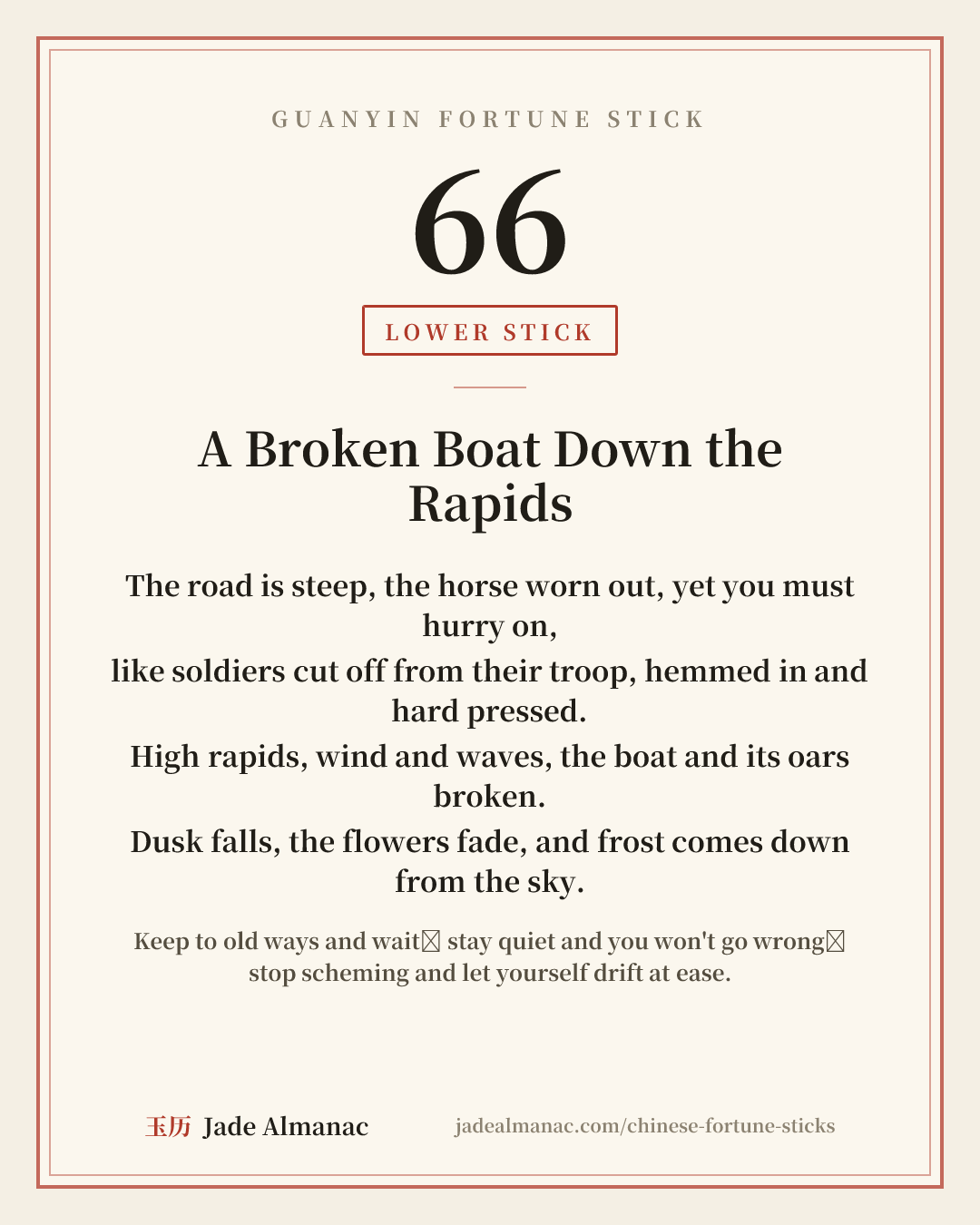
66

Lower stick

Guanyin fortune stick 66: A Broken Boat Down the Rapids

The road is steep, the horse worn out, yet you must hurry on,
like soldiers cut off from their troop, hemmed in and hard pressed.
High rapids, wind and waves, the boat and its oars broken.
Dusk falls, the flowers fade, and frost comes down from the sky.

jadealmanac.com

Save image

The verdict
Keep to old ways and wait; stay quiet and you won't go wrong; stop scheming and let yourself drift at ease.
What it says to you
Every line of this poem piles on another hardship: a tired horse on a steep road, soldiers separated from their unit, a cracked boat in white water, frost on late flowers. It is one of the bleaker sticks, and it doesn't pretend otherwise. Yet the verdict is oddly calm. When everything is pushing you to rush, it says stop rushing. Stillness does no harm here, and fresh schemes will only break more oars. So for now, don't make the big move, the risky purchase, the dramatic exit. Rest the horse. Let the current slow. Write down what you would do and revisit it when the frost lifts.

Matter by matter

Love
Unsteady.
Money
Losses likely; trade fails.
Work and study
Unstable, so tend it with care; exams are hard, stay calm.
Health
The stick calls for prayers and merit; keep up your care.
Home
Worry and unease; do not move house.
Travel
Blocked on the way.
Lost things
No trace; the stick gives no sign of it.

The story behind the stick

Xiang Yu, the Hegemon King of Chu, is the figure behind this lot in most editions. For years his armies seemed unbeatable. In 202 BC Han forces under Han Xin surrounded him at Gaixia, and at night he heard the songs of his own Chu homeland rising from the enemy camps, as if his people had gone over. His troops lost heart. He broke out with a small band of riders and reached the Wu River, where a ferryman waited to carry him home. Ashamed to face the elders east of the river after losing so many of their sons, he refused the boat, gave away his horse, fought on foot and cut his own throat. The poem's spent horse, scattered soldiers and broken boat read almost like his last day, which is why this is one of the bleaker lower lots.
Line by line

  1. The road is steep, the horse is spent, and yet you must hurry. Readers take this as pressure to move fast at the very moment your strength and means are lowest.

  2. Soldiers cut off from their troop are hemmed in and hard pressed. Traditionally this means isolation from allies, so help you usually count on may not reach you in time.

  3. High rapids, wind and waves, the boat and oars broken. Temple readers treat this as a warning against travel, risky purchases and any venture that depends on luck holding.

  4. Dusk falls, flowers fade and frost comes down. The day, the season and the weather all close at once, and readers take it as a time to shelter rather than start anything new.

The original verse

路险马乏人行急
失群军卒困相当
滩高风浪船棹破
日暮花残天降霜

Seven characters a line, as printed in the BW Monastery edition.

Sources for the story: https://www.51chouqian.com/guanyinlingqian/66.html (The Hegemon King Besieged); masterseanchan.com/guanyin-oracle/lot-66 (edition A: Xiang Yu Takes His Life at the Wu River).

Optional: the temple way

At a temple the stick is not yours until two moon blocks agree: one flat side up and one round side up, a holy cup.

About stick 66

Is Guanyin stick 66 good or bad?

Stick 66, "A Broken Boat Down the Rapids", is a lower stick, a cautionary stick. Keep to old ways and wait; stay quiet and you won't go wrong; stop scheming and let yourself drift at ease.

What does Guanyin stick 66 say about love?

Unsteady.

What does Guanyin stick 66 say about money?

Losses likely; trade fails.

What does Guanyin stick 66 say about work?

Unstable, so tend it with care; exams are hard, stay calm.

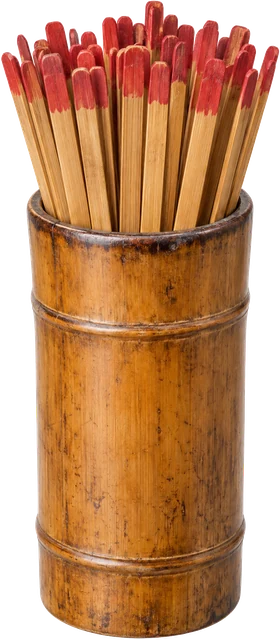
A bamboo fortune-stick cup

Draw another stick , or for a straight yes or no, throw the moon blocks

The verse follows the BW Monastery edition of the Guanyin set; the English rendering and reading are Jade Almanac's own. A drawn stick is a tradition and a prompt for reflection, not advice about health, money or the law.

Stay in the loop.

Chinese mythology, the zodiac, and the meaning behind names and symbols, rooted in the classics and read back to you. No spam. Unsubscribe anytime.