Guanyin fortune stick

65

Lower stick

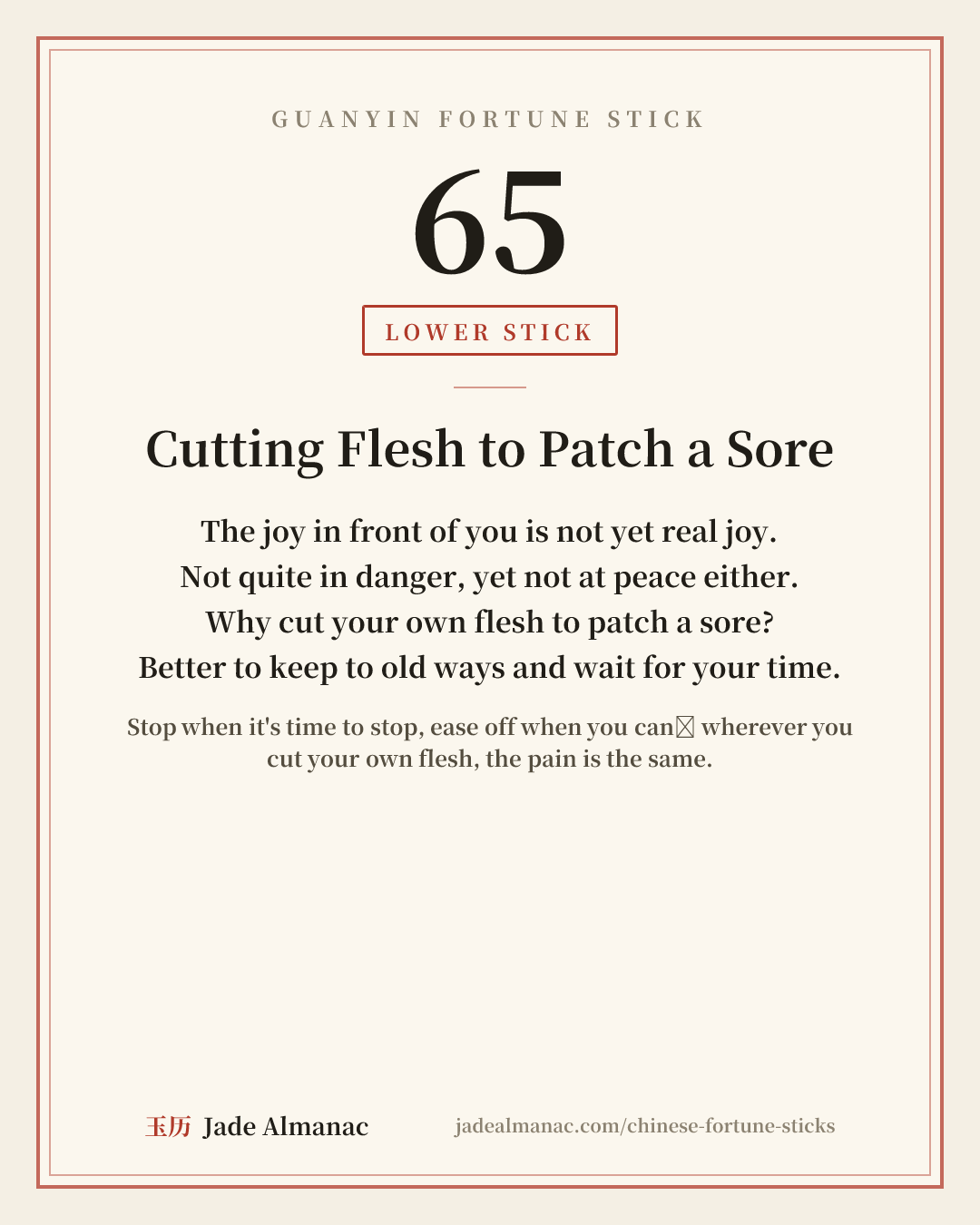
Guanyin fortune stick 65: Cutting Flesh to Patch a Sore

The joy in front of you is not yet real joy.
Not quite in danger, yet not at peace either.
Why cut your own flesh to patch a sore?
Better to keep to old ways and wait for your time.

jadealmanac.com

Save image

The verdict
Stop when it's time to stop, ease off when you can; wherever you cut your own flesh, the pain is the same.
What it says to you
Some fixes are worse than the wound. The image here is someone carving flesh from one part of the body to patch a sore on another, and the verdict adds the dry point that it hurts the same wherever you cut. If you are about to rob one part of your life to prop up another, giving up sleep to meet a deadline you set yourself, borrowing from one promise to keep another, this stick says stop. The pleasure in front of you isn't the real thing yet. Know when to halt, loosen your grip where you can, and wait. Pick the one fix you were about to force and set it down for now.

Matter by matter

Love
It lasts only if you make room for each other.
Money
Not smooth; watch for petty people in trade.
Work and study
Steady, careful steps; exams give a scare but pass.
Health
Illness may come back; keep up your care.
Home
Unsettled, with arguments.
Travel
Delays on the road.
Lost things
Hard to find.

The story behind the stick

Sun Bin and Pang Juan are the pair temple editions name here, with one adding King Goujian of Yue as an alternate. In the Warring States period, both men studied military arts under the same master, by tradition the sage Guiguzi. Pang Juan became a general of Wei, and, jealous of Sun Bin's greater talent, had him framed and maimed. Sun Bin pretended to be mad, escaped to Qi and became its chief strategist. At the battle of Maling he lured Pang Juan into an ambush by cutting the number of campfires each night so his army seemed to be deserting. Trapped, Pang Juan killed himself. Pang Juan had harmed his own friend to protect his place, and the injury came back on him. It is the image of cutting your own flesh to patch a sore, and the reason the lot is lower.
Line by line

  1. The joy in front of you is not yet real joy. Readers take this as a pleasure or gain that looks good now but has not proved itself and may not last.

  2. Not in danger, yet not at peace. Traditionally the line describes an unsettled middle state, nothing collapsing, nothing secure, where hasty action does the most harm.

  3. Cutting flesh to patch a sore is an old Chinese saying for a cure that does as much damage as the illness. Temple readers apply it to robbing one need to cover another.

  4. Better to keep the old ways and wait for your time. Readers treat this as the lot's plain instruction: no drastic fixes now, and patience until conditions change.

The original verse

眼前欢喜未为欢
亦不危时亦不安
割肉补疮为甚事
不如守旧待时光

Seven characters a line, as printed in the BW Monastery edition.

Sources for the story: https://www.51chouqian.com/guanyinlingqian/65.html (Sun Bin and Pang Juan); masterseanchan.com/guanyin-oracle/lot-65 (edition A: Sun Bin Is Wronged, also King Goujian of Yue).

Optional: the temple way

At a temple the stick is not yours until two moon blocks agree: one flat side up and one round side up, a holy cup.

About stick 65

Is Guanyin stick 65 good or bad?

Stick 65, "Cutting Flesh to Patch a Sore", is a lower stick, a cautionary stick. Stop when it's time to stop, ease off when you can; wherever you cut your own flesh, the pain is the same.

What does Guanyin stick 65 say about love?

It lasts only if you make room for each other.

What does Guanyin stick 65 say about money?

Not smooth; watch for petty people in trade.

What does Guanyin stick 65 say about work?

Steady, careful steps; exams give a scare but pass.

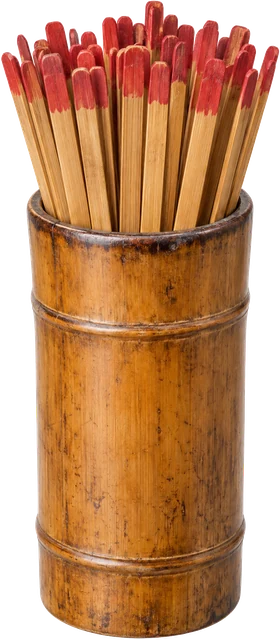
A bamboo fortune-stick cup

Draw another stick , or for a straight yes or no, throw the moon blocks

The verse follows the BW Monastery edition of the Guanyin set; the English rendering and reading are Jade Almanac's own. A drawn stick is a tradition and a prompt for reflection, not advice about health, money or the law.

Stay in the loop.

Chinese mythology, the zodiac, and the meaning behind names and symbols, rooted in the classics and read back to you. No spam. Unsubscribe anytime.