Guanyin fortune stick

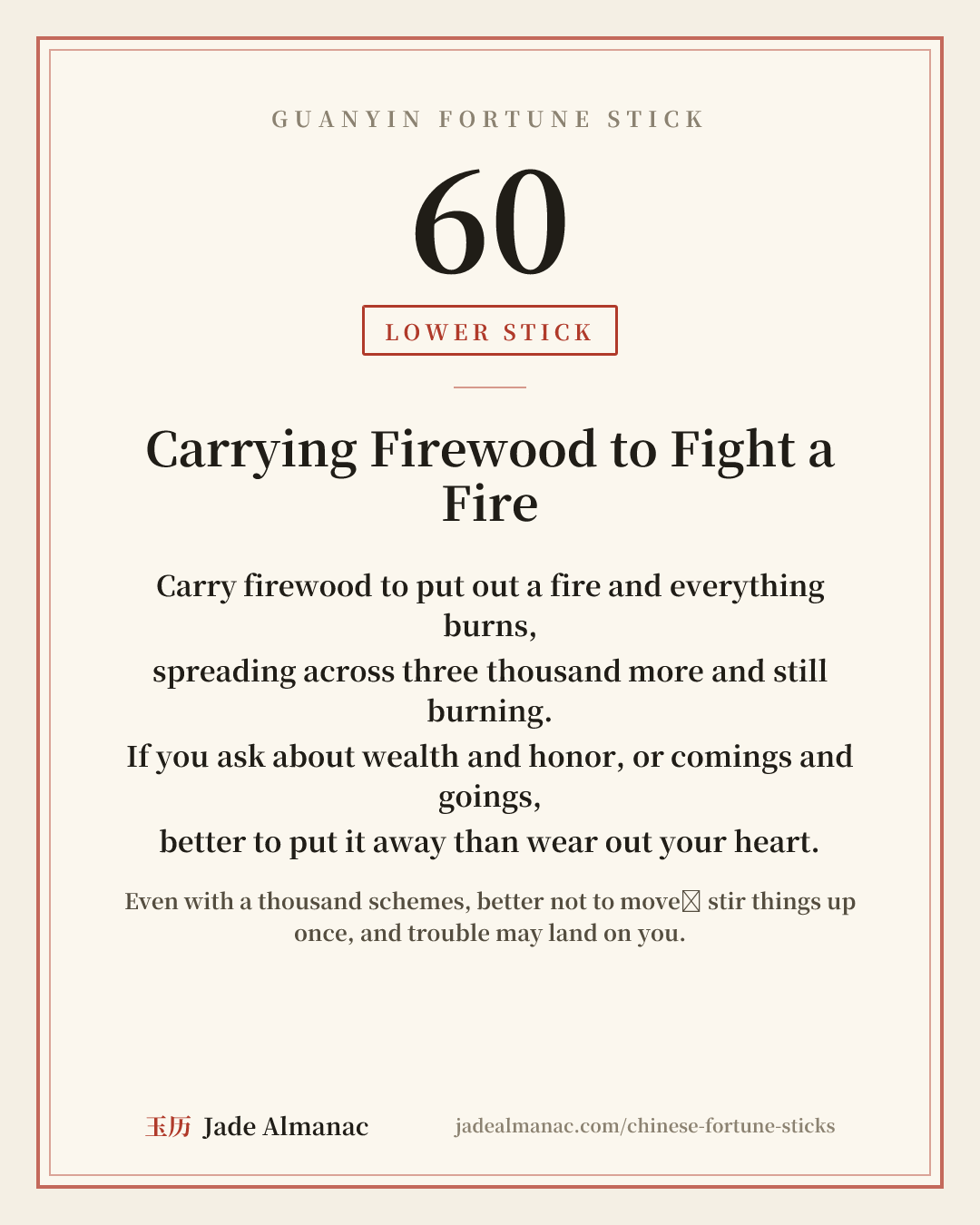
60

Lower stick

Guanyin fortune stick 60: Carrying Firewood to Fight a Fire

Carry firewood to put out a fire and everything burns,
spreading across three thousand more and still burning.
If you ask about wealth and honor, or comings and goings,
better to put it away than wear out your heart.

jadealmanac.com

Save image

The verdict
Even with a thousand schemes, better not to move; stir things up once, and trouble may land on you.
What it says to you
Some fixes feed the fire. The poem's image is someone rushing to a blaze with an armful of kindling, sure they are helping, and making it spread. If you are tempted to solve a problem by adding more of the same, more money, more argument, more pressure, this lower stick is a clear warning. Every clever plan you have is less useful right now than doing nothing. Stirring things up invites the trouble onto you. The kind part is that stillness is possible today. Put down the firewood. Don't send the message, don't raise the stakes, and let the fire burn down before you decide anything.

Matter by matter

Love
Not a match.
Money
Small returns; business will not succeed.
Work and study
Hold on to what you have.
Health
Guard against shocks; keep up your care.
Home
Danger at home; take care.
Travel
Delays on the road.
Lost things
Look to the west.

The story behind the stick

Carrying firewood to fight a fire is the image line, and temple editions set it beside the Battle of Red Cliffs in 208. Cao Cao had brought a vast army south to the Yangtze, sure of conquering the south. Zhou Yu of Wu joined forces with Liu Bei. The veteran Huang Gai sent ships packed with fuel against Cao's fleet, which lay crowded together, and the wind drove the fire through it. In the novel Romance of the Three Kingdoms, the ships are chained to one another and Zhuge Liang calls up the east wind. Cao's army was broken, and the country stayed divided for decades. Every move Cao made to secure his win, packing in more ships and more men, gave the fire more to burn. That is why this is a lower lot: the effort itself feeds the disaster.
Line by line

  1. Carrying firewood to put out a fire is a classic Chinese saying for a remedy that makes things worse. Readers take it as a warning against adding more of what caused the problem.

  2. The fire spreads across three thousand worlds and still burns. Three thousand is a Buddhist figure for the whole universe, so the line means trouble that grows far beyond its starting point.

  3. Wealth, honor, and comings and goings are the usual questions people ask. Temple readers say this line answers all of them at once with the same caution.

  4. Better to put it away than wear out your heart. Traditionally this is the lot's instruction: drop the scheme for now, since effort spent here is wasted and may draw harm.

The original verse

抱薪救火大皆燃
烧遍三千亦复然
若问荣华并出入
不如收拾枉劳心

Seven characters a line, as printed in the BW Monastery edition.

Sources for the story: masterseanchan.com/guanyin-oracle/lot-60 (edition A: The Battle of Red Cliffs); https://www.51chouqian.com/guanyinlingqian/60.html.

Optional: the temple way

At a temple the stick is not yours until two moon blocks agree: one flat side up and one round side up, a holy cup.

About stick 60

Is Guanyin stick 60 good or bad?

Stick 60, "Carrying Firewood to Fight a Fire", is a lower stick, a cautionary stick. Even with a thousand schemes, better not to move; stir things up once, and trouble may land on you.

What does Guanyin stick 60 say about love?

Not a match.

What does Guanyin stick 60 say about money?

Small returns; business will not succeed.

What does Guanyin stick 60 say about work?

Hold on to what you have.

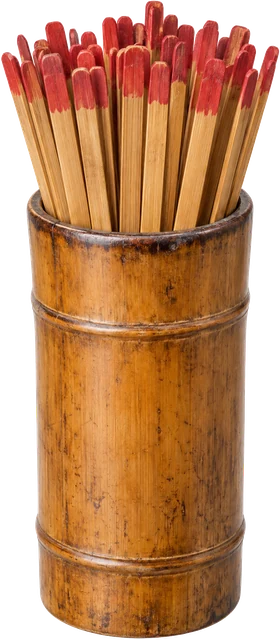
A bamboo fortune-stick cup

Draw another stick , or for a straight yes or no, throw the moon blocks

The verse follows the BW Monastery edition of the Guanyin set; the English rendering and reading are Jade Almanac's own. A drawn stick is a tradition and a prompt for reflection, not advice about health, money or the law.

Stay in the loop.

Chinese mythology, the zodiac, and the meaning behind names and symbols, rooted in the classics and read back to you. No spam. Unsubscribe anytime.