Guanyin fortune stick

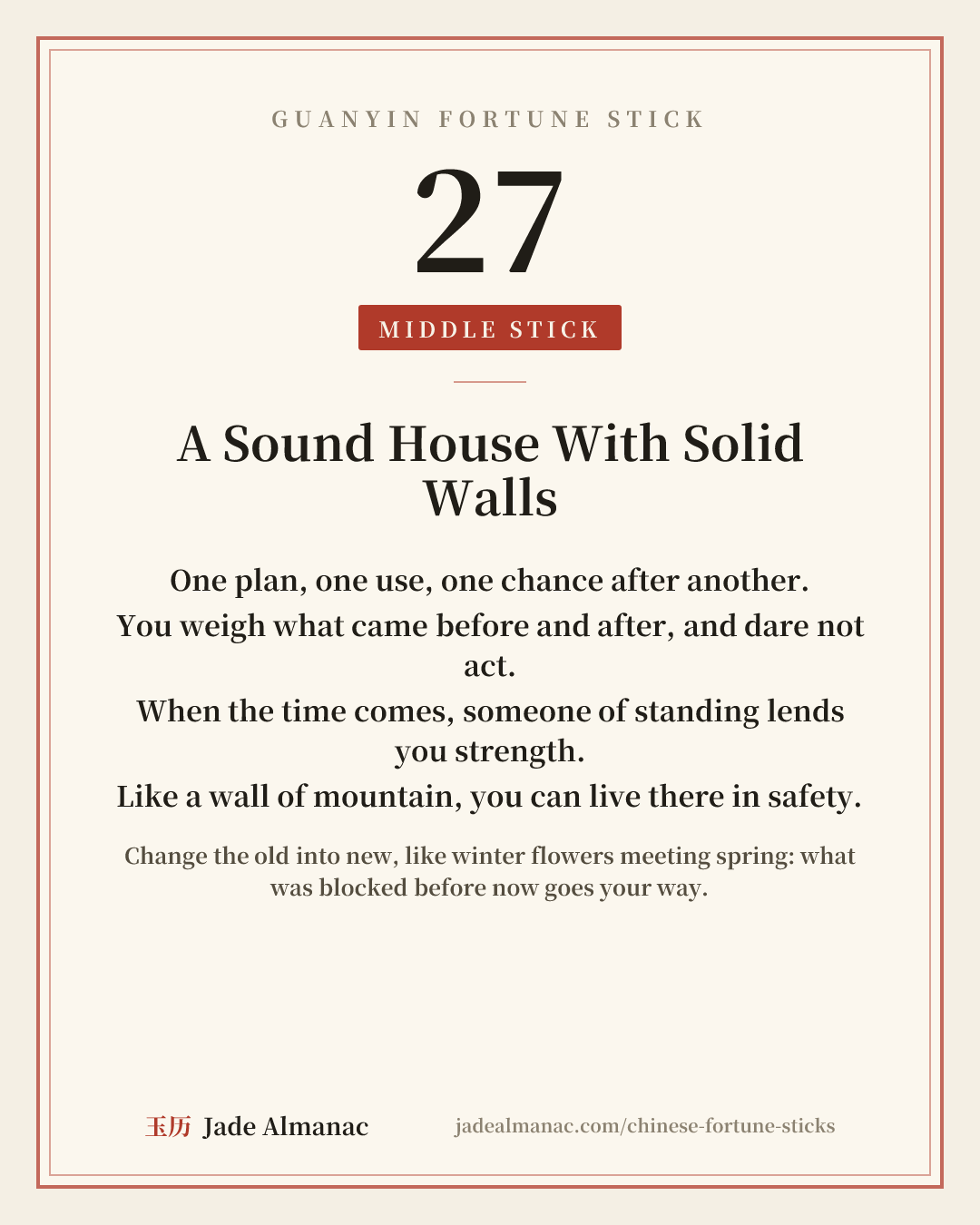
27

Middle stick

Guanyin fortune stick 27: A Sound House With Solid Walls

One plan, one use, one chance after another.
You weigh what came before and after, and dare not act.
When the time comes, someone of standing lends you strength.
Like a wall of mountain, you can live there in safety.

jadealmanac.com

Save image

The verdict
Change the old into new, like winter flowers meeting spring: what was blocked before now goes your way.
What it says to you
You have had plans, more than one, and each time you turned it over so many times that nothing got built. The stick is gentle about it. When the moment arrives, someone with standing will put a shoulder to it, and what you make will stand like a mountain wall, solid enough to live inside. The verdict talks about winter flowers meeting spring and old things turned new, so the delays behind you are no judgment on you. The useful move now is to change one method that has kept you stuck, and then actually start.

Matter by matter

Love
Obstacles still in the way.
Money
Profit to be had, though trade is hard.
Work and study
Change your approach; hard work brings returns.
Health
Needs time to mend, nothing serious.
Home
Peaceful.
Travel
You will arrive, later than planned.
Lost things
No trace of it.

The story behind the stick

Lot 27 is tied in most editions to Liu Ji, better known as Liu Bowen, the strategist who helped Zhu Yuanzhang found the Ming dynasty. In 1363 Zhu decided to march to Anfeng to break a siege there. Liu urged him not to leave his base exposed. Zhu went anyway, and while he was away his great rival Chen Youliang laid siege to Hongdu, the city now called Nanchang. The official Ming history records Zhu admitting afterward that he should never have made the Anfeng trip. The story sits behind a poem about weighing what came before and after, and about a house with walls like a mountain. Good counsel is the wall. The lot is middle because the safety depends on listening to it.
Line by line

  1. One plan, one use, one chance after another stacks schemes on top of each other. Readers see a mind full of options and calculations, busy but not yet committed to any single course.

  2. Looking back and looking ahead until you dare not move is the picture of over-caution. Temple readers do not scold it; they read it as the pause before help arrives.

  3. The person of standing here is a patron or protector, a fixture of fortune-stick language. The line says that timing, more than your own effort, brings that person to your side.

  4. A wall like a sheer mountain face is the stick's image of a sound house. Readers take it as lasting security: once the help lands, what you build will not be easily shaken.

The original verse

一谋一用一番机
虑后思前不敢为
时到贵人相助力
如山壁立可安居

Seven characters a line, as printed in the BW Monastery edition.

Sources for the story: https://www.sheup.org/constellationmatch/guanyinlingqian/guanyin27.htm; https://www.masterseanchan.com/guanyin-oracle/lot-27/; BW Monastery Singapore, Guanyin lots (base text); History of Ming, biography of Liu Ji (Anfeng episode).

Optional: the temple way

At a temple the stick is not yours until two moon blocks agree: one flat side up and one round side up, a holy cup.

About stick 27

Is Guanyin stick 27 good or bad?

Stick 27, "A Sound House With Solid Walls", is a middle stick, a mixed stick, good with conditions. Change the old into new, like winter flowers meeting spring: what was blocked before now goes your way.

What does Guanyin stick 27 say about love?

Obstacles still in the way.

What does Guanyin stick 27 say about money?

Profit to be had, though trade is hard.

What does Guanyin stick 27 say about work?

Change your approach; hard work brings returns.

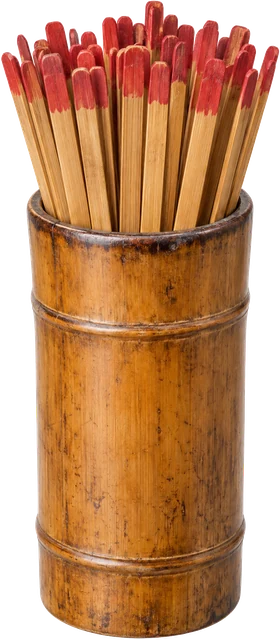
A bamboo fortune-stick cup

Draw another stick , or for a straight yes or no, throw the moon blocks

The verse follows the BW Monastery edition of the Guanyin set; the English rendering and reading are Jade Almanac's own. A drawn stick is a tradition and a prompt for reflection, not advice about health, money or the law.

Stay in the loop.

Chinese mythology, the zodiac, and the meaning behind names and symbols, rooted in the classics and read back to you. No spam. Unsubscribe anytime.