Guanyin fortune stick

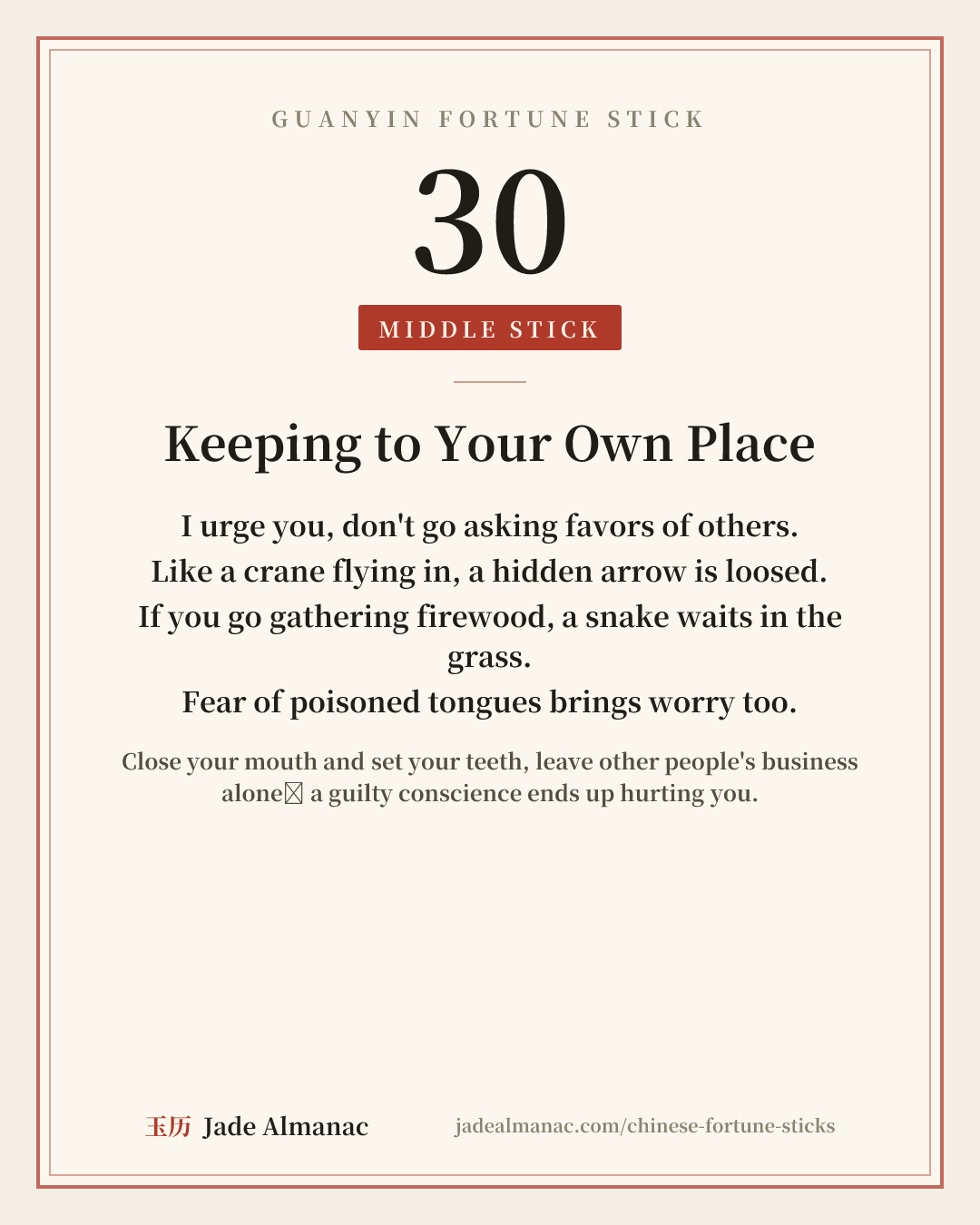
30

Middle stick

Guanyin fortune stick 30: Keeping to Your Own Place

I urge you, don't go asking favors of others.
Like a crane flying in, a hidden arrow is loosed.
If you go gathering firewood, a snake waits in the grass.
Fear of poisoned tongues brings worry too.

jadealmanac.com

Save image

The verdict
Close your mouth and set your teeth, leave other people's business alone; a guilty conscience ends up hurting you.
What it says to you
A crane comes down to land and someone in the reeds has an arrow ready. You go out for firewood and there is a snake under the grass. This stick is full of small hidden hazards, and most of them come from asking the wrong people for help or saying too much. It is a middle draw because you are safe where you stand. The trouble starts when you reach outward. So for now, rely on yourself, keep your plans and opinions private, and stay out of quarrels that aren't yours. Check that your own dealings are clean, and the arrows have nothing to aim at.

Matter by matter

Love
The right match hasn't come yet.
Money
Wait for the moment; business has stalled.
Work and study
Mind your own work and skip other people's business.
Health
Slow to heal; keep up your care.
Home
Peaceful.
Travel
Obstacles along the road.
Lost things
It will not be found.

The story behind the stick

Most editions pair lot 30 with the last ride of Xiang Yu, the Hegemon-King of Western Chu. Defeated at Gaixia and fleeing with a few hundred horsemen, he lost his way near Yinling and asked a farmer which road to take. The farmer told him to go left, and the left road ran into a great marsh, where the Han cavalry caught up with him. The historian Sima Qian records the episode in the Shiji, and Xiang Yu died soon after by the Wu River. One edition substitutes a romance about rival families at Chessboard Mountain, and its own compiler notes it does not match the poem. The farmer's lie is the hidden arrow of the second line, and the grade stays middle because the danger lies in whom you ask.
Line by line

  1. The opening is a plain warning against seeking favors or help from others. Temple readers take it as the key line: the danger in this stick comes from reaching outward, not from where you stand.

  2. A crane landing in what seems a safe place meets an arrow shot from cover. Readers read the crane as someone innocent and exposed, harmed by a person they never saw.

  3. Gathering firewood is ordinary daily work, and the snake waits in the grass beside it. The line says hazards hide in routine errands, so look before you reach.

  4. Poisoned mouths are malicious tongues: slander, gossip, a cruel remark repeated. Readers take the line as a call to guard what you say and whom you confide in.

The original verse

劝君切莫向他求
似鹤飞来暗箭投
若去采薪蛇在草
恐遭毒口也忧愁

Seven characters a line, as printed in the BW Monastery edition.

Sources for the story: https://www.sheup.org/constellationmatch/guanyinlingqian/guanyin30.htm; https://www.masterseanchan.com/guanyin-oracle/lot-30/; BW Monastery Singapore, Guanyin lots (base text); Shiji, Basic Annals of Xiang Yu (Yinling marsh).

Optional: the temple way

At a temple the stick is not yours until two moon blocks agree: one flat side up and one round side up, a holy cup.

About stick 30

Is Guanyin stick 30 good or bad?

Stick 30, "Keeping to Your Own Place", is a middle stick, a mixed stick, good with conditions. Close your mouth and set your teeth, leave other people's business alone; a guilty conscience ends up hurting you.

What does Guanyin stick 30 say about love?

The right match hasn't come yet.

What does Guanyin stick 30 say about money?

Wait for the moment; business has stalled.

What does Guanyin stick 30 say about work?

Mind your own work and skip other people's business.

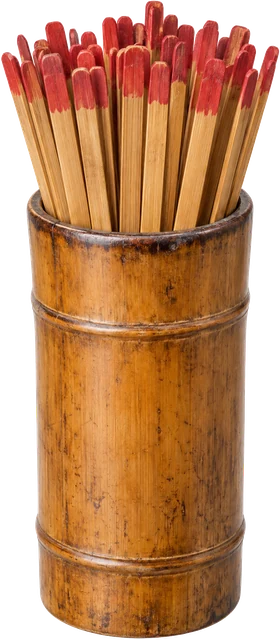
A bamboo fortune-stick cup

Draw another stick , or for a straight yes or no, throw the moon blocks

The verse follows the BW Monastery edition of the Guanyin set; the English rendering and reading are Jade Almanac's own. A drawn stick is a tradition and a prompt for reflection, not advice about health, money or the law.

Stay in the loop.

Chinese mythology, the zodiac, and the meaning behind names and symbols, rooted in the classics and read back to you. No spam. Unsubscribe anytime.