Guanyin fortune stick

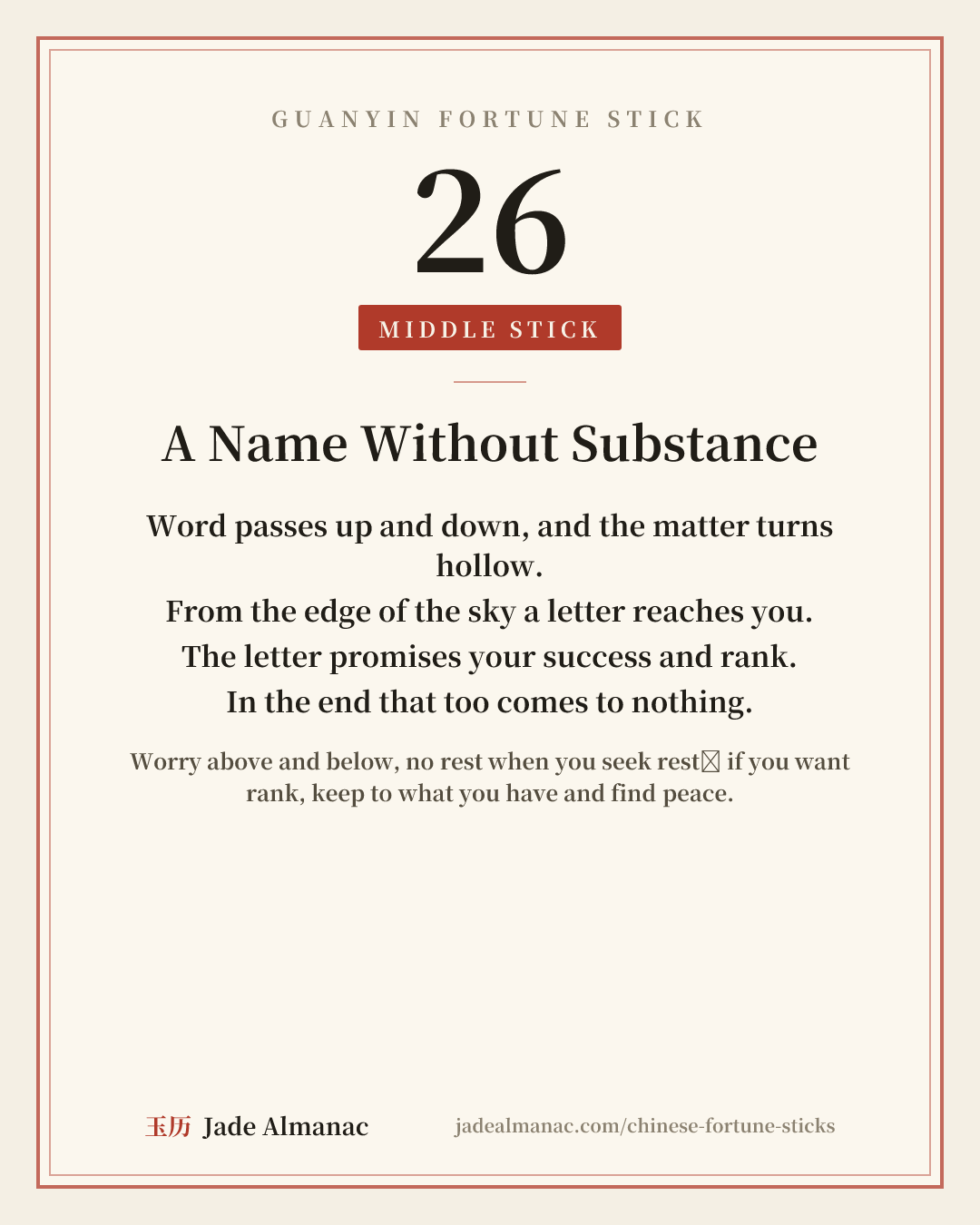
26

Middle stick

Guanyin fortune stick 26: A Name Without Substance

Word passes up and down, and the matter turns hollow.
From the edge of the sky a letter reaches you.
The letter promises your success and rank.
In the end that too comes to nothing.

jadealmanac.com

Save image

The verdict
Worry above and below, no rest when you seek rest; if you want rank, keep to what you have and find peace.
What it says to you
A letter from far away promising you success is a lovely thing to hold, and the poem asks you to read it twice. Rumors pass up and down, the promise sounds fine, and at the end there is little in your hand. The stick's image is a name without substance: more talk than solid ground. That doesn't mean nothing good is coming. It means you should weigh every offer by what is actually signed and delivered. Keep your current footing, keep your expectations level, and let your peace of mind come from what is already yours.

Matter by matter

Love
Challenges ahead.
Money
Obstacles; business is hard to land, so hold steady.
Work and study
Stay clear-headed and settle into where you are.
Health
Do good and pray for protection; peace follows.
Home
Do good deeds and pray for blessing.
Travel
News is on its way to you.
Lost things
Hard to find.

The story behind the stick

Temple books disagree on the tale behind lot 26. The Hong Kong-style edition names Zhong Kui, a Tang scholar who, as the legend goes, came first in the palace examination and was refused the title because his face was judged too ugly. He took his own life in protest and was afterward made the queller of demons, the fierce figure still hung on doors at the New Year. Another edition names the Jin general Huan Wen and the Daoist Wu Meng instead, a story we could not confirm in detail. Zhong Kui fits the poem closely: a letter promises top rank, and the promise turns hollow at the very moment it should pay. The grade is middle rather than lower because the empty title led him to a different and lasting role.
Line by line

  1. Word passing up and down means news relayed between superiors and those below, each telling it a little differently. Readers take it as rumor that sounds official but has no firm source.

  2. The edge of the sky is old shorthand for somewhere very far off. A letter from there is news you cannot check in person, so temple readers treat its promises as unproven.

  3. The letter speaks of examination success and an official post, the highest worldly hope in old China. The line names the kind of prize that tempts people to stop thinking clearly.

  4. The closing line answers the third: the promise comes to nothing in the end. Readers take it as the stick's real verdict, a reason to keep your present ground rather than stake it on the letter.

The original verse

上下传来事转虚
天边接得一封书
书中许我功名遂
直到终时亦是虚

Seven characters a line, as printed in the BW Monastery edition.

Sources for the story: https://www.sheup.org/constellationmatch/guanyinlingqian/guanyin26.htm; https://www.masterseanchan.com/guanyin-oracle/lot-26/; BW Monastery Singapore, Guanyin lots (base text).

Optional: the temple way

At a temple the stick is not yours until two moon blocks agree: one flat side up and one round side up, a holy cup.

About stick 26

Is Guanyin stick 26 good or bad?

Stick 26, "A Name Without Substance", is a middle stick, a mixed stick, good with conditions. Worry above and below, no rest when you seek rest; if you want rank, keep to what you have and find peace.

What does Guanyin stick 26 say about love?

Challenges ahead.

What does Guanyin stick 26 say about money?

Obstacles; business is hard to land, so hold steady.

What does Guanyin stick 26 say about work?

Stay clear-headed and settle into where you are.

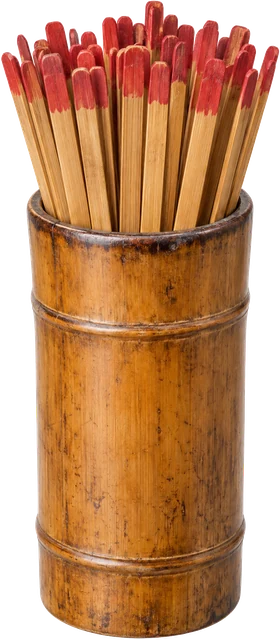
A bamboo fortune-stick cup

Draw another stick , or for a straight yes or no, throw the moon blocks

The verse follows the BW Monastery edition of the Guanyin set; the English rendering and reading are Jade Almanac's own. A drawn stick is a tradition and a prompt for reflection, not advice about health, money or the law.

Stay in the loop.

Chinese mythology, the zodiac, and the meaning behind names and symbols, rooted in the classics and read back to you. No spam. Unsubscribe anytime.