Guanyin fortune stick

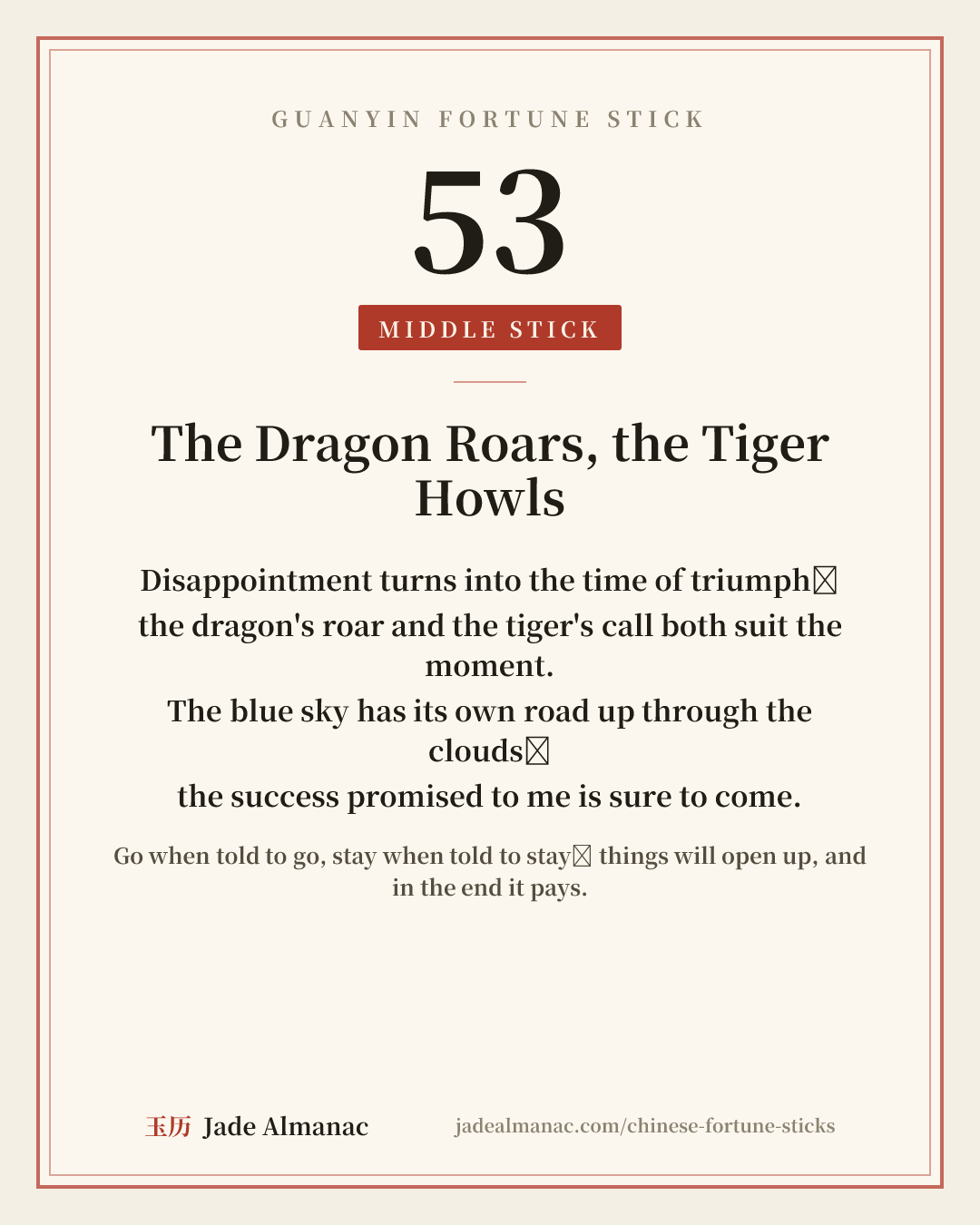
53

Middle stick

Guanyin fortune stick 53: The Dragon Roars, the Tiger Howls

Disappointment turns into the time of triumph;
the dragon's roar and the tiger's call both suit the moment.
The blue sky has its own road up through the clouds;
the success promised to me is sure to come.

jadealmanac.com

Save image

The verdict
Go when told to go, stay when told to stay; things will open up, and in the end it pays.
What it says to you
A low stretch is about to flip. The poem's image is loud and physical: the dragon roaring, the tiger answering, both in their element. If you have been passed over or knocked back, this stick reads it as the setup for a turn, with a road up through the clouds already in place. The verdict adds a surprising instruction. Go when you're told to go, stay when you're told to stay. Progress here comes from moving with the people and signals around you, without forcing your own pace. Face what is hard head-on, keep working, and when the opening is shown to you, take it.

Matter by matter

Love
It will end well.
Money
Average returns; business is hard going.
Work and study
Face the difficulty bravely; crisis can become opportunity.
Health
You will be well.
Home
Unsettled at home.
Travel
The traveler has already arrived.
Lost things
It will be found.

The story behind the stick

A dragon roaring and a tiger howling give this lot its image. Temple editions tell the story of Liu Bei seeking a bride, best known from the novel Romance of the Three Kingdoms. Sun Quan, ruler of Wu, wanted the province of Jing back, so he offered his younger sister in marriage as bait to lure Liu Bei south and hold him. Zhuge Liang saw the trap and gave the general Zhao Yun sealed bags of instructions to open at each crisis. Following them step by step, Liu Bei turned the sham match into a real wedding and came home with his bride. People still say Wu lost both the lady and its soldiers. A plot meant to ruin him became a gain because he did exactly as told. That fits a middle lot whose verdict says go when told and stay when told.
Line by line

  1. Disappointment flips into triumph in a single line. Readers take it as a reversal already underway, so a setback you are living through now is read as the first half of the turn.

  2. Dragon and tiger are the paired emblems of power, sky and mountain. Hearing both together means conditions on every side suit you, and temple readers treat it as permission to act boldly.

  3. The road through the clouds belongs to the sky itself and needs no building. Traditionally this is read as an opening that already exists, waiting to be found rather than forced open.

  4. The speaker is promised rank and a good name, and the promise is presented as settled. Readers apply it most often to exams, promotions and public recognition that has been slow to come.

The original verse

失意翻成得意时
龙吟虎啸两相宜
青天自有通霄路
许我功名必可期

Seven characters a line, as printed in the BW Monastery edition.

Sources for the story: masterseanchan.com/guanyin-oracle/lot-53 (edition A: Liu Bei Seeks a Bride); https://www.51chouqian.com/guanyinlingqian/53.html.

Optional: the temple way

At a temple the stick is not yours until two moon blocks agree: one flat side up and one round side up, a holy cup.

About stick 53

Is Guanyin stick 53 good or bad?

Stick 53, "The Dragon Roars, the Tiger Howls", is a middle stick, a mixed stick, good with conditions. Go when told to go, stay when told to stay; things will open up, and in the end it pays.

What does Guanyin stick 53 say about love?

It will end well.

What does Guanyin stick 53 say about money?

Average returns; business is hard going.

What does Guanyin stick 53 say about work?

Face the difficulty bravely; crisis can become opportunity.

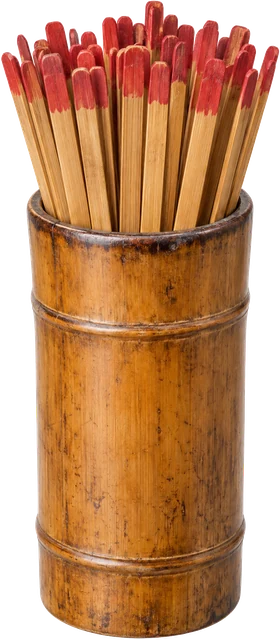
A bamboo fortune-stick cup

Draw another stick , or for a straight yes or no, throw the moon blocks

The verse follows the BW Monastery edition of the Guanyin set; the English rendering and reading are Jade Almanac's own. A drawn stick is a tradition and a prompt for reflection, not advice about health, money or the law.

Stay in the loop.

Chinese mythology, the zodiac, and the meaning behind names and symbols, rooted in the classics and read back to you. No spam. Unsubscribe anytime.