Guanyin fortune stick

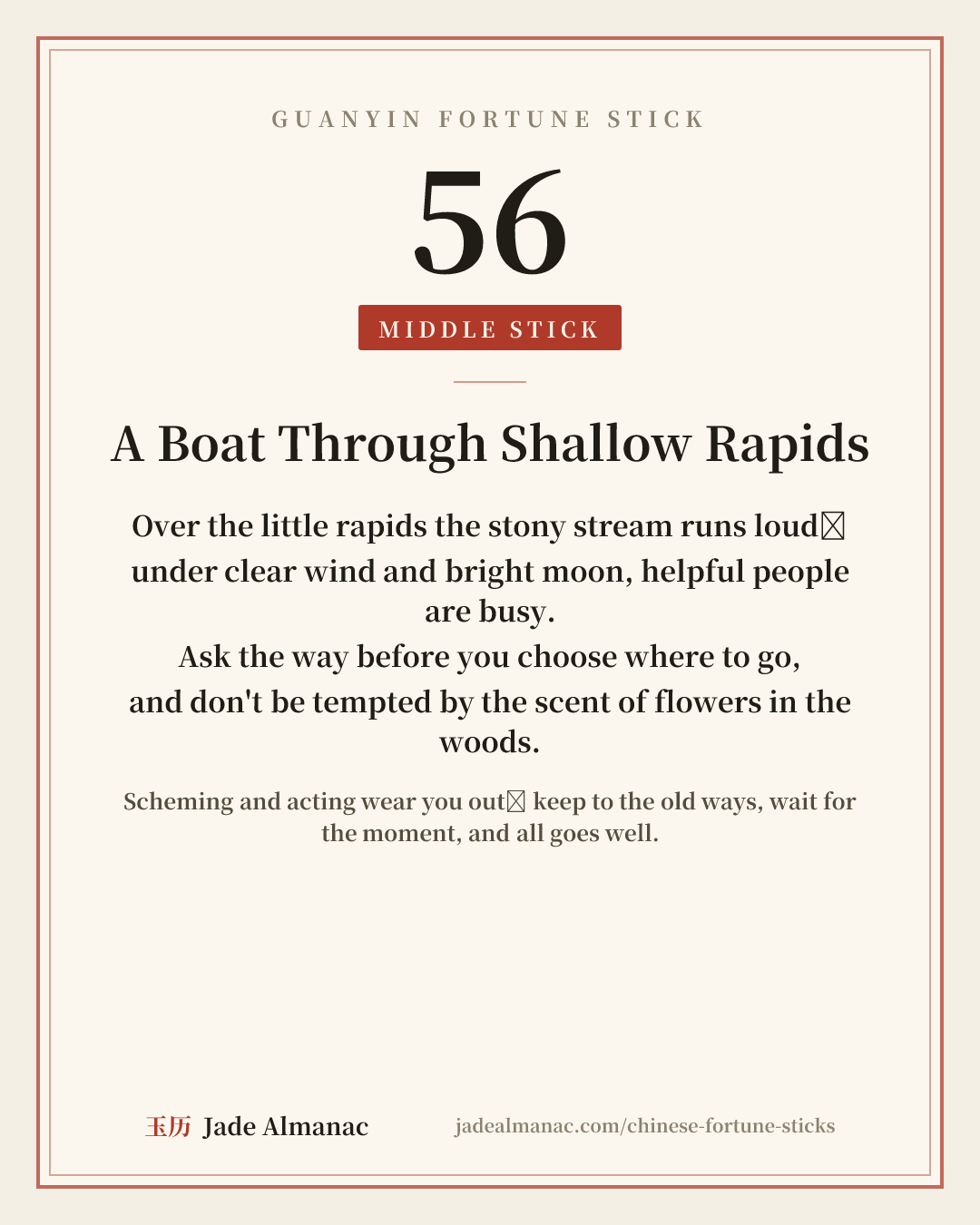
56

Middle stick

Guanyin fortune stick 56: A Boat Through Shallow Rapids

Over the little rapids the stony stream runs loud;
under clear wind and bright moon, helpful people are busy.
Ask the way before you choose where to go,
and don't be tempted by the scent of flowers in the woods.

jadealmanac.com

Save image

The verdict
Scheming and acting wear you out; keep to the old ways, wait for the moment, and all goes well.
What it says to you
You are in a small boat on a noisy little stream, stones knocking under the hull, the wind clean and the moon bright. Helpful people are around, but they are busy with their own work, so you will need to ask. The poem's advice is twofold. First, ask the way before you pick a direction. Second, don't get pulled off course by whatever smells sweet in the woods along the bank. Big schemes to change everything will tire you out. Steady progress gets you through the shallows. Name the one person who knows this stretch of water, ask them directly, and stay in the channel.

Matter by matter

Love
Things go as you hope.
Money
Average returns; business goes smoothly.
Work and study
Grow steadily from a stable base.
Health
Health is about to return.
Home
Peaceful at home.
Travel
The traveler has already arrived.
Lost things
Not easy to find.

The story behind the stick

Two editions name An Lushan's rebellion for this lot, while a variant title points instead to Fan Li sailing away on the lakes. An Lushan was a frontier general of Sogdian and Turkic descent who rose high in the favor of the Tang emperor Xuanzong and his consort Yang Guifei, then fell out with her cousin, the chief minister Yang Guozhong. In 755 he rebelled, took Luoyang, broke through Tong Pass and drove the emperor to flee to Sichuan. He declared his own dynasty and was murdered by his own son within two years. The poem's warning not to chase the scent of flowers in the woods is the point: a man with helpers and a clear channel left it for a prize he could not hold. The middle grade holds both sides, steady progress for the patient and ruin for the reckless.
Line by line

  1. A small boat runs over shallow rapids where the stones make the water loud. Readers take this as a passage that is noisy and a little bumpy but not truly dangerous.

  2. Clear wind and a bright moon set a calm scene, while the people who could help are busy. Traditionally this means help exists, but it will not come looking for you.

  3. Ask the way before choosing a direction. Temple readers treat this line as practical instruction: consult someone who knows the ground before committing to any change of course.

  4. The sweet scent of flowers in the woods is the temptation off the riverbank. Readers take it as a pleasant distraction or a tempting side deal that pulls the boat out of its channel.

The original verse

滩小石溪流水响
清风明月贵人忙
路须借问何方去
莫取林中花草香

Seven characters a line, as printed in the BW Monastery edition.

Sources for the story: masterseanchan.com/guanyin-oracle/lot-56 (edition A: An Lushan Rebels, also Fan Shaobo Sails Away); https://www.51chouqian.com/guanyinlingqian/56.html.

Optional: the temple way

At a temple the stick is not yours until two moon blocks agree: one flat side up and one round side up, a holy cup.

About stick 56

Is Guanyin stick 56 good or bad?

Stick 56, "A Boat Through Shallow Rapids", is a middle stick, a mixed stick, good with conditions. Scheming and acting wear you out; keep to the old ways, wait for the moment, and all goes well.

What does Guanyin stick 56 say about love?

Things go as you hope.

What does Guanyin stick 56 say about money?

Average returns; business goes smoothly.

What does Guanyin stick 56 say about work?

Grow steadily from a stable base.

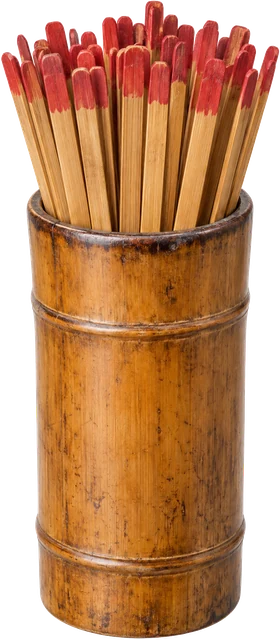
A bamboo fortune-stick cup

Draw another stick , or for a straight yes or no, throw the moon blocks

The verse follows the BW Monastery edition of the Guanyin set; the English rendering and reading are Jade Almanac's own. A drawn stick is a tradition and a prompt for reflection, not advice about health, money or the law.

Stay in the loop.

Chinese mythology, the zodiac, and the meaning behind names and symbols, rooted in the classics and read back to you. No spam. Unsubscribe anytime.