Guanyin fortune stick

37

Middle stick

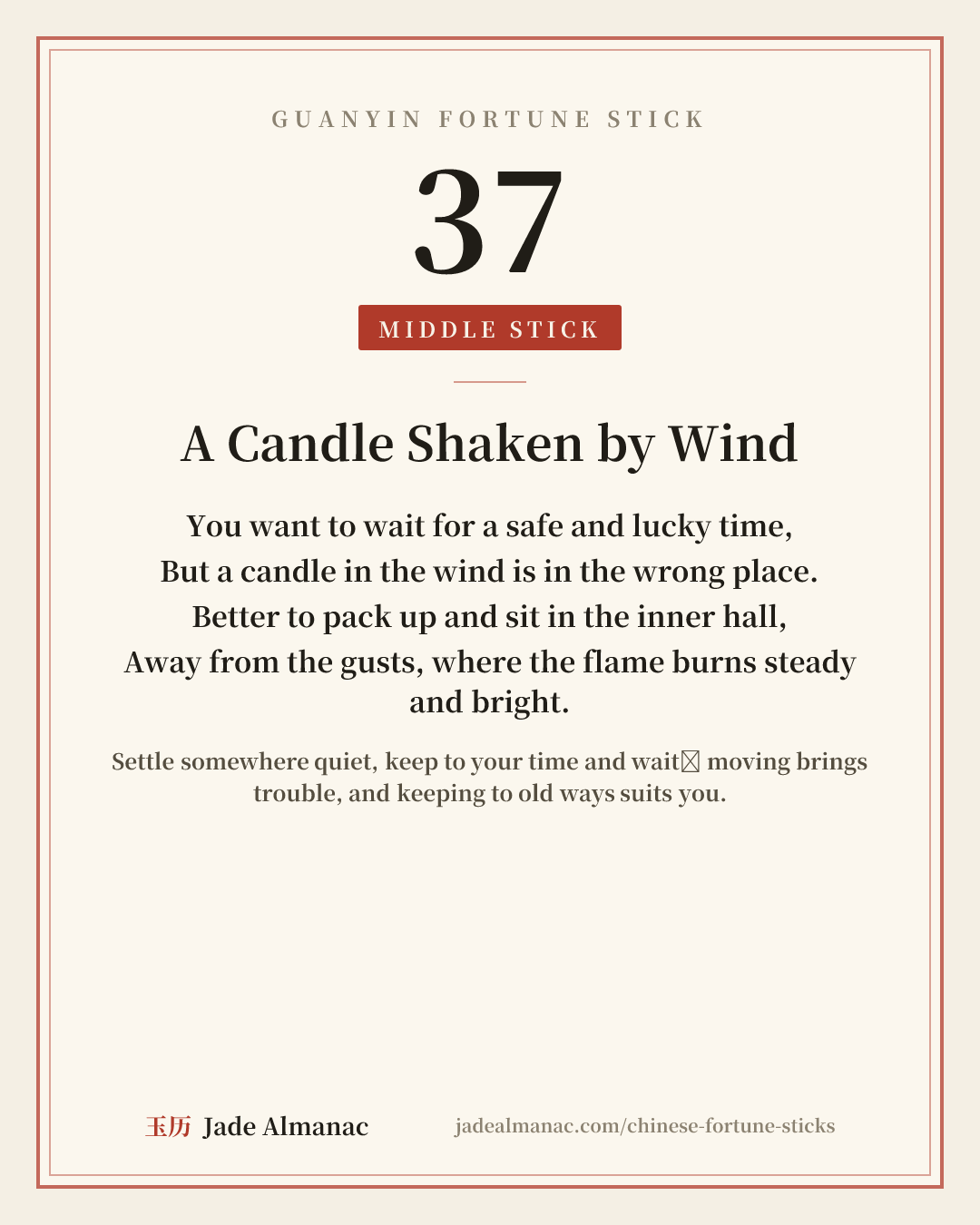
Guanyin fortune stick 37: A Candle Shaken by Wind

You want to wait for a safe and lucky time,
But a candle in the wind is in the wrong place.
Better to pack up and sit in the inner hall,
Away from the gusts, where the flame burns steady and bright.

jadealmanac.com

Save image

The verdict
Settle somewhere quiet, keep to your time and wait; moving brings trouble, and keeping to old ways suits you.
What it says to you
A candle on a windowsill on a gusty night burns badly and might go out. Carried into an inner room, the same flame stands straight. The stick reads your present position as that windowsill: exposed, pushed around, using up energy just staying lit. Its fix is simple. Pull back from whatever is buffeting you, keep to familiar routines, and don't make a dramatic move now, because moving stirs up trouble. Your time hasn't arrived yet. Choose your inner room, a steady job, a quiet evening routine, a smaller circle, and let the flame steady itself there.

Matter by matter

Love
The two of you are not in step.
Money
Investments pay; business is hard to land.
Work and study
Not your time yet; little to show so far.
Health
Make offerings and dedicate merit, the stick advises.
Home
Keep things as they are.
Travel
News will reach you.
Lost things
What you seek can be found.

The story behind the stick

Editions differ on lot 37. The Hong Kong-style edition names Li Jing, the Pagoda-Bearing Heavenly King of the novel Investiture of the Gods. With his sons, among them Nezha, he helped Jiang Ziya in the war that brought down the last Shang king and founded the Zhou. In the temple book's telling, when the new court handed out rewards, Li Jing and his sons declined them and returned to the mountains to keep up their cultivation. Another edition names Guan Zhong, minister of Qi, who nearly lost everything before his friend Bao Shuya recommended him. The Li Jing reading fits the poem well: fame and office are the wind, and a quiet inner hall keeps the lamp burning. The grade is middle because safety comes from stepping back.
Line by line

  1. Wanting to wait for a time when you are safe and fortune runs smoothly sets the scene. Readers take it as an honest wish for stability that the present moment cannot yet grant.

  2. A candle in the wind is out of place. Temple readers read it as exposure: your energy flickering under pressure from people or events you cannot control.

  3. Better to pack up and sit in the deep inner hall, the sheltered back rooms of an old house. Readers take it as deliberate withdrawal to safer, familiar ground.

  4. There, away from the gusts, the flame stays bright. Readers take the line as the stick's promise: what is protected now keeps its light and can be used later.

The original verse

欲待身安运泰时
风中灯烛不相宜
不如收拾深堂坐
庶免光摇静处明

Seven characters a line, as printed in the BW Monastery edition.

Sources for the story: https://www.sheup.org/constellationmatch/guanyinlingqian/guanyin37.htm; https://www.masterseanchan.com/guanyin-oracle/lot-37/; BW Monastery Singapore, Guanyin lots (base text).

Optional: the temple way

At a temple the stick is not yours until two moon blocks agree: one flat side up and one round side up, a holy cup.

About stick 37

Is Guanyin stick 37 good or bad?

Stick 37, "A Candle Shaken by Wind", is a middle stick, a mixed stick, good with conditions. Settle somewhere quiet, keep to your time and wait; moving brings trouble, and keeping to old ways suits you.

What does Guanyin stick 37 say about love?

The two of you are not in step.

What does Guanyin stick 37 say about money?

Investments pay; business is hard to land.

What does Guanyin stick 37 say about work?

Not your time yet; little to show so far.

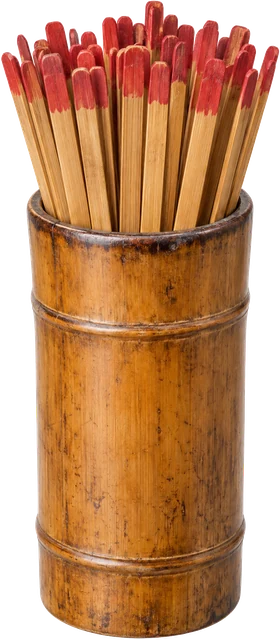
A bamboo fortune-stick cup

Draw another stick , or for a straight yes or no, throw the moon blocks

The verse follows the BW Monastery edition of the Guanyin set; the English rendering and reading are Jade Almanac's own. A drawn stick is a tradition and a prompt for reflection, not advice about health, money or the law.

Stay in the loop.

Chinese mythology, the zodiac, and the meaning behind names and symbols, rooted in the classics and read back to you. No spam. Unsubscribe anytime.