Guanyin fortune stick

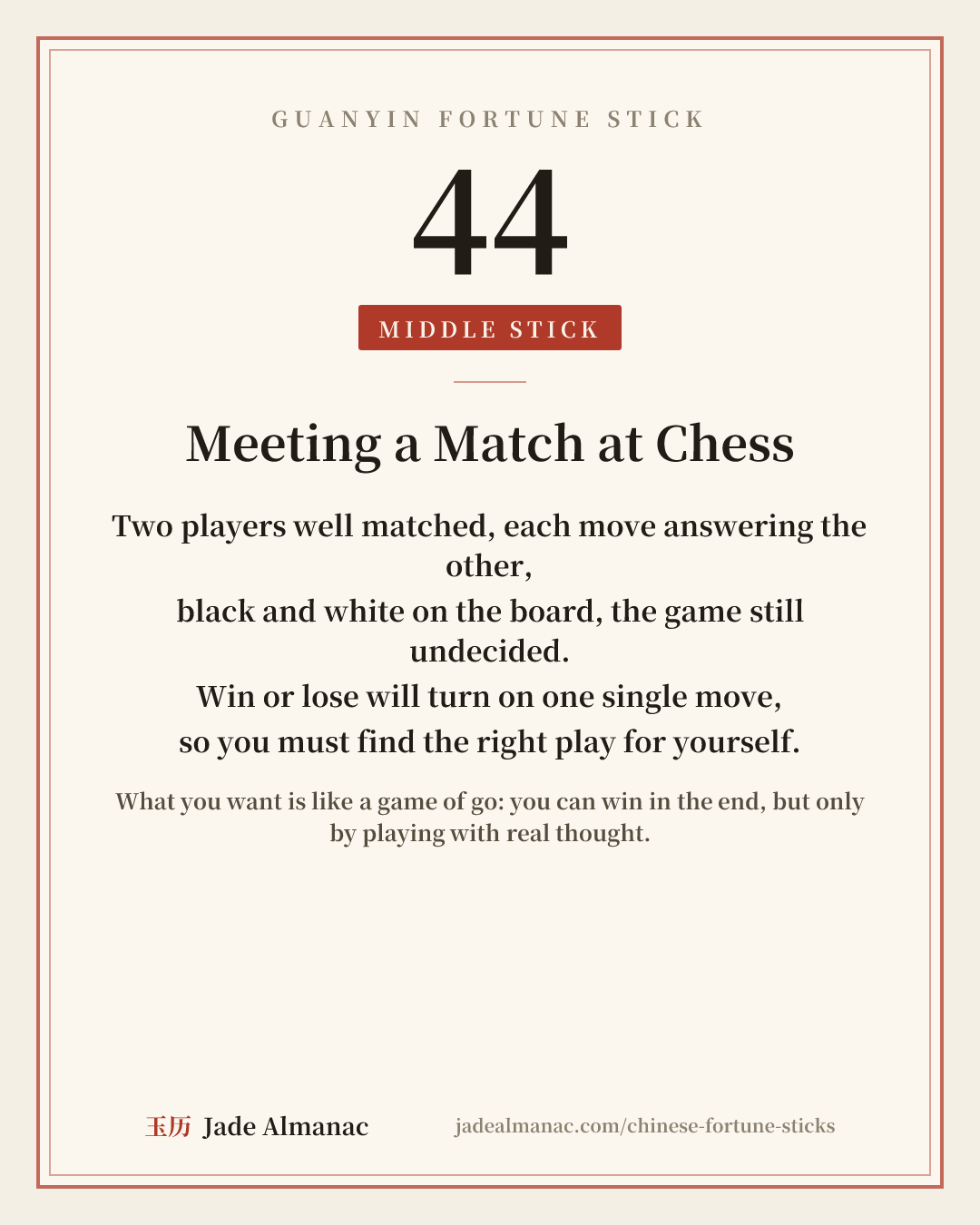
44

Middle stick

Guanyin fortune stick 44: Meeting a Match at Chess

Two players well matched, each move answering the other,
black and white on the board, the game still undecided.
Win or lose will turn on one single move,
so you must find the right play for yourself.

jadealmanac.com

Save image

The verdict
What you want is like a game of go: you can win in the end, but only by playing with real thought.
What it says to you
You are up against someone as good as you are, and the board is still open. The poem pictures a game of go, black stones and white, too close to call, where one move settles everything. That is a middle reading for a reason: you can win, but not by luck or force. Slow down and think several moves ahead. Study what the other side wants, where they are strong, where they leave a gap. Then make your one good move and stop fidgeting with the rest. Before your next important conversation or decision, write down three possible replies and choose deliberately.

Matter by matter

Love
Not suited to each other yet.
Money
Investments go as hoped; trade runs smoothly.
Work and study
Use your wits to work through the difficulty.
Health
Do good and pray for protection; keep up your care.
Home
Very smooth at home.
Travel
Held up on the way.
Lost things
Cannot be found.

The story behind the stick

Lot 44 recalls the long duel between Jiang Wei, the last great general of Shu, and Deng Ai of Wei in the closing years of the Three Kingdoms. In the novel's account of one campaign near the Qi Mountains, the two commanders challenge each other to a contest of battle formations. Each lays out the eight trigrams formation, and each reads the other's correctly. Jiang Wei then shifts his troops into a long serpent formation and traps Deng Ai inside, and the Wei general escapes only when Sima Wang comes to his rescue. Two evenly matched minds, one move deciding the day: the poem's game between black and white is the same contest. The grade is middle because winning takes careful thought, not luck.
Line by line

  1. Meeting an equal opponent at chess, each move answers the other. The game is go, the board game of black and white stones. Readers take it as a contest where neither side has an easy edge.

  2. Black and white sit on the board with the game still undecided. Temple readers read it as a situation in the balance, a negotiation, rivalry or decision whose outcome is open.

  3. Victory or defeat turns on a single move. Readers take the line as the hinge of the stick: one well-judged choice matters more than many hurried ones.

  4. You must find the right play for yourself. The verdict says strategy brings success here, and readers take it as permission to plan carefully and play shrewdly.

The original verse

棋逢敌手着相宜
黑白盘中未决时
皆因一着知胜败
须教自有好推宜

Seven characters a line, as printed in the BW Monastery edition.

Sources for the story: https://www.sheup.org/constellationmatch/guanyinlingqian/guanyin44.htm; https://www.masterseanchan.com/guanyin-oracle/lot-44/; BW Monastery Singapore, Guanyin lots (base text); Romance of the Three Kingdoms, chapter 113.

Optional: the temple way

At a temple the stick is not yours until two moon blocks agree: one flat side up and one round side up, a holy cup.

About stick 44

Is Guanyin stick 44 good or bad?

Stick 44, "Meeting a Match at Chess", is a middle stick, a mixed stick, good with conditions. What you want is like a game of go: you can win in the end, but only by playing with real thought.

What does Guanyin stick 44 say about love?

Not suited to each other yet.

What does Guanyin stick 44 say about money?

Investments go as hoped; trade runs smoothly.

What does Guanyin stick 44 say about work?

Use your wits to work through the difficulty.

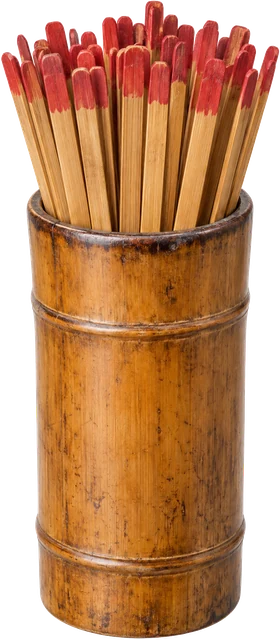
A bamboo fortune-stick cup

Draw another stick , or for a straight yes or no, throw the moon blocks

The verse follows the BW Monastery edition of the Guanyin set; the English rendering and reading are Jade Almanac's own. A drawn stick is a tradition and a prompt for reflection, not advice about health, money or the law.

Stay in the loop.

Chinese mythology, the zodiac, and the meaning behind names and symbols, rooted in the classics and read back to you. No spam. Unsubscribe anytime.