Guanyin fortune stick

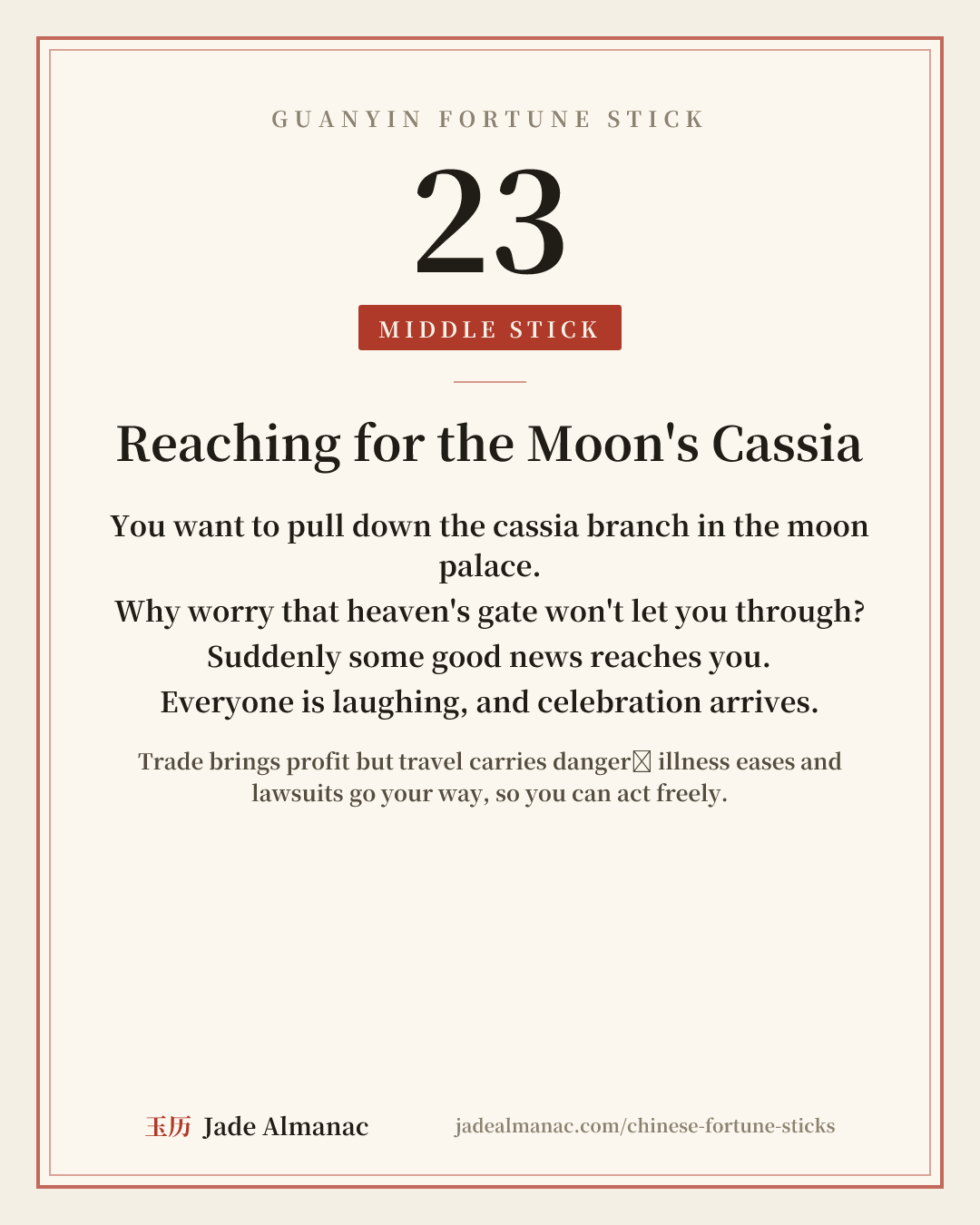
23

Middle stick

Guanyin fortune stick 23: Reaching for the Moon's Cassia

You want to pull down the cassia branch in the moon palace.
Why worry that heaven's gate won't let you through?
Suddenly some good news reaches you.
Everyone is laughing, and celebration arrives.

jadealmanac.com

Save image

The verdict
Trade brings profit but travel carries danger; illness eases and lawsuits go your way, so you can act freely.
What it says to you
Reaching up for the cassia tree on the moon was the old picture of aiming for a top place, the kind of goal that sounds slightly absurd out loud. The poem asks why you would doubt the gate will open, and then good news simply arrives. The stick's image promises a helper: someone with standing who notices you and lifts you. It is a middle draw because the help comes from outside, and the road carries real risk, so don't take chances while traveling. Your part is to keep reaching and make yourself easy to find. Tell the people who could vouch for you what you are aiming at.

Matter by matter

Love
Obstacles stand in the way for now.
Money
Investments go as hoped; business succeeds.
Work and study
Full effort pays; ask others and learn humbly.
Health
Peace and recovery.
Home
Unsettled at home; pray for blessing.
Travel
Danger on the road; take extra care.
Lost things
Hard to find.

The story behind the stick

The cassia branch in the moon stood for top honors, and the story mainland lists attach is a marriage into honor, Gao Huaide Wins a Bride. Gao came from a family of generals and helped found the Song. After Zhao Kuangyin took the throne, Gao married the new emperor's sister, the Princess of Yan, and became an imperial son-in-law. Good news arriving suddenly, everyone laughing, a celebration in the house: the poem reads like his wedding day. Editions disagree sharply on this lot. Master Sean Chan's edition grades it lower and pairs it with King Huai of Chu, who ignored the poet Qu Yuan's warnings and died a captive in Qin. The base edition used here keeps the middle grade and the happier reading.
Line by line

  1. The moon palace, named for the toad said to live there, holds a cassia tree. Breaking off a cassia branch meant placing first in the imperial exams.

  2. Heaven's gate is the entrance to the celestial court, and the line asks why you would doubt it opens for you. Temple readers hear encouragement against self-doubt before an application or test.

  3. News arriving suddenly is the turn of the poem. Readers expect word from outside, a letter, a result or an offer, which finishes what your own effort began.

  4. Everyone laughing and celebration arriving describes a household party, the kind held for an exam pass or a wedding. Because the joy is shared, interpreters see good news for the family too.

The original verse

欲扳仙桂入蟾宫
岂虑天门不任君
忽遇一般音信好
人人欢笑喜庆来

Seven characters a line, as printed in the BW Monastery edition.

Sources for the story: https://www.k366.com/guanyin/28881.htm; https://services.shen88.cn/chouqian/guanyin-23.html; https://www.masterseanchan.com/guanyin-oracle/lot-23/; https://www.fatekeep.com/blog/3640.

Optional: the temple way

At a temple the stick is not yours until two moon blocks agree: one flat side up and one round side up, a holy cup.

About stick 23

Is Guanyin stick 23 good or bad?

Stick 23, "Reaching for the Moon's Cassia", is a middle stick, a mixed stick, good with conditions. Trade brings profit but travel carries danger; illness eases and lawsuits go your way, so you can act freely.

What does Guanyin stick 23 say about love?

Obstacles stand in the way for now.

What does Guanyin stick 23 say about money?

Investments go as hoped; business succeeds.

What does Guanyin stick 23 say about work?

Full effort pays; ask others and learn humbly.

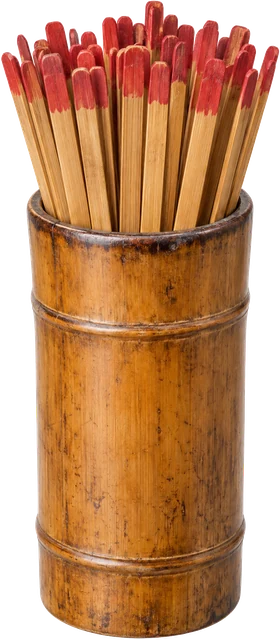
A bamboo fortune-stick cup

Draw another stick , or for a straight yes or no, throw the moon blocks

The verse follows the BW Monastery edition of the Guanyin set; the English rendering and reading are Jade Almanac's own. A drawn stick is a tradition and a prompt for reflection, not advice about health, money or the law.

Stay in the loop.

Chinese mythology, the zodiac, and the meaning behind names and symbols, rooted in the classics and read back to you. No spam. Unsubscribe anytime.