Chinese Zodiac · The story

The Great Race: the story behind the Chinese zodiac, and where it really comes from

The Great Race is the folktale that explains the order of the Chinese zodiac. The Jade Emperor calls the animals to cross a river, and the first twelve to reach him get a year each. The Rat wins by riding on the Ox and jumping off at the bank, the Pig naps and comes last, and the Cat, tricked by the Rat, never arrives. It is a folktale, and a young one: the animals are on bamboo slips buried in 217 BCE, but we could not find the race in any text before the twentieth century.

So this page does two things, and keeps them apart. First the story, told properly, with every animal's excuse. Then the record, which is older, odder and has a deer in it.

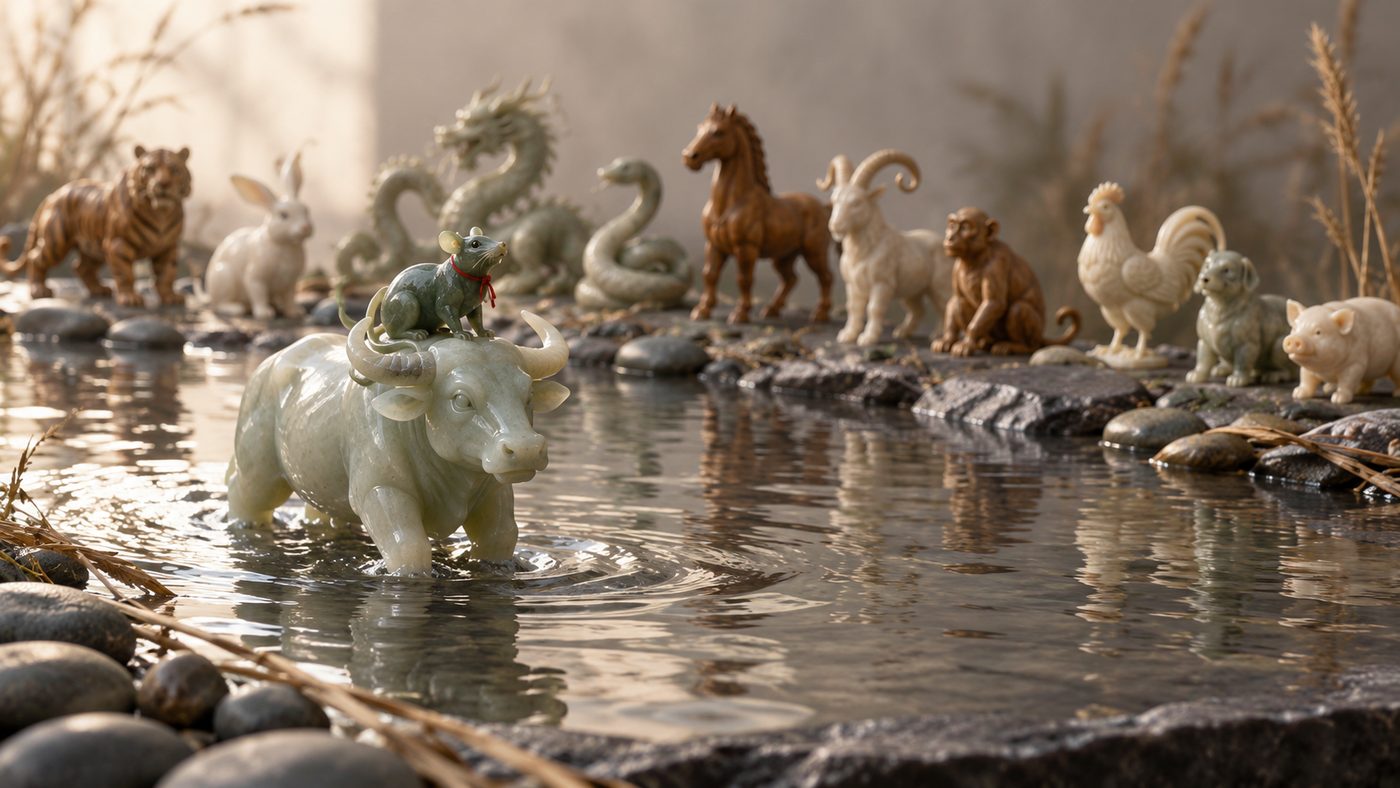
A small carved jade rat rides on the head of a jade ox wading through a shallow river, with the other zodiac animal figurines waiting on the far bank.
The Rat crosses dry. Eleven others wait their turn. Illustration.

The Great Race, told properly

The Jade Emperor, who runs Heaven the way a very senior civil servant runs a ministry, decides that people need a better way to keep track of the years. His solution is a contest. Every animal is invited to his palace, there is a wide, fast river in the way, and the first twelve across will each have a year named after them, in the order they arrive.

The Rat and the Cat are clever and poor swimmers, so they ask the Ox for a ride. The Ox, strong and good-natured and not built for suspicion, agrees. Halfway across the Rat pushes the Cat into the water. As the Ox wades up the far bank, the Rat leaps off its head and reaches the Emperor first. The Ox, who did the swimming, comes second, which tells you most of what the story thinks about effort and reward.

The Tiger is third, soaked and annoyed, having fought the current the whole way. The Rabbit is fourth, having hopped from stone to stone and then grabbed a floating log. The Dragon, who could have flown over everyone, is only fifth: it stopped to make rain for a village in a drought, and on the way it saw the Rabbit's log drifting and blew it ashore. Then comes the Horse, galloping, and coiled around one of its hooves is the Snake, which drops off at the line and takes sixth while the startled Horse rears back into seventh.

The Goat, the Monkey and the Rooster arrive together on a raft the Rooster found, with the Monkey and the Goat hauling the weeds out of its way, and they are seated eighth, ninth and tenth. The Dog, the best swimmer of them all, is eleventh, because it could not resist a bath. And just as the Emperor is about to close the gate there is a grunt from the bushes: the Pig, who stopped to eat, fell asleep, and woke up just in time to be last.

The Cat, depending on who is telling it, drowns, or crawls out too late. Either way it has hated the Rat ever since, which is the story's other job: to explain why cats chase rats.
The finishing order, and what each place really labels

The race is a story about a list, and the list is real. Each place on it is one of the twelve Earthly Branches, the counting signs that name years, months and the twelve two-hour blocks of the day. The animals' finishing order is the branches' order, and the hours are the two-hour blocks each branch names on the traditional Chinese clock.

The twelve Chinese zodiac animals in their Great Race finishing order, how each got its place in the popular telling, and the Earthly Branch and double hour each one labels.
Place Animal How it got there, in the story Branch Its hours
1 Rat Rode across on the Ox, pushed the Cat into the river, and jumped off at the bank zǐ 11 p.m. to 1 a.m.
2 Ox Swam the whole river carrying passengers, then lost first place by one jump chǒu 1 a.m. to 3 a.m.
3 Tiger The strongest animal there, but the current kept pushing it downstream yín 3 a.m. to 5 a.m.
4 Rabbit Hopped from stone to stone, then clung to a floating log mǎo 5 a.m. to 7 a.m.
5 Dragon Stopped to make rain for a village, and blew the Rabbit’s log to shore on the way chén 7 a.m. to 9 a.m.
6 Snake Rode coiled around the Horse’s hoof and slipped out ahead at the finish sì 9 a.m. to 11 a.m.
7 Horse Reared back when the Snake appeared under its feet wǔ 11 a.m. to 1 p.m.
8 Goat Crossed on a shared raft, pulling the weeds out of the way wèi 1 p.m. to 3 p.m.
9 Monkey Same raft, same weeds, landed second of the three shēn 3 p.m. to 5 p.m.
10 Rooster Found the raft in the first place, and landed last of the three yǒu 5 p.m. to 7 p.m.
11 Dog The best swimmer of the lot, but it stopped to play and bathe xū 7 p.m. to 9 p.m.
12 Pig Stopped to eat, fell asleep, and arrived as the gate was closing hài 9 p.m. to 11 p.m.

The reasons are the common English telling; Chinese versions shuffle the excuses but never the order. The hours, with their old names, are on our page on the twelve Chinese double hours.

Why there is no cat

Every version agrees that the Rat is to blame and disagrees about the crime. In the English telling the Rat pushes the Cat off the Ox mid-river. In a version told in China, retold by Guangming Daily, the Cat, afraid of oversleeping, asks the Rat to wake it on the morning of the selection, and the Rat simply does not, so the Cat misses the roll call. Ed Young's picture book Cat and Rat (1995) makes them friends before the betrayal, which is crueler and better storytelling.

The dull answer is probably the true one: there were no house cats in China to include. A Peking University team led by Luo Shujin, reading ancient DNA from feline bones, found that the small cats living around Chinese farms until about AD 220 were wild leopard cats, and that the earliest domestic cat, from the Tongwan City site in Shaanxi, dates to AD 706 to 883, in the Tang dynasty. By then the twelve animals had been settled for well over half a millennium. The cat did not lose the race. It had not yet arrived in the country.

Vietnam, characteristically, fixed the problem itself. Its zodiac has a cat in the fourth seat, where China has the rabbit, and a water buffalo where China has the ox. The usual explanation is the sound of the branch name, mao, close to the Vietnamese word for cat, though as a Vietnamese cultural consultant told NPR, nobody knows when the switch happened, and older Vietnamese texts still have the rabbit.

Other tellings

The host changes. In some versions it is not the Jade Emperor but the Buddha, and there is no race at all: before leaving the world he invites every animal to a farewell banquet, only twelve come, and he names the years for them in the order they arrived. The contest changes too, from a swim across a river to a plain first-come roll call at court. What never changes is the order of the twelve, because the order is the one thing the story was made to explain.

That looseness is itself the clue. A tale with a fixed text and a known author holds its shape; this one has the shape of a story passed from grandparent to child, and the details drift with the teller. The Jade Emperor page makes the same point about the god's other popular jobs.

The record: twelve branches first, animals second

Before there were animals there was counting. The twelve branches, together with the ten Heavenly Stems, were already a complete working system on Shang dynasty oracle bones, more than three thousand years ago, and they were letters in a code, not creatures. Our page on the stems and branches has all twenty-two. The question is when someone hung an animal on each branch, and the answer came out of the ground.

In 1975 archaeologists opened tomb 11 at Shuihudi, in Hubei, the grave of a Qin dynasty man buried in 217 BCE, and found about 1,200 bamboo slips. Among them were two daybooks, almanacs for choosing lucky and unlucky days. One chapter, "Thieves," tells you what the thief looks like from the day the thing went missing. On a zi day, "the rat: the thief has a pointed mouth and sparse whiskers." On a chou day, the ox, and a thief with a big nose. It is a zodiac, built for catching burglars.

It is also not quite ours. A second Qin daybook with its own "Thieves" chapter, from a tomb at Fangmatan in Gansu dated to the end of the Warring States or the Qin, is much closer to the modern list but has its own oddities. Here is the line-up, branch by branch, as the scholars transcribe them, beside the first complete list in a book.

The animal of each Earthly Branch today compared with the Shuihudi Qin daybook (buried 217 BCE), the Fangmatan Qin daybook, and Wang Chong's Lunheng (first century AD).
Branch Today Shuihudi, 217 BCE Fangmatan, Qin Lunheng, 1st c. AD
zi Rat rat rat rat
chou Ox ox ox ox
yin Tiger tiger tiger tiger
mao Rabbit rabbit rabbit rabbit
chen Dragon no animal named “creature” (read by some as a miscopied dragon) dragon, in a different chapter
si Snake serpent chicken snake
wu Horse deer horse horse
wei Goat horse goat goat
shen Monkey huan (read by some as ape) disputed: monkey or stone monkey
you Rooster “water” (read as pheasant) chicken chicken
xu Dog old ram dog dog
hai Pig pig pig pig

Read down the Shuihudi column and the race's finishing order starts to wobble. There is a deer where the horse should be, the horse is one seat late in the goat's place, an old ram sits where the dog now sits, and the dragon's seat has a thief described but no animal named. The pheasant and the ape are scholars' readings of words that, on the slip, say "water" and something like "ring." Fangmatan has a chicken in the snake's seat as well as in the rooster's, and its monkey is disputed: a Fudan University reading group reads the word as "stone." Han dynasty slips from Kongjiapo, in Hubei, still had "water," "jade stone" and "old fire" in some seats. The Rat, the Ox, the Tiger, the Rabbit and the Pig are the only animals who hold their places on all three lists.

The first complete set survives because a skeptic wanted to argue with it. Wang Chong, writing his Lunheng in the first century AD, quotes the theory that the animals fight because their branches' elements fight, names eleven of the pairs between the theory and his reply, and then demolishes the idea: if water beats fire, "why does the rat not chase the horse?" The twelfth, the dragon, turns up in a later chapter on poisons, in one line: chen is the dragon, si is the snake. From then on the list is ours. It has not changed in nineteen hundred years.

So when does the race appear?

Here is where we have to be honest, because most retellings call the race "ancient" and none of them gives a date. We looked for one. The best evidence turned out to be the scholars who tried to explain the order and did not mention a race at all.

Around 1400, early in the Ming, a Hangzhou fortune-teller and bookworm named Wang Kui explained each seat by yin and yang: the rat goes with zi, the darkest point of the night, because it hides; the horse with wu, high noon, because it runs. A century and a half later the scholar Lang Ying went further and counted toes. Branches alternate yang and yin, he noted, and so do the animals' feet: five claws for the tiger, the dragon, the monkey and the dog, cloven hooves for the ox, the goat and the pig, a forked tongue for the snake. The rat is the clever one. It has four toes in front and five behind, even and odd, so it straddles yin and yang exactly as the zi hour straddles last night and this morning. That is why it is first.

Lang Ying also tells us what ordinary people said about the animals in his day, and it is not a race. "People say they took the incomplete ones," he writes, meaning every zodiac animal was chosen for lacking something, and he dismisses the idea; Wang Kui had dismissed it too. Two learned men, both collecting popular explanations of the order, both arguing with them, and neither mentions a river.

After that the trail goes cold. We found no datable text of the race before the twentieth century, and Wikipedia's own article on the zodiac carries a flag saying the origin of the folktale is missing. The race is told everywhere now, and English readers mostly meet it in picture books like Ed Young's. It may well be older in the mouths of grandparents than on paper; folktales usually are. But on the present evidence the cycle is at least twenty-two centuries old, and the story that explains it, as far as anything written shows, is closer to a hundred. That is the finding, and it is a better story than "ancient legend": the zodiac was so old that people had to make up a reason for it.

Questions people ask

What is the Great Race in the Chinese zodiac? +

It is the folktale that explains the order of the twelve zodiac animals. The Jade Emperor, the ruler of Heaven in Chinese folk religion, calls the animals to a race across a river and names the years after the first twelve to arrive, in the order they finish. The Rat wins by riding on the Ox and jumping off at the end, the Pig comes last after stopping to eat and nap, and the Cat never makes it at all.

Who won the Great Race? +

The Rat. It cannot swim well, so it gets a ride across the river on the Ox, and as the Ox reaches the bank the Rat jumps off its head and reaches the Jade Emperor first. That is why the Rat leads the cycle and the Ox, which did all the work, comes second.

Why is the rat first in the Chinese zodiac? +

In the story, because it cheated. In the record, because its branch, zi, is the first of the twelve, and the animals were attached to an order that already existed. The rat holds that seat on the oldest list we have, bamboo slips buried in 217 BCE. A sixteenth-century scholar, Lang Ying, offered a neater reason: the rat has four toes on its front feet and five on its back, an even and an odd number, so it stands across yin and yang the way the zi hour, eleven at night to one in the morning, stands across two days.

Why is there no cat in the Chinese zodiac? +

The story says the Rat tricked the Cat: it promised to wake the Cat for the race and did not, or pushed it off the Ox into the river, which is why cats have hunted rats ever since. The likelier reason is that China had no house cats when the list was made. A Peking University DNA study published in 2025 found that the cats living around Chinese villages until about AD 220 were wild leopard cats, and the earliest house cat dates from the Tang dynasty, centuries after the twelve animals were fixed.

Is the Great Race a real Chinese legend? +

It is a real folktale, told widely in China and across the diaspora, and nobody invented it for a picture book. But it is a late one. The twelve animals are on bamboo slips from the third century BCE, yet the Ming scholars who explained their order four to six hundred years ago reasoned from yin and yang and toe counts and never mention a race. We could not find a datable text of the race before the twentieth century.

What order did the animals finish the Great Race in? +

Rat, Ox, Tiger, Rabbit, Dragon, Snake, Horse, Goat, Monkey, Rooster, Dog, Pig: the same order as the zodiac, which is the point of the story. The common telling gives each place a reason, from the Dragon stopping to make rain to the Goat, Monkey and Rooster sharing a raft.

Why did the pig come last in the Great Race? +

It got hungry halfway, stopped to eat, and fell asleep. It woke up and finished just before the Jade Emperor closed the race. In the calendar the Pig closes the cycle because its branch, hai, is the twelfth, the hour from nine to eleven at night when the household goes to bed.

Why does Vietnam have a cat instead of a rabbit? +

The Vietnamese zodiac puts the cat in the fourth place, the branch the Chinese calendar gives to the rabbit. The usual explanation is the sound of the branch name, mao, which is close to the Vietnamese word for cat, though nobody knows when the switch happened and older Vietnamese texts still have the rabbit. Vietnam also has a water buffalo where China has the ox.

Sources and further reading

More of the zodiac

  • Chinese zodiac All twelve signs, a sign finder with the New Year cutoff, and every year since 1936.
  • Year of the Rat The race's winner, and the one animal every list agrees on.
  • Year of the Ox Second place and the best reputation in the story.
  • The Jade Emperor The race's host, and Heaven's chief of paperwork.
  • Li Chun When the zodiac year actually starts, and why there are two answers.

Stay in the loop.

Chinese mythology, the zodiac, and the meaning behind names and symbols, rooted in the classics and read back to you. No spam. Unsubscribe anytime.