Chinese Zodiac, Compatibility
Tiger and Rooster Compatibility: The Blade and the Green Wood
No formal bond, and their fixed elements rub: Metal controls Wood in the five-element cycle.
Tiger and Rooster sit at seats three and ten with nothing formal between them, no trine, no secret friend, no clash, no harm, and no shared punishment set. The branch tables have no opinion. The five elements do: the Rooster is Metal and the Tiger is Wood, and Metal controls Wood, which is why tradition grades this one workable and calls it a match that takes work. The image behind that line is not a weapon. It is a blade on green wood, which is either pruning or damage depending entirely on where you cut and when, and the whole of this pairing is contained in that distinction.

How the wheel reads this pair
Chinese zodiac verdicts are positions, not vibes. The Tiger holds position 3 on the twelve-branch wheel (branch yín) and the Rooster position 10 (branch yǒu); their verdict follows from that geometry alone. The order of the names changes nothing: Rooster and Tiger compatibility is this same reading and the same verdict, because it comes from the two positions, not from who is named first.
- Verdict
- Takes work
- Bond
- No formal bond
- Branches
- yín 寅 + yǒu酉
- Fixed elements
- Wood + Metal
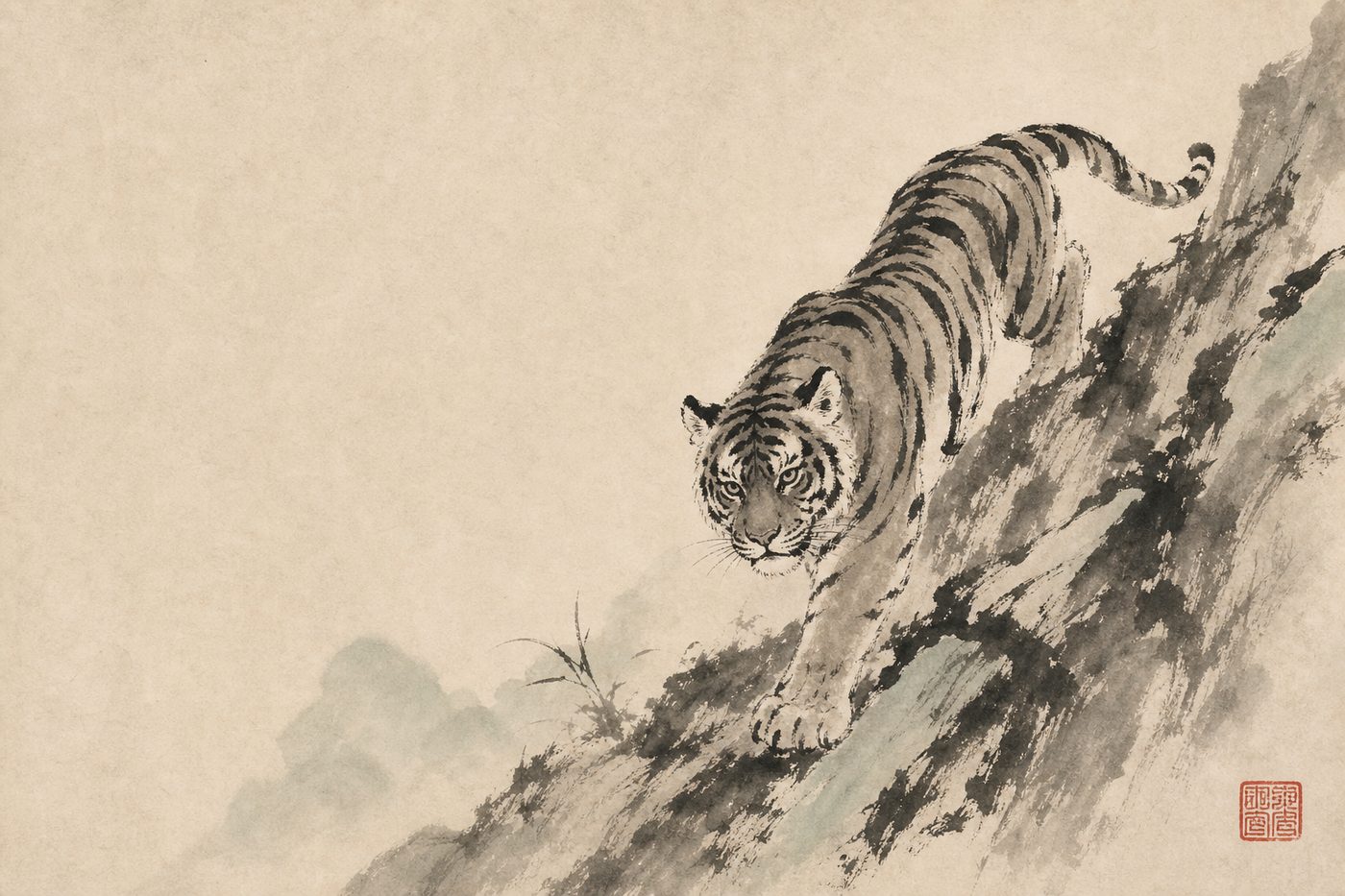
The Tiger and the Rooster, side by side
The Tiger and the Rooster in 2026 and 2027
A pairing is a fixed position; a year is a moving one. Here is where each of the two signs stands against the year's branch, read off the tables and nothing more. Unsure of a sign? The zodiac calculator reads a birth date with the New Year cutoff done properly.
2026 · the Fire Horse year
Tiger: Same trine (san he). The Horse sits four places from the Tiger on the wheel, which puts both in the Fire trine, san he. A trine is the strongest supportive relation the tables record, stronger than the six harmonies, and it is the closest the tradition comes to naming a good year for a sign.
Rooster: No named relation. No named relation holds between the Horse's branch and the Rooster's. That is the ordinary state of the tables for most of the wheel in most years, and the tradition treats it as unremarkable rather than as bad news: nothing flagged, nothing promised.
2027 · the Fire Goat year
Tiger: No named relation. No named relation holds between the Goat's branch and the Tiger's. That is the ordinary state of the tables for most of the wheel in most years, and the tradition treats it as unremarkable rather than as bad news: nothing flagged, nothing promised.
Rooster: No named relation. No named relation holds between the Goat's branch and the Rooster's. That is the ordinary state of the tables for most of the wheel in most years, and the tradition treats it as unremarkable rather than as bad news: nothing flagged, nothing promised.
With no formal bond the reading falls back to the fixed elements, which is a softer claim than a named relation. Does he like me takes two birthdays instead of two signs, works out both animals across the New Year boundary, and names the relation between them.
Love and romance
What the Tiger notices first is that somebody has finally arrived who is not impressed. The Tiger spends most of its life being reacted to, admired, resisted, managed around, and the Rooster does none of that. It looks at the Tiger the way it looks at everything, closely and with a slight air of taking inventory, and it says what it finds. For a sign that has never in its life been given an accurate account of itself, that is intoxicating for about a year.
What the Rooster notices is that the Tiger acts on what it says. Roosters are used to being right and ignored. They see the flaw early, name it precisely, watch it happen anyway, and then have to be gracious about it, which is not their strongest event. A Tiger hears the objection, decides it is correct, and changes course inside a minute without any of the wounded processing most signs require first. To a Rooster that is close to being loved.
The turn comes when the accuracy stops being about the plan and starts being about the person. The Rooster does not experience the shift, because to a Rooster a fact is a fact and the subject of the sentence is a detail. The Tiger experiences it as the day the person who admired it began itemizing it instead.
Trust
Neither of these two lies, and that is worth stating because it removes the usual failure mode and leaves a stranger one. The Tiger cannot dissemble; whatever is happening in it is on the outside within seconds. The Rooster will not dissemble; it has a standard about it, and a slightly proud one. So there is no suspicion here in the ordinary sense, and both of them find the relationship restfully free of the guesswork they do everywhere else.
What has to be earned instead is the belief that the criticism is on your side. The Tiger's working assumption about correction is that it is an attack, because in the Tiger's experience it usually has been. The Rooster's working assumption is that correction is a gift and that withholding it would be the real disloyalty. Until they have this conversation explicitly, and most couples never do, every accurate observation the Rooster makes lands in the Tiger as a small deposit of evidence that it is being audited by somebody who is keeping score.
Communication
Metal and Wood in daily conversation, which is a difference in what each one thinks a sentence is for.
| The Tiger | The Rooster | |
|---|---|---|
| A statement | A commitment | An assessment |
| Being wrong | Move on fast | Establish exactly how |
| Under stress | Louder and sooner | Sharper and more precise |
| Praise | Given freely, meant broadly | Given rarely, meant literally |
Row one is the root of nearly every fight this pair has. When a Tiger says a thing it has decided the thing, and the sentence is a small public bond. When a Rooster says a thing it is offering the current reading, subject to revision, and it will revise it in front of you without embarrassment because that is what evidence is for. So the Tiger keeps hearing promises where none were made, and the Rooster keeps being accused of changing its story when it was never telling one.
Row four costs more than it looks. A Tiger praises expansively and means it as weather rather than measurement. A Rooster hears an inflated claim and quietly discounts everything the Tiger says by the same margin. Meanwhile the Rooster's own rare compliments are exact and load-bearing, and the Tiger, calibrated to its own generous scale, does not register them as praise at all. Both of them end up feeling under-appreciated by somebody who was appreciating them the whole time in the wrong currency.
Marriage and family
This works, and the households where it works all look the same: the Rooster owns the systems and the Tiger owns the direction, and neither one is allowed to grade the other's department.
The Rooster genuinely wants the money, the calendar, the maintenance and the standards, and it will run all four better than the Tiger ever could, and it does not experience this as drudgery but as the pleasure of a well-kept machine. The Tiger genuinely wants to decide what the family is for, where it goes, what it risks, and it will not be talked out of that by a spreadsheet. Those are compatible appetites. The couples who fail are the ones where the Rooster starts auditing the vision and the Tiger starts overruling the system, and both of those intrusions come from the same anxiety, which is that the other person is not being careful with something that matters.
One rule holds the whole thing up. The Rooster gets to name the cost of any decision, in full, once, before it is made. The Tiger gets to make it anyway. Both halves are load-bearing. A Rooster silenced in advance becomes an accountant of grievances; a Rooster granted a veto turns a Tiger into somebody who stops mentioning what it wants.
Work and money
Professionally these two are considerably better than the grade suggests, and it is the one arena where Metal on Wood is straightforwardly an advantage. A Tiger's raw output is fast, ambitious and structurally unsound in about a third of its particulars, and it does not know which third. A Rooster does. Put a Rooster on a Tiger's work and the failure rate falls off a cliff, and the Tiger, who is not vain about the work itself, will usually be delighted.
The order matters enormously, and here the elemental picture is worth taking literally. Pruning happens after growth, not during it. A Rooster brought in while the Tiger is still generating will cut the thing back to nothing, because at that stage everything is unfinished and a Rooster cannot help seeing unfinished as wrong. The same Rooster brought in when there is something to shape will make it twice as good in an afternoon. Teams that get value out of this pair separate the two phases explicitly and defend the boundary, because both signs will violate it on instinct.
The other structural move is to give the Rooster something of its own to be excellent at, not merely a role improving the Tiger's output. Roosters who spend years as quality control on somebody else's ideas become bitter in a very specific way, precise and unanswerable and directed at the person rather than the work, and by the time it surfaces it has been accruing for a long time.
Where it breaks
It breaks by accumulation of accuracy. There is rarely a betrayal and almost never a scene. What happens is that the Rooster is right several hundred times, says so each time, and is right to say so each time, and the Tiger arrives at a settled understanding that it is living with somebody who is compiling a case. Nothing in that understanding is fair, and nothing in it is entirely wrong either.
The Tiger's exit is abrupt and looks unprovoked from outside. It does not withdraw by degrees; it stays fully present right up until it decides, and then it goes, and the decision is not appealable because Tigers do not relitigate. The Rooster is left holding a detailed and completely accurate record of a relationship it did not understand was ending, and its first instinct, which it should resist, is to demonstrate with evidence that the Tiger's account is inaccurate in several particulars.
What is worth knowing is that none of this is written into the branches. The Rooster's genuinely difficult Wood sign is the Rabbit, which is its direct clash. The Tiger it has no formal quarrel with at all. Whatever goes wrong between these two is built rather than inherited, which also means it can be unbuilt.
How to fix it
- 1
Separate the phases. The Rooster does not touch the Tiger's work while it is still being generated, and the Tiger does not defend it once it is done. Pruning after growth, never during.
- 2
The Rooster names the full cost once, before the decision. The Tiger makes the decision anyway. Neither half works without the other.
- 3
Agree out loud that correction is not an attack. It sounds like a therapy exercise and it is the single highest-yield conversation available to this pair, because both of them are operating on an unstated assumption the other has never heard.
- 4
Fix the praise exchange rate. The Tiger deliberately understates once a week so it can be believed, and the Rooster says the good thing out loud even when it feels redundant.
- 5
Give the Rooster its own territory to be excellent in. A Rooster whose entire contribution is improving somebody else's work turns precise and personal about it, and by then it has been building for years.
The two of you, not the two signs
The year animals are one character out of the eight in each of your charts, and with no bond between them, the other seven carry the answer. The compatibility reading sets your two whole charts side by side: what each of you brings the other, where you will rub, and the years your timing lines up.
Share this pairing
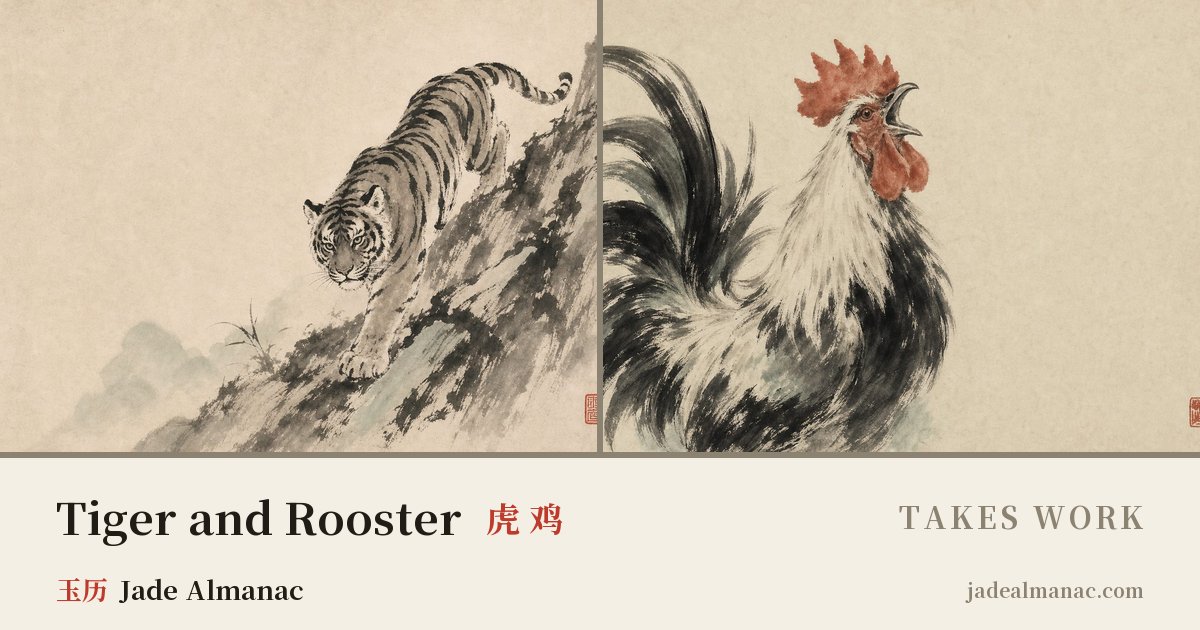
The card carries both portraits and the verdict.
Questions people ask
Are Tiger and Rooster compatible in the Chinese zodiac?
Workable, and graded as a match that takes work. The twelve branches place no formal relationship between them at all, no trine, no secret friend, no clash and no harm, so the reading falls entirely to the fixed elements, where the Rooster's Metal controls the Tiger's Wood. That is real pressure rather than open conflict, and the traditional verdict is conditional. This pairing does well when the Rooster is given the systems and the Tiger is given the direction, and badly when either one starts grading the other's department.
Why do Tiger and Rooster have no formal bond?
Position on the wheel. The Tiger holds seat three and the Rooster seat ten, and none of the classical groupings falls that way. The Tiger's trine is Horse and Dog, its secret friend is the Pig, its clash is the Monkey and its harm is the Snake. The Rooster's trine is Ox and Snake, its secret friend is the Dragon, its clash is the Rabbit and its harm is the Dog. Neither one appears anywhere in the other's list, which is why everything on this page comes from the elements instead.
Does the Rooster crow at the Tiger's hour?
It does, and the branch system is oddly candid about it. Each of the twelve branches owns a double-hour. The Tiger's branch, yin, is the watch called ping dan, from three to five in the morning, the dark just before first light, and the old explanation for giving it to the Tiger is that this is when tigers are abroad and most dangerous. The Rooster's branch, you, is ri ru, sunset, from five to seven in the evening, and the Rooster was assigned to it not for crowing but because that is the hour poultry go in to roost. So the two of them hold the two hinges of the day, dawn and dusk, and the noise the Rooster is famous for happens in the Tiger's watch rather than its own.
Is Metal controlling Wood a bad sign for a relationship?
It is a pressure, not a verdict, and this pair is the proof. The Rooster meets both of the wheel's Wood signs and its difficult one is the other. The Rabbit is the Rooster's direct clash, the strongest negative relation the system has, while the Tiger has no formal tie to it whatsoever. Metal over Wood is the same elemental relation in both cases and it produces a clash in one and nothing in the other, which is the clearest available evidence that the fixed elements describe the weather rather than the outcome.
The verdict above rests on two birth years
Tiger and Rooster are year branches, one character apiece. A full reading gives each of you four pillars: year, month, day, hour. The day pillar, not the year, is the one the tradition reads as the person. Cast both charts and the pairing is argued on eight characters a side instead of one.
Year of the Tiger 虎
Personality, years, matches, and where the sign comes from.
Year of the Rooster 鸡
Personality, years, matches, and where the sign comes from.
Chinese zodiac compatibility: all 66 pairings, with verdicts
Signs turn over at Chinese New Year, not January 1, a January or February birthday can belong to the previous animal. Check a birthday on the lunar calendar
Sources & further reading
- Chinese zodiac (the compatibility system and its layers), Wikipedia
- Earthly Branches (the twelve-branch cycle, seat order, the double-hours each branch owns, and the fixed element of each branch), Wikipedia
- Wu Xing (the five elements, and the controlling cycle in which Metal overcomes Wood)
- Chinese units of measurement (the twelve double-hours of the traditional day, with yin at three to five in the morning and you at five to seven in the evening)
By Julian 祝君瑜, verdict derived from the twelve-branch system, not assigned by hand, updated 2026-09-16