Chinese Zodiac, Compatibility
Monkey and Dog Compatibility: The Loophole and the Line
No formal bond, but their fixed elements cooperate: Earth feeds Metal in the generating cycle.
Monkey and Dog sit at seats nine and eleven, two apart, and the branch tables draw nothing between them at all. No trine, no secret friend, no clash, no harm, no shared punishment set. The verdict falls to the fixed elements, where the Dog's Earth generates the Monkey's Metal, and tradition grades a generating pair good. Underneath that ordinary line sits a fact about the Dog that nothing else on its row reveals. The Dog is the only sign on the wheel that carries a clash, a harm, or a punishment against every single one of its own element-mates: it clashes with the Dragon and shares a punishment set with both the Ox and the Goat. The sign built to hold a line is formally at odds with all of its own kin. And because the wheel's other Metal sign is the Rooster, which is the Dog's harm, the Monkey is the one partner the Dog's element simply feeds, with nothing marked against it. The most rule-bound sign on the wheel gives freely, once, to the one sign that treats every rule as a proposal.
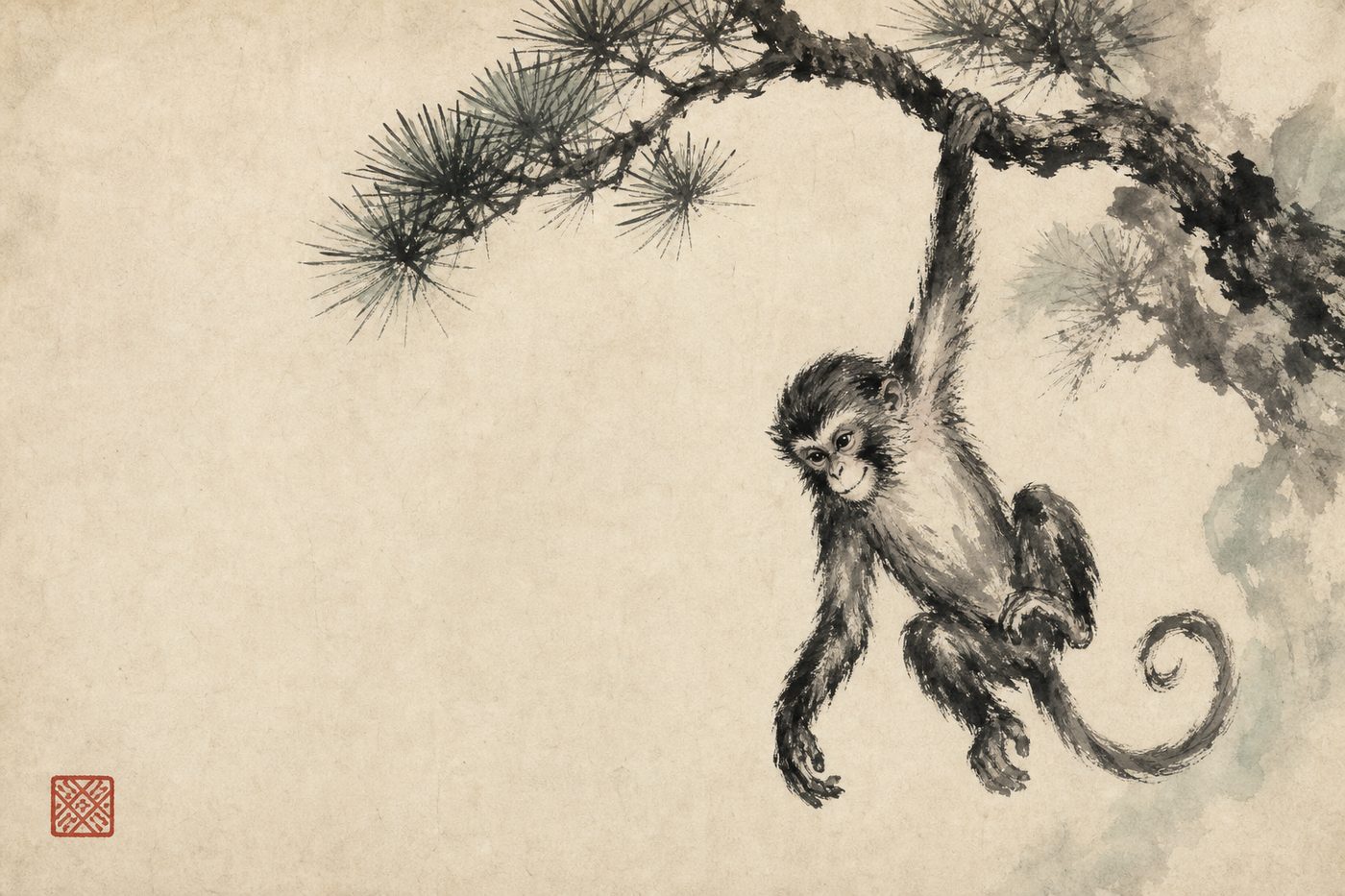
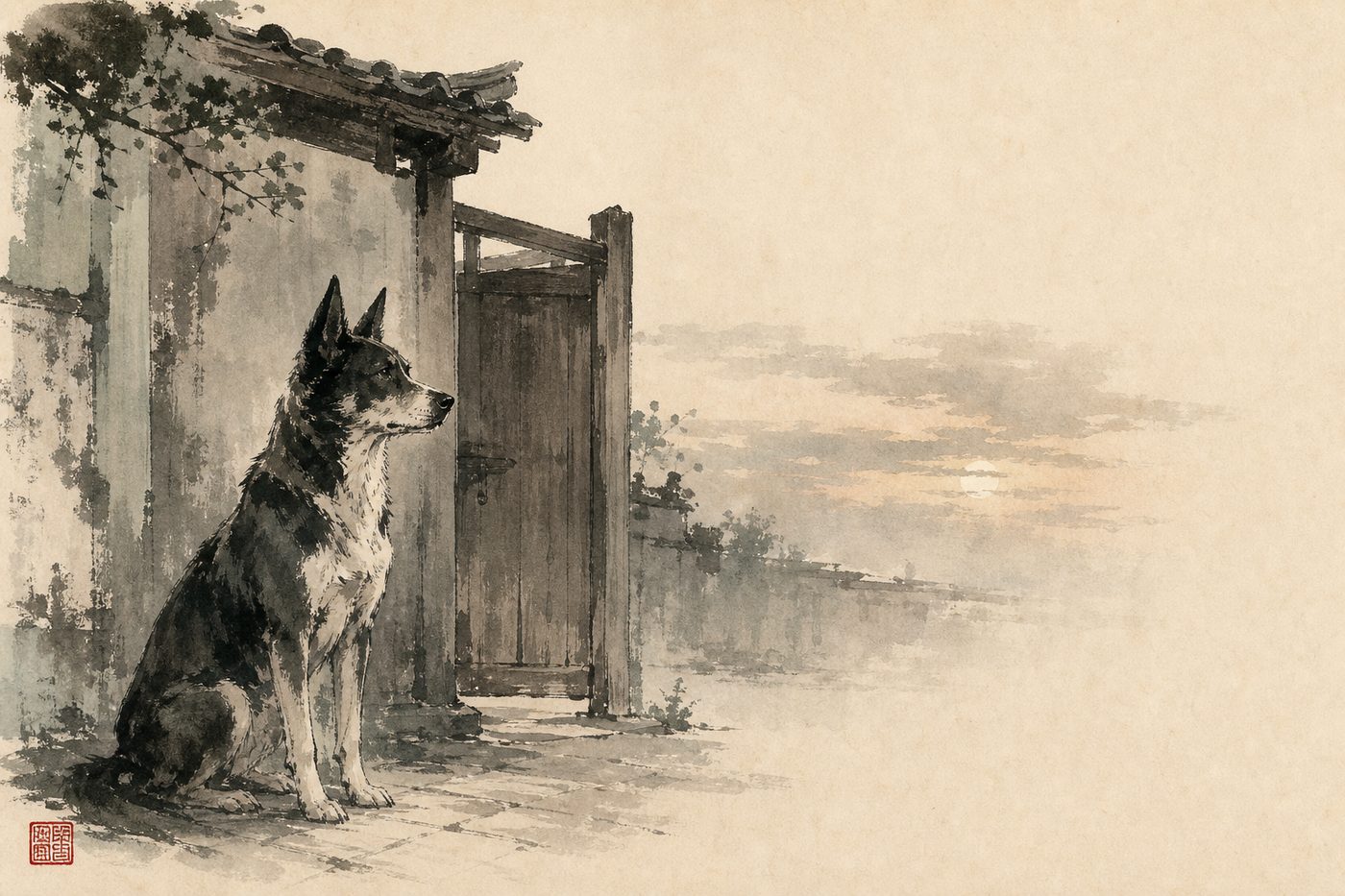
How the wheel reads this pair
Chinese zodiac verdicts are positions, not vibes. The Monkey holds position 9 on the twelve-branch wheel (branch shēn) and the Dog position 11 (branch xū); their verdict follows from that geometry alone. The order of the names changes nothing: Dog and Monkey compatibility is this same reading and the same verdict, because it comes from the two positions, not from who is named first.
- Verdict
- Good match
- Bond
- No formal bond
- Branches
- shēn 申 + xū戌
- Fixed elements
- Metal + Earth
The Monkey and the Dog, side by side
The Monkey and the Dog in 2026 and 2027
A pairing is a fixed position; a year is a moving one. Here is where each of the two signs stands against the year's branch, read off the tables and nothing more. Unsure of a sign? The zodiac calculator reads a birth date with the New Year cutoff done properly.
2026 · the Fire Horse year
Monkey: No named relation. No named relation holds between the Horse's branch and the Monkey's. That is the ordinary state of the tables for most of the wheel in most years, and the tradition treats it as unremarkable rather than as bad news: nothing flagged, nothing promised.
Dog: Same trine (san he). The Horse sits four places from the Dog on the wheel, which puts both in the Fire trine, san he. A trine is the strongest supportive relation the tables record, stronger than the six harmonies, and it is the closest the tradition comes to naming a good year for a sign.
2027 · the Fire Goat year
Monkey: No named relation. No named relation holds between the Goat's branch and the Monkey's. That is the ordinary state of the tables for most of the wheel in most years, and the tradition treats it as unremarkable rather than as bad news: nothing flagged, nothing promised.
Dog: Punishment group (xing). No clash holds between the Goat and the Dog, but the two branches share a punishment set, xing, in the old tables. The tables flag it without calling it a verdict, and practitioners treat it as a caution about disputes rather than as a bad year.
With no formal bond the reading falls back to the fixed elements, which is a softer claim than a named relation. Does he like me takes two birthdays instead of two signs, works out both animals across the New Year boundary, and names the relation between them.
Love and romance
The Dog falls for the Monkey against its own better judgment, and knows it at the time. What gets through is not charm, which Dogs are unusually resistant to, having spent their lives noticing the gap between how a person talks and what a person does. It is that the Monkey is the first company in years that does not make the Dog feel like the room's designated adult. Dogs get handed that job everywhere. They are the one who reads the contract, remembers the promise, notices the thing nobody wants noticed, and they are tired in a way they never mention. A Monkey does not need supervising in the ways that exhaust a Dog. It needs supervising in entirely new ones, and novelty, to a sleepless sign, reads almost like rest.
The Monkey's side is stranger and takes longer to admit. Monkeys are used to being enjoyed. They perform, the room laughs, and the transaction closes. The Dog laughs too, and then asks a question about the thing, usually whether it was fair to somebody who was not in the room. It is not a rebuke and the Monkey can tell it is not. It is the first evidence the Monkey has had in a long time that somebody is taking the content seriously rather than the delivery, and a sign that has been applauded since childhood finds being genuinely considered almost embarrassingly moving.
Trust
These two do not fail on honesty, which surprises people who expect the Monkey to be the wheel's liar. The Monkey is not a liar. The Monkey is a literalist, and that is a different and much more survivable problem, though it takes a Dog about three years to work out the difference.
Ask a Monkey whether it did the thing it agreed to do and the answer will be true. It will also be answering the question that was asked rather than the question that was meant, because to a Monkey the words of an agreement are the agreement, and a route through them that nobody thought to close is not cheating, it is reading. Dogs hold the opposite view with their whole body. To a Dog a promise is a direction of travel and the words are just the shortest way to write it down, so a technically perfect answer that misses the point registers not as cleverness but as the first move of somebody who has decided to be managed rather than trusted.
The repair is unglamorous and it works. The Monkey has to volunteer the shortcut before the Dog finds it. Not confess it, which implies wrongdoing neither of them believes in, but mention it in passing at the time, as a piece of news. A Dog told about a workaround by the person using it files it under resourcefulness. The same Dog discovering that workaround on its own, three weeks later, files it somewhere it does not come back from.
Communication
Both of these signs talk easily, which fools everybody, including them. The trouble is that they are running two different definitions of what a conversation is for.
| The Monkey | The Dog | |
|---|---|---|
| A rule | An interesting shape to be tested | A load-bearing wall |
| A promise | The words that were said | The direction that was meant |
| Being caught out | Delighted, then explains the reasoning | Assumes the explaining is the problem |
| A silence | Space to fill with a better idea | Something being weighed |
Row four is the quiet killer and neither of them can see it happening. When a Dog goes quiet it is running an assessment, and the assessment is nearly always about conduct rather than the topic. When a Monkey meets a silence it fills it, because to a Monkey an unfilled pause is a puzzle with an obvious solution, and what it fills it with is usually a better version of the proposal. So the Dog is halfway through deciding whether something was fair when a new and more attractive plan arrives on top of the old one, which the Dog reads as the subject being changed on purpose. It almost never is. The mechanical fix is a phrase rather than a virtue. The Dog says the words hold on, I am still on the last one, and the Monkey stops. Monkeys are perfectly good at stopping. They simply need to be told the pause was occupied.
Marriage and family
This household works on a division that sounds lopsided and is not: the Dog owns the standard, the Monkey owns the method.
In practice the Dog decides the short list of things this house will not do. Not the budget, not the schedule, not the plan, just the floor, which in a Dog's hands is usually four or five items long and does not change in twenty years. Everything above that floor belongs to the Monkey, and the Monkey is extraordinary there. Household problems that other couples solve by working harder, a Monkey solves by noticing that the problem is optional. This is the rare pairing where the more inventive partner is genuinely happier for having a fixed edge to work against, because a Monkey with no constraint at all does not produce more ideas, it produces fewer, having lost the friction that makes inventing feel like anything.
It fails when the Monkey treats the floor as an opening position. Everything in a Monkey's experience says that a stated limit is the beginning of a negotiation, because for most of the wheel it is. For a Dog it is not a position at all. It is the part of itself it would still be if everything else were taken away, and a partner who tests it is not haggling, it is auditing whether the Dog meant what it said. The Dog will answer that audit once, patiently, and privately record the result.
Work and money
As colleagues these two are worth more than the sum of them, and the reason is timing rather than talent.
The Monkey finds the route. It is the person who reads the requirements, sees the assumption nobody questioned, and comes back with a way to do the job in a fifth of the time by not doing most of it. The Dog is the only person in the building who will say out loud that the route is not allowed, and will say it in the meeting rather than in the corridor afterwards. That combination is close to unbeatable because the expensive mistakes get caught while they are still free. Every organization has Monkeys. Very few have somebody who will object early, on the record, without enjoying it.
The failure mode is drift into roles. If the Dog objects often enough it stops being a colleague and becomes the compliance function, which it does not want and is not suited to, since a Dog's judgment is about conduct and not about procedure. And a Monkey that has been objected to enough times stops bringing half-formed ideas and starts bringing finished ones, which sounds like an improvement and is a disaster, because the whole value of the pairing was catching things early. The control is a standing agreement that the Monkey brings the route at the sketch stage, when changing it costs nothing, and the Dog spends its objection there rather than saving it for the version that already has a date on it.
Where it breaks
There is no scene. That is the thing to know about this failure, because both of these signs would tell you they are the type who says what they think.
What happens is that the Dog reclassifies. Not from partner to enemy, which would at least be visible, but from partner to person who needs to be checked, and the reclassification happens in one afternoon and is never announced. Afterwards the Dog is warm, present and entirely unchanged in behavior except that it now verifies things. Quietly, without comment, as a matter of routine. The Monkey does not notice for a year and then notices all at once, usually because it realizes it is being told about decisions rather than asked, and the discovery is genuinely bewildering, since nothing was ever wrong and nobody ever complained.
What prevents it has to come from the Monkey, because the Dog will not raise it. Dogs do not renegotiate a verdict they have reached about somebody's character; they simply live with it. The habit is to hand the Dog the audit before it asks for one. Once a month, unprompted, the Monkey names the corner it cut and why, in one sentence, with no case for the defense attached. A Dog given that information voluntarily does not use it against anybody. It uses it to stop checking.
How to fix it
- 1
Volunteer the shortcut at the time. Mention the workaround as news, in passing, before the Dog finds it, because a Dog told is a Dog reassured and a Dog who discovers it is a Dog who has started verifying.
- 2
Answer the question that was meant. A technically true answer to the literal words is the one move that costs the Monkey more credit than an ordinary mistake ever would.
- 3
Say hold on, I am still on the last one. The Dog's silences are occupied, and a better idea landing on top of an unfinished assessment reads as the subject being changed on purpose.
- 4
Treat the floor as the floor. The Dog's four or five non-negotiables are not an opening position, and testing them is not haggling, it is asking whether the Dog meant it.
- 5
Spend the objection at the sketch stage. The Monkey brings the route while changing it is still free, and the Dog uses its one objection there instead of on the version that already has a date.
The two of you, not the two signs
The year animals are one character out of the eight in each of your charts, and with no bond between them, the other seven carry the answer. The compatibility reading sets your two whole charts side by side: what each of you brings the other, where you will rub, and the years your timing lines up.
Share this pairing
The card carries both portraits and the verdict.
Questions people ask
Are Monkey and Dog compatible in the Chinese zodiac?
Good, and for a specific reason. The branch tables mark nothing between them, so the reading falls to the fixed elements, where the Dog's Earth generates the Monkey's Metal, and tradition grades a generating pair good. The direction is worth knowing. The Dog is the partner supplying and the Monkey the partner gaining, which suits both, since the Dog is happiest when its steadiness is being used for something and the Monkey works best with a fixed edge to push against.
Why is there no formal bond between Monkey and Dog?
Seat position. The Monkey holds seat nine and the Dog seat eleven, two apart on a twelve-seat wheel, which is neither the four-apart spacing that makes a trine nor the six-apart opposition that makes a clash. They appear in none of the six harmony or six harm listings, and although each sits in a punishment set, they sit in different ones, the Monkey with the Tiger and the Snake and the Dog with the Ox and the Goat. With nothing marked, the verdict passes down to the five elements.
What elements are Monkey and Dog?
The Monkey's branch carries fixed Metal and the Dog's carries fixed Earth, and Earth generates Metal in the five-element cycle. There is a sharper fact behind it. The wheel's other Metal sign is the Rooster, which is the Dog's harm, so the Monkey is the only sign the Dog's element feeds with nothing marked against it. On a row otherwise built from guarding and clashing, this is the Dog's one outward flow.
Why is the Dog at odds with the other Earth signs?
Because of how the marks happen to fall, and the Dog is unique in this. Its three Earth relatives are the Dragon, the Ox and the Goat. The Dragon is its clash, and the Ox and the Goat both share its punishment set. Run the same check on the other three Earth signs and each has at least one clean relation inside the element. The Dog has none, which is why a pairing that reads as unremarkable from the Monkey's side is, from the Dog's, the most straightforward relationship on its row.
What problems do Monkey and Dog couples have?
One, mostly, and it has two faces. The Monkey treats the words of an agreement as the agreement, and the Dog treats them as shorthand for a direction of travel, so a technically perfect answer that misses the point lands as evasion rather than wit. The Dog's response is not a fight. It quietly reclassifies the Monkey as somebody to be checked and never mentions it. The repair is the Monkey volunteering the corner it cut before anybody asks.
The verdict above rests on two birth years
Monkey and Dog are year branches, one character apiece. A full reading gives each of you four pillars: year, month, day, hour. The day pillar, not the year, is the one the tradition reads as the person. Cast both charts and the pairing is argued on eight characters a side instead of one.
Year of the Monkey 猴
Personality, years, matches, and where the sign comes from.
Year of the Dog 狗
Personality, years, matches, and where the sign comes from.
Chinese zodiac compatibility: all 66 pairings, with verdicts
Signs turn over at Chinese New Year, not January 1, a January or February birthday can belong to the previous animal. Check a birthday on the lunar calendar
Sources & further reading
- Chinese zodiac (the compatibility system and the layers it is read in), Wikipedia
- Earthly Branches (the twelve-branch cycle, seat order, the fixed element of each branch, and the punishment groups), Wikipedia
- Wu Xing (the five elements, and the generating cycle in which Earth produces Metal), Wikipedia
By Julian 祝君瑜, verdict derived from the twelve-branch system, not assigned by hand, updated 2026-09-16