Chinese Symbol
Chinese Symbol for Joy: Meaning, the Four Joys, and How to Write It
The Chinese symbol for joy is 喜 (xǐ, sounds like "she"), and it is built out of noise: a drum on its stand with a mouth singing beside it. Where the character for happiness covers the feeling of being glad, 喜 is joy with a date attached, the character Chinese pins to occasions: weddings, births, good news, exam results. Double it and you get the wedding emblem 囍. This page is about the single, hardworking original.
- Strokes
- 12
- Radical
- 口 (mouth)
- Formation
- Compound ideograph (会意)
Trace 喜 yourself, or watch it drawn
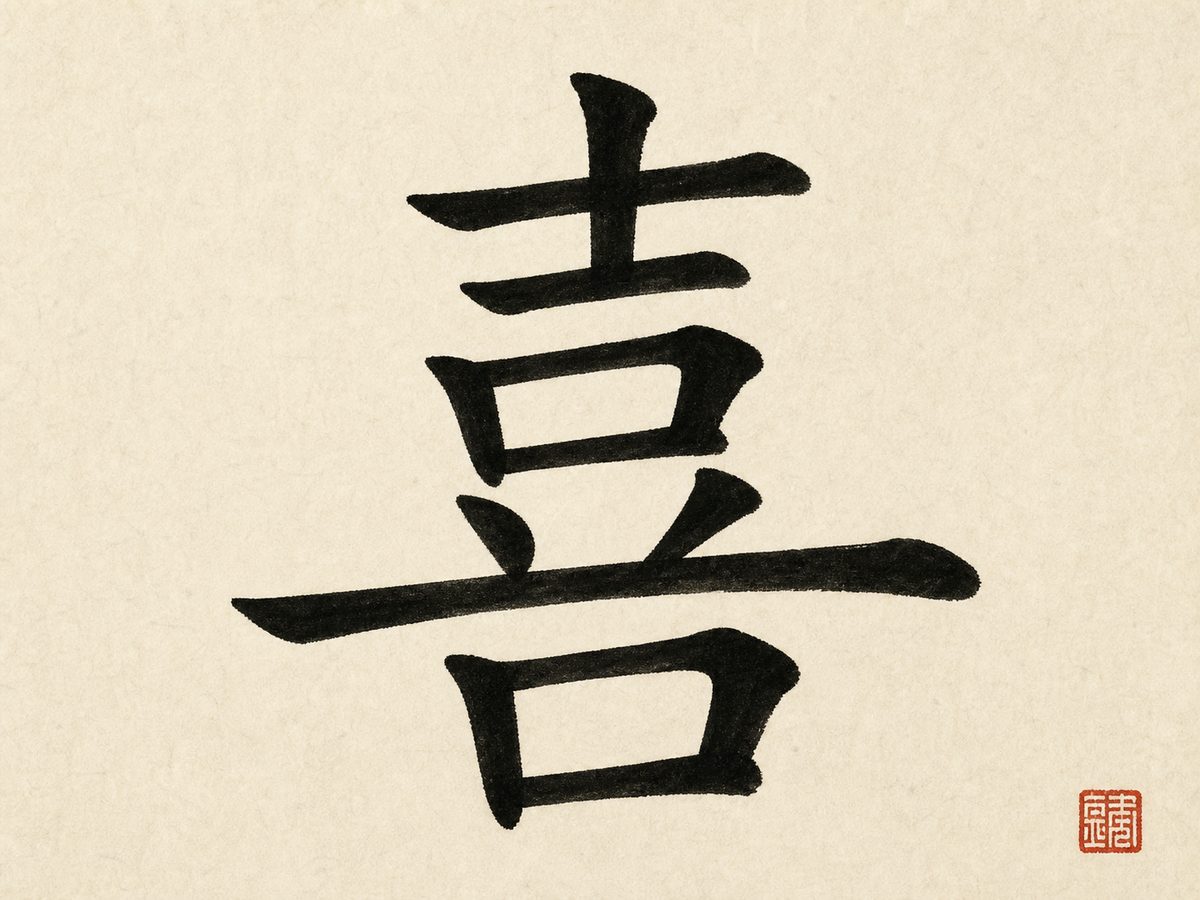
See 喜 in seal, brush & cursive Try it
How it's written
Read 喜 from the top down and you are looking at a drum. The upper block is 壴 (zhù), a freestanding drum drawn head-on: the ornament at the crown, the round drum body, and the stand it sits on, rendered as a wide horizontal with two small flaring strokes. Beneath the whole instrument sits 口, a mouth, wide open. Percussion above, a voice below: that is the entire recipe. Twelve strokes, written top to bottom, and the finished character stacks neatly into the square every Chinese character must occupy, which makes it a satisfying one to practice. If it looks faintly familiar doubled, that is because two of them welded together make the wedding symbol, which has a page of its own.
What it means
喜 (xǐ) is joy of the announced kind. It attaches to events rather than moods: a happy occasion is a "joy event," xǐshì, good news is a "joy report," xǐxùn, and a surprise is jīngxǐ, literally "startled joy," which is as good a definition of a surprise party as you will find. English "happiness" is spread across several characters that divide the work between them. The feeling of being happy belongs to 乐 (lè), luck and blessing to 福 (fú), and the doubled wedding form to 囍. What 喜 owns is the moment something worth celebrating happens.
It also owns something far more everyday. Add one syllable and you get xǐhuan, "to like," one of the most-used verbs in the language, deployed on dumplings, dogs, songs, and people. And because it is the milder cousin of ài, "to love," it does delicate work in romance:
| 喜欢 (xǐhuan) | 爱 (ài) | |
|---|---|---|
| What it says | I like you; I enjoy this | I love you |
| Weight | Everyday, warm, safe to say | Heavy, declarative, not said lightly |
| Used on | Foods, hobbies, songs, crushes | Partners, family, country |
| The classic line | wǒ xǐhuan nǐ, the standard first confession | wǒ ài nǐ, said later, and more rarely |
A confession in Chinese usually starts at "like," not "love"; wǒ xǐhuan nǐ is the sentence that opens most relationships, with the heavier word held in reserve. Joy, in other words, is also the language's way of easing into love.
- 喜欢 to like; to be fond of (the everyday verb)
- 喜悦 joy, delight (the literary noun)
- 惊喜 a surprise (literally startled joy)
- 喜讯 good news; glad tidings
- 喜剧 comedy (joy drama, opposite of tragedy)
- 喜庆 festive, celebratory
- 欢喜 delighted, overjoyed
- 喜好 a liking, a taste for something
- 喜宴 wedding banquet (the joy banquet)
- 有喜 to be expecting a baby (literally to have joy)
Idioms
- 喜闻乐见“delighted to hear and see”describes things the public genuinely enjoys; the standard phrase for crowd-pleasing art or news.
- 大喜过望“great joy exceeding hope”overjoyed because the outcome beat expectations. (Records of the Grand Historian (史记), on the general Ying Bu)
- 沾沾自喜“pleased and pleased with oneself”smug; quietly delighted with yourself, usually over too little. (Records of the Grand Historian (史记), on the marquis Dou Ying)
- 喜新厌旧“delight in the new, tire of the old”fickle in affections; forever trading in the old for the new, said of lovers and shoppers alike.
- 人逢喜事精神爽“meet a joy event and the spirit brightens”good news puts a spring in anyone's step; the proverbial link between occasion and mood.
Right vs wrong forms
| Form | Type | Note |
|---|---|---|
| 喜 | simplified ✓ | The one and only standard form. 喜 was never simplified, so mainland China, Taiwan, Hong Kong, and Singapore all write it identically; there is no version decision to make. |
| 㐂 | wrong | A Japanese cursive shorthand that stacks three 七 (seven) shapes, used in Japan for the 77th-birthday celebration. Not a standard Chinese form; a Chinese reader will not read it as 喜. |
| 喜 (flipped or rotated) | mirrored | Not a real variant. Stencils lifted from low-resolution images sometimes come out mirrored; the character is roughly symmetrical but not exactly, so check against a dictionary rendering before inking. |
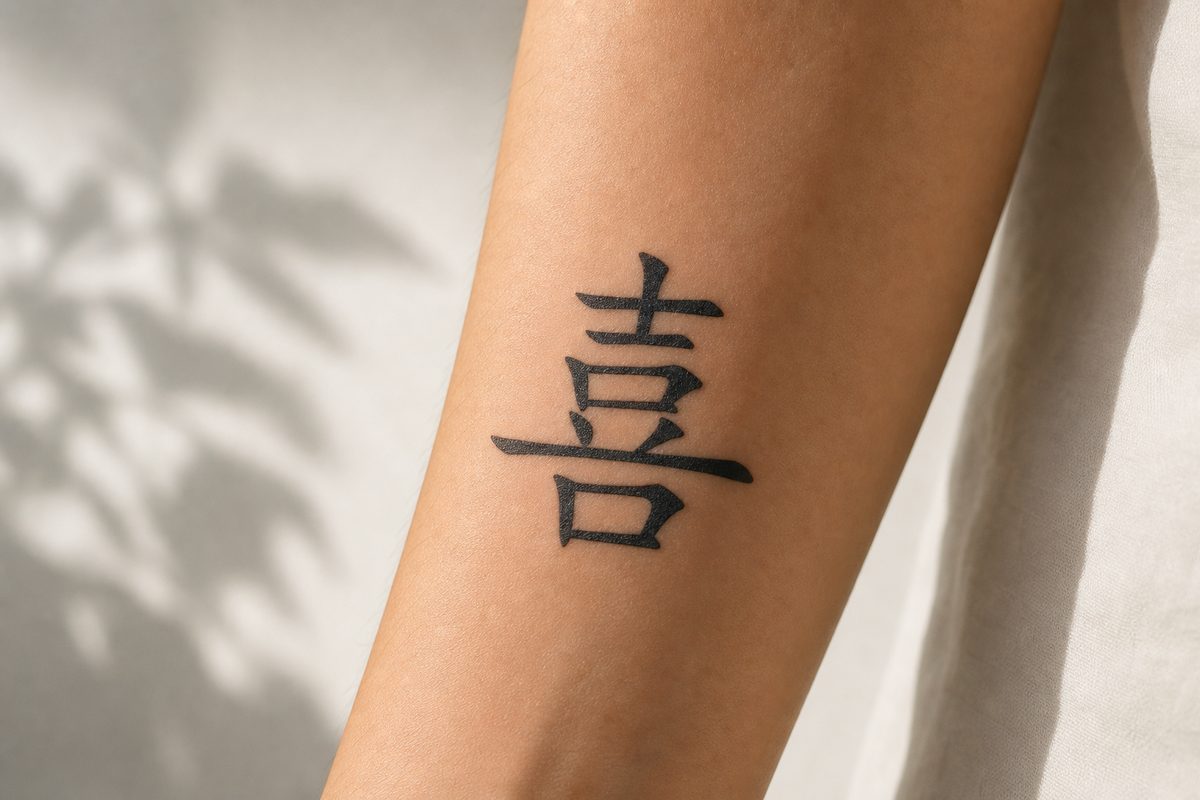
For a tattoo
喜 has one large practical advantage as a tattoo: it was never simplified, so mainland China, Taiwan, and Hong Kong all write it identically and there is no simplified-versus-traditional decision to agonize over. Twelve strokes, compact and symmetrical, it reads clearly at small sizes and means exactly what you hope: joy, celebration, good news. The real decision is single or double. On its own, 喜 is a general wish for a joyful life and reads that way to any Chinese speaker. Doubled into 囍 it stops being general: that form announces a marriage, full stop, so choose it for a couple's tattoo and not because the symmetry looks pleasing. Skip 㐂, a Japanese shorthand built from three sevens and tied to seventy-seventh-birthday celebrations in Japan, which a Chinese reader will not recognize as standard. Keep the character upright and unmirrored, print the stencil at full size, and have someone who reads Chinese confirm it before the needle comes out.
Before you commit to any character, the eight ways a Chinese tattoo goes wrong covers the failure modes that are not specific to this one, including the stroke-density arithmetic that decides whether a traditional form survives at small sizes.
Joy in life today
The word for liking anything
The character's biggest modern job is hiding in plain sight. Xǐhuan, "to like," is among the first verbs any learner meets and among the most spoken words in Mandarin, covering everything from a favorite noodle shop to a crush. The romantic register is where it earns its keep. In a culture that famously shows love rather than says it, wǒ xǐhuan nǐ, "I like you," is the standard opening confession, a full rung below the heavyweight wǒ ài nǐ. The joy character lets you say something true and survivable, which is exactly what a first confession needs to be.
Good news only, please
There is a set phrase that explains a billion phone calls home: bào xǐ bù bào yōu, "report the joys, not the worries." A student abroad calls her parents and mentions the scholarship, not the overdraft; the parents mention the new grandnephew, not the health scare. The phrase can be used with a sigh, as a gentle criticism of families that polish the truth for each other. But it is built on 喜 doing its oldest work, marking out which news gets announced, and it describes long-distance family love with uncomfortable precision.
An idiom assembled from four idioms
The internet has given the character one of its strangest offspring. The slang term xǐdàpǔbēn stitches together the first syllables of four existing phrases, roughly "delighted to hear it, deeply satisfying, the whole world celebrates, run and tell everyone," into one fake classical idiom used to announce good news, often, as the dictionaries that now record it note, with a thick layer of sarcasm. It started on a Baidu Tieba forum and reads to a Chinese eye the way "ROFL, huzzah" might to an English one: brand-new slang wearing a scholar's robe. The first of its four donors, a phrase about news people are delighted to see and hear, appears in the idiom list below.
A wedding banquet at the Berlinale
The joy character has a film festival trophy. Xǐyàn, "the joy banquet," is the everyday word for a wedding feast, and Ang Lee borrowed it as the title of his 1993 comedy The Wedding Banquet, about a gay Taiwanese man in New York staging a marriage to appease his parents. The joke is in the title: it is a joy banquet with the joy carefully faked, at least at first. The film shared the Golden Bear, the top prize at the Berlin film festival, and the story proved durable enough that a remake with Bowen Yang premiered at Sundance in 2025. Not bad mileage for a word that usually lives on banquet invitations.
As a given-name element, 喜 is a plain, sunny wish that a child's life will have much to celebrate.
Curious what your own name could become in Chinese, matched to its sound and
a good meaning? Our Chinese name generator builds one for you.
Where the character comes from
The Shuowen Jiezi, the first Chinese dictionary, compiled around the year 100, keeps the definition to two words and the recipe to four: "joy; from 壴 and 口," a drum and a mouth. The oracle-bone forms, three thousand years old, draw the same pair. In the oldest Chinese analysis, joy is not a private state at all. It is percussion plus a voice, the sound a courtyard makes when the news is good.
The commentator Duan Yucai, annotating the Shuowen in the eighteenth century, added the observation that gives this character its best twist: in old Chinese, the word for music and the word for joy were one and the same. That makes 喜 the second half of a remarkable pattern, because the language's other great joy character, 乐 (lè), began life as a picture of a stringed instrument. Chinese wrote joy down twice, and both times it drew musical equipment: once the strings, once the drum with a voice beside it. Most languages locate joy somewhere in the chest. Chinese locates it in the band.
History & roots
The four joys of life
Somewhere around the Song dynasty, Chinese tradition sat down and made a ranked list of the best moments a life can offer. The rhyme, still quoted a thousand years later, names four: sweet rain after a long drought; meeting an old friend far from home; the candlelit night in the wedding chamber; and your name on the golden list of exam results. Attribution is honestly murky. Tellings credit the rhyme to Wang Zhu, a Song child prodigy, while the scholar Hong Mai recorded a version in his Rongzhai essays, and nobody holds the receipt. The list itself is the point: relief, friendship, love, and success, one joy per human hunger. Ming craftsmen turned it into the Four Happiness Boys, an optical-illusion figurine of two boys drawn to read as four, still sold as a wedding gift today. Banquet cooks turned it into sìxǐ wánzi, "four-joy meatballs," four large pork meatballs to a plate, one per joy. And the famous legend behind the doubled wedding symbol, in which a scholar lands his exam result and his wedding on the same day, is really a story about two of the four joys arriving at once, which is why it needed a character all its own.
Joy heads the list of emotions
When classical China counted the emotions, joy went first. The stock phrase xǐ nù āi lè, "joy, anger, sorrow, delight," is the language's shorthand for the whole emotional keyboard, and it opens one of the most important sentences in Confucian philosophy. The Doctrine of the Mean teaches, in James Legge's translation, that "while there are no stirrings of pleasure, anger, sorrow, or joy, the mind may be said to be in the state of Equilibrium," and that feelings expressed in due degree produce harmony. Joy, in this scheme, is not suspect and not to be chased; it is weather, to be felt fully and in proportion. It says something about the character's standing that when the philosophers reached for their example of an emotion, 喜 came first.
The polite word for delicate news
喜 is also the word Chinese reaches for when news is too big, or too delicate, to say plainly. A woman "has joy," yǒuxǐ, meaning she is pregnant, no further detail required; morning sickness is hàixǐ, "troubled by joy." In earlier centuries even smallpox was wrapped in the character as a euphemism, a flattery meant to coax a feared disease into leaving gently, a sense dictionaries now file as dated. And at the far end of life, the funeral of someone who lived long and fully is counted a "white joy," a gentler idea told in full on the double happiness page. Follow the character around the language and you keep finding it standing guard over the biggest moments, softening them so they can be spoken.
The bird that borrowed the character
One animal carries the character in its name. The magpie is xǐquè, the "joy magpie," the traditional messenger of good news; under the Qing dynasty it ranked as the official bird of joy. Once a year, in the Qixi legend, the magpies of the world fly up and build a bridge across the Milky Way so two separated lovers can meet. Painters perch the bird on plum branches as a visual pun on brimming joy, a rebus decoded on the double happiness page, where the bird does its best-known work.
Questions people ask
What does the Chinese character 喜 mean?
喜 (xǐ) means joy, delight, and celebration, with a particular lean toward happy occasions: weddings, births, good news, exam results. A happy event is a xǐshì, a 'joy event.' The character is built from a drum (壴) over a mouth (口), joy you can hear. It also forms xǐhuan, the everyday Chinese verb for 'to like.'
What is the difference between 喜 (xǐ) and 乐 (lè)?
Both mean joy, but they divide the work: 乐 (lè) is happiness as a feeling, the 'happy' in kuàilè, while 喜 (xǐ) is joy tied to an occasion, the character of weddings and good news. Remarkably, both began as musical equipment in the oldest script: 乐 was a stringed instrument and 喜 a drum with a mouth singing beside it.
Is the Chinese character for joy the same in simplified and traditional Chinese?
Yes. 喜 was never simplified, so mainland China, Taiwan, Hong Kong, and Singapore all write it exactly the same way: twelve strokes, a drum over a mouth. That makes it a low-risk choice for calligraphy and tattoos compared with characters like 乐/樂, which changed drastically under simplification.
What is the difference between 喜欢 (xǐhuan) and 爱 (ài)?
喜欢 (xǐhuan) means 'to like' and 爱 (ài) means 'to love,' and the gap between them matters in Chinese. Xǐhuan is the everyday, safe word, used for food, hobbies, and early-stage romance; wǒ xǐhuan nǐ, 'I like you,' is the standard first confession. Ài is the heavyweight, reserved for partners, family, and country, and said far more sparingly.
Should I choose 喜 or 囍 for a tattoo?
Choose by meaning, not looks. Single 喜 is a general wish for joy and celebration, and reads that way to Chinese speakers. Doubled 囍 specifically announces a marriage; it is the emblem pasted up at Chinese weddings, so it suits a couple's or anniversary tattoo. If you are not marking a marriage, the single character says what you mean. Either way, have a Chinese reader confirm the design first.
Sources
- Wiktionary: 喜 (glyph origin as ideogrammic compound 壴 drum + 口 mouth; readings; senses including the pregnancy and dated smallpox euphemisms)
- Shuowen Jiezi entry for 喜: 樂也。从壴从口, with Duan Yucai's commentary on 樂 and 喜 sharing sound and sense (hancibao.com)
- The Doctrine of the Mean (中庸): 喜怒哀樂之未發謂之中, Legge translation (Chinese Text Project)
- Wikipedia: Four Happiness Boys, the Ming figurine of the four joys of life
- Wikipedia: Oriental magpie, the 'bird of joy' (喜鹊) in Chinese culture and the Qixi magpie bridge
- Wiktionary: 喜大普奔, the internet acrostic idiom for announcing good news
- Wikipedia: The Wedding Banquet (喜宴), Ang Lee's 1993 Golden Bear winner and the 2025 remake
- Wiktionary: 红白喜事, weddings and funerals counted together as 'joy events'
Make Joy your own
See 喜 in calligraphy
From ancient seal script to flowing cursive. Pick a look before a tattoo or a card.
 Name
Name Get a Chinese name
A name matched to the sound of yours, with a meaning that fits.
Start yours Chinese Almanac
 Try the Chinese Gender Predictor
A different corner of Chinese culture: the old Qing-palace birth chart, worked out from your lunar birth date, with the math shown and its coin-flip odds honestly weighed.
Open the toolRelated: happiness, double happiness, love, good luck, peace
By Julian 祝君瑜, sourced from the classics and from modern life, updated 2026-07-26